
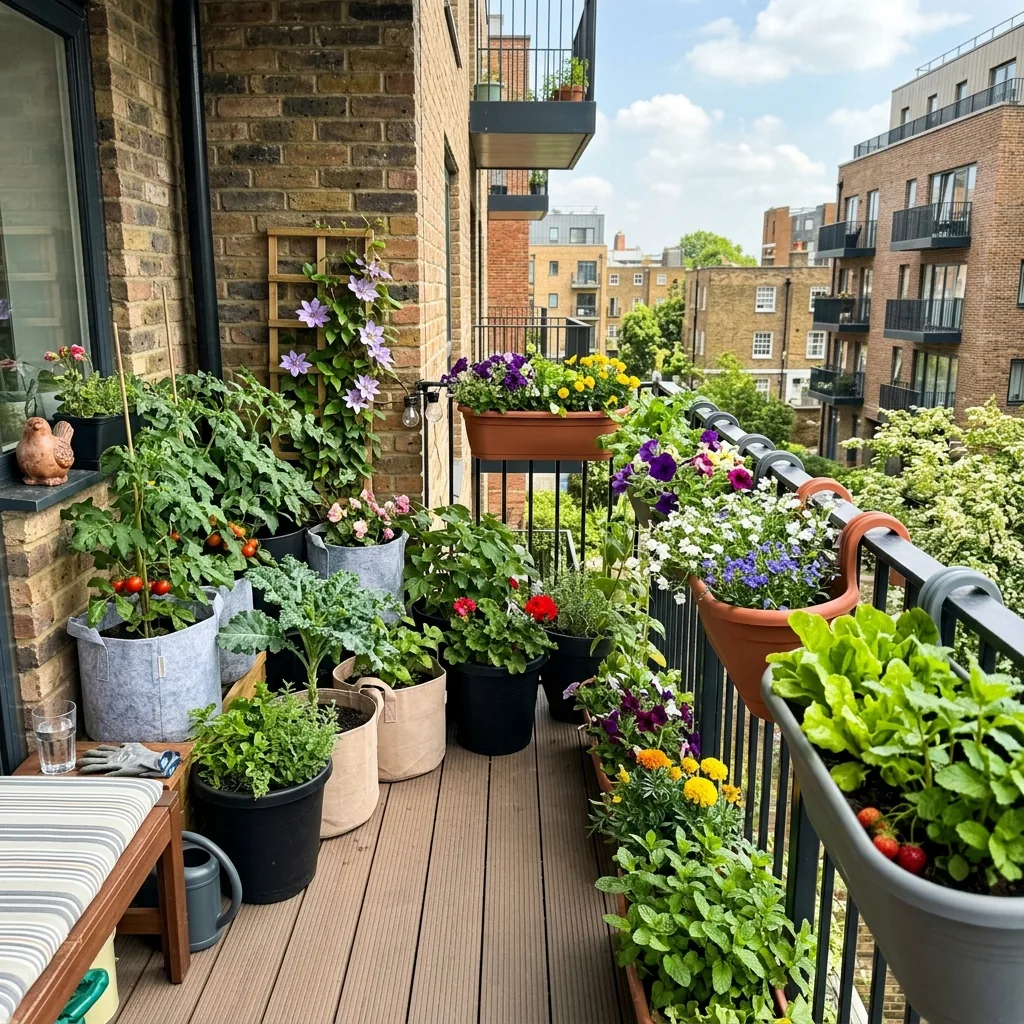
Building a DIY balcony garden does not require a garden centre membership, a drill, or a landlord who says yes to everything. What it requires is $50–$150, about four hours on a Saturday, and a clear plan — because the number one reason renter balcony gardens fail is not bad weather or wrong plants. It is buying everything impulsively, overloading the floor, and realising in October that nothing was designed to come back inside.
Why trust this guide? My first attempt at a DIY balcony garden in a rental was a disaster. I spent $180 on ceramic pots, filled them with standard topsoil, lined them up against the railing, and watched my 3rd-floor steel-frame balcony develop a subtle bounce after the first rainstorm. I moved everything off in a panic, did the math on wet soil weight, and started over. This guide is what I wish I had read first.
Table of Contents
- What You Need Before You Buy Anything
- Materials & Budget Breakdown
- Step 1: Audit Your Balcony — Space, Sun, and Load
- Step 2: Lay the Floor Foundation
- Step 3: Set Up Your Container System
- Step 4: Build the Railing Layer
- Step 5: Fill With the Right Soil Mix
- Step 6: Set Up Watering Without a Hose
- Step 7: Plant and Arrange by Zone
- My DIY Balcony Garden on 3.5 m²
- Common DIY Mistakes That Kill the Garden
What You Need Before You Buy Anything
Three numbers define your entire build. Get these wrong and no amount of pretty planters will save you.
1. Your balcony area in m² — measure length × width. A typical rental balcony runs 2–6 m². Yours is your absolute constraint for floor containers.
2. Your load limit — most post-1990 concrete balconies handle 2.5–3.5 kN/m² (255–357 kg/m²). Keep your total plant load under 30% of that to leave room for furniture and yourself. On a 3 m² balcony at 2.5 kN/m², your plant budget is roughly 230 kg — wet weight, not dry. One large ceramic pot saturated after rain can hit 80 kg. Do the math before you shop. Our balcony weight limit calculator walks through the exact formula.
3. Your sun hours — stand on your balcony at 10am, 1pm, and 4pm. Count hours of direct sun. Under 4 hours = shade garden (herbs, ferns, hostas). 4–6 hours = partial sun (lettuce, basil, strawberries). 6+ hours = full sun garden (tomatoes, peppers, most flowers).
Materials & Budget Breakdown
| Item | Budget Tier ($50) | Mid Tier ($100) | Full Tier ($150) | Weight (wet) |
|---|---|---|---|---|
| Floor layer | Skip | Outdoor rug $15 | Composite click-deck tiles $40 | 2–8 kg/m² |
| Main containers (×3) | Fabric grow bags $12 | Polypropylene pots $25 | Fibreglass trough $55 | 15–35 kg each |
| Railing planters (×2) | Hook railing boxes $14 | Self-watering railing boxes $22 | Drip-system railing boxes $38 | 5–12 kg each |
| Soil mix (40L) | Potting mix $9 | Coco coir + perlite $18 | Coco coir + perlite + compost $26 | 24–56 kg |
| Plants (×6) | Seeds/seedlings $8 | Established herbs $14 | Mixed edibles + flowers $22 | negligible |
| Watering | Watering can $7 | Self-watering stakes $11 | Drip timer + reservoir $28 | — |
| TOTAL | ~$50 | ~$105 | ~$209 | ~60–130 kg |
All wet weights are calculated at saturation. Coco coir + perlite mix saturates at ~0.6 kg/litre vs standard potting mix at 1.4 kg/litre — the single biggest weight saving you can make.
Step 1: Audit Your Balcony — Space, Sun, and Load
Before anything else: photograph your balcony from the door. Then draw a rough rectangle with measurements in metres. Mark the wall edge (strongest load zone) and the railing edge (weakest — cantilever physics). Your heaviest containers go against the wall. Your lightest items — railing planters, string lights, a small bistro table — go toward the rail.
Micro-Fail Warning: Never place heavy ceramic pots against the railing. A cantilever slab bears weight at the wall connection. Weight at the far edge (railing) multiplies stress on that connection. I learned this from a structural engineer after my bounce incident. Same weight, placed 60 cm closer to the wall, creates dramatically less stress.
Check your lease for two things only: 1. Is there a weight limit mentioned? (rare, but some leases specify) 2. Are “permanent fixtures” prohibited? Drilling counts — pressure-fit and hook-over systems don’t.
Pro-Tip Checklist: – Photograph existing balcony condition before starting (deposit protection) – Note which direction the floor drains — containers should not block drainage – Check for overhead neighbour balcony overhang — this cuts your sun by 1–3 hours
Step 2: Lay the Floor Foundation
The floor layer is optional but earns its cost. Bare concrete is hard, ugly, and hot in summer — it radiates heat back up at your plants and makes the space feel like a parking garage.
Budget option ($0): Skip it. Clean the concrete and work with what you have.
Mid option ($15): An outdoor rug (100×150 cm, polypropylene). Adds warmth, defines the space, zero structural impact. Wet weight: roughly 2–4 kg. Roll it up and store it in winter. Look for UV-resistant weave — cheap rugs fade in one season.
Best option ($40–$55): Composite or polypropylene click-deck tiles (30×30 cm, sold in packs of 9–12). No tools, no adhesive, no damage to the slab. Lift individual tiles if one cracks. Wet weight around 3–5 kg/m² vs acacia wood tiles at 14–18 kg/m². If you’re on a weight-restricted balcony, composite is the only sensible choice. See our full comparison of balcony deck tiles for renters for specific product recommendations.
Step 3: Set Up Your Container System
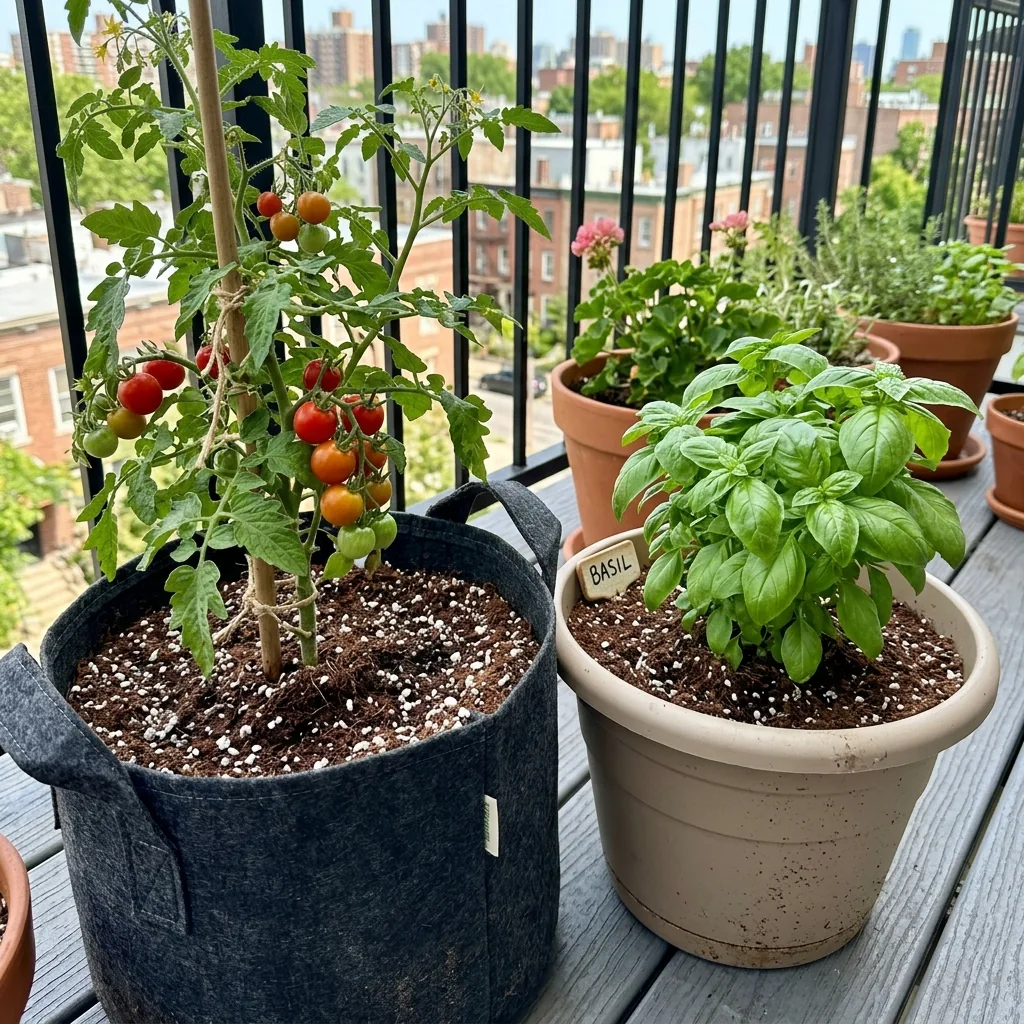
This is where most DIY balcony gardens go wrong. People buy what looks good in the shop and end up with heavy ceramic that eats their weight budget for one pot.
Rule: use the lightest container that does the job.
Fabric grow bags (cheapest, lightest): A 30-litre fabric grow bag weighs about 400g empty and saturated runs 18–22 kg — roughly half of a same-volume ceramic pot. Air-pruning through the fabric prevents root circling, which means healthier plants. Downside: they dry out faster, which means more frequent watering.
Polypropylene pots (best all-round): A 40-litre polypropylene pot weighs ~1.2 kg empty and saturated ~28 kg with coco/perlite mix. Looks close enough to ceramic from 2 metres away. Lasts 5+ years. IKEA’s SOCKER and BÄSTIS lines both work well.
Fibreglass troughs (premium): If you want the visual impact of a large rectangular planter without 60–70 kg of dead weight, fibreglass is the answer. A 90×30 cm fibreglass trough runs ~4 kg empty, saturated ~35 kg. Ideal for a herb row along the wall.
Sizing for your plants: – Herbs (basil, mint, thyme, parsley): 10–15 litre pots, one herb per pot or 3 together in a 20L – Cherry tomatoes, strawberries: 20–25 litre minimum – Dwarf pepper, compact courgette: 30 litre minimum – Flowers, trailing nasturtiums, petunias: 10–15 litre
Step 4: Build the Railing Layer
The railing layer is free vertical growing space that most renters ignore. It adds 40–80% more planting area without a single gram of floor load.
Hook-over railing planters: Galvanised steel brackets that hook over the railing with no drilling, no screws. They hold a standard window box (50–80 cm). Weight when loaded: 5–12 kg per box. Stick to smaller 40 cm boxes on higher floors where wind is a factor — larger boxes act as sails.
Railing-clamp self-watering boxes: A step up — these include a water reservoir in the base that feeds soil via capillary wicks. You fill the reservoir once every 3–5 days instead of daily. On a south-facing balcony in summer, this is not a luxury, it is survival for the plants.
What to grow on railings: – Herbs: basil, parsley, coriander (lighter, manageable) – Trailing flowers: lobelia, bacopa, million bells — all cascade beautifully over the edge – Strawberries: perfect railing crop, heavy fruiting, light root system
Micro-Fail Warning: Do not hang anything from the railing that you are not prepared to lose in a storm. On my 3rd-floor balcony, an unclipped railing planter became a projectile in a 50 km/h gust. The IKEA bracket survived. The neighbours’ outdoor table did not. Always use the secondary safety clip.
Step 5: Fill With the Right Soil Mix
Standard garden soil or heavy topsoil has no place on a rental balcony. It compacts, it waterloads, and it can weigh 1.4 kg per saturated litre. On a weight-restricted build, that is the single most expensive mistake per kilogram.
The renter’s standard mix: – 60% coco coir — lightweight (0.3 kg/L dry, 0.8 kg/L wet), excellent water retention, sustainable – 25% perlite — near-weightless volcanic glass (0.1 kg/L), improves drainage and aeration – 15% worm castings or slow-release compost — nutrition without the weight penalty of peat
This mix saturates at approximately 0.6 kg/litre — less than half the weight of standard potting compost. For a 30-litre grow bag, that is 18 kg wet versus 42 kg wet with topsoil. On a full setup with six containers, the difference is 100+ kg.
Buy coco coir as compressed bricks (5kg brick expands to ~70 litres) — far cheaper and lighter to carry up than pre-mixed bags. Rehydrate in a bucket, mix in perlite, and fill your containers on the balcony.
Step 6: Set Up Watering Without a Hose
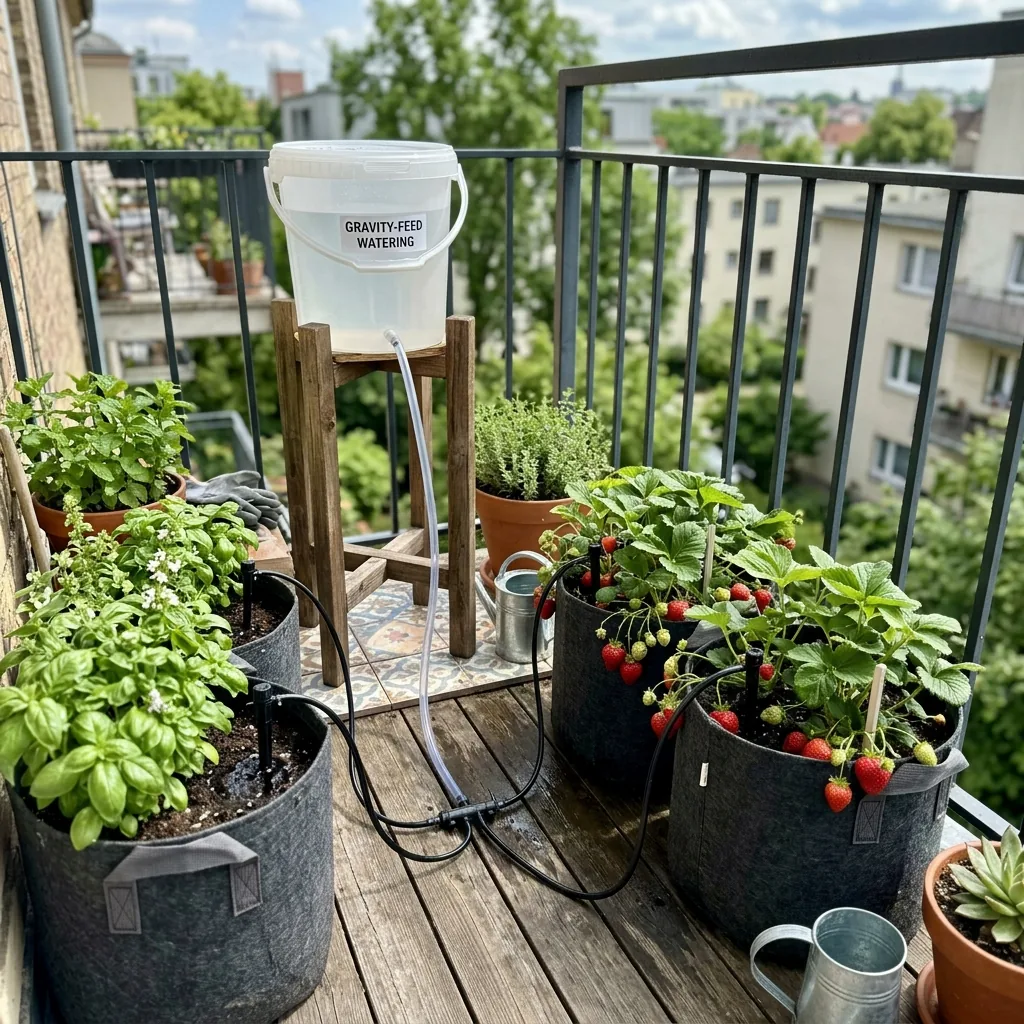
Almost no rental balcony has an outdoor tap. You will be carrying water. This is fine at setup — it becomes a problem in July when six 30-litre grow bags need daily watering in 30°C heat.
The three-tier solution:
Tier 1 — Watering can + self-watering stakes ($11): For a small setup (3–4 containers), a 10-litre watering can plus moisture-wicking terracotta stakes inserted into each pot reduces frequency to every 2–3 days. The stakes draw water down from a small reservoir (a plastic bottle) into the soil as the plant needs it.
Tier 2 — Drip-feed gravity system ($28–$45): A 20-litre reservoir bucket elevated 30 cm above the containers with thin drip tubes to each pot. Add a basic timer valve and the whole system runs for 7–10 days without intervention. Ideal for holidays and forgetful waterers.
Tier 3 — Smart self-watering planters: If you are buying new containers anyway, consider self-watering planters with sub-irrigation reservoirs — they hold 2–5 litres in the base and passively wick moisture upward. Our self-watering planters guide covers the best options for balcony use.
The golden rule for renter balcony watering: always water into the saucer first, then top-dress. It forces roots downward. And invest in one moisture meter (~$8 on Amazon) — it removes all guesswork and prevents the most common killer of balcony plants: overwatering.
Step 7: Plant and Arrange by Zone
A well-organised DIY balcony garden has three zones: wall zone (heaviest, tallest), mid zone (main growing area), and railing zone (trailing/lightweight).
For a full-sun balcony (6+ hours):
| Zone | What to Plant | Container |
|---|---|---|
| Wall | Cherry tomatoes (1 plant), compact pepper | 25L polypropylene pot |
| Wall | Basil (3 plants), thyme, oregano | 20L fibreglass trough |
| Mid | Strawberries (4–6 plants) | 2× 15L fabric bags |
| Mid | Dwarf French marigolds (pest control) | 10L pot |
| Railing | Trailing lobelia + million bells | 2× railing boxes |
For a shade balcony (under 4 hours):
| Zone | What to Plant | Container |
|---|---|---|
| Wall | Hosta (2 varieties) | 20L polypropylene pot |
| Wall | Mint, parsley, coriander | 20L trough |
| Mid | Lettuce mix (cut-and-come-again) | 2× 15L fabric bags |
| Mid | Fern + trailing pothos | 10L pot |
| Railing | Bacopa, ivy | 2× railing boxes |
Arrange pots so the tallest are at the back (wall side) and shorter ones step down toward the railing. This keeps the view open, maximises light access, and makes watering easier.
What Is the Best Setup for a DIY Balcony Garden in a Rental?
A renter-friendly DIY balcony garden relies on four principles: lightweight containers (fabric grow bags or polypropylene pots, not ceramic), a coco coir and perlite soil mix to minimise load, no-drill railing planters for vertical growing, and a gravity drip or self-watering system for hands-off moisture management. For a typical 3 m² balcony rated at 2.5 kN/m², the practical plant weight budget is approximately 200–230 kg wet. With six 20–30 litre containers filled with coco/perlite mix, total wet weight sits around 100–120 kg — well within limits and leaving room for a bistro set and two adults. Start with three containers in the first season, observe sun patterns and drainage, then expand. Most balcony gardeners who fail do so because they overplant in year one before understanding their specific microclimate.
My DIY Balcony Garden on 3.5 m²
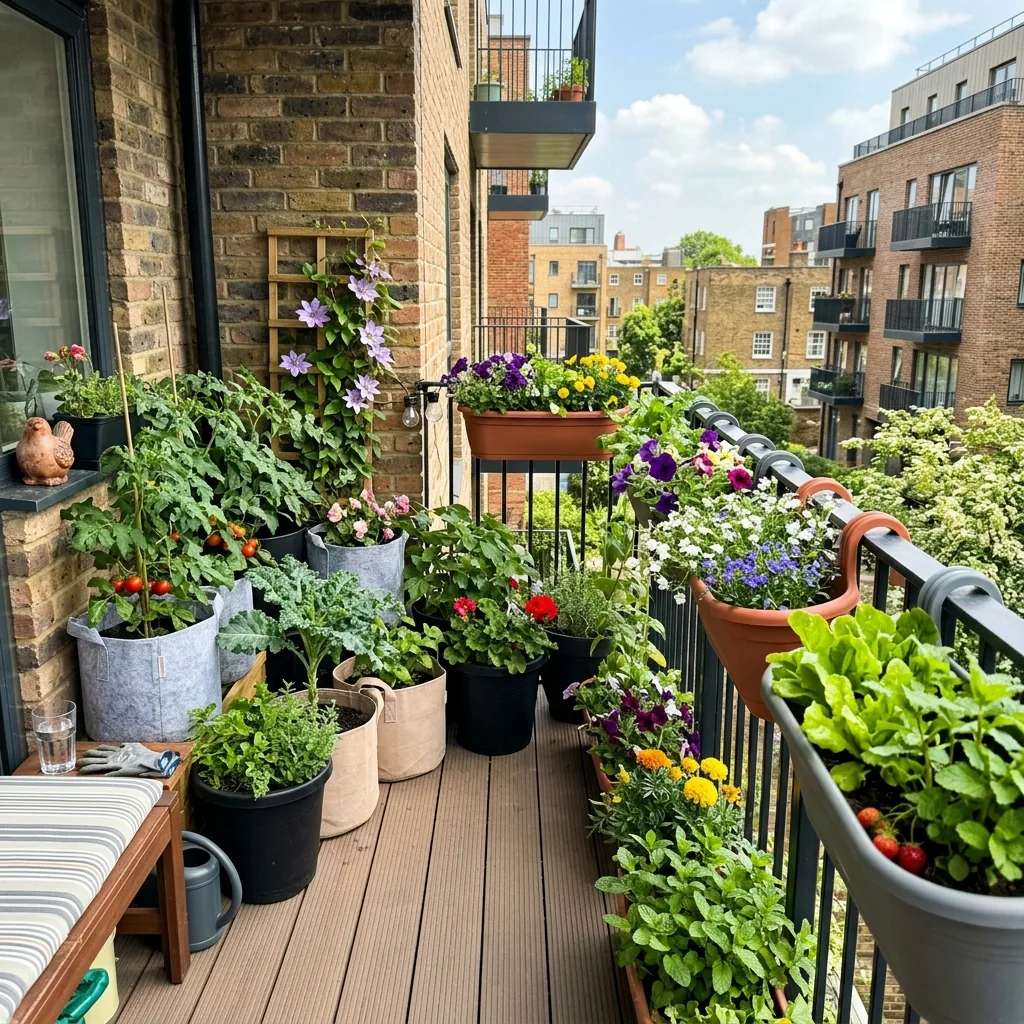
My current setup took three seasons to optimise. The final version is a 3.5 m² north-facing balcony in a 1990s concrete-frame building, rated at 3.0 kN/m². Total plant budget: roughly 320 kg.
Current inventory: – 2× 25L polypropylene pots against the wall: one mint-and-coriander, one hosta – 1× 40L fibreglass trough (wall side): cut-and-come-again lettuce + parsley – 2× railing boxes (hook-over): bacopa trailing + lobelia – 1× 15L fabric bag: strawberries (6 plants, second year) – Total wet weight: ~115 kg — well under the 320 kg cap
Cost to build: £94 over two seasons (I reuse containers). Annual seed and plant cost: £22.
The north-facing orientation killed any ambition for tomatoes. That was the right lesson — work with your sun, not against it. The lettuce trough produces two cuts a month from March to October. The strawberries produce more fruit than I can eat in June.
The one upgrade that made the biggest difference: switching from a watering can to a 20L gravity-feed drip bucket with a basic timer. I went from daily 15-minute watering sessions to filling the bucket every 8 days. That one change is why the garden survived my two-week holiday in August.
Common DIY Mistakes That Kill the Garden
1. Buying heavy containers first, calculating weight second
This is the single most common expensive mistake. One 45 cm glazed ceramic pot can cost $45–$90 and weigh 75–85 kg wet. That is a third of your entire plant budget — for one pot. Buy a polypropylene equivalent for $12 and put the $33–$78 difference toward more plants or a drip system.
2. Using garden soil or topsoil in containers
Garden soil compacts in containers, waterloads catastrophically, and runs 1.2–1.5 kg per saturated litre — roughly double the weight of a proper container mix. It also introduces weed seeds, fungi, and drainage problems. Never use it in pots. Always use a dedicated container/potting mix, or build your own coco/perlite blend.
3. Planting everything at once in week one
Buy three plants and three containers first. Run them for three weeks. Watch where the puddles form after rain, where the wind comes from, how fast the soil dries. Your balcony microclimate — temperature, humidity, wind exposure, reflected heat — is completely unique. Every additional pot you add after that initial observation period will be placed more intelligently.
A DIY balcony garden is not a weekend fantasy. For $50–$150 and one afternoon of setup, you get fresh herbs every week from April to October, a genuinely usable outdoor space, and the specific satisfaction of having built something that works within your exact constraints — lease, load limit, and light levels included.
Start with the audit. Measure the balcony. Calculate the weight budget. Then buy. In that order.
For more on choosing the right plants for your specific light conditions, see our complete balcony herb garden guide. For wind-proofing tips on high-rise balconies, see our balcony wind protection guide.
Safety Disclaimer
Balcony load limits are structural specifications. The weight figures in this guide are based on typical Eurocode and US IRC residential ratings — they are not a substitute for your building’s actual specification. Before placing heavy containers or furniture on your balcony, confirm the load rating with your property manager. Signs of structural stress (cracking, sagging, unusual sounds) require immediate professional inspection. Always secure railing planters with secondary safety clips, especially on high-rise balconies.
