
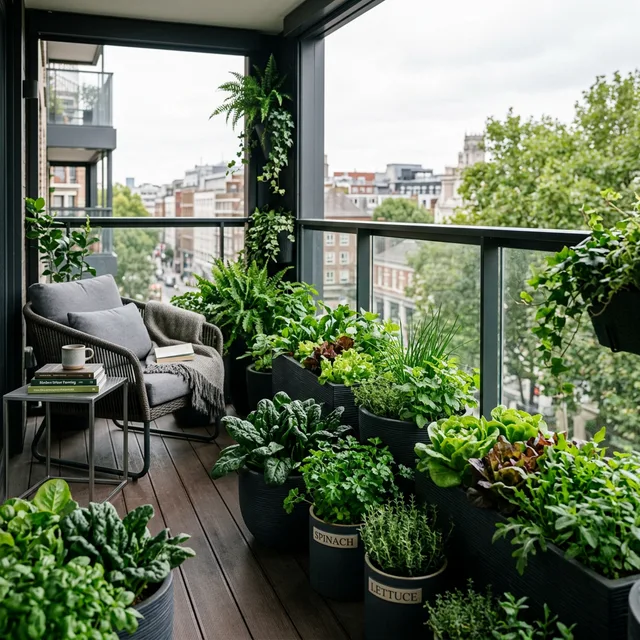
The biggest myth in urban gardening is that you need “full sun” to grow food. While that’s true for heavy-feeders like watermelons or large beefsteak tomatoes, a north-facing balcony is actually a secret weapon for high-quality leafy greens. Shade tolerant vegetables for balcony gardening thrive in the cooler, consistent temperatures of a shadowed space. If you’ve ever tried to grow spinach in the blazing south-facing sun, you know it bolts (goes to seed) in days. On my north-facing balcony, I harvest crisp, sweet greens well into the summer. In this guide, I’ll show you how to master the “North-Facing Paradox” and which 6 crops will turn your shadow into a salad bowl.
Why trust this guide? I lived in a ground-floor studio for two years where my balcony received exactly zero minutes of direct sunlight. I spent those 24 months experimenting with reflective foils and specific cultivars to see what actually grows in the dark. I didn’t just read about this; I lived it.
| Vegetable | Light Needed | Best Variety | Daily Light (Hours) |
|---|---|---|---|
| Spinach | Deep Shade | Bloomsdale | 2-3 |
| Bok Choy | Partial Shade | Toy Choy | 3-4 |
| Arugula | Partial Shade | Wild Rocket | 3-4 |
| Kale | Moderate Shade | Nero di Toscana | 4-5 |
| Swiss Chard | Moderate Shade | Fordhook Giant | 4-5 |
| Lettuce | Deep Shade | Black Seeded Simpson | 2-3 |
Understanding The North-Facing Paradox
Most people see a shaded balcony and think “dead zone.” I see it as a controlled environment. Direct sun is erratic, hot, and causes rapid moisture loss. Diffused sky light (the light that reaches a north-facing balcony) is consistent and prevents the “scorched earth” effect. However, you must understand the difference between shade and darkness. If your balcony is blocked by another skyscraper and has a ceiling, you are dealing with “Deep Shade” (under 500 LUX). If it’s open to the sky but just doesn’t get direct beams, it’s “Partial Shade” (1000-2000 LUX). This distinction is critical for your apartment balcony gardening success.
How to Optimize Light on a Shaded Balcony
Before we plant, we need to “harvest” light. Even on the darkest balcony, there are ways to amplify the available photons for your urban micro-living setup.
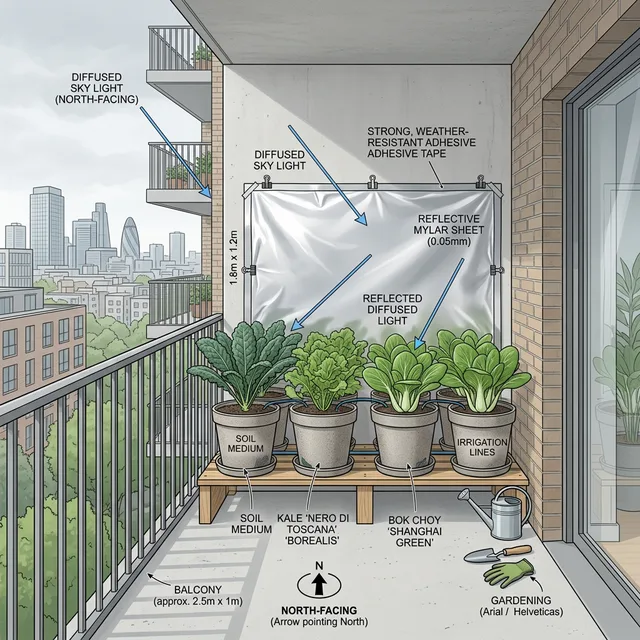
- The White Wall Hack: If your balcony walls are brick or dark grey, paint them white (with landlord permission) or hang white waterproof panels. White reflects up to 80% of diffused light.
- Mylar Reflectors: Placing reflective Mylar sheets behind your pots can bounce light onto the underside of leaves, where many stomata are located. This is a pro-move for smart balcony herb garden enthusiasts.
- Elevated Planting: Light levels are often higher at the railing level than on the floor. Use tiered shelving to get your plants as high as possible.
The Best 6 Shade-Tolerant Vegetables
1. Bloomsdale Long Standing Spinach
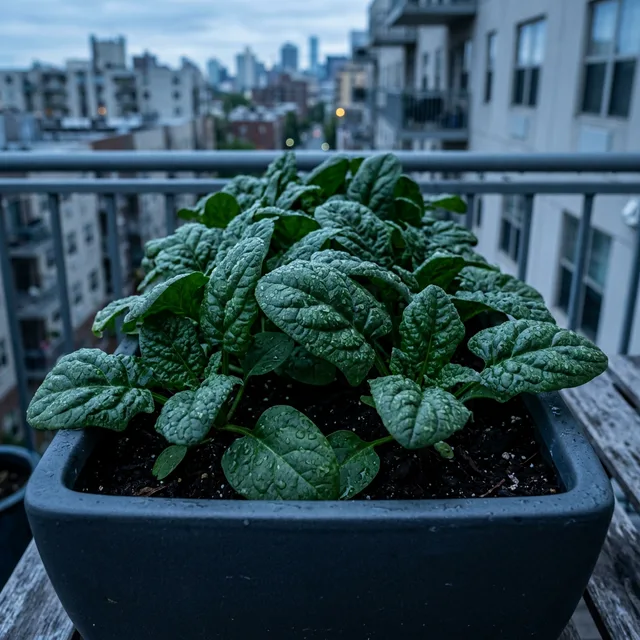
Spinach is the king of the north-facing balcony. It loves the cool soil and consistent indirect light. In fact, if you give it too much sun, the leaves become bitter and tough. In my small apartment layout, a single trough of Bloomsdale provides enough for three salads a week.
- Light Level: 2-3 hours of indirect light.
- Pro Tip: Water from the bottom to keep the leaves dry and prevent mildew in the humid shade.
- ✅ Pros: Extreme cold tolerance; superior flavor in shade.
- ❌ Cons: Slower growth than in partial sun.
2. “Toy Choy” Dwarf Bok Choy
This is a “micro-vegetable” that only grows to about 10cm. Because it’s so small, it doesn’t need a massive amount of energy to build structure. It is a staple of my complete balcony herb garden rotation. See the complete balcony herb garden guide. Indoors, try an indoor windowsill herb garden.
- Light Level: 3-4 hours of indirect light.
- Pro Tip: Harvest the whole plant at once for the most tender “baby” bok choy texture.
- ✅ Pros: Fast harvest (30 days); very space-efficient.
- ❌ Cons: Highly attractive to slugs if your balcony is damp.
3. Wild Rocket (Arugula)
Wild rocket is almost indestructible. It handles the low-light conditions of a windowless kitchen transition perfectly. It has a spicy kick that actually becomes more pronounced in cooler, shaded conditions.
- Light Level: 3-4 hours.
- Pro Tip: Use the “cut and come again” method—only take the outer leaves so the center keeps producing.
- ✅ Pros: Self-seeding; perenial in some climates.
- ❌ Cons: Tiny seeds are hard to space correctly.
4. Nero di Toscana (Lacinato/Dino Kale)
While most kale likes sun, the dark blue-green Lacinato variety is surprisingly shade-tolerant. Its dark pigments are designed to soak up every available photon. It adds a “prehistoric” look to your edible balcony aesthetic.
- Light Level: 4-5 hours.
- Pro Tip: Remove any yellowing bottom leaves immediately to ensure the plant focuses energy on new growth.
- ✅ Pros: High nutrient density; ornamental value.
- ❌ Cons: Needs deeper pots (25cm+) than lettuce.
5. Fordhook Giant Swiss Chard
Chard is a “moderate-shade” champion. It won’t grow as large as it would in full sun, but the stalks will be more tender and less fibrous. It’s perfect for a smart balcony herb garden where you want both beauty and food. Light them with smart balcony lighting.
- Light Level: 4-5 hours.
- Pro Tip: Use white pots to reflect light back into the plant’s base.
- ✅ Pros: Survives high-rise winds; biennial.
- ❌ Cons: Can attract leaf miners in stagnant air.
6. Black Seeded Simpson Lettuce
This is one of the most reliable low-light crops for renters. It doesn’t form a tight head, which allows light to penetrate every leaf. I’ve grown this successfully on a 1x1m shaded balcony with zero issues.
- Light Level: 2-3 hours.
- Pro Tip: Keep the soil consistently moist but never soggy.
- ✅ Pros: Very fast growth; heat resistant.
- ❌ Cons: Leaves are delicate; protect from heavy rain.
Common Mistakes in Shaded Balcony Gardening
- Overwatering: Shaded soil doesn’t evaporate moisture as fast as sunny soil. I lost my first crop of spinach to root rot because I watered on a “sunny day schedule.” Always check the top 2cm of soil with your finger before adding water. This is where automatic watering for renters needs careful sensor calibration.
- Choosing Fruiting Crops: Do not try to grow peppers, eggplants, or standard tomatoes in the shade. They will grow leaves, but they will never have enough energy to produce flowers and fruit. You will end up with a “green desert.”
- Ignoring Airflow: Shade can mean higher humidity. Ensure your pots aren’t packed too tightly together. Good airflow is the best defense against powdery mildew.
My Experience: The North-Facing “Salad Factory”
When I first moved into my north-facing apartment, I was devastated. I thought my gardening days were over. But after the first season of harvesting perfectly crisp, non-bitter lettuce in mid-July while my friends’ south-facing gardens were wilting, I was a convert. I now run a “Salad Factory” on my 1.5m x 3m balcony. I use a tiered wire rack with a white plastic backing, and I produce roughly 1.5kg of greens every month from March to October. It’s the ultimate apartment gardening hack.
Conclusion
Shade is not a limitation; it’s an opportunity. By selecting the right shade tolerant vegetables for balcony gardening, you can enjoy a lush, productive garden without the stress of scorching heat. Start with the “Big Three”—Spinach, Lettuce, and Bok Choy—and use light-harvesting tricks to boost your yields. Your north-facing balcony is ready to become a thriving urban farm.
Can I grow tomatoes in the shade?
Only if you have at least 4-5 hours of very bright reflected light, and even then, stick to ‘Micro-Tomatoes’ like Tiny Tim. Standard tomatoes will fail.
Do I need special soil for shade?
Use a very well-draining potting mix. Because the soil stays wet longer, you need more perlite or vermiculite to ensure oxygen reaches the roots.
Which herbs grow best in the shade?
Mint, Parsley, Chives, and Cilantro (Coriander) are extremely shade-tolerant. Bascil needs more warmth/sun.
Is my balcony too dark?
If you can read a book comfortably at noon without a lamp, you have enough light for spinach and lettuce.
