


How do you grow a lush garden without watching your seedlings snap off daily? You must protect balcony plants from wind high rise to stop drafts from destroying your hard work. High floors create microclimates where air currents dehydrate delicate leaves. You can solve this issue. Deploying a thoughtful approach lets you build a calm, safe oasis anywhere. We will rethink your space so you can successfully protect balcony plants from wind high rise. See the complete balcony herb garden guide. Choose wind-resistant plants.
Understanding the High-Altitude Wind Threat
Living on the 10th floor is incredibly exciting. Unfortunately, high-speed gusts treat your urban garden terribly. In my personal experience, losing three expensive tomato plants in one weekend forced me to change methods.
I quickly realized that solid glass barriers often fail. Instead of blocking the draft, they create air turbulence right behind the pane. The swirling vortex can snap soft stems. You must protect balcony plants from wind high rise using diffusion techniques, not solid walls.
Why Solid Walls Fail
Solid balcony walls force air currents to jump over the top. This air drops down onto your fragile leafy greens. You should avoid installing solid acrylic sheets. Instead, we need a porous solution that slows the wind down. Windbreak mesh is a perforated fabric that filters gales into soft breezes.
You must protect balcony plants from wind high rise by managing the air pressure. A mesh screen filters the breeze. It drops the wind speed by up to 50%. According to atmospheric studies by the National Weather Service, urban wind speeds can increase around high-rise corners. A mesh is essential and cost-effective. Watch for plant pests.
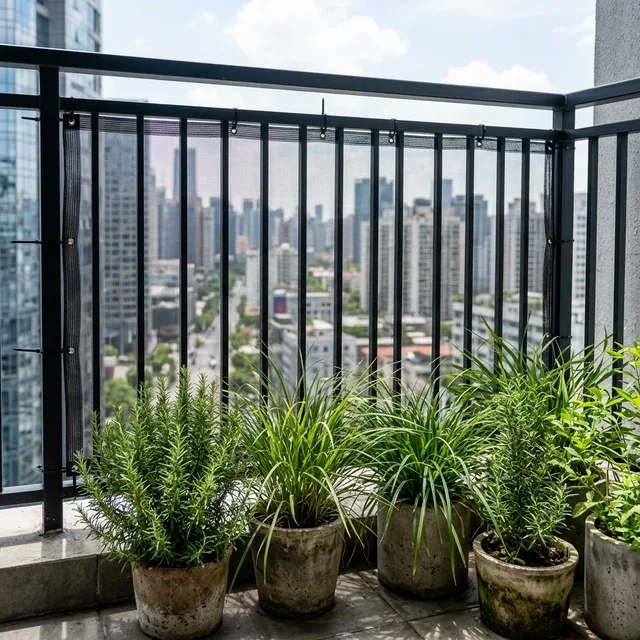
Step 1: Installing the Windbreak Mesh
If you want to protect balcony plants from wind high rise, you should install an agricultural shade cloth or windbreak mesh. This is an effective defense line.
I tested several plastic sheets initially, but they tore within weeks. I switched to a 60% perforated shade sail fabric. You zip-tie this fabric securely along your outer metal railing. Because it contains small holes, it lets fresh air pass through smoothly. Most importantly, it breaks the force of the incoming gust. The patio becomes a calm zone.
The Physics of Mesh Filtration
When the gale hits the mesh, it splits into small, harmless breezes. This prevents damage to your plants. To protect balcony plants from wind high rise, stretch the fabric tight. A flapping mesh will be noisy. Use heavy-duty UV-resistant cable ties to prevent sun rot.
- The best mesh reduces airflow violently without blocking precious sunlight.
- Always secure the bottom edge tightly to the floor line.
- Importantly, remember to check the plastic ties monthly for dangerous sun rot.
Step 2: Selecting Heavy Urban Planters
A strong draft does not just break thin stems. It can pick up light plastic pots. You should protect balcony plants from wind high rise by lowering the center of gravity.
Initially, I bought cheap, lightweight plastic containers. The very first spring storm blew them violently across my tiny 2sqm patio. Dirt scattered everywhere. Now, I exclusively use heavy concrete, thick ceramic, or sturdy thick-walled resin pots.
Anchoring the Bottom
If you cannot afford heavy concrete troughs, you can add weight to lighter pots. Before adding potting soil, put heavy river rocks or gravel in the bottom. This anchors the container. You successfully protect balcony plants from wind high rise when the base weighs significantly more than the top.
Comparison: Balcony Planter Materials
Let us compare the best materials to handle aggressive weather.
| Planter Material | Weight Profile | Wind Resistance | Best Used For |
|---|---|---|---|
| Thin Plastic | Very Light | Extremely Poor | Indoor use only |
| Wood Trough | Medium | Good | Small herbs, strawberries |
| Concrete | Very Heavy | Outstanding | Tall plants, small trees |
| Ceramic/Terrapot | Heavy | Excellent | Tomatoes, bushy plants |
Step 3: Choosing Wind-Resistant Plant Species
You should protect balcony plants from wind high rise by selecting tough species. Avoid planting fragile, tall, broad-leaf tropicals on higher floors.
Instead, heavily favor native coastal plants and tough Mediterranean herbs. They evolved naturally to handle extreme, battering coastal winds easily.
The Best Herbs for High Floors
Rosemary and creeping thyme are suitable choices. They grow low to the soil. Their needle-like leaves do not catch the breeze as much. They can protect balcony plants from wind high rise scenarios by withstanding the air currents.
- Rosemary: Grows dense woody stems quickly.
- Thyme: Hugs the soil tightly, staying below the wind line.
- Lavender: Features flexible silver stems that bend beautifully.
- Ornamental Grasses: They rustle nicely and never snap under pressure.
If you strongly desire taller visual height, carefully use flexible bamboo in an extremely heavy trough. Just ensure the bamboo variety is the “clumping” type. It should not be the aggressive “running” type. Likewise, consider local native grasses.
Watering Strategy in High Wind
Fast air can dehydrate your soil and plant leaves. You should protect balcony plants from wind high rise by adjusting your watering schedule.
My pots dried out within six hours during autumn gales. You should check the soil moisture daily. Consider using a self-watering planter system. These pots store water in a bottom reservoir away from the drying air. Alternatively, cover the top soil with gravel mulch. Mulch helps stop surface water from evaporating. It is helpful to monitor water levels during dry storms.
Creating Temporary Shelter Zones
Sometimes, a severe storm rolls through aggressively. When gale warnings flash, you need a backup plan quickly. I always group my smaller pots tightly together in the very back corner of my patio.
Huddling the pots closely creates a micro-climate. The outer plants shield the inner ones. You can protect balcony plants from wind high rise by moving them behind your furniture temporarily. Alternatively, cover the cluster with a clear plastic bin overnight.
Conclusion
Creating a garden oasis is rewarding. You should protect balcony plants from wind high rise using basic engineering. Use sturdy bases for your pots. Securely zip-tie a perforated shade mesh to your railing. Finally, plant rugged Mediterranean herbs that bend in the wind. You can manage the high-floor microclimate.
Do not let air currents destroy your garden. Secure your space now. Explore our other guides on balcony gardening to maximize your outdoor layout safely.
Safety Disclaimer
Secure every planter to the interior rail. Do not place loose pots on the outer ledge of a high-rise building. Falling objects can cause injury or damage. Always comply with building management rules.
FAQ
Does clear glass protect balcony plants from wind high rise better than mesh?
No. Solid clear glass aggressively forces the fast wind straight up and immediately over. This brutally creates violent, swirling air turbulence directly onto your soft plants. A breathable mesh works significantly better.
How heavy should my 10th-floor planter be?
Your heavy planter base should ideally weigh more than 15 pounds when completely dry. You should actively add heavy river rocks generously to the bottom layer deeply before planting.
Should I bring my plants completely inside during a storm?
Yes, absolutely bring fragile or tall top-heavy plants completely indoors. Temporary strong gusts over 40 mph will easily break rigid stems cleanly, despite having a good tight mesh installed properly.
