
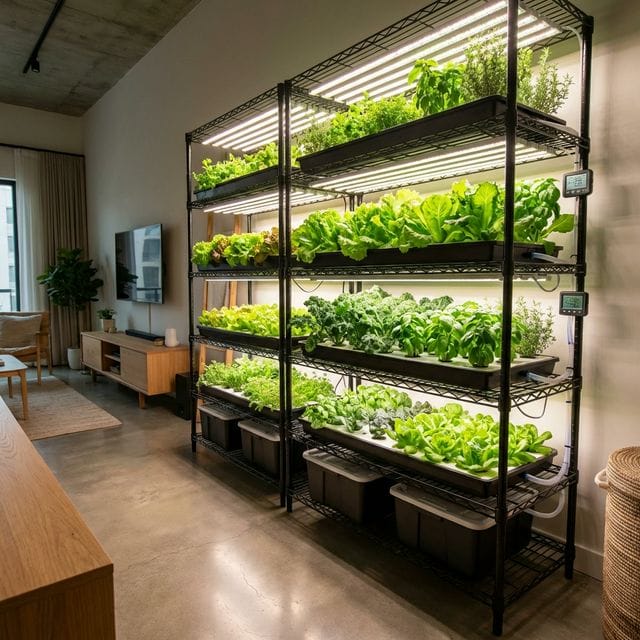
Your only window faces a brick wall. Or another apartment building. Or a lightwell. The idea of growing your own food feels like a joke. Try a fast crop of growing microgreens.
It isn’t. You can harvest fresh lettuce, basil, cherry tomatoes, and microgreens without a single beam of natural sunlight. What you need isn’t a window — it’s a grow light, the right crops, and about 60cm of shelf space. Then see harvesting and storing edibles.
This is the practical, numbers-first guide to building a productive indoor micro-farm in a windowless or low-light studio apartment.
Table of Contents
- The Light Problem: What Plants Actually Need
- Best Grow Lights for Apartment Food Growing
- Choosing What to Grow: Realistic Yield Expectations
- Soil vs Hydroponics: Which Makes More Sense Indoors
- Setting Up a Vertical Grow Shelf in 60cm of Floor Space
- Airflow and Humidity: The Two Things Most People Get Wrong
- Monthly Cost and Harvest Breakdown
- FAQ
The Light Problem: What Plants Actually Need
Plants photosynthesize using specific wavelengths of light — primarily blue (400–500nm) for leaf and stem growth, and red (600–700nm) for flowering and fruiting. Standard ceiling bulbs and desk lamps emit mostly green wavelengths, which plants reflect rather than absorb. This is why a plant under a regular lamp stays alive but doesn’t grow productively.
The metric that matters: PPFD (Photosynthetic Photon Flux Density), measured in μmol/m²/s. It tells you how many photons in the photosynthetically active range hit a square metre of leaf surface per second.
- Microgreens and leafy greens: 100–200 μmol/m²/s
- Herbs (basil, cilantro, mint): 200–400 μmol/m²/s
- Fruiting plants (tomatoes, peppers): 400–700 μmol/m²/s
Most grow light product pages now list PPFD at various distances. Look for this number rather than watts when comparing lights.
Best Grow Lights for Apartment Food Growing
For leafy greens and herbs only (low budget):
A basic LED grow light strip or a compact 20–30W full-spectrum panel is sufficient. GE Grow Light LED (9W T8 tube) costs around €15 and works for a single shelf of herbs. Run it 14 hours per day.
For a mixed setup including fruiting plants:
You need 50–100W true draw. The Mars Hydro TS 600 (€55, 100W true draw) covers roughly 30cm × 60cm adequately for herbs and dwarf tomatoes. The Viparspectra P600 covers a similar area at comparable cost.
The most practical apartment option:
A clip-on LED grow light (like the BAMLED 40W or the Spider Farmer SF-1000) that attaches to a wire shelving unit. Position it 25–40cm above the plant canopy for herbs, 15–25cm for leafy greens.
Light hours by crop:
– Microgreens: 12 hours/day
– Leafy greens: 14 hours/day
– Herbs: 14 hours/day
– Fruiting vegetables: 16 hours/day
Use a programmable outlet timer (€8–€12) to automate the schedule. Plants need a dark period — never run lights 24/7.
Choosing What to Grow: Realistic Yield Expectations
Microgreens (fastest, most productive):
Ready in 7–14 days. Grow in a shallow tray (5cm deep) with a basic grow light. One standard 30cm × 20cm tray yields 60–100g of microgreens per harvest. With 3–4 trays staggered, you can harvest something every few days. High in nutrients, minimal light requirement.
Leafy greens (reliable, continuous harvest):
Lettuce, spinach, rocket, kale. Cut-and-come-again varieties (like Butterhead lettuce or Oak Leaf) allow harvesting outer leaves while the plant continues producing from the centre. One 25cm container yields 2–3 harvests over 6–8 weeks.
Herbs (best return on investment):
Basil, parsley, chives, mint, cilantro. A single 15cm pot of basil under adequate light will supply all the basil you need for cooking if harvested correctly (cut from the top, leaving 2–3 node pairs). Mint in a hanging planter spreads aggressively and provides an ongoing yield.
Dwarf fruiting vegetables (rewarding but slower):
‘Micro Tom’ tomato (18cm tall), ‘Mini Belle’ pepper (25cm tall), ‘Bambino’ aubergine (30cm tall). These produce real fruit in 10–12cm pots. Expect 20–40 cherry tomatoes per plant over a 12-week fruiting cycle. You’ll need at least 14 hours of strong light daily (PPFD 400+) to reliably set fruit. See the hand-pollinating indoor vegetables guide for how to ensure fruit set without bees.
Soil vs Hydroponics: Which Makes More Sense Indoors
The problem with soil indoors:
Cheap potting mix often contains fungus gnat larvae. Within weeks of bringing soil into a small, warm apartment, you can develop a significant fungus gnat infestation. They don’t bite but are persistent and annoying. Using pasteurised, gnat-free soil mixes (like Plagron or Canna Coco) eliminates this, but adds cost.
Soil also requires drainage — meaning drip trays that accumulate standing water, which leads to root rot and odour if not managed.
The case for hydroponics:
Hydroponic systems (water + nutrients, no soil) eliminate both problems. Plants in hydroponic systems typically grow 20–30% faster than soil equivalents because nutrients are directly available to roots without the energy cost of breaking down organic matter.
Practical hydroponic options for apartments:
| System | Best for | Cost | Complexity |
|---|---|---|---|
| Mason jar kratky | Single herbs | €5–€10 | Very low |
| AeroGarden Harvest | Herbs + greens | €80–€130 | Very low |
| DIY NFT/DWC | Multiple plants | €50–€150 | Medium |
| Click & Grow Smart Garden 9 | Herbs + greens | €100–€180 | Very low |
For beginners, the AeroGarden or Click & Grow handles light, water, and nutrients automatically. For experienced growers, a DIY mason jar kratky system costs almost nothing and works reliably for herbs and greens. See our guide on hydroponic mason jar herb gardens for the DIY setup.
Setting Up a Vertical Grow Shelf in 60cm of Floor Space
A standard 4-tier wire shelving unit (90cm tall × 60cm wide × 30cm deep) is the most efficient indoor growing structure for apartments. Wire shelves allow airflow between levels and make it easy to suspend grow lights from the shelf above each tier.
Suggested layout:
– Bottom shelf: Heavy items (water reservoir, nutrient bottles) or root vegetables
– Shelf 2: Dwarf tomatoes or peppers under highest-intensity light
– Shelf 3: Herbs and leafy greens
– Top shelf: Microgreen trays under a basic LED strip
Mount a grow light panel to the underside of each shelf using cable ties or small S-hooks. Adjust the height by moving the shelf pins.
Total floor footprint: 60cm × 30cm = 0.18m². That’s less than a kitchen appliance.
Airflow and Humidity: The Two Things Most People Get Wrong
Airflow: Without moving air, moisture accumulates on leaves — a perfect environment for powdery mildew and botrytis (grey mould). It also prevents stems from developing the mechanical strength they’d build outdoors in wind. A small USB-powered oscillating fan running at low speed (positioned to create gentle leaf movement, not blast) eliminates both problems. Cost: €10–€20.
Humidity: Most food crops prefer 45–65% relative humidity. LED grow lights dry the immediate area; plant transpiration adds moisture back. In dry-heated winter apartments (common in northern Europe, RH often drops to 25–35%), add a small ultrasonic humidifier near the grow area or place a shallow tray of water with pebbles under the grow shelf.
Temperature: Most food crops grow best at 18–25°C. In a windowless apartment, temperature is rarely an issue — LED heat output is low and room temperature stays consistent.
Monthly Cost and Harvest Breakdown
| Setup | Monthly electricity cost | Monthly harvest value (at supermarket prices) |
|---|---|---|
| Herbs only (1 shelf, 20W) | ~€1.50 | €15–€25 in fresh herbs |
| Herbs + greens (2 shelves, 55W) | ~€3.50 | €30–€45 |
| Full setup including tomatoes (4 shelves, 100W) | ~€6.00 | €50–€80 |
The payback period on equipment (€150–€300 for a full setup) is typically 4–8 months, after which the harvest represents net savings.
Safety Disclaimer
LED grow lights produce UV radiation. Don’t look directly into them during operation. Keep lights at manufacturer-recommended distances from plants — too close causes light burn (bleached patches on leaves). Ensure your shelving unit’s weight rating is adequate for multiple pots with moist soil (saturated pots are heavy — a 25cm pot with wet soil can weigh 4–6kg).
FAQ
How much electricity does a grow light use?
A 45W LED panel running 14 hours/day uses 0.63kWh per day — about €0.15/day or €4.50/month at average European electricity rates. This is less than a phone charger running continuously.
Do grow lights attract insects?
Full-spectrum LED grow lights attract fewer insects than traditional fluorescent tubes. Keep the grow area clean (no standing water, no decaying plant matter) and fungus gnats won’t establish even if they find the light attractive.
Can I grow food in a bathroom with no window?
Yes, if there’s adequate air circulation. Bathrooms have higher humidity (beneficial for many plants) but also risk mould. Run a small fan and ensure the grow shelf isn’t directly above a water source. The bathroom is actually ideal for growing ferns and some herbs.
What’s the cheapest way to start?
One mason jar kratky setup: a wide-mouth mason jar (€2), a grow light tube (€12–€15), net cup lid (€2), and nutrients (€8 starter bottle). Total: under €30. Grow basil or lettuce. If you enjoy it after 6 weeks, scale up.
Do I need special nutrients for hydroponics?
Yes — plants in water with no soil need all nutrients supplied. Use a complete hydroponic nutrient solution (General Hydroponics Flora Series or similar). Follow the manufacturer’s dilution ratios — too concentrated burns roots; too dilute produces slow growth.
