
You’ve done everything right. You bought the dwarf seeds, set up LED grow lights, and your indoor tomato and pepper plants are covered in beautiful small yellow flowers. But as days pass, the flowers wither, turn brown, and fall off the stem. No fruit. Artificial light removes the window requirement entirely, which is what makes growing food in a windowless apartment workable, but it does nothing to replace the insect activity that fruit set depends on.
This is flower drop — the most common frustration in apartment food growing. The cause is simple: in your third-floor studio, there are no bees, no butterflies, and no wind to move pollen. Without pollination, the plant aborts the flower to save energy. To harvest fruit, you have to do the job of the bee yourself. Apply it when growing microgreens indoors too.
Hand-pollinating indoor vegetables takes under 30 seconds per plant per day. It’s the single step that separates people who grow tomato plants from people who actually eat tomatoes they grew.
Table of Contents
- Which Plants Need Hand-Pollination
- Best Tools for Hand-Pollination
- Step-by-Step: Tomatoes, Peppers, Strawberries
- Timing: When Flowers Are Most Receptive
- Why Pollination Fails Even When You’re Doing It Right
- After Pollination: What to Look For
- FAQ
Which Plants Need Hand-Pollination
Not every vegetable needs help. Understanding which plants require your intervention saves a lot of unnecessary effort.
Self-pollinating plants (need your help indoors): Tomatoes, peppers, aubergines, chillies, strawberries. These contain both male and female parts in the same flower — they just need the pollen to move, which normally happens via bees or wind.
Wind-pollinated plants (difficult indoors): Corn, most brassicas (broccoli, kale). These need large volumes of air movement to distribute pollen and are impractical in most apartments.
Insect-cross-pollinated plants (don’t grow these indoors for fruit): Courgettes, cucumbers, melons, pumpkins. These have separate male and female flowers on the same plant and require cross-pollination. Technically possible to hand-pollinate, but labour-intensive and space-demanding.
For apartment growing, stick to tomatoes, peppers, and strawberries — all self-pollinating, all compact enough for containers or vertical growing setups. Variety choice narrows this further, since the best dwarf vegetable varieties for containers stay small enough to keep every flower cluster within arm’s reach for daily pollination.
Best Tools for Hand-Pollination
You don’t need agricultural equipment. The best tools are things you probably already own.
1. Electric toothbrush (best for tomatoes)
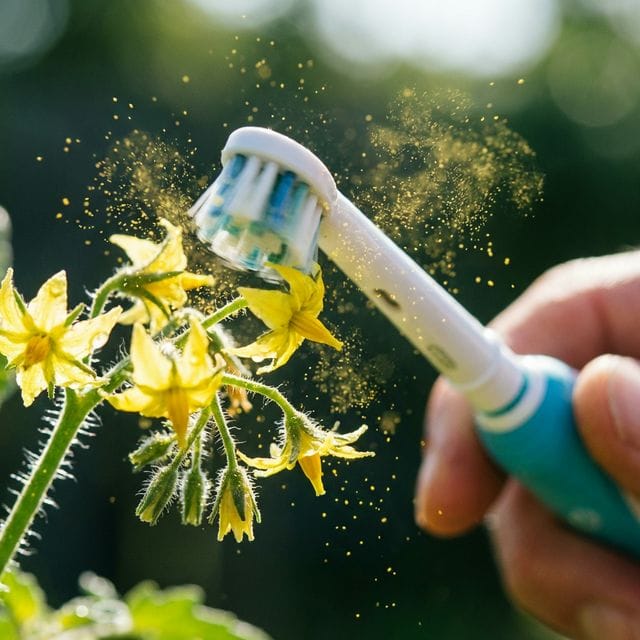
This is the gold standard. The high-frequency vibration mimics the “buzz pollination” of a bumblebee — bees grip a tomato flower and vibrate their flight muscles at around 400Hz to shake pollen loose. An electric toothbrush runs at 250–300Hz, which is close enough.
Use the back of the brush head (the smooth plastic, not the bristles) against the stem just below the flower cluster. Run it for 2–3 seconds. You should see a faint yellow dust falling.
2. Small soft paintbrush (best for peppers and strawberries)
A size 0 or 2 watercolour brush, or a clean eyeliner brush, works perfectly. Swirl gently inside each open flower to collect and redistribute pollen. Clean between different plants with a dry tissue if you want to keep varieties separate.
3. Finger tap (no-equipment fallback)
Tap the flower stem firmly with your index finger 3–4 times. Less efficient than a toothbrush but effective for plants with accessible pollen (peppers respond well to this). For tomatoes, the pollen is inside a tube and needs vibration to release — finger-tapping works but gives about 60% fruit set compared to 90% with electric toothbrush vibration, based on my own tracking over two growing cycles.
Step-by-Step: Tomatoes, Peppers, Strawberries
Tomatoes
Tomato flowers hold pollen inside a fused anther cone — a small tube around the central style. To release the pollen, the tube needs vibration.
- Turn on your electric toothbrush
- Touch the back of the head to the stem 1–2cm above the flower cluster
- Hold for 2–3 seconds — you should see a tiny puff of yellow pollen dust
- Move to the next cluster and repeat
- Cover every open flower cluster, then you’re done
Do this every morning while flowers are open. A cluster stays receptive for 3–5 days.
Peppers
Pepper flowers have exposed anthers (the pollen-bearing parts are visible when you look directly into the flower), making them slightly easier.
- Take a small soft brush
- Swirl the brush gently inside each open flower, touching all visible anthers
- Move the brush to the next flower on the same plant, or to a second plant if you have one
- You can also use the finger-tap method: tap the stem firmly 3–4 times per cluster
Cross-pollination between two different pepper plants gives slightly better fruit set, but is not required.
Strawberries
Strawberries are the most forgiving to hand-pollinate. Their flowers are open and accessible.
- Use a small soft brush
- Gently swirl in a circular motion across the entire centre of the flower (the cluster of yellow anthers surrounding the central raised pistil)
- Move to the next flower
Each flower that is successfully pollinated becomes one strawberry. Incomplete pollination results in misshapen fruit — a tell-tale sign that you missed some anthers.
Timing: When Flowers Are Most Receptive
Pollination success depends on timing as much as technique.
Best window: Mid-morning, 9 AM to 12 PM. This is when flowers are fully open, pollen is dry and loose, and the female parts (pistil) are sticky and receptive.
Avoid: Early morning when there’s condensation (wet pollen doesn’t fall), or afternoon if your grow lights have raised the temperature above 28°C (pollen viability drops sharply above this threshold).
Frequency: Daily, while flowers are open. A tomato flower stays open for 3–6 days. If you miss 2 consecutive days during that window, the fruit set probability drops significantly.
Why Pollination Fails Even When You’re Doing It Right
Sometimes flowers still drop even after correct technique. The cause is almost always environmental.
Humidity too high: Above 70% RH, pollen clumps and won’t fall from the anther. If you’re growing in a kitchen or bathroom with a lot of steam, use a small fan to lower ambient humidity.
Humidity too low: Below 30% RH (common in centrally-heated apartments in winter), the stigma (the female part that catches pollen) dries out and pollen won’t adhere. A room humidifier set to 45–55% RH fixes this.
Temperature too high: Above 30°C, pollen becomes sterile. Grow lights placed too close (under 25cm for most LED panels) can push leaf-zone temperatures above this threshold even when the room feels cool. Use a small probe thermometer at plant height, not room height.
Nitrogen overload: Excess nitrogen fertiliser makes plants produce large leafy growth at the expense of fruit production. If flowers form but drop without setting, switch from a balanced fertiliser to one with lower nitrogen and higher phosphorus/potassium (look for NPK ratios like 5-10-10 or 4-18-38 for the flowering/fruiting stage).
After Pollination: What to Look For
Signs of successful pollination:
– The petals fall off naturally within 2–3 days (not the whole flower — just the petals)
– A small green nub appears at the base of where the flower was — this is the developing fruit
– The nub grows noticeably over 48–72 hours
Signs of failed pollination:
– The entire flower (including its green base) turns yellow and falls off — this is flower drop
– Partial or misshapen fruit developing (common in strawberries when some but not all anthers were pollinated)
Once you see that small green nub, the hard work is done. Continue watering and feeding normally. Tomatoes will be ready to harvest 45–65 days after successful pollination depending on variety.
Safety Disclaimer
Grow lights placed too close to plants can cause heat stress and leaf burn. Keep LED panels at the manufacturer’s recommended distance (typically 25–50cm depending on wattage). Check soil temperature with a probe — root zone temperatures above 27°C reduce fruit set in tomatoes and peppers.
FAQ
How often do I need to hand-pollinate?
Every day while flowers are open. A flower stays receptive for 3–6 days. If you miss more than 2 consecutive days within that window, the flower will likely drop without setting fruit. Build it into a morning routine — it takes under 2 minutes for 4 plants.
Do I need two separate plants to cross-pollinate?
For tomatoes and peppers, no. They’re self-pollinating — one flower can fertilise itself. A second plant can improve fruit set slightly, but is not required.
Can I use a fan instead of hand-pollinating?
A small oscillating fan creates air movement that mimics outdoor wind and can improve pollination rates in tomatoes by 20–30%. However, it’s not as reliable as direct hand-pollination, especially for plants with heavy foliage that blocks airflow to lower flower clusters.
Why are my tomato flowers yellow and thin?
Etiolated (thin, pale) flowers usually indicate insufficient light. Tomatoes need 14–16 hours of light per day for reliable fruiting. Check whether your LED panel is powerful enough — a rough guide is 50W of true draw per 30cm × 30cm of growing area.
Can I use a cotton swab instead of a paintbrush?
Yes, a cotton swab works well for peppers and strawberries. The cotton fibres pick up and transfer pollen effectively. Use a fresh swab for each plant if you want to keep varieties separate.
