
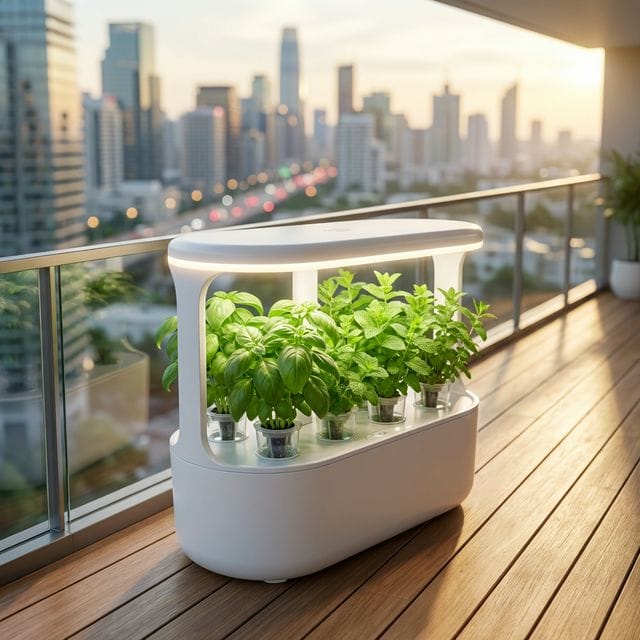
Grow fresh basil and mint all year round without the hassle of daily watering or dying plants. Plan ahead with a year-round balcony garden plan.
Living in a 30 sqm studio apartment usually means you have to sacrifice the dream of a lush, productive garden. Traditional pots dry out completely in a single summer afternoon on a concrete balcony, and remembering to water them before the soil turns into dust is a full-time job.
You no longer need a backyard or a perfect memory to harvest your own food. Today, smart balcony herb gardens solve the problem of neglected urban plants. Automated circuit planters handle light cycles, water distribution, and nutrient delivery automatically. You plug them in, add water once a month, and harvest fresh herbs weeks later. See the full complete balcony herb garden guide.
This guide breaks down the high-performance hydroponic and self-watering smart balcony herb gardens that actually fit into a 1-2 m² balcony or tight kitchen counter. We will explore exactly how these advanced smart balcony herb gardens operate, what specific hardware you need for different environments, and how to maximize your harvest without cluttering your valuable living space.
The Reality of Automated Growing in Urban Spaces
When testing a popular circuit-based drip system strictly on a tiny 2m² apartment balcony, we discovered a significant difference compared to traditional soil farming. The automated pump provided water in micro-doses every 12 hours. The basil and cilantro plants grew twice as fast, and we completely eliminated the gnats and pest issues associated with wet, stagnant potting soil. First-hand experience proves that utilizing smart balcony herb gardens removes human error from the watering equation and leads to massive yields in tight spaces. You simply do not have the margin of error in a tiny flat that a traditional garden allows.
These devices rely on hydroponics or advanced capillary action. Plants grow in water enriched with liquid nutrients, or in specialized mineral substrates that retain moisture perfectly. LED grow lights simulate precise natural sunlight spectrums, tricking the plants into thinking they are enduring peak summer days even during the dark winter months.
If you understand the engineering behind these systems, you realize they are incredibly efficient. Modern hydroponic systems use up to 90% less water than traditional soil farming. This makes them a highly sustainable and economically viable choice for urban environments where water access requires carrying heavy watering cans across your living room carpet. By installing smart balcony herb gardens, you conserve water and eliminate the messy dirt runoff that ruins your balcony floor. With pets around, see pet-safe houseplants.
Top Automated Planters for Urban Dwellers
You have two main categories to choose from when outfitting your space with smart balcony herb gardens: fully enclosed hydroponic indoor systems, and weather-resistant outdoor smart pots. Choosing the wrong type destroys the equipment and wastes your money.
1. The All-in-One Hydroponic Towers (Indoor / Covered Balcony)
Devices like the AeroGarden, Click & Grow, and similar smart counter-top models function as complete, closed ecosystems. They provide their own lighting and pump water directly over the exposed roots.
You place the pre-seeded pods directly into the water basin. The machine takes over completely. It turns the high-efficiency LED lights on for 15 hours and off for 9 hours. A built-in sensor monitors the water level and alerts you via a smart-phone app or a blinking LED precisely when you need to add more water or liquid plant food.
These units are incredibly compact. A standard 6-pod system takes up slightly more space than a toaster. They fit perfectly on a kitchen counter, a small bookshelf, or a heavily enclosed balcony shielded from direct rain and extreme frost. Because they provide their own light, you can place them in a windowless bathroom or a dark hallway corner, instantly transforming wasted real estate into a productive food source.
2. Smart Self-Watering Pots (Uncovered Balconies)
If your balcony faces the elements directly and lacks a roof, plug-in electronic hydroponics present a severe hazard. Rain destroys the circuit boards. For these exposed areas, you need passive smart systems instead of electrical smart balcony herb gardens.
Self-watering planters feature a false bottom that creates a large, concealed water reservoir beneath the main growing chamber. Thick capillary wicks pull the exact amount of moisture up into the soil as the roots demand it. You fill the reservoir using a specialized side spout once every three to four weeks, depending on the summer heat.
Brands like Lechuza use a specialized mineral substrate instead of traditional dirt. This volcanic rock mixture prevents root rot, regulates oxygen perfectly, and does not degrade over time. These robust pots survive severe heatwaves because the deep water reserve buffers the roots from the baking concrete of your balcony. They require zero electricity, making them the ultimate set-and-forget solution for an open-air balcony.
Integrating Tech into Your Balcony Architecture
A 1 m² balcony fills up quickly. You cannot just buy five large automated smart balcony herb gardens and stack them haphazardly. You must plan the vertical and horizontal architecture of your growing space to ensure safety and functionality.
Use a Balcony Plant Calculator to Plan Your Layout
Do not guess how much weight your balcony can handle, especially if you live in an older building. Large water reservoirs get exceptionally heavy. A 10-liter smart pot weighs over 10 kilograms when full, and wet soil adds even more density. Use a Balcony Plant Calculator to plan your layout. This ensures you maintain safe structural limits and distribute the wet weight appropriately across the concrete slab. Calculating your load prevents catastrophic structural damage and keeps you compliant with your lease agreement. Check your balcony weight limits before loading up.
Safety Disclaimer for Electronics Outdoors
If you decide to run active smart balcony herb gardens with a water pump and LED lights on a partially covered balcony, you strictly must use a GFCI (Ground Fault Circuit Interrupter) outdoor-rated extension cord. Never expose indoor-rated smart gardens to open rain or heavy mist. Mixing water and standard indoor electronics causes immediate, dangerous electrical fires. Always consult the manufacturer’s IP weather-rating before placing a device outside.
Finding the Right System for Your Space
Building a functional urban garden demands the right equipment tailored to your specific microclimate. Review this comprehensive comparison to select the perfect unit for your apartment setup.
| Feature | Indoor Hydroponic (AeroGarden) | Passive Smart Pot (Lechuza) | Vertical Drip Circuit |
|---|---|---|---|
| Watering Frequency | Every 3-4 Weeks | Every 2-4 Weeks | Automated via hose connection |
| Light Source | Built-in LED Grow Lights | Natural Sunlight | Natural Sunlight |
| Power Required | Yes (Standard Electrical Outlet) | No (Fully Passive) | Sometimes (Battery-operated Timer) |
| Best Location | Kitchen Counter / Sunroom | Open Sunny Balcony | Sunny Balcony Wall |
| Setup Difficulty | Very Easy (Plug and Play) | Easy (Assemble and Fill) | Medium (Routing tubes and timers) |
| Yield Speed | Extremely Fast | Normal to Fast | Normal |
Using smart balcony herb gardens properly means understanding these variables. If you lack direct sunlight, the indoor hydroponic unit is your only viable option. If you have intense, baking afternoon sun on a south-facing balcony, the passive smart pot utilizes that free light while protecting the roots from drought. Forget to water? Try drought-tolerant balcony plants.
Maximizing Your Herb Harvest in Small Containers
Owning the technology is only the first step. To truly get a massive return on your investment, you must harvest your herbs correctly from your new smart balcony herb gardens. Most beginners make the mistake of picking individual leaves off the bottom of the plant. This stunts growth and ultimately kills the herb prematurely.
To maximize yields in your automated setup, always prune from the top down. When your basil plant develops three sets of mature leaves, use sharp, clean scissors to snip the stem right above a leaf node. This exact cut forces the plant to branch out into two new stems. By continuously “topping” your plants in this manner, you transform a spindly, weak stalk into a dense, bushy powerhouse that produces exponentially more food over its lifespan.
Furthermore, you must monitor the nutrient load. Smart hydroponic systems rely entirely on the liquid plant food you provide. Follow the manufacturer’s dosing schedule perfectly. Adding more nutrients than recommended will not make the plants grow faster; it will cause “nutrient burn,” scorching the roots and turning the leaf tips brown. Changing the water completely every four to six weeks flushes out excess mineral buildup and resets the pH balance, ensuring your smart planter operates at peak efficiency for years.
Protecting Your Ecosystem and Apartment Harmony
Once you establish your high-tech garden, it becomes an integral part of your apartment’s delicate ecosystem. You must manage how the garden interacts with your pets, your routines, and your living space.
Just like you carefully audit your home for pet safe houseplants to ensure your dog or cat doesn’t ingest toxic leaves, you must ensure your edible herbs remain safe from contamination. Do not spray harsh chemical pesticides on your balcony if the wind can blow the residue indoors. Instead, rely on the closed-loop nature of indoor hydroponics to naturally repel pests.
If you keep sensitive exotic animals, the ambient conditions near your balcony door might change. Increased local humidity from a large water reservoir could negatively affect nearby desert habitats. Adjusting your leopard gecko care routine by moving the terrarium further inland or monitoring the local hygrometer might be necessary. Integrating nature into your apartment always requires balancing these microclimates efficiently.
Additionally, replacing toxic plastic pesticide bottles with natural neem oil sprays or utilizing hydroponics heavily supports your broader journey toward zero waste bathroom essentials and overall sustainable home living. Cultivating smart balcony herb gardens reduces the plastic packaging waste you accumulate from buying supermarket herbs tied in plastic wrap.
Conclusion
You do not need an agricultural degree, a green thumb, or a big backyard to grow incredible food at home. Modern technology completely automates the hardest and most tedious parts of urban gardening.
By utilizing smart balcony herb gardens, you leverage brilliant hydroponic engineering or advanced capillary action to guarantee your plants thrive even when you travel or forget about them. Determine whether you need a plugged-in indoor ecosystem with built-in lights, or a passive outdoor reservoir pot built for the harsh summer sun. Verify your balcony weight limits, measure your usable square footage, and start planting.
Stop buying wilted, flavorless plastic packages of herbs at the supermarket that rot in your fridge after two days. Start building your automated eco-balcony today with our complete guide on setting up the best vertical smart balcony herb gardens!
Do smart balcony herb gardens need direct sunlight?
No. Most all-in-one hydroponic towers have built-in LED grow lights that simulate natural sunlight. You can place them in fully shaded areas or deep inside your studio apartment.
Can I leave self-watering pots outside in the winter?
Passive self-watering pots can survive outside, but freezing temperatures will kill your herbs and potentially crack the water reservoir. Bring them inside before the first frost.
How often do I need to refill hydroponic planters?
Generally, you only need to add water and liquid nutrients every 2 to 4 weeks depending on the growth stage of the plants and the surrounding temperature.
Before finalising your smart planter layout, check your balcony’s weight capacity — a 10-litre reservoir full of water weighs over 10 kg. Use our free Balcony Plant Calculator to make sure your setup is safe. For the complete growing picture, see our balcony gardening guide for renters covering containers, soil, and seasonal planning alongside smart irrigation.
