
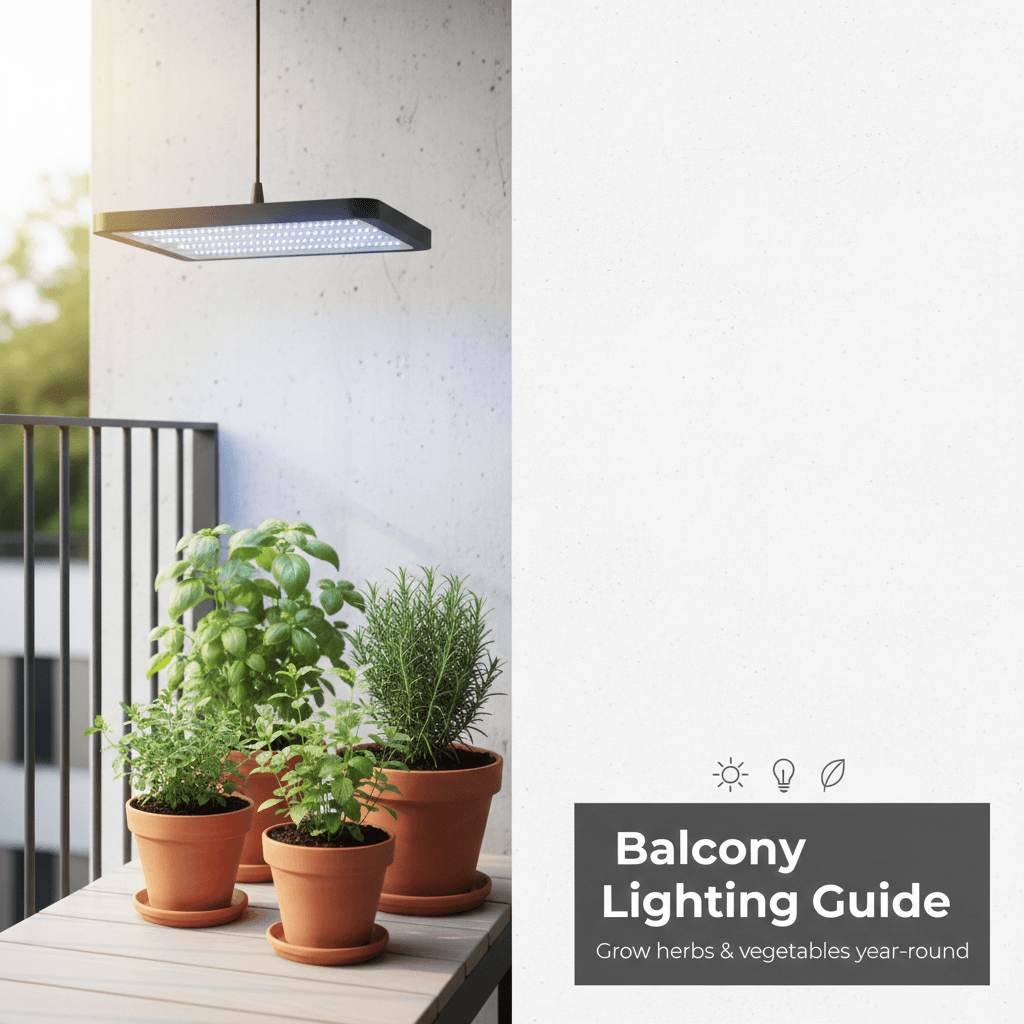
Most balcony gardening guides assume you have a south-facing terrace with six hours of direct sun. Most apartment balconies don’t. A north-facing balcony in a city centre, a lightwell-adjacent terrace, or a west-facing balcony shaded by the building opposite — these are the real conditions most urban renters are dealing with.
Lighting determines what you can grow and how much you harvest. This guide covers how to measure what you have, what it means for your plant choices, and when and how to supplement with grow lights — with real cost figures for both the US and European markets. For ambience, see renter-friendly lighting.
Table of Contents
- How Much Light Does Your Balcony Actually Get?
- Light Requirements by Herb and Vegetable
- When You Need a Grow Light (And When You Don’t)
- Best Grow Lights for Balconies and Covered Terraces
- How to Mount Grow Lights Without Drilling
- Electricity Cost: What It Actually Adds to Your Bill
- FAQ
How Much Light Does Your Balcony Actually Get?
“Low light” means different things to different plants. The practical framework is hours of direct sun per day plus ambient lux at plant height during the remaining hours. Browse low-light indoor plants if sun is scarce.
How to measure it: A free lux meter app on your phone (Lux Light Meter Pro, available for both iOS and Android) gives a directional reading. Hold the phone camera-up at plant canopy height and take readings at three times: 9am, 12pm, and 3pm on a clear day. Average the three readings.
| Balcony Type | Typical Peak Lux | Direct Sun Hours | What This Means |
|---|---|---|---|
| South-facing, unobstructed | 50,000–80,000 lux | 6–8 hours | Grows everything without supplementation |
| West or east-facing | 20,000–40,000 lux | 3–5 hours | Good for herbs; tomatoes may struggle |
| North-facing | 5,000–15,000 lux | 0–2 hours | Shade-tolerant herbs only |
| Lightwell or shaded terrace | 1,000–5,000 lux | 0 | Supplemental light required for most crops |
The direction your balcony faces is the primary determinant of what you can grow. Orientation is harder to compensate for than you think — reflective surfaces and grow lights help, but a north-facing balcony in October is not going to produce tomatoes. How usable light shifts month to month on each aspect is mapped in the balcony plant calendar.
Light Requirements by Herb and Vegetable
| Plant | Minimum Daily Light | Ideal Conditions | What Happens Without Enough |
|---|---|---|---|
| Basil | 6–8 hours direct | South/west, unshaded | Leggy stems, weak flavour, bolts early |
| Rosemary | 6–8 hours direct | South-facing, dry | Won’t develop essential oils, poor aroma |
| Thyme | 6–8 hours direct | South-facing | Poor flavour, lanky growth |
| Parsley | 4–6 hours | Any direct sun | Slow growth, pale leaves |
| Chives | 4–5 hours | Any direct sun | Thin shoots, slow regrowth |
| Mint | 3–4 hours indirect | North/east fine | Still grows; keeps moisture better |
| Lettuce | 3–5 hours | Partial shade ok | Slower but less bitterness; shade reduces bolting |
| Spinach | 3–5 hours | Partial shade ok | Smaller leaves, still edible |
| Cherry tomatoes | 6–8 hours direct | South/west only | Few flowers, poor fruit set |
| Courgette/zucchini | 6–8 hours direct | South/west only | Large leaves, minimal fruit |
| Climbing beans | 5–7 hours | South/west | Viable in partial shade; fewer pods |
The practical summary: Mediterranean herbs (basil, rosemary, thyme) need your sunniest position and fail in shade. Cold-climate crops (lettuce, spinach, mint, parsley, chives) tolerate north-facing or shaded balconies well. Fruiting vegetables (tomatoes, peppers, courgette) require 6+ hours of direct sun — don’t attempt them on shaded balconies without grow lights. Set it up with our no-drill balcony herb garden guide.
When You Need a Grow Light (And When You Don’t)
You don’t need a grow light if:
– Your balcony gets 5+ hours of direct sun and you’re growing herbs or leafy greens
– You’re only growing mint, parsley, chives, or lettuce on a partially shaded balcony
– It’s April through August in a sunny location (natural light is sufficient) You can also maximize natural light in the room.
You do need a grow light if:
– You want to grow basil, tomatoes, or peppers on a north-facing or heavily shaded balcony
– You’re trying to start seeds indoors in January–March (window light is insufficient for strong seedlings)
– You want to extend the growing season into November–February
– Your balcony faces a lightwell or gets less than 3 hours of sun
The threshold where grow lights become worth it: if your balcony registers under 5,000 lux at midday and you want to grow anything beyond shade-tolerant herbs. The same lux thresholds apply indoors, where growing food in a windowless apartment depends entirely on artificial light.
Best Grow Lights for Balconies and Covered Terraces
For herbs and leafy greens (budget option)
A basic LED grow strip or compact panel — GE BR30 Full Spectrum LED (around $20 / €18), Sansi 15W Full Spectrum Bulb ($18 / €16), or a clip-on LED panel (Mars Hydro SP-150, $35 / €32) — is sufficient for one shelf of herbs. Run for 14 hours per day.
For herbs plus fruiting plants
You need at least 50W true draw. The Mars Hydro TS 600 ($55 / €50) and Viparspectra P600 ($60 / €55) cover approximately 30 × 60cm adequately for herbs and dwarf tomatoes. Check for the true wattage draw (listed in specs), not the “equivalent” wattage — a “600W equivalent” LED typically draws 100W actual, which is what matters for your electricity bill.
For a covered balcony with weather exposure
Any light fixture rated IP65 or higher is safe for covered outdoor use (protected from rain spray and condensation). Most indoor grow lights are rated IP40 — fine for a covered terrace with no direct rain, but not suitable for an open balcony where rain can reach the fixture. Check the IP rating before mounting outside.
Practical mounting options (no drilling required)
| Method | Best For | Cost |
|---|---|---|
| Adjustable floor tripod stand | Full herb shelf coverage | $25–$50 / €22–€45 |
| Tension rod across balcony opening | Hanging clip-on grow lights | $8–$15 / €7–€13 |
| Railing clamp fixture | Attaching to balcony railing | $15–$35 / €13–€30 |
| Plant shelf with built-in grow light | Covered balcony or indoor | $45–$90 / €40–€80 |
All of these are renter-friendly — no wall damage, no landlord conversation required.
Electricity Cost: What It Actually Adds to Your Bill
A 45W LED panel running 14 hours/day uses 0.63 kWh per day.
- US average rate (~$0.16/kWh): approximately $3.00/month
- European average rate (~€0.28/kWh): approximately €5.30/month
Running two panels for a full herb shelf:
– US: ~$6/month
– Europe: ~€10–11/month
At European electricity prices, one grow light adds roughly the cost of a bunch of supermarket basil per month to your bill — but produces continuous harvests instead of one bunch. The payback calculation still works; it just takes a little longer in Europe than in the US.
Use a programmable outlet timer ($8–$12 / €7–€10) to automate the light schedule. Plants need a dark period — never run grow lights 24/7.
Safety Disclaimer
Grow lights not rated for outdoor use (IP40 or lower) must be used on fully covered balconies only. Direct rain or heavy condensation on an indoor-rated fixture creates an electrical hazard. Ensure all outdoor extension cords and power strips are rated for outdoor use (IP44 minimum). Keep grow lights at manufacturer-recommended distances from plants — too close causes light burn (pale, bleached patches). Don’t look directly into LED grow panels during operation; they emit UV wavelengths.
FAQ
What type of grow light is best for balcony herbs?
Full-spectrum LED panels are the most energy-efficient option. They cover the red (630–660nm) and blue (430–460nm) wavelengths plants use, without generating the heat of HPS or fluorescent alternatives. For herbs and greens, a 20–45W panel is sufficient. For fruiting plants (tomatoes, peppers), use at least 50–100W true draw.
How many hours of artificial light do herbs need?
Leafy herbs (mint, chives, parsley, lettuce): 12 hours/day. Mediterranean herbs (basil, rosemary, thyme): 14 hours/day. Fruiting plants (tomatoes, peppers): 16 hours/day. Always include a dark period — running lights 24/7 doesn’t help and can cause light stress.
Are grow lights safe to use outdoors?
Only if rated for outdoor use (IP65 for full weather protection, IP44 for splash protection on a covered balcony). Standard indoor grow lights (IP40 or lower) are not waterproof and should only be used on fully covered, enclosed balconies where rain cannot reach them.
Will grow lights noticeably increase my electricity bill?
A 45W panel at 14 hours/day adds approximately $3/month (US) or €5.30/month (Europe) to your bill. Running two panels for a full herb shelf: $6/month US or €10–11/month Europe. This is offset by the cost of not buying fresh herbs at the supermarket.
Can I use any LED bulb as a grow light?
Standard warm white LED bulbs don’t provide the full spectrum plants need — they’re heavy in green wavelengths, which plants reflect rather than absorb. Use bulbs specifically labelled as “full spectrum” or “grow light.” These emit more blue and red wavelengths. Look for 5000K–6500K colour temperature as a minimum guide; proper grow lights also list PPFD output in their specifications.
How close should a grow light be to plants?
This varies by light power, but general guidelines: LED strips and low-power panels (under 25W): 10–20cm. Mid-power panels (25–100W): 20–40cm. High-power panels (100W+): 40–60cm. Too close causes light burn (bleached patches); too far reduces effective PPFD to below the threshold for productive growth. Check the manufacturer’s recommendation for your specific model.
