
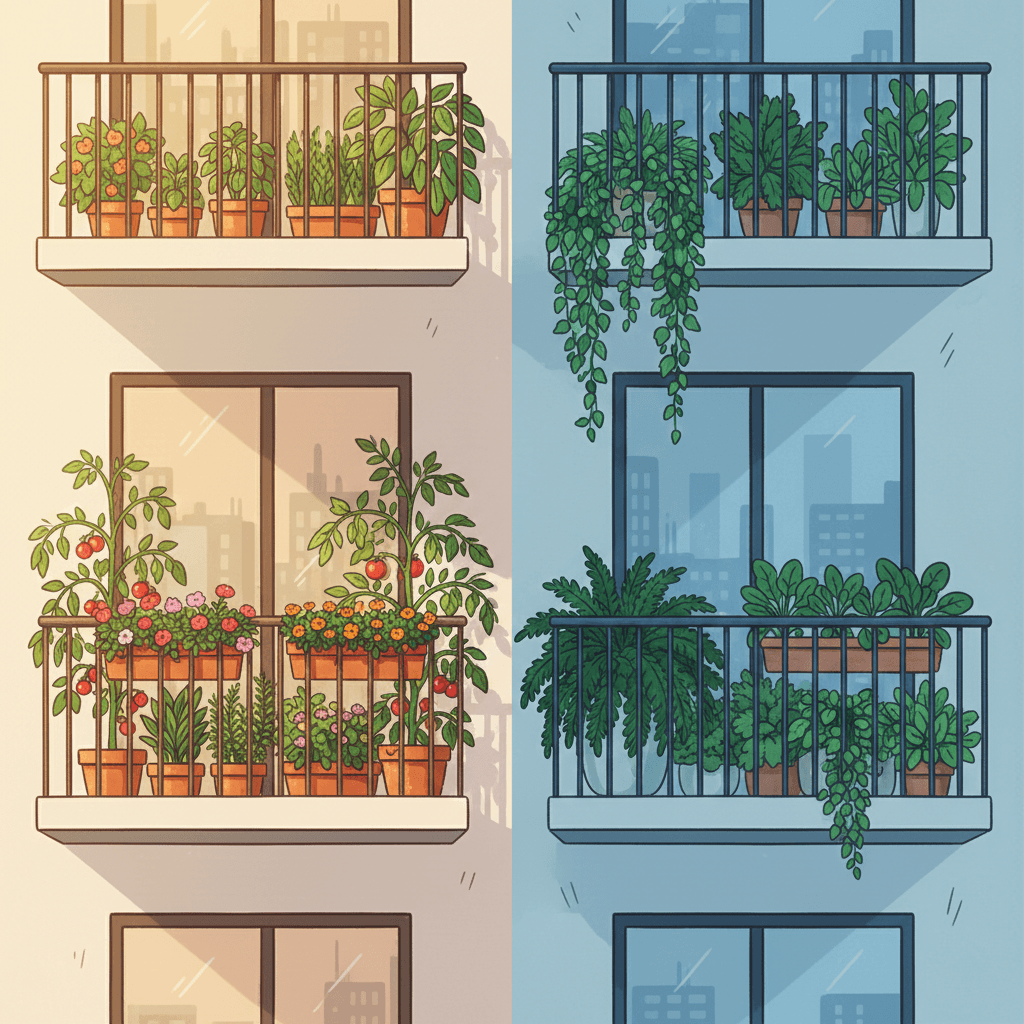
Before you buy a single pot or bag of soil, check which direction your balcony faces. It’s the single most important variable in balcony gardening — more important than pot size, soil mix, or fertiliser schedule. Plant the wrong species on the wrong exposure and you’ll spend the growing season fighting the light instead of working with it. See the complete balcony herb garden guide.
Here’s how to design a productive balcony garden around the sun you actually have — whether that’s a full-sun south-facing terrace or a shaded north-facing strip.
Table of Contents
- How to Find Your Balcony’s Orientation
- South-Facing Balcony: Best Plants and Layout Tips
- North-Facing Balcony: Best Plants and Layout Tips
- East-Facing Balcony: The Gentle Morning Light Option
- West-Facing Balcony: Afternoon Heat Specialists
- My Experience Growing on Both a North and South-Facing Balcony
- Quick Comparison: All Four Orientations
- How Latitude Changes Everything
- FAQ
How to Find Your Balcony’s Orientation
The quickest method: step onto your balcony around 10 AM on a clear day. If you need sunglasses and the floor is already warm underfoot, you’re on a south or west-facing balcony. If the light is soft and indirect, you’re north or east-facing.
For precision, use your phone’s compass app. Stand at the balcony railing and point outward — the direction the railing faces is your balcony orientation. Use the balcony railing for more space.
A practical calibration test: At 10 AM, place your hand flat on the floor. On a south-facing balcony in summer, the concrete will feel noticeably warm within 2 hours of sunrise. On a north-facing balcony at the same time, it stays cool until well into the afternoon, if it ever warms at all.
South-Facing Balcony: Best Plants and Layout Tips
A south-facing balcony is the most productive for food growing. It receives 6–10 hours of direct sun per day in summer, making it suitable for heat-loving crops and Mediterranean herbs.
Best plants for south-facing balconies
Vegetables:
– Cherry tomatoes (Tiny Tim, Tumbling Tom) — 6+ hours required
– Peppers and chillies — need heat to set fruit
– Aubergines — similarly heat-demanding
– Bush beans — compact, productive in full sun
Herbs:
– Rosemary, thyme, oregano, sage — prefer dry, warm conditions
– Basil — loves heat but needs consistent watering to prevent bolting
Ornamentals:
– Geraniums, petunias, lantana, lavender
– Succulents and cacti — use the hottest corner
Layout tips for south-facing balconies
The shadow-play strategy: Position your tallest plants (a dwarf citrus, a tomato cage, a potted olive) on the western edge. They’ll cast afternoon shade over more delicate plants positioned behind them, reducing heat stress without eliminating sun.
Watering frequency: In full summer, small containers on a south-facing concrete balcony can dry completely in 24 hours. Self-watering pots with a reservoir (like the Lechuza Balconera) are not optional — they’re survival equipment. See our guide to self-watering planters vs regular pots for a comparison.
Heat reflection: White or pale-coloured pots reflect heat away from roots. Dark terracotta pots absorb heat and can cook roots in full afternoon sun on a south-facing balcony in July. Switch your most sun-exposed pots to white fibreglass or light-coloured ceramic.
North-Facing Balcony: Best Plants and Layout Tips
A north-facing balcony feels like a limitation but is actually a strength if you design around it. It stays cooler, retains moisture longer, and is the only balcony orientation where leafy greens thrive through summer without bolting.
Best plants for north-facing balconies
Edibles:
– Lettuce, spinach, kale, rocket — perform better in indirect light; heat causes bolting
– Mint — actually prefers part-shade, spreads in a hanging planter
– Chives — low light tolerant, harvest repeatedly For shade, try low-light indoor plants.
Foliage plants:
– Boston ferns, hostas, heucheras in containers
– Snake plant (Sansevieria) — can stay outdoors in warm months
Shade flowers:
– Fuchsias, begonias, impatiens — produce colour without direct sun
Layout tips for north-facing balconies
The reflective surface strategy: Use light-coloured pots, pale gravel mulch, and white or cream railings to bounce whatever light enters the space back upward into the plant canopy. This measurably increases photosynthesis in low-light conditions.
Moisture management: Shade means slower evaporation. North-facing balconies are prone to overwatering errors — soil that feels dry on the surface may be saturated at root depth. Use moisture meter probes (under €10) rather than relying on visual or touch checks.
Vertical space: Without harsh sun to cause scorch, you can run climbers (ivy, climbing hydrangea) up the full height of the railing and wall without damage. This creates a dense living green wall that insulates the balcony and reduces road noise.
East-Facing Balcony: The Gentle Morning Light Option
East-facing balconies receive 4–6 hours of morning sun (roughly 7 AM to 12–1 PM) and shade for the rest of the day. This is the goldilocks exposure for many plants that struggle with both full shade and intense afternoon heat.
Best plants: Herbs (parsley, coriander, chives), strawberries, begonias, fuchsias, most ferns. Strawberries in particular thrive on east-facing balconies — they get enough light to produce fruit without the heat stress that causes small, dry berries on south-facing exposures.
What doesn’t work: Tomatoes, peppers, and aubergines need 6+ continuous hours of direct sun. East-facing balconies usually fall just short, producing leggy plants with few fruits.
Watering: Morning sun dries the top layer of soil before afternoon shade prevents deep evaporation. This creates uneven moisture distribution. Water in the morning after the sun hits, not in the evening.
West-Facing Balcony: Afternoon Heat Specialists
West-facing balconies receive shade in the morning and intense, direct sun from approximately 1–2 PM until sunset. The afternoon heat is more intense than morning sun at equivalent UV index because surfaces have accumulated heat throughout the day.
Best plants: Succulents, drought-tolerant ornamentals, lavender, rosemary, geraniums. Tomatoes can work but need shade cloth during the 3–6 PM peak heat window in summer.
The heat-trap problem: West-facing balconies are the hottest of all four orientations in the late afternoon. Concrete and tile floors absorb heat all day and re-radiate it through the evening. This keeps temperatures 4–8°C higher than ambient after sunset, which is uncomfortable for sitting outside but beneficial for heat-loving plants.
Layout tip: Place your seating area in the far corner (most shaded during the hottest hours) and your heat-tolerant plants along the railing. A bamboo privacy screen on the south railing post filters the harshest early afternoon light while letting cooler late-afternoon light through.
My Experience Growing on Both a North and South-Facing Balcony
I’ve grown food on two very different balconies in the same city in consecutive years: a 1.6m × 3.2m south-facing balcony in my previous flat, and the 1.4m × 2.8m north-facing balcony in my current apartment.
On the south-facing balcony, I harvested 2.1kg of cherry tomatoes (Tumbling Tom) from two hanging planters in a single summer. The plants grew aggressively and needed daily watering during July — I was emptying the self-watering reservoirs every 36 hours at peak heat. The specific failure I made: I put basil in the corner nearest the south railing, where temperatures hit 38°C on hot days. It bolted within 6 weeks and became inedible. Moving it 40cm back behind the tomato cage fixed it the following year.
On the current north-facing balcony, I can’t grow tomatoes reliably — the sun hours fall about 2 short of what the varieties need. But the lettuce and kale have been extraordinary. I’m cutting salad leaves from April to November (I bring the plants inside in October) with zero bolting issues that plagued me in full sun. The trade-off is clear and worth understanding before you buy.
For more on structuring a productive balcony garden, see the full balcony gardening guide for renters and our overview of the best containers with perfect drainage.
Quick Comparison: All Four Orientations
| Orientation | Direct Sun Hours | Best For | Avoid |
|---|---|---|---|
| South | 6–10 hours | Tomatoes, peppers, herbs | Lettuce, ferns |
| North | 0–2 hours | Leafy greens, ferns, mint | Tomatoes, peppers |
| East | 4–6 hours (morning) | Strawberries, herbs, begonias | Aubergines, chillies |
| West | 4–6 hours (afternoon) | Succulents, lavender, geraniums | Delicate greens |
How Latitude Changes Everything
A south-facing balcony in London (51°N latitude) receives significantly less intense sun than a south-facing balcony in Barcelona (41°N). At higher latitudes, the sun’s arc is lower in the sky, meaning direct light hits at a more oblique angle and passes through more atmosphere, reducing intensity.
Practical implication: In the UK, Ireland, or northern Europe above 52°N, a south-facing balcony functions more like an east-facing balcony does in Spain or Italy. Adjust your plant selection accordingly — tomatoes will work but need the most heat-retaining setup you can manage (dark containers, south railing as windbreak, reflective surface behind plants).
In southern Europe or similar latitudes, a north-facing balcony receives enough ambient light for a wider range of plants than it would in northern climates — including some that are considered shade-intolerant further north.
Safety Disclaimer
When adding heavy pots and planters to a balcony, always check the load rating of your balcony structure. As a general guide, most modern balconies are rated for 200–400kg per square metre, but older buildings vary significantly. See our balcony weight limits guide for a practical calculation method.
FAQ
How do I know exactly how many sun hours my balcony gets?
The most accurate method: place a small notebook on the balcony railing at 9 AM on a clear day. Check it hourly and mark each hour it’s in direct sun (warm to the touch, casts a clear shadow). Do this across 3 different days to account for seasonal variation.
Can I grow tomatoes on a north-facing balcony?
Technically yes, but practically very difficult. Tomatoes need 6–8 continuous hours of direct sun to set fruit reliably. On a north-facing balcony, you’d need supplemental LED grow lights, which adds cost and complexity. You’d do better growing leafy greens and herbs.
My balcony faces southeast — is that south or east?
Southeast is excellent — it combines the benefits of both exposures. Morning sun arrives early (east component), and it transitions to warm midday sun rather than the harsh afternoon heat of a west-facing exposure. Tomatoes, strawberries, and herbs all do well in southeast exposures.
Does balcony orientation affect winter growing?
Significantly. A south-facing balcony in winter still receives some direct sun (the sun is lower in the sky but still present), making cold-hardy vegetables like kale and winter lettuces viable with row cover. A north-facing balcony in winter receives almost no direct sun at all above 50°N latitude.
Can I change my balcony’s effective orientation with mirrors?
Not practically. Mirrors would need to track the sun to be useful and would create glare hazards for neighbours. White or reflective surfaces help marginally within the balcony space itself, but they don’t meaningfully increase sun hours on a north-facing exposure.
