
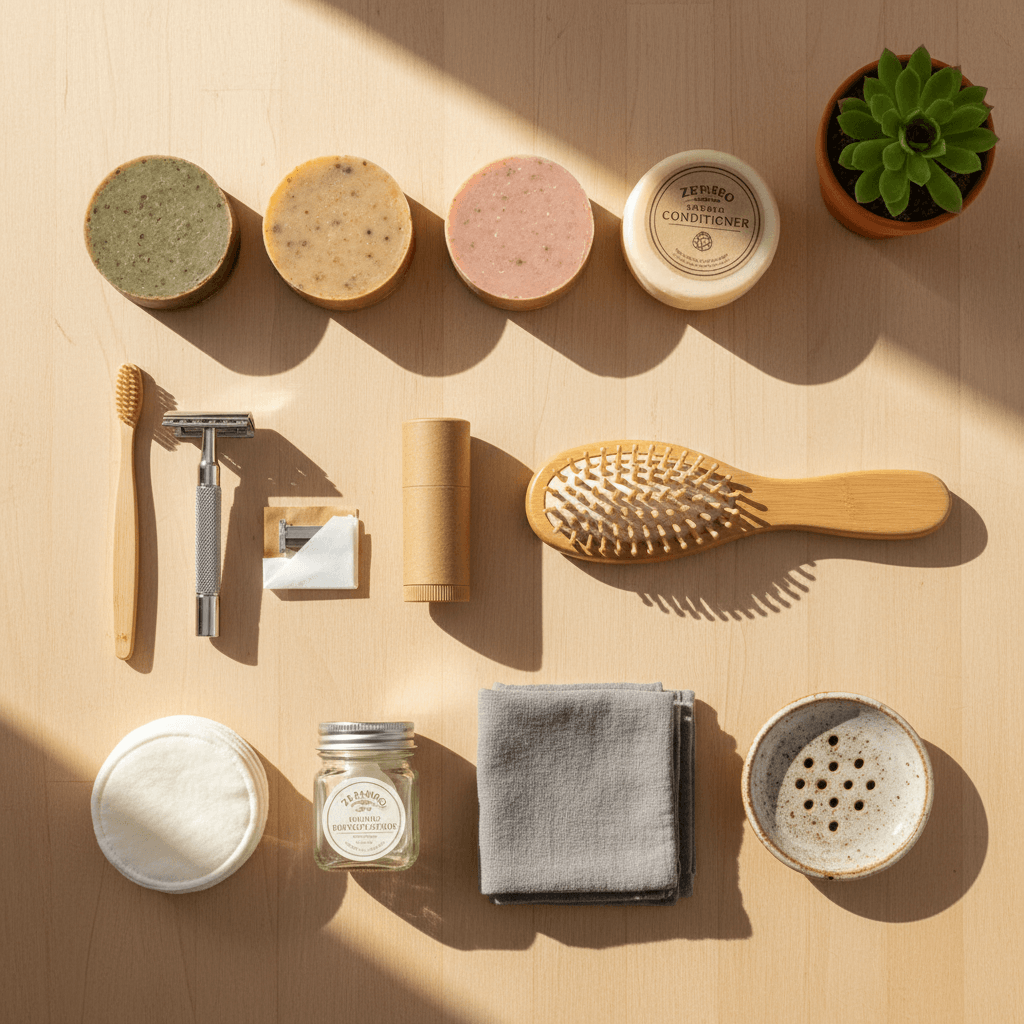
The bathroom is the easiest room in your home to start reducing plastic waste — and the most impactful. Most bathroom products are single-use containers that do one job and then go to landfill. The swap from plastic-packaged liquids to package-free solids usually costs the same or less over 12 months, requires no lifestyle change, and cuts bathroom plastic waste by 60–80% for most people. In a studio, where storage and living space overlap, these swaps sit alongside wider strategies for creating zones in a studio apartment without walls.
This is a practical guide for beginners: what to swap first, what to expect during the transition, and realistic cost comparisons between conventional and zero-waste equivalents — with both US and European pricing.
Table of Contents
- Why the Bathroom First?
- The Starter Swap: 5 Items Under $50 / €45
- Solid Toiletries: Soap, Shampoo, Conditioner, Deodorant
- Safety Razors: The Maths Over 5 Years
- Bamboo Toothbrushes and Plastic-Free Dental Care
- Reusable Cotton Rounds and Makeup Removal
- What Doesn’t Work (Yet) and What to Do Instead
- Cost Comparison Over 12 Months
- FAQ
Why the Bathroom First?
The average household generates 25–40% of its total plastic waste from the bathroom — shampoo bottles, conditioner, body wash, face wash, disposable razors, cotton rounds, toothbrushes, and packaging for every product inside. Most of this plastic is not recycled: contaminated personal care packaging is typically rejected at recycling facilities.
The bathroom is the best room to start because:
– Products are used regularly — you notice and build habits faster with daily-use items
– Swaps are direct substitutes — a shampoo bar does exactly what liquid shampoo does, with the same application method
– No infrastructure required — unlike kitchen composting, there’s nothing to install or build
– Compact apartment-friendly — solid products take less space and work better in small bathrooms
The Starter Swap: 5 Items Under $50 / €45
Start here. These five swaps cover the highest-volume plastic items in most bathrooms:
| Item | Replaces | Cost | Lasts |
|---|---|---|---|
| Bar soap (body + hands) | Body wash + hand soap bottles | $4–$6 / €3–€5 | 2–3 months |
| Shampoo bar | Shampoo bottle | $8–$12 / €7–€11 | 60–90 washes |
| Bamboo toothbrush | Plastic toothbrush | $3–$5 / €2.50–€4.50 | 3 months |
| Reusable cotton rounds (10–15 pack) | Disposable cotton pads | $8–$12 / €7–€11 | Indefinitely |
| Safety razor (starter kit) | Disposable razors | $15–$25 / €13–€22 | Indefinitely (blades replaced) |
Total starter investment: $38–$60 / €32–€53. After the initial purchase, ongoing costs drop significantly — blades are 10–20 cents each, bar soaps and shampoo bars replace $4–$12 liquid bottles.
Solid Toiletries: Soap, Shampoo, Conditioner, Deodorant
Bar soap
Bar soap is the simplest swap and requires no adjustment period. It lathers identically to liquid soap. The only practical consideration for small bathrooms: keep bar soap on an elevated soap dish or wooden rack that allows drainage — pooled water softens bars rapidly and wastes product. Giving every item one fixed spot works the same way here as it does in a small entryway landing strip.
Cost per wash: approximately $0.05–$0.08 / €0.04–€0.07 for bar soap, versus $0.10–$0.15 / €0.09–€0.13 for body wash. Bar soap is cheaper even before the packaging savings.
Good brands available in both US and EU: Dr. Bronner’s (castile soap bars, multi-use), Ethique, local artisan brands.
Shampoo bars
Shampoo bars have an adjustment period of 1–2 weeks. This is not because they don’t work — it’s because conventional liquid shampoos leave a silicone coating on the hair that takes time to wash out. During this period, hair may feel waxy or heavy. This resolves after 7–14 washes.
Application: Wet hair thoroughly. Rub the bar between your palms to generate lather, then apply to the scalp with fingertips in circular motions. Rinse thoroughly — incomplete rinsing is the most common cause of the waxy feeling.
One bar typically lasts 60–90 washes. Cost per wash: $0.09–$0.15 / €0.08–€0.13, compared to $0.25–$0.40 / €0.22–€0.35 for premium liquid shampoo. Comparable cost to budget liquid shampoo.
Brands widely available in both markets: Lush, Ethique, HiBAR, Beauty and the Bees.
Conditioner bars
Work similarly to shampoo bars. Application: rub the bar between palms, apply directly to mid-lengths and ends (not the scalp). Rinse out. Particularly useful for people with longer or dry hair who find shampoo bars alone leave hair dry. Not all hair types need a separate conditioner — test without first.
Solid deodorant
The most variable category — effectiveness depends significantly on body chemistry and product formulation. Natural deodorants (bicarbonate-based, clay-based) work for most people but not all. There is a 2–4 week adjustment period as the microbiome of underarm skin shifts.
If solid deodorant doesn’t work for you, a refillable deodorant (reusable metal or plastic casing, compostable refill cartridge) is a middle-ground option available from brands like Wild (EU) and Native (US).
Safety Razors: The Maths Over 5 Years
A safety razor is the investment with the best long-term return in the zero-waste bathroom.
Upfront cost: $15–$35 / €13–€30 for a solid stainless steel safety razor handle. The handle lasts indefinitely — many razors from the 1950s are still in use.
Ongoing cost: Double-edge blades cost $0.10–$0.25 / €0.08–€0.22 each. One blade lasts 5–10 shaves. Annual blade cost for daily shaving: $7–$18 / €6–€16.
Comparison: A pack of 4 disposable cartridge razors costs $10–$25 / €9–€22 and lasts 3–6 months for daily shaving. Annual cost: $20–$100 / €18–€90.
5-year total:
– Safety razor: $40–$90 (initial + 5 years of blades) / €35–€80
– Disposable cartridges: $100–$500 / €90–€450
The safety razor pays back the upfront investment within 3–6 months for most users.
Learning curve: Safety razors require a different technique than cartridge razors — use the weight of the razor rather than pressing, hold at a 30° angle to the skin, use short strokes. There is a 1–2 week adjustment period. Cutting the skin is possible but uncommon once technique is established.
Bamboo Toothbrushes and Plastic-Free Dental Care
Approximately 1 billion toothbrushes go to landfill in the US each year; another 5 billion globally. Standard plastic handles take 400+ years to decompose.
Bamboo toothbrushes: The handle is compostable after removing the nylon bristles (use pliers — the bristles are not yet compostable in most products). Performance is identical to plastic at equivalent bristle quality. Replace every 3 months as with any toothbrush. Cost: $3–$5 / €2.50–€4.50 each.
Toothpaste alternatives:
– Toothpaste tablets (packaging-free or glass jar): chew one tablet, wet your brush, brush normally. Works identically to paste. Brands: Bite Toothpaste Bits (US), Georganics, Denttabs (EU). Cost is comparable to premium paste.
– Toothpaste in aluminium tube: mainstream brands (Tom’s of Maine, Marvis) offer recyclable aluminium tubes. Not zero-waste but significantly lower plastic than standard tubes.
Dental floss: Conventional floss is nylon in a plastic case — non-recyclable. Alternatives: silk floss in glass refillable containers (Dental Lace, Georganics), or a water flosser (initial investment of $30–$60 / €27–€55, then just water).
Reusable Cotton Rounds and Makeup Removal
Disposable cotton rounds are used once and discarded. A typical user goes through 1–3 per day — 365–1,095 per year per person.
Reusable rounds (typically organic cotton or bamboo, 10–15 in a set with a mesh laundry bag) cost $8–$15 / €7–€13 and last indefinitely. Wash in the mesh bag on a regular laundry cycle.
Performance is identical for makeup removal with micellar water, cleansers, or toner. The only practical difference: you need to remove them from the laundry bag and store them before next use, adding 30 seconds to laundry folding.
For stubborn waterproof makeup, a microfibre makeup remover cloth (no product needed — just warm water) is more effective than cotton rounds with any product.
What Doesn’t Work (Yet) and What to Do Instead
Some zero-waste alternatives are either not yet effective, not widely available, or add significant inconvenience:
Mouthwash tablets: Limited formulas available; effectiveness varies. Use a concentrated refillable mouthwash (glass bottle) as a middle ground.
Package-free sunscreen: Effective SPF in a solid format is difficult to formulate. Current solid sunscreen options have lower SPF and less even application. Use conventional sunscreen in a recyclable aluminium tube (Ultrasun, Shade in EU; Blue Lizard, Coola in US) rather than compromising sun protection.
Completely plastic-free period care: Menstrual cups and period underwear are excellent zero-waste options. Reusable pads are available but take adjustment. Not right for everyone — don’t let perfect be the enemy of good.
Cost Comparison Over 12 Months
| Product | Conventional (annual) | Zero-Waste (annual after first year) |
|---|---|---|
| Shampoo | $40–$80 / €35–€72 | $18–$30 / €16–€27 |
| Body wash/soap | $30–$60 / €27–€54 | $12–$20 / €11–€18 |
| Razors | $30–$80 / €27–€72 | $7–$18 / €6–€16 |
| Toothbrushes (4/year) | $10–$20 / €9–€18 | $12–$20 / €11–€18 |
| Cotton rounds | $10–$20 / €9–€18 | $0 (reusable) |
| Total | $120–$260 / €107–€234 | $49–$88 / €44–€79 |
Year 1 is cost-neutral or slightly higher due to initial purchases (safety razor, reusable rounds). Year 2 onwards is 30–65% cheaper than conventional, with near-zero new plastic packaging.
Safety Disclaimer
Safety razors require careful handling — blades are sharper than cartridge razors. Store in a closed case, not loose in a bag. Dispose of used blades in a metal sharps container or a dedicated blade bank (available from safety razor suppliers for $2–$5 / €2–€4) — never directly in household waste where they can cut through bin bags and injure waste workers. Check local regulations for blade disposal; many councils/municipalities accept sharps banks at recycling centres.
FAQ
What’s the easiest zero-waste bathroom swap to start with?
Bar soap for body and hands. No adjustment period, identical performance to liquid, immediately reduces one or two plastic bottles per month. It’s also cheaper per use than most liquid body wash.
Do shampoo bars actually work?
Yes, but there’s a 1–2 week transition period while silicone residue from conventional shampoo washes out. Hair may feel waxy or heavy during this period. Persist past week 2 — this is the most common reason people give up prematurely.
Is a safety razor actually cheaper than disposable razors?
After the initial investment ($15–$35 / €13–€30), yes — significantly. Replacement blades cost $0.10–$0.25 / €0.08–€0.22 each. Most people recoup the safety razor cost within 3–6 months compared to cartridge razor spending.
Are bamboo toothbrushes as effective as plastic ones?
Performance is identical at equivalent bristle quality. The handle is compostable (remove bristles first); the nylon bristles are not yet widely compostable. Some brands are developing plant-based bristle alternatives.
What do I do with used safety razor blades?
Never put them loose in household waste. Use a dedicated blade bank (a small metal container that holds used blades safely until full, then goes to metal recycling) or a sharps container. Blade banks cost $2–$5 / €2–€4 and hold 100+ blades.
Can I do zero-waste bathroom in a studio apartment with limited storage?
More easily than in a large bathroom — solid products (bars, tablets) take significantly less space than their liquid equivalents. A full set of zero-waste bathroom products typically takes 30–40% less shelf space than the equivalent liquid versions.
