
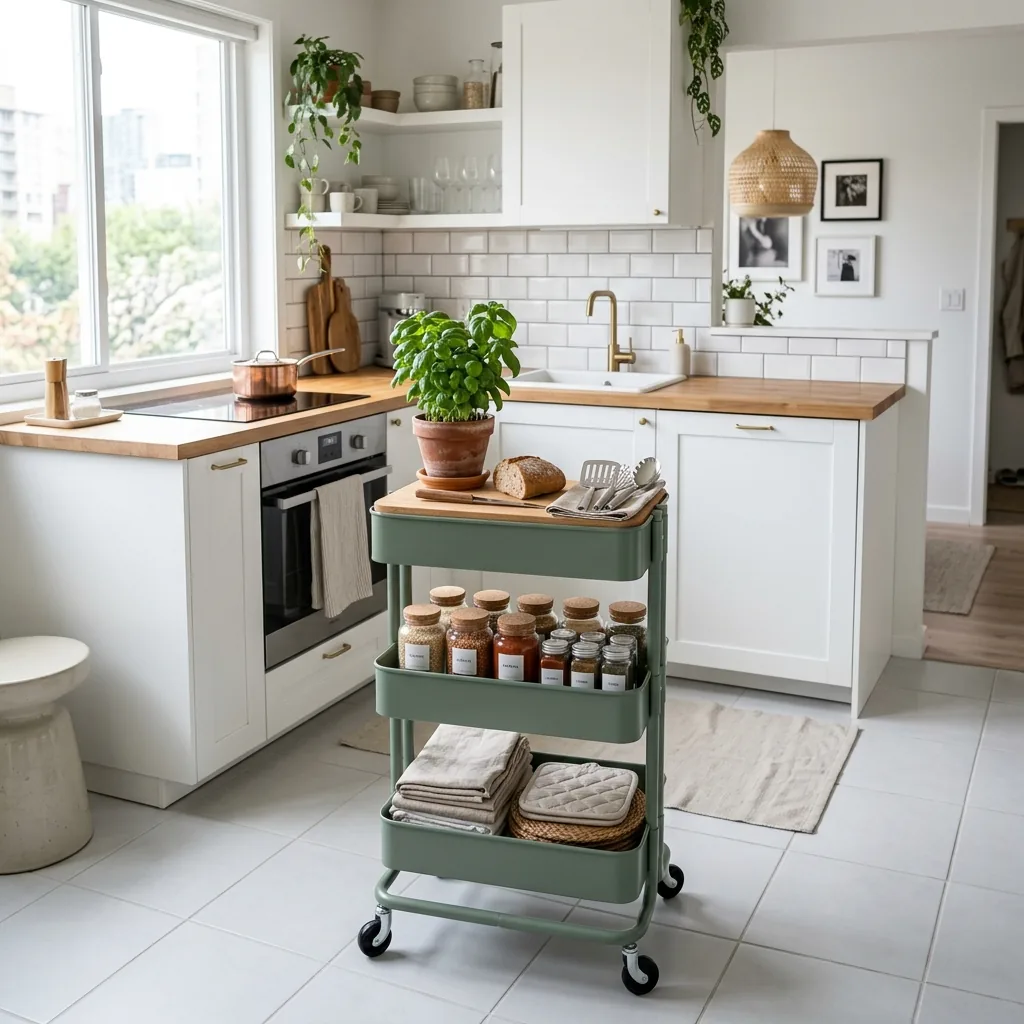
A portable kitchen island for renters solves a specific problem: you need more counter space, more storage, or both, and you cannot alter the kitchen in any permanent way. No drilling into cabinets, no moving the sink, no modifying the countertop. The entire addition needs to roll in, function, and roll out when you leave.
The difference between a portable kitchen island and a fixed one is not just the wheels. It’s the mindset: a portable island earns its floor space every day, or it rolls into the corner until you need it.
Table of Contents
- What to Look for in a Renter-Portable Island
- 5 Best Portable Kitchen Islands for Renters
- How to Use a Rolling Island in a Rental Kitchen
- My Experience: 18 Months with Rolling Islands in a Rental
- FAQ
What to Look for in a Renter-Portable Island
Wheels with locks. The entire point is mobility. You need locking casters to keep the island stationary during prep, and smooth-roll casters to move it when you’re hosting. Both non-locking and locking casters need to coexist — typically two locking front casters and two free-rolling rear casters.
Under 36 inches wide. Above 36 inches, a rolling island stops helping and starts blocking the traffic path in a rental kitchen. The sweet spot for most rental kitchens is 28–34 inches wide — wide enough to prep on, narrow enough to push flat against a wall.
No assembly that modifies the kitchen. This sounds obvious. It isn’t. Some “portable” carts come with a mounting bracket that attaches to the side of a cabinet. That’s not portable — it leaves holes. Everything on this list free-stands.
Enclosed storage. In a rental kitchen where the kitchen is visible from the rest of the apartment, open shelving exposes clutter. Closed cabinet doors are significantly better than open shelves for the visual clarity that matters in a small space.
5 Best Portable Kitchen Islands for Renters
1. Winsome Wood Inglewood — Best All-Around Under $100
$85–$100 | 32×18×36 inches | Butcher block top | 4 locking casters
The Inglewood has been the benchmark renter-friendly rolling cart for several years because it hits every constraint: 32 inches wide (fits narrow kitchens), standard counter height (36 inches), butcher block top that handles prep, and locking casters on all four corners.
The open bottom shelves hold bulky items — a stand mixer, a pasta maker, pots. The footprint when pushed against a wall is 18 inches deep — about the depth of a standard refrigerator. It disappears into a kitchen lineup.
Assembly requires re-tightening screws after the first month as the wood adjusts to kitchen humidity. After that, it’s stable. At $85–$100, it’s the best first portable island for most rental kitchens.
2. Sauder HomePlus Storage Cart — Best Closed Storage
$120–$150 | 29.5×20×35.5 inches | Laminate top | 4 casters (no locks)
The Sauder HomePlus has two closed cabinet doors and an interior shelf — more storage volume than it looks from photos. The laminate top is more water-resistant and easier to clean than butcher block. Dimensions: 29.5×20×35.5 inches.
The weakness: the casters don’t lock. On a flat floor, it stays put. On a slightly sloped floor — common in older buildings — it drifts. Worth noting if you have hardwood or tile floors that aren’t perfectly level.
For a rental kitchen where you want the island to look like furniture rather than a cart, the closed-door design is significantly better than open shelving.
3. Costway Stainless Steel Rolling Cart — Best for Serious Cooking
$150–$180 | 30×20×35.5 inches | Stainless steel top | 2 locking casters
The Costway’s stainless steel top is the differentiator. Stainless handles direct heat from pans, resists cuts from prep work, cleans instantly, and never needs sealing or oiling. For anyone doing volume cooking in a small kitchen, this is the professional choice in the under-$200 range. Fit it into small apartment kitchen ideas.
The extra 2 inches of depth (20 inches vs the standard 18) makes a practical difference for two-handed work — kneading dough, rolling pastry, or anything that requires pressing down rather than slicing.
The drawer and two cabinet doors provide adequate enclosed storage. At $150–$180, it’s the premium option on this list — worth it specifically for the stainless top if you cook frequently.
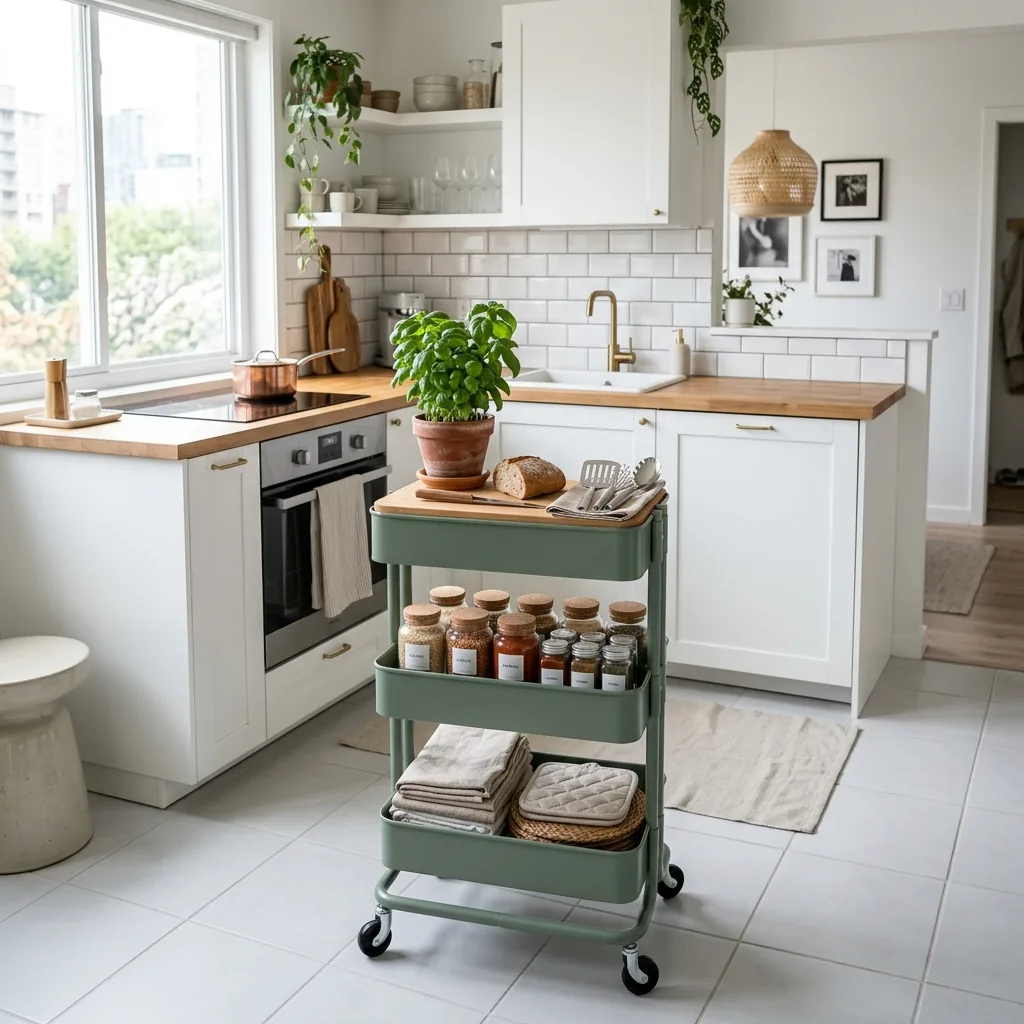
4. IKEA RÅSKOG (Modified) — Best Under $50 Solution
$30–$35 | 13.75×15.5×23 inches | Steel frame | 4 casters (no locks)
The RÅSKOG is not a kitchen island in the traditional sense — it’s 23 inches tall (below standard counter height) and 13.75×15.5 inches in footprint. But as a rolling prep station next to the stove — where you can prep standing at an angle — or as a supplemental trolley for a single task (coffee station, appliance stand), it’s the most useful $35 piece in any small kitchen.
Add a bamboo cutting board ($12) permanently on the top shelf and you have a functional low prep surface for under $50. Works best alongside a counter-height island, not as the primary island in a kitchen that needs counter space.
5. Butcher Block Top Rolling Island (Generic) — Best for Aesthetics on a Budget
$90–$130 | 30–34×18 inches | Butcher block top | Various caster configs
Several Amazon/Wayfair house brands sell a near-identical butcher block rolling island at $90–$130: 30–34 inches wide, 18 inches deep, drawer plus two lower shelves or cabinet doors, four casters with at least two locking.
The design is common enough that it blends into almost any kitchen aesthetic — light wood top, white or black cabinet body. Not the most distinctive piece, but for a rental you’re leaving in 12–18 months, “it looks fine and works correctly” is exactly right.
What to check before buying any generic version: caster lock quality (cheap plastic locks fail fast) and whether the drawer has a stop mechanism (drawers without stops fall out on a slope).
How to Use a Rolling Island in a Rental Kitchen
Daily position: perpendicular to your main counter run, forming an L-shape. Prep happens on the island (facing the room), plating and cooking happen on the main counter (facing the wall). This layout separates clean and dirty work zones without modifying anything.
Hosting mode: roll the island against the wall. A 32-inch-wide island pushed against the far wall opens up 32 inches of circulation space — enough for two people to move past each other without turning sideways.
Appliance parking: if your counter doesn’t have space for a toaster or coffee maker, park it on the island. The island becomes the appliance zone, keeping the main counter clear for prep. This is especially effective with a counter-height rolling island at 36 inches — appliances are at the right height to use without bending.
The full layout guide with more options across a wider budget range is in the renter-friendly kitchen islands guide for small apartments.
My Experience: 18 Months with Rolling Islands in a Rental
I’ve had the Winsome Inglewood for 18 months in a 38 sqm studio with a galley kitchen — 180 cm of counter between the sink and the stove. The island sits perpendicular to the counter run, creating an L-shape prep zone. Or a kitchen island for a studio apartment.
The thing that changed how I cook: I stopped using the main counter for prep and started using it only for the stove side of cooking. The island becomes the entire prep zone. Everything gets chopped, portioned, and arranged on the island, then moved to the stovetop. When I’m done prepping, I slide the cutting board to the lower shelf and the island becomes a serving surface.
What I didn’t expect to care about: the locking casters. I thought this was a checkbox feature. It’s not. Every time you apply any downward or sideways pressure — pressing on a knife, kneading dough — an unlocked island drifts. After two weeks of fighting drift, I understand why the locking casters matter more than the surface material for daily use.
One honest complaint: the butcher block top requires oiling every 2–3 months or it dries and develops surface cracks. I’ve missed this twice and had to sand light cracks. If you don’t want the maintenance, the stainless top (Costway) or the laminate top (Sauder) are lower maintenance in daily use.
