
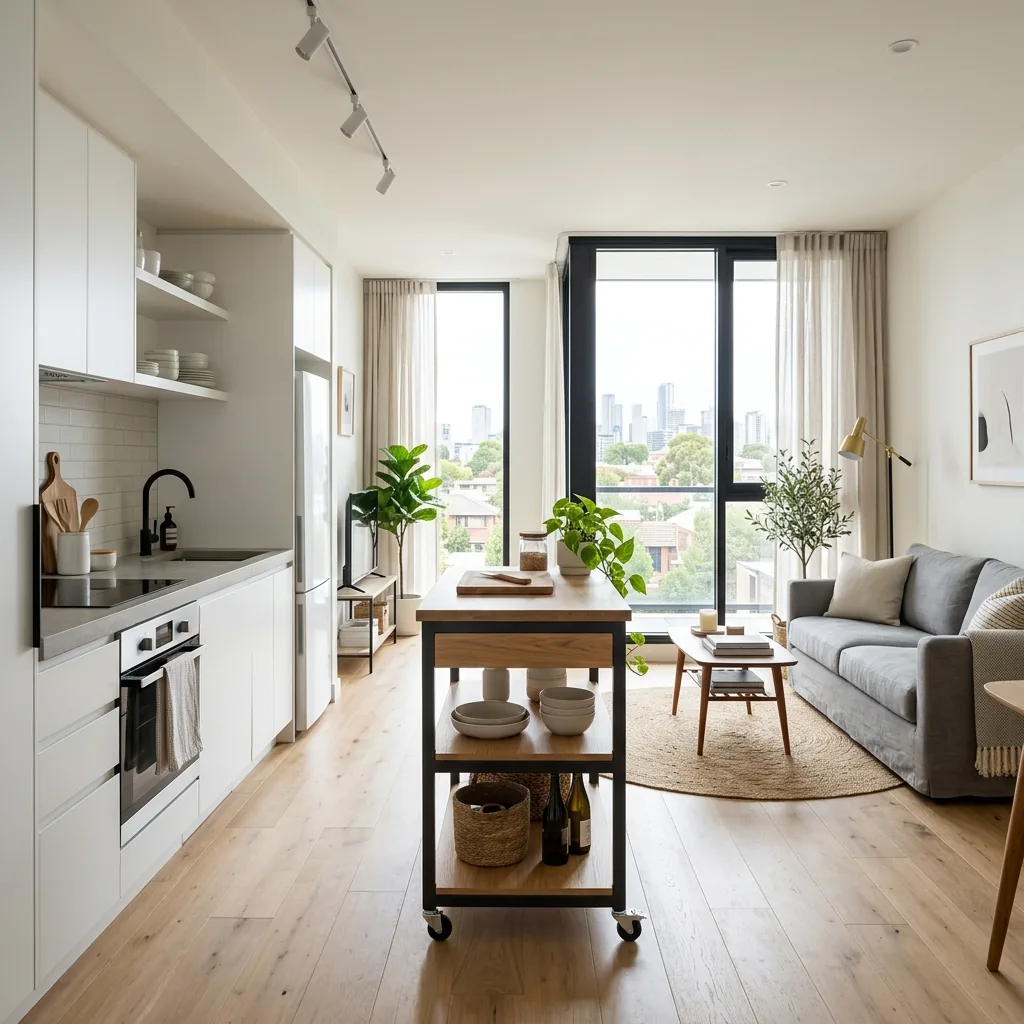
A kitchen island for a studio apartment has exactly one job: add counter space and storage without blocking the path from your bed to your bathroom. In a studio, the kitchen isn’t a separate room — it’s a corner of the room. That changes everything about what works.
The five picks below all cost under $200, measure under 36 inches wide (the threshold where an island stops helping and starts being an obstacle in a tight galley), and can be moved or disassembled when you leave — no drill marks, no landlord conversation. I’ve tested layouts with each of these in studios ranging from 25 to 45 square meters.
Table of Contents
- What Makes a Studio Kitchen Island Different
- The 5 Best Kitchen Islands for Studio Apartments Under $200
- How to Position a Kitchen Island in a Studio
- My Experience with Kitchen Islands in a Studio
- When NOT to Get an Island
- FAQ
What Makes a Studio Kitchen Island Different
In a dedicated kitchen, an island can be 36–48 inches wide and still leave plenty of circulation space on both sides. In a studio, the island sits between your kitchen zone and your living zone — usually between 4 and 8 feet of total width. The practical upper limit for a non-disruptive island in a studio is 30–34 inches wide and 18–22 inches deep.
Three other studio-specific requirements:
Wheels or easy mobility. You’ll want to push it aside when people visit, when you need to access the refrigerator from an odd angle, or when you rearrange your layout. Locking casters are non-negotiable.
Vertical storage. Counter space is the primary gain, but every cubic inch of storage underneath matters in a studio. Closed cabinet doors hide visual clutter better than open shelves in a one-room living situation.
Under $200. Studios typically mean entry-level rent budgets. A $400 Butcher Block Boos island that takes 6 hours to assemble is a poor fit for someone who might move in 18 months.
The 5 Best Kitchen Islands for Studio Apartments Under $200
1. IKEA RÅSKOG Cart (Modified) — Best Under $50
The RÅSKOG isn’t marketed as a kitchen island, but at 13.75 × 15.5 inches footprint with three shelves and four casters, it’s the most compact functional counter extension available at $30–$35. Use the top shelf for prep, the middle for frequently-used items, and the bottom for heavy items (oils, cans).
The catch: it’s only 23 inches high, well below standard counter height (36 inches). For standing prep work, this is uncomfortable. But as a rolling side table next to the stove or sink — with the top shelf at elbow height when seated — it works extremely well in a 20–25 sqm studio where a full island would be an obstacle.
Add a bamboo cutting board ($12) as a permanent top layer and you have a functional prep surface for under $50 total.
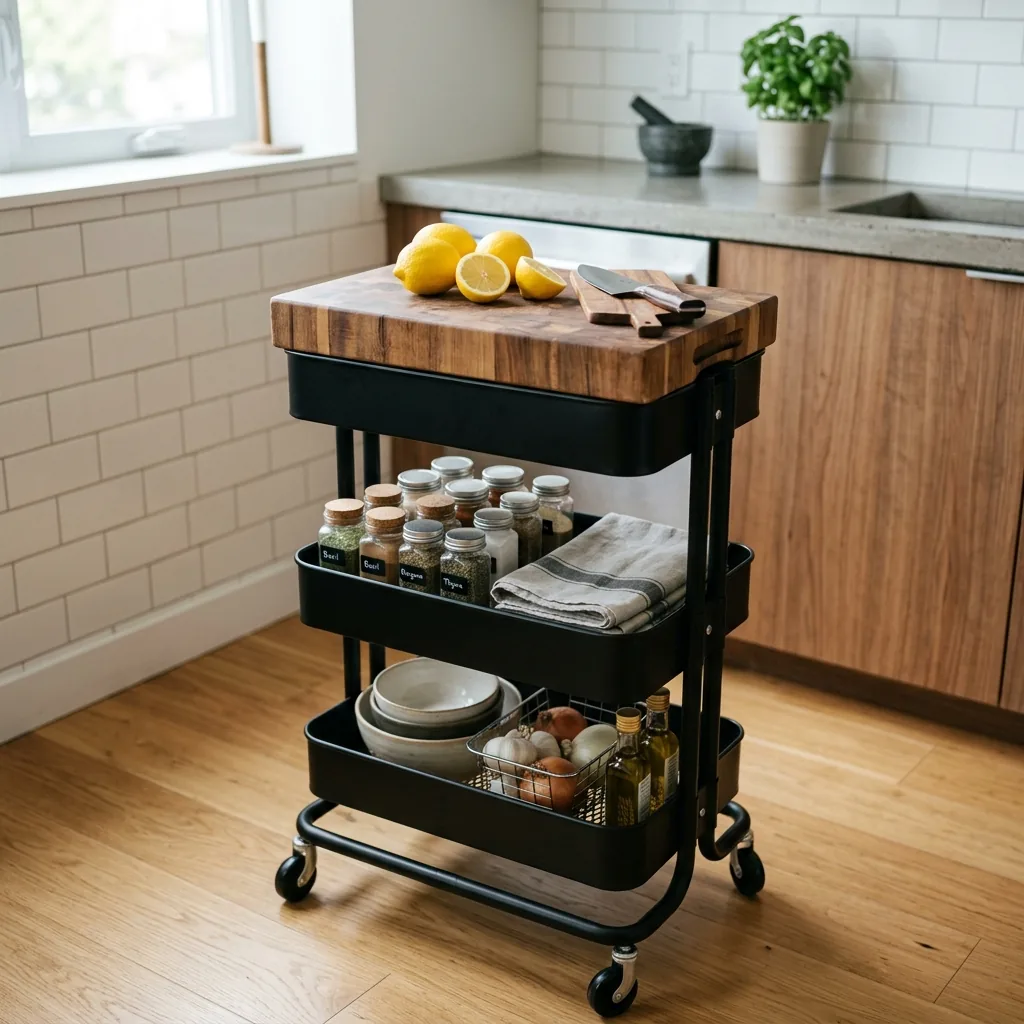
2. Winsome Wood Inglewood Kitchen Cart — Best True Island Under $100
At $85–$95 on Amazon, the Inglewood is a 32 × 18 × 36-inch wooden cart with a butcher block top, two bottom shelves, and four rolling casters with locks. It matches standard counter height, has enough depth to use as a prep surface, and fits tight kitchens without dominating the visual field.
The width (32 inches) is the sweet spot for studios — wide enough to be genuinely useful, narrow enough to push flat against the wall when not in use. The open shelving below is less storage-dense than a closed cabinet but makes the piece feel lighter visually.
One note: the assembly screws require re-tightening after the first month of use — the wood seat slightly under normal kitchen humidity before stabilizing.
3. Sauder HomeBase Storage Cart — Best Closed-Storage Option
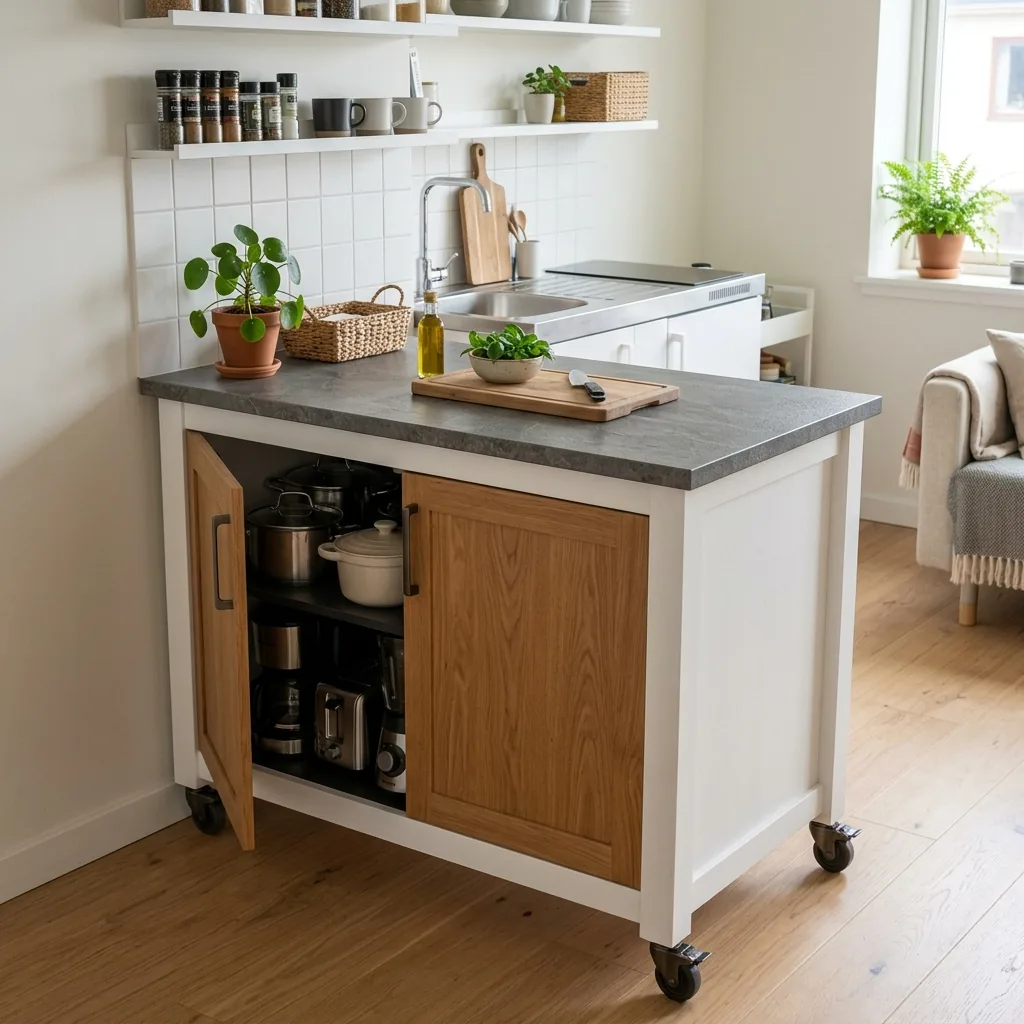
If visual clutter is your primary concern (it usually is in a studio), the Sauder HomeBase at $120–$140 offers two closed cabinet doors beneath a laminate top. Dimensions: 27.5 × 18 × 35.5 inches. It has four rolling casters but they’re smooth-roll rather than locking — worth noting if you have hardwood floors that slope.
The closed doors make this feel more like furniture and less like a kitchen cart. In an open-plan studio where the kitchen is visible from the bed, that matters. The laminate surface is more water-resistant than solid wood and easier to clean after prep.
Storage capacity is better than it looks from photos — two full shelves behind the doors hold a stand mixer, three cutting boards, and a pot, with room left.
4. Costway Rolling Kitchen Island Cart — Best Heavy-Duty Pick
At $150–$170, the Costway cart offers stainless steel top, two locking casters, two non-locking front casters, and a drawer plus two cabinet doors. Dimensions: 30 × 20 × 35.5 inches.
The stainless top is the main differentiator — it handles heat, cuts (use a board though), and moisture without any surface treatment. For anyone who does serious cooking in a small space, this is the most practical surface material. The extra 2-inch depth (20 inches vs the usual 18) makes it better for kneading, rolling, or prep that requires two-handed work.
Weight when assembled is 35–40 lbs — heavier than the wooden options but still manageable for repositioning by one person.
5. Homfa Kitchen Storage Cabinet with Wheels — Best Small Footprint
At $90–$110, the Homfa is notable for its 24 × 16-inch footprint — the narrowest true-function island on this list. It has three closed shelves, a drawer, and four locking casters. Height is 35.4 inches.
At 24 inches wide, this can genuinely be pushed into a kitchen corner and forgotten when not needed, then rolled out as a prep surface when cooking. In studios under 30 sqm where every square foot is contested, the compact footprint matters more than extra storage volume.
The laminate finish is basic but serviceable. Assembly takes about 45 minutes and the instructions, while not great, are decipherable.
How to Position a Kitchen Island in a Studio
The standard rule for kitchen islands — 42 inches of clearance on the working side, 36 inches on the non-working side — doesn’t apply in a studio because you don’t have that space. The practical minimum clearances for a compact studio island:
| Clearance | Minimum | Why |
|---|---|---|
| Between island and counter/stove | 36 inches (90 cm) | Need to open oven/fridge door fully |
| Between island and opposite wall | 30 inches (75 cm) | Minimum to walk sideways; 36 in is comfortable |
| Island width | 28–34 inches | Above 36 in starts blocking the studio’s visual flow |
The best position in most studios is perpendicular to the kitchen run, forming an L-shape with the counter — not extending the line of the counter (which just makes the kitchen longer without adding usable perimeter). This creates a prep zone that faces the room rather than the wall.
For more layouts, including how to connect the kitchen zone to the rest of your studio, see the full renter-friendly kitchen islands guide — it covers more options across a wider budget range.
My Experience with Kitchen Islands in a Studio
My studio in Chicago is 38 sqm, galley kitchen running along one wall — 180 cm of counter total between the sink and the stove, with the fridge on the end. Standard for a 2005-era mid-rise.
The problem wasn’t counter space exactly — it was the lack of any surface that didn’t have something permanently on it. The Winsome Inglewood was the first island I actually kept long-term. I’ve had it positioned perpendicular to the counter for 18 months, which creates an effective L-shaped work zone. Prep happens on the island, plating and hot items stay on the counter.
The thing that surprised me: the island changed the way the room felt more than the counter space itself. It created a visual break between the kitchen zone and the rest of the studio — almost like a room divider that also functions as storage. I hadn’t expected that.
What didn’t work: the IKEA RÅSKOG at full kitchen duty. The height is wrong for standing prep. It’s a brilliant supplemental trolley, not a primary island. I use one now just as a coffee station — kettle on top, beans and filters on the second shelf, cups on the bottom.
When NOT to Get an Island
A studio kitchen island is a net negative in two situations:
1. Your galley is under 6 feet (180 cm) wide. Below that threshold, even a 28-inch island leaves less than 30 inches of clearance on each side — fine to walk through, miserable to cook in.
2. You entertain frequently. An island creates a fixed obstacle between your kitchen and living area. If you regularly have 4+ people in your studio, the open floor plan is more valuable than the extra counter space. Get a fold-down wall shelf instead.
If you’re dealing specifically with seating as well as prep space, the renter-friendly kitchen island with seating guide covers models that work as both prep surface and breakfast bar in tight layouts.
FAQ
What size kitchen island works in a studio apartment?
Can you have a kitchen island in a studio apartment?
What is the cheapest kitchen island for a small apartment?
How do I add counter space to a studio apartment kitchen?
Do kitchen islands need to be installed permanently?
Safety Disclaimer
Check your building’s floor load capacity before adding heavy kitchen equipment. A fully-loaded kitchen cart with dense storage can weigh 60–100 lbs — negligible for most floors, but worth noting in older buildings with wood-frame construction.
