
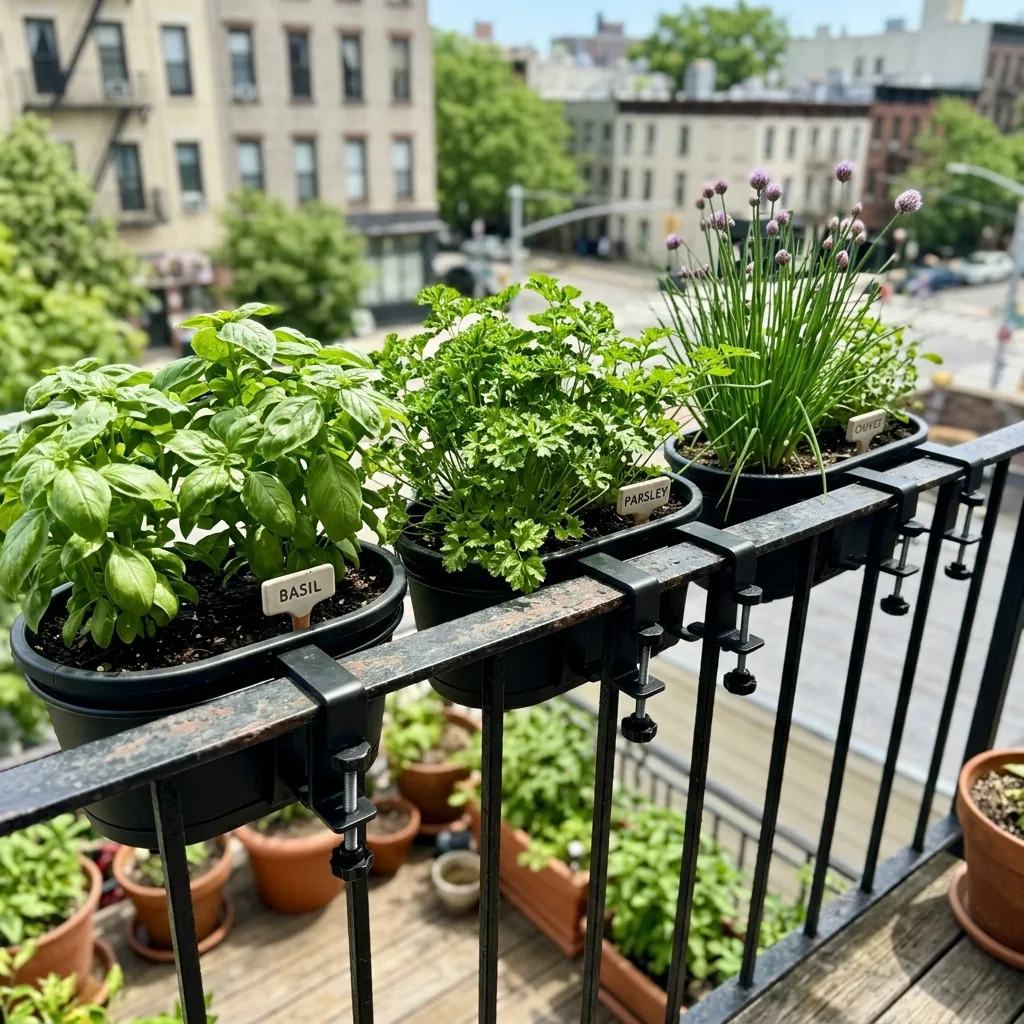
The best herbs for a balcony depend on one thing before anything else: how many hours of direct sun does your balcony get daily? Not estimated sun. Actual direct sun from when the sun hits the railing to when it clears the building above. That number determines 80% of what you can and cannot grow. It also helps to know the average apartment balcony size before you buy pots, so nothing overwhelms the floor. For the full setup beyond which herbs to pick, see our complete balcony herb garden guide.
I’ve killed enough basil by planting it on the wrong balcony to have opinions about this.
Table of Contents
- Sun Hours: The Only Number That Matters
- Best Herbs by Sun Exposure
- Best Herbs by Container Size
- Wind-Tolerant vs Wind-Sensitive Herbs
- Seasonal Schedule
- FAQ
Sun Hours: The Only Number That Matters
Before buying a single plant, measure your actual daily sun:
- Full sun: 6+ hours direct sun daily → basil, rosemary, thyme, oregano, sage, chili
- Partial sun: 3–6 hours → parsley, cilantro, mint, chives, lemon balm
- Shade/low light: under 3 hours → chives, mint (in containers — both spread aggressively in open soil)
How to measure: sit on your balcony with a notebook. Write down the time the sun first hits the floor of the balcony and the time it disappears behind the building above. That’s your window. Subtract any periods when a neighboring building, overhang, or tree blocks direct light during that window.
Reality check by orientation: – South-facing balcony: 6–9 hours in summer, 3–5 hours in winter → full-sun herbs work – West-facing: 4–6 hours of afternoon sun → basil works with effort, rosemary thrives – East-facing: 3–5 hours of morning sun → parsley, chives, cilantro; basil struggles – North-facing: under 2 hours → mint and chives only; most herbs fail
Best Herbs by Sun Exposure
Full Sun (6+ hours): The High-Performance Balcony Herbs
Basil is the most useful culinary herb if you have the sun for it. Mediterranean cooking’s backbone herb. Grows fast, needs consistent moisture (wilts visibly if stressed by heat or underwatering), and hates wind on the leaves. Grow it in a 6–8-inch pot in the most sheltered full-sun spot you have. In a good summer on a south-facing balcony, one basil plant produces more than a solo cook can use.
Rosemary is the most drought-tolerant herb in this list. It evolved on Mediterranean hillsides and actively prefers dry, poor soil. In containers, the main killer is overwatering — terracotta pots that breathe reduce root rot risk. Rosemary grows slowly but lives for years in the right conditions. In Chicago I’ve had the same rosemary plant in a 10-inch terracotta pot for three seasons now. It pairs well with the other drought-tolerant balcony plants if you tend to forget watering.
Thyme has the best effort-to-reward ratio of any balcony herb. It’s compact (stays under 10 inches tall), extremely drought-tolerant, handles wind, and regrows vigorously after cutting. A 6-inch pot of thyme survives neglect that would kill basil in 48 hours. Cook with it constantly — frequent harvesting actually encourages bushier growth.
Oregano is similar to thyme — compact, drought-tolerant, wind-resistant. Greek oregano is stronger in flavor than standard Italian oregano; both work in containers. Spreads aggressively in the ground but stays contained in pots.
Sage grows large (needs a 10-inch or larger pot for a productive plant) and has woody stems after the first season. The payoff is that established sage is essentially unkillable — it handles summer heat, survives drought, and regrows after hard cutting.
Partial Sun (3–6 hours): The Reliable Mid-Range
Chives are the most forgiving herb in this whole list. They grow in almost any soil, handle partial shade, tolerate brief drought, come back from the dead after a hard winter, and self-propagate. A single 4-inch pot of chives will produce harvestable growth within two weeks of planting. Cut them to an inch above the soil; they regrow in a week. If you have 3+ hours of sun, you can grow chives. Once any of these get going, our notes on harvesting and storing your herbs help you use the surplus.
Parsley is a biennial (grows for two years) that tolerates partial sun better than most guides acknowledge. On a 4-hour east-facing balcony, parsley grows slowly but steadily. It needs more water than thyme or oregano, and it bolts (goes to seed and becomes bitter) in its second year. Start fresh seeds or a new nursery start every spring.
Cilantro is fast-growing and short-lived — it bolts in 6–8 weeks in hot weather, which is why grocery store bunches go stale. On a balcony, the solution is successive planting: one pot every 3 weeks rather than one large harvest. In partial shade, cilantro bolts slower than in full sun.
Mint deserves special mention. Mint grows in almost any condition, spreads aggressively, and is nearly impossible to kill. The problem is that it will take over any container it shares with other plants. Always plant mint alone. A single 8-inch pot of mint will produce more mint than most households use in a summer.
Lemon balm (Melissa officinalis) is underused on balconies — it grows in partial shade, handles wet soil, and makes a genuinely excellent tea. It’s in the mint family so it spreads, but it’s slower than mint and more controllable. On a shadier balcony you can push further into shade-tolerant vegetables too.
Low Light (under 3 hours)
If your balcony gets fewer than 3 hours of direct sun, your realistic options are:
- Chives — the single most shade-tolerant culinary herb
- Mint — grows in almost any light condition, though flavor is less intense in shade
- Vietnamese coriander (Persicaria odorata) — similar flavor to cilantro, more shade-tolerant
Everything else is likely to disappoint. Consider using your window sills for a supplemental herb garden in mason jars under a grow light, and using the balcony for planters that don’t require culinary production.
Best Herbs by Container Size
| Herb | Minimum Pot Depth | Minimum Diameter | Notes |
|---|---|---|---|
| Chives | 4 inches | 4 inches | Very small — fits any window box |
| Thyme | 4 inches | 6 inches | Shallow roots, compact habit |
| Oregano | 4 inches | 6 inches | Same as thyme |
| Cilantro | 6 inches | 6 inches | Taproot needs depth |
| Basil | 6 inches | 8 inches | Needs room to grow bushy |
| Parsley | 8 inches | 8 inches | Taproot |
| Mint | 6 inches | 10 inches | Contained by the pot |
| Rosemary | 10 inches | 10 inches | Growing woody, needs stability |
| Sage | 12 inches | 12 inches | Mature plant is substantial |
For a railing hook setup on a balcony, chives, thyme, and oregano fit in the smallest pots and tolerate the wind and weight constraints of hanging planters best. Save the larger pots (basil, rosemary, sage) for a freestanding surface where you can use heavier terracotta. Hook-on planters avoid drilling altogether, which fits the wider constraints covered in the guide to balcony gardening for renters.
Wind-Tolerant vs Wind-Sensitive Herbs
Wind dries soil faster, tears large-leaved plants, and can uproot seedlings. On an exposed high-rise balcony (floor 5+, with open exposure on multiple sides), wind management matters as much as sun. On an exposed floor, wind protection screens make a bigger difference than any plant choice.
Wind-tolerant: thyme, oregano, chives, rosemary, sage. Small leaves, low growth habit, handle desiccation well.
Wind-sensitive: basil (large leaves tear and wilt), cilantro (tall and top-heavy when bolting), mint (recovers quickly but wilts dramatically).
For wind-sensitive herbs on an exposed balcony: position them against the wall, not the railing. The railing itself creates a wind shadow on the interior side — use it. A 5×8 ft balcony has a wind-shadow zone roughly 2 feet deep from the railing going inward. That’s where basil lives.
Seasonal Schedule
| Month | Action |
|---|---|
| March | Start basil seeds indoors; buy chive/parsley nursery starts |
| April | Move chives and parsley outside once nights are above 40°F |
| May | Move basil outside after last frost; plant full garden |
| June–August | Harvest weekly; keep basil pinched to prevent bolting |
| September | Harvest heavy; bring basil indoors before first frost (below 50°F at night) |
| October | Let chives, thyme, oregano, sage stay outside — they tolerate light frost |
| November–March | Overwinter rosemary, thyme, sage in protected spot or windowsill |
Basil is the most cold-sensitive herb — bring it in when overnight temperatures drop below 50°F (10°C). Everything else in this list handles light frost.
