
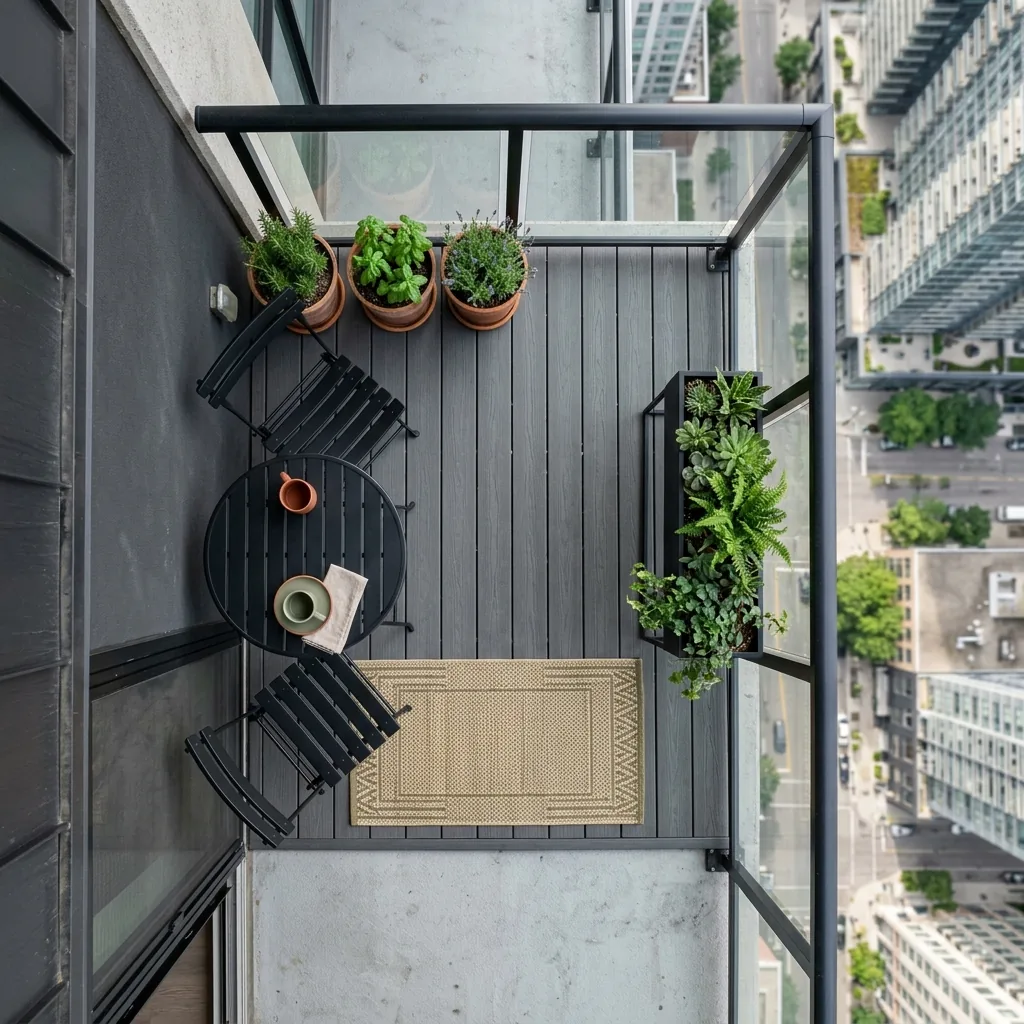
The average apartment balcony size in the US is 5 feet deep by 8 feet wide (40 sq ft). That’s the standard you’ll find in most mid-rise and high-rise residential buildings constructed after 1990. Older buildings and urban infill projects often run smaller — 3×6 ft (18 sq ft) Juliet-style balconies are common in cities like New York and Chicago. Larger suburban complexes sometimes offer 6×12 ft (72 sq ft) or more.
Knowing your exact dimensions matters for two reasons: buying furniture that fits without becoming a hazard, and staying within your building’s weight limit — which for a typical reinforced concrete balcony is 40–60 lbs per square foot.
Table of Contents
- Standard Balcony Dimensions by Building Type
- How to Measure Your Balcony Correctly
- What Fits on Each Size Balcony
- Balcony Size vs Weight Limit: The Calculation That Actually Matters
- Our Experience Planning a Small Balcony Around Real Dimensions
- Balcony Size by Country: US vs UK vs Europe
- FAQ
Standard Balcony Dimensions by Building Type
Not all apartment balconies are built the same. Depth and width vary significantly based on when and where the building was constructed.
| Building Type | Typical Depth | Typical Width | Total Area |
|---|---|---|---|
| Urban high-rise (post-1990) | 5 ft (1.5m) | 8–10 ft (2.4–3m) | 40–50 sq ft |
| Juliet / French balcony | 1–2 ft (0.3–0.6m) | 4–6 ft (1.2–1.8m) | 4–12 sq ft |
| Mid-rise suburban (post-2000) | 6 ft (1.8m) | 10–12 ft (3–3.6m) | 60–72 sq ft |
| Older urban walk-up (pre-1970) | 3–4 ft (0.9–1.2m) | 5–8 ft (1.5–2.4m) | 15–32 sq ft |
| Luxury/penthouse | 8–12 ft (2.4–3.6m) | 12–20 ft (3.6–6m) | 96–240 sq ft |
| Wrap-around balcony | Varies | Varies | 150–400 sq ft |
Depth is the critical measurement. A balcony that is only 3 feet deep cannot accommodate a standard bistro chair with a person sitting in it — you need a minimum of 4 feet to pull a chair out and sit comfortably without the back legs hitting the railing. At 5 feet, you can fit a small table and two chairs with space to walk behind. At 6 feet+, you have genuine outdoor living space.
Width determines how many seating arrangements you can fit side by side, but depth determines whether you can actually use them.
How to Measure Your Balcony Correctly
Measuring sounds obvious, but there are four numbers you actually need:
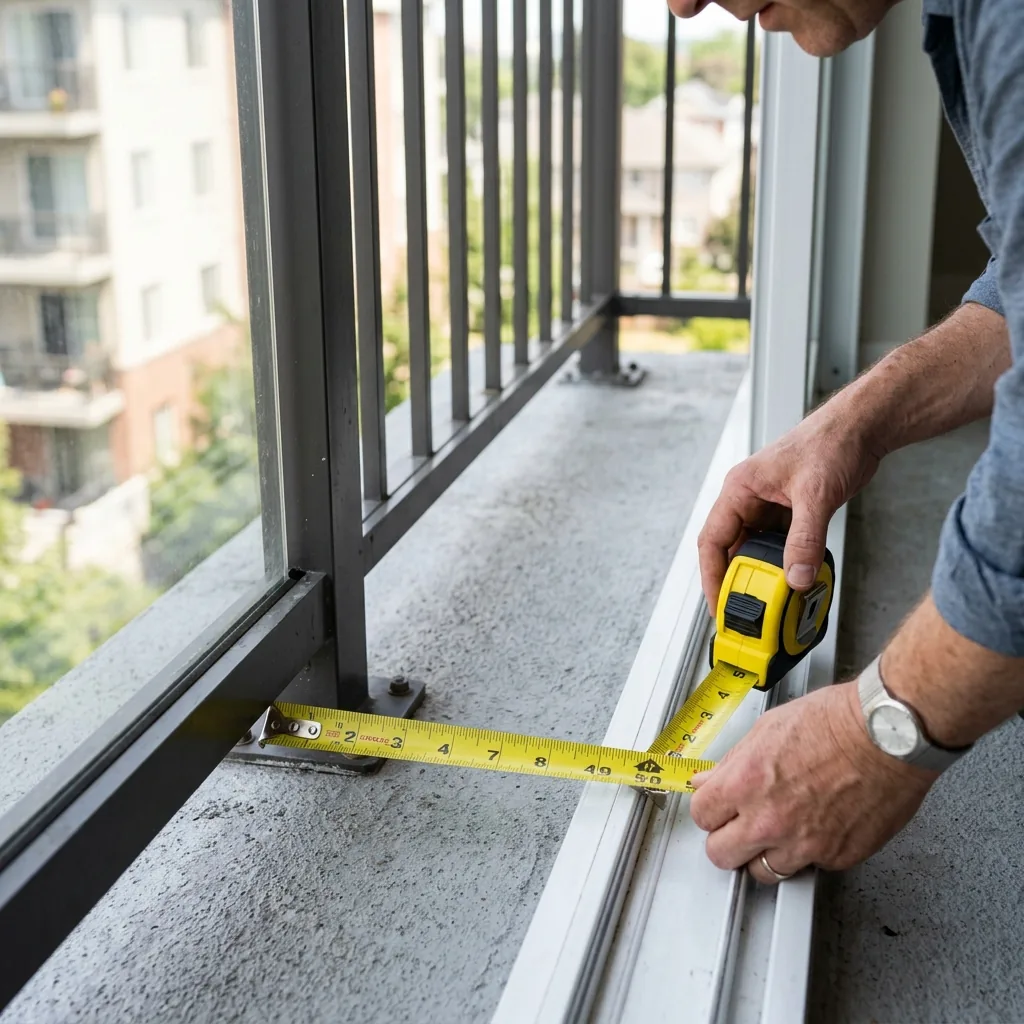
1. Usable depth — measure from the interior wall (or door threshold) to the inside face of the railing. Not the outside edge. The railing itself takes 4–6 inches, and many balconies have a structural lip or drain channel that eats another inch or two.
2. Usable width — measure between the two side walls or the side railing posts, not the outer face. If you have corner support columns, measure the clear span between them.
3. Clear height — measure from floor to the underside of the balcony above (if applicable). Most buildings have 8–9 ft between floors. This matters for tall planters, vertical gardens, and any overhead structures.
4. Door swing clearance — measure how far your balcony door swings outward when fully open. On a 5-ft deep balcony, an outward-swinging door eats 18–24 inches of your usable depth while open. This affects where you position furniture permanently.
Write these four numbers down before buying any furniture. A bistro table listed as “24 inches wide” sounds small but combined with two chairs at 18 inches each you’re looking at 60 inches (5 ft) of width minimum just for that one piece of furniture.
What Fits on Each Size Balcony
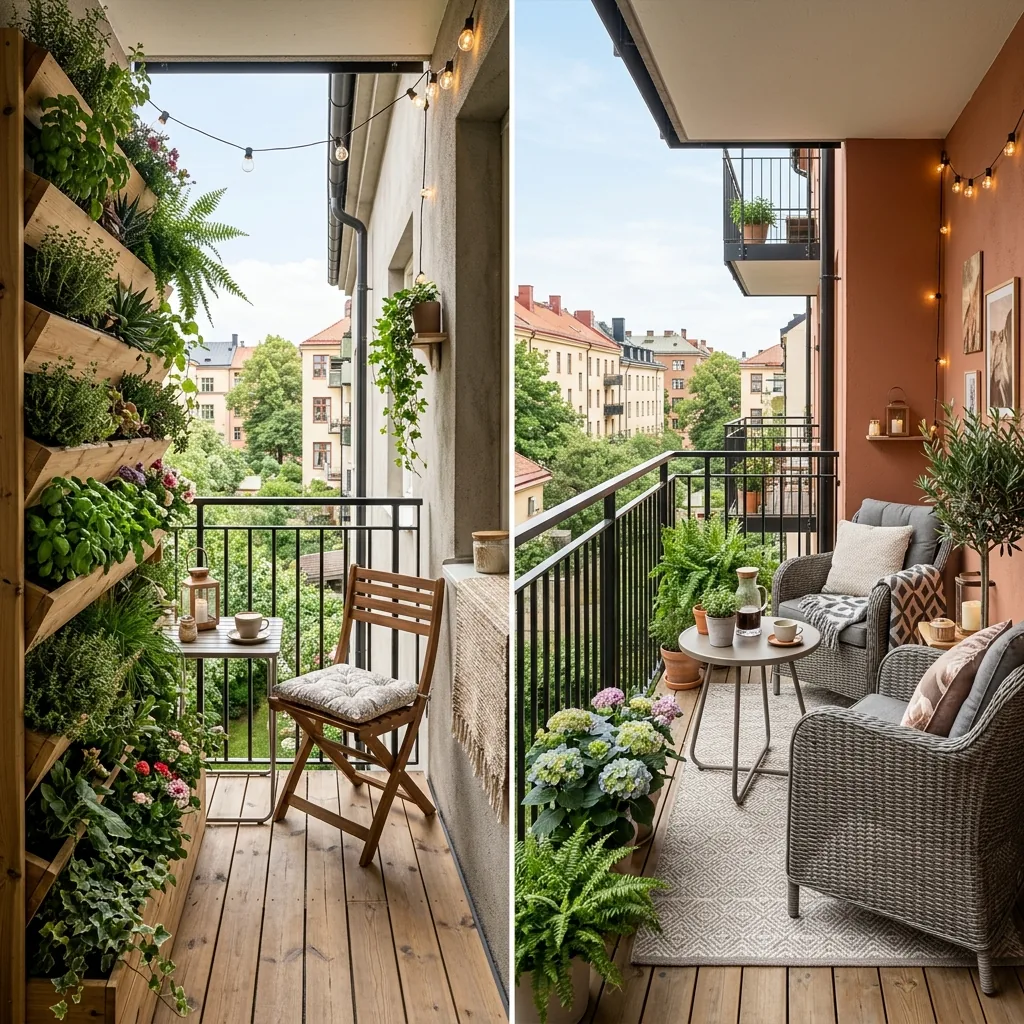
Micro balcony: under 30 sq ft (e.g., 3×8 ft or 4×6 ft)
The minimum viable outdoor space. What realistically fits: – 1 folding chair + small side table (16-inch round) – Wall-mounted planter rail with 4–6 herb pots – 1 vertical planter tower (12-inch footprint) – String lights along the railing
What does NOT fit: a two-person bistro set with chairs pulled out, a full-size sun lounger, any planter over 14 inches wide without significant clearance loss.
Small balcony: 30–50 sq ft (e.g., 5×8 ft)
The most common size in US urban apartments. What fits well: – Bistro set: 2 chairs + 24-inch round table (leaves walking clearance on both sides) – 3–4 railing planters (herb garden or flowers) – 1 medium planter (16–18 inch) in a corner – Compact storage bench with cushion (42-inch length)
What requires planning: a full herb garden setup needs vertical space — railing-mounted planters or a 3-tier shelf is the right approach. See the balcony herb garden complete guide for layouts that work in this size range.
Medium balcony: 50–80 sq ft (e.g., 6×10 ft)
This is where outdoor living becomes genuinely comfortable: – 4-person dining set (compact, 35-inch square table + 4 folding chairs) – OR loveseat + 2 chairs with a coffee table – Full railing herb garden + 2 large planters (20-inch) – Outdoor rug (5×7 ft fits with clearance) – Small grill (electric — check our balcony fire pit rules before buying any combustion device)
Large balcony: 80+ sq ft (e.g., 6×14 ft or 8×12 ft)
Full outdoor room. Standard outdoor furniture guidelines apply. The main constraint shifts from size to weight — a large balcony loaded with soil-filled planters, furniture, and people can approach structural limits faster than a small one simply because there’s more space to fill.
Balcony Size vs Weight Limit: The Calculation That Actually Matters
Square footage tells you what fits spatially. But the number that determines what’s actually safe is your balcony’s load capacity — typically expressed in pounds per square foot (psf).
Standard reinforced concrete residential balconies in the US are designed to 40–60 psf live load under the International Building Code. That means:
- A 40 sq ft balcony (micro) handles roughly 1,600–2,400 lbs total — including furniture, planters, people, and everything else on it simultaneously.
- A 60 sq ft balcony (standard) handles roughly 2,400–3,600 lbs.
This sounds like a lot until you account for wet soil. A single 20-inch planter filled with standard potting mix weighs 40–80 lbs depending on how wet it is. Six large planters alone can weigh 300–500 lbs. Add outdoor furniture (150–300 lbs), two adults (300–400 lbs), and you can hit 70–80% of the limit before you sit down.
The full calculation method — including how to find your specific building’s load rating — is covered in detail in the balcony weight limits guide for renters. If you’re planning a serious balcony garden setup, read that before buying planters.
Our Experience Planning a Small Balcony Around Real Dimensions
We’ve measured dozens of apartment balconies across different building types as part of testing furniture and planter setups for this site. The single most common mistake we see: people measure the total balcony footprint but forget to subtract the door swing, the railing thickness, and any AC unit or gas meter mounted on the exterior wall.
On a 5×8 ft balcony we tested in a 2008-built mid-rise: the outward-swinging door consumed 20 inches of depth while open, leaving a true working depth of 40 inches — just under the minimum to use a standard bistro chair without repositioning every time someone enters or exits. The solution that actually worked was a folding side table (22 inches when folded flat) kept against the wall, deployed only when sitting. The chairs were Fermob Luxembourg style stackers that sit flush to the railing when not in use.
On a 3×6 ft Chicago walk-up balcony, the usable depth after the door swing was 18 inches — barely a ledge. We gave up on seating entirely and converted it into a vertical herb wall using tension-mounted rod planters. That space now produces basil, mint, and chives year-round from a footprint that can’t fit a chair.
The lesson: measure first, subtract the door swing, then shop. Not the other way around.
Balcony Size by Country: US vs UK vs Europe
If you’ve rented internationally or are researching global standards:
| Country/Region | Typical Balcony Depth | Typical Width | Notes |
|---|---|---|---|
| United States | 4–6 ft (1.2–1.8m) | 8–12 ft (2.4–3.6m) | Varies widely by state/era |
| United Kingdom | 3–5 ft (0.9–1.5m) | 6–10 ft (1.8–3m) | Often narrower in London |
| France / Germany | 1.2–2m (4–6.5 ft) | 2–4m (6.5–13 ft) | Juliet balconies common in city centers |
| Spain / Italy | 1–2m (3–6.5 ft) | 2–5m (6.5–16 ft) | Mediterranean buildings often wider |
| Australia | 1.5–3m (5–10 ft) | 3–6m (10–20 ft) | Larger balconies standard in newer builds |
| Japan | 1–1.8m (3–6 ft) | 2–4m (6.5–13 ft) | Narrow; designed primarily for laundry |
European metric standard for a “usable” balcony is typically 1.5m deep — anything less is classified as a Juliet or false balcony in most building codes.
FAQ
What is the average apartment balcony size in the US?
What are standard balcony dimensions?
How do I measure my apartment balcony?
What can I fit on a small apartment balcony?
How much weight can a small apartment balcony hold?
What is the minimum balcony size for a table and chairs?
Safety Disclaimer
Balcony weight limits vary by building age, construction type, and local building code. The 40–60 psf figures cited here are standard design loads under the IBC and should not substitute for a structural assessment of your specific building. If you have concerns about load capacity, contact your building manager or a licensed structural engineer.
