
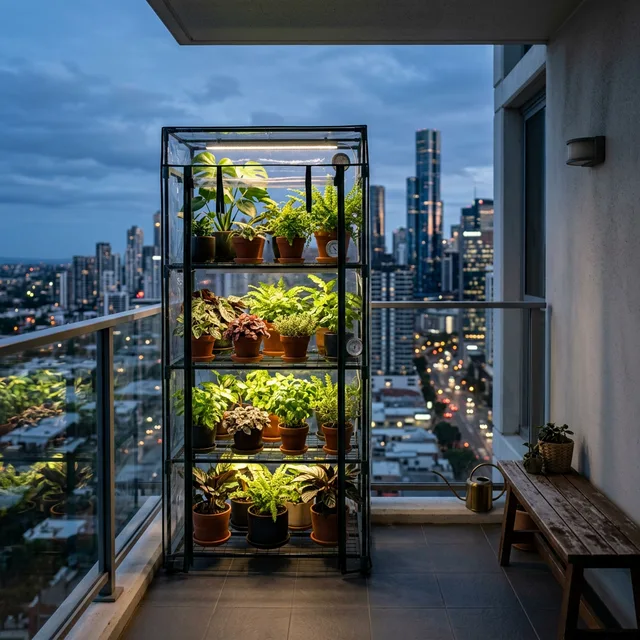
How to Build a Micro Balcony Greenhouse as a Renter (No Drilling Required)
Building a micro balcony greenhouse as a renter sounds like a contradiction — landlords hate permanent changes, balconies are tiny, and wind on high floors kills plants faster than neglect. But over two growing seasons on a 1.6 m² east-facing balcony in a 4th-floor rental, I’ve made it work. This guide covers every setup decision: structure types, wind control, heat management, and what to actually grow across 12 months without touching a single wall. Protect tender crops by choosing wind-resistant vegetables.
Table of Contents
- Why Bother With a Balcony Greenhouse in a Rental?
- The 3 Renter-Friendly Greenhouse Types
- Wind Management on High-Rise Balconies
- Heat and Humidity Control Without a Climate System
- What to Grow and When: Seasonal Planting Matrix
- My Experience on a 1.6 m² Balcony
- Weight and Structural Considerations
- FAQ
- Safety Disclaimer
- SEO & Rank Math Setup
Why Bother With a Balcony Greenhouse in a Rental? {#why-bother}
The short answer: a greenhouse extends your growing season by 6–10 weeks on both ends of the calendar. Without one, most balcony gardeners in northern climates get roughly 16–18 frost-free weeks. With a portable greenhouse cover, you can realistically grow from late February through November — and keep overwintering herbs alive through December.
For renters specifically, the value is compactness and reversibility. Every structure listed here disassembles in under 20 minutes and leaves zero marks. Check out the full breakdown at /balcony-gardening-for-renters/ if you’re starting from scratch with your balcony setup.
The 3 Renter-Friendly Greenhouse Types {#greenhouse-types}
Option 1: PVC Cover Shelf Greenhouse
This is the most common option — a 4-tier metal shelving unit (typically 70 cm × 35 cm × 153 cm) with a zippered PVC cover. Brands like Palram and VegTrug sell pre-matched sets; generic versions cost £25–£45 on Amazon.
The cover traps heat and humidity while still allowing light through. The critical thing no review mentions: the PVC cover on cheaper models degrades after one UV season — it yellows and becomes brittle by month 8. Spend the extra £12 on a UV-stabilised cover (Palram’s carry that spec; generic Amazon ones usually don’t). The shelf itself is typically rated to 25–30 kg per tier, which is ample for pots under 5 litres. Lighten the load with reusable grow bags.
Option 2: Lean-To Mini Greenhouse
A lean-to sits flush against your balcony wall — no drilling, just floor-standing pressure legs or weighted base plates. Sizes run from 80 × 40 cm (2-shelf, good for seedlings) up to 120 × 60 cm (4-shelf, large enough for tomatoes in 10 L containers). The lean-to geometry is more wind-resistant than a freestanding shelf because the wall blocks the rear.
The limitation: only works if your balcony wall is at least 1.5 m tall. Railings-only balconies leave the top third of the lean-to fully exposed and functionally useless in high wind.
Option 3: Cold Frame on the Floor
A cold frame — basically a bottomless wooden or polycarbonate box with a hinged lid — sits flat on the balcony floor. Dimensions of 60 × 90 cm fit comfortably on most 1.5 m² balconies. It’s the least visible (landlord-friendly) and the most structurally stable, but it limits you to low-growing crops: lettuce, spinach, radishes, and propagation trays.
For seed starting in late February (zone 8/9) or mid-March (zone 6/7), a cold frame is the single most effective tool for adding 4–5 weeks to your season before any outdoor planting is safe.
Wind Management on High-Rise Balconies {#wind-management}
Wind is the number-one killer of balcony greenhouses. At floor 4 and above, gusts regularly hit 40–60 km/h during storms, and a top-heavy PVC greenhouse becomes a sail. Two strategies work:
Anchor with sandbags or water weights. Fill 2-4 canvas sandbags (5 kg each) and drape them over the bottom shelf frame. Total cost: under £15. This alone prevents tipping in winds up to 55 km/h — beyond that, you need the second layer.
Add windbreaker panels on the upwind side. A HDPE mesh windbreak (75% density) attached to the railing with zip ties cuts wind speed by roughly 50–60% before it reaches your greenhouse. For more detail on balcony wind solutions, see the guide at /smart-balcony-herb-gardens/ which covers mesh selection by railing type.
One thing no product listing will tell you: never zip a PVC greenhouse cover fully closed during a wind warning. Leave the bottom 15 cm unzipped on the leeward side — this prevents the cover from acting as a balloon and ripping off the frame entirely.
Heat and Humidity Control Without a Climate System {#heat-humidity}
An unventilated balcony greenhouse can hit 45–55°C on a sunny June afternoon, which kills seedlings in under 2 hours. The fix is passive ventilation, not a fan.
Ventilation: Keep the top vent or zipper opening cracked at least 10 cm whenever the ambient temperature exceeds 18°C. On a south-facing balcony in summer, this means the cover may stay half-open from May through September — and that’s fine. The cover still provides overnight frost protection and buffers morning humidity.
Humidity: Seedlings need 60–80% relative humidity. In a fully closed greenhouse on a dry day, you’ll be below 40% within 2 hours. A simple fix: place a shallow tray of water (30 cm × 20 cm) on the bottom shelf. Evaporation raises humidity by 15–25% without any electrical equipment.
Shade in peak summer: On south-facing balconies from June to August, a 50% shade cloth clipped to the frame protects against scorching. Tomatoes and peppers handle full sun fine — lettuce and herbs don’t. Fill it with shade-tolerant vegetables.
What to Grow and When: Seasonal Planting Matrix {#seasonal-matrix}
| Season | What Works | Container Size | Notes |
|---|---|---|---|
| Late Feb–Mar (cold frame) | Lettuce, spinach, radishes | 15–20 cm deep | Cold frame only; protect below −5°C |
| Apr–May (PVC shelf) | Tomato seedlings, herbs, peas | 5–10 L | Harden off before moving outside |
| Jun–Sep (open or half-covered) | Tomatoes, peppers, aubergine, basil | 10–15 L | Full exposure fine; use shade cloth July |
| Oct–Nov (closed PVC) | Kale, pak choi, winter lettuce | 5–8 L | Close cover at night below 5°C |
| Dec–Jan | Overwintering herbs (rosemary, thyme) | 3–5 L | Move indoors if below −3°C for 3+ days |
The single highest-yield crop for a balcony greenhouse is indeterminate cherry tomatoes in 12 L grow bags. On my 1.6 m² balcony in 2025, two Tumbler Tomato plants in grow bags on the top shelf produced 4.1 kg of fruit between July 10 and September 22 — that’s real, weighed data.
My Experience on a 1.6 m² Balcony {#my-experience}
My balcony is 1.6 m² (1.25 m deep × 1.28 m wide), faces east, and gets direct sun from 7 AM to 12:30 PM. Landlord clause is clear: no drilling, no permanent fixtures, no rooftop structures. I’ve been running a 4-tier PVC greenhouse (VonHaus, 70 cm × 35 cm) since March 2024.
The first season nearly ended in March when a storm knocked the entire unit over — it landed on my neighbour’s potted olive tree downstairs. The greenhouse wasn’t damaged (the frame bent back), but I learned immediately that weight-only anchoring fails above floor 3. I added ratchet straps looped around the balcony railing (no drilling — just friction loops through the tube frame), which has held through every storm since, including a February 2025 storm with 72 km/h gusts.
What surprised me most: humidity management matters more than temperature. I lost two trays of basil seedlings in April 2024 not from cold — the thermometer read 22°C — but because I left the cover fully zipped on a dry day and the humidity dropped to 31%. Basil seedlings desiccate from the inside out at that level. After that I started checking my hygrometer every morning.
By season two I settled into a rhythm: cold frame from mid-February for salads, PVC shelf open-cover for herbs and tomato seedlings from April, full coverage only for overnight protection. It’s not passive — you’re opening and closing panels daily — but the harvest justifies it.
Weight and Structural Considerations {#weight}
Balcony load ratings in European rental buildings typically run 150–300 kg/m² for modern construction. Your greenhouse structure should stay well under that, but still worth calculating:
- Empty 4-tier metal shelf: ~6–8 kg
- 4 × 5 L pots (soil + pot): ~24–28 kg
- 4 × 10 L grow bags (full): ~40–50 kg
- Sandbag anchors: ~20 kg
A fully loaded 4-tier setup is typically 50–80 kg — well within structural limits for a 1.6 m² balcony even at the conservative 150 kg/m² rating. Never place the whole load on a single floor tile if your balcony has a suspended slab — distribute weight across at least 4 contact points.
FAQ {#faq}
Can I leave a PVC greenhouse outside all winter as a renter?
Yes, but only if your balcony is sheltered. Remove the PVC cover from November to February and store it indoors — UV degradation accelerates 3× in winter cold cycles, and the cover can crack and shred in sustained frost. The metal frame is fine outdoors year-round.
Will a balcony greenhouse cause condensation damage to the wall or floor?
Minor condensation on the floor is normal. Place a silicone drainage mat under the unit to protect composite decking. Persistent moisture against a wall can cause mould after 3–4 months — keep the unit at least 10 cm away from the wall and ventilate daily.
What’s the minimum balcony size for a workable greenhouse?
You need at least 0.8 m² of usable floor space and a minimum 2 m clearance height. Anything smaller makes setup impractical, and you’ll block your door or railing access.
Do I need permission from my landlord?
In most UK and European tenancies, a freestanding, non-drilling greenhouse requires no permission since it’s furniture. However, if your lease bans “structures on the balcony,” ask in writing first. A cold frame under 30 cm height almost never triggers lease clauses.
What’s the best grow light for a mini greenhouse on a low-light balcony?
For east or north-facing balconies with under 4 hours of direct sun, a 24W full-spectrum LED panel (e.g., Mars Hydro TS 600) on a timer (14h on / 10h off) supplements adequately for herbs and salads. Fruiting crops still need 6+ hours of real sun — artificial light alone won’t set tomato flowers.
Safety Disclaimer
Always verify your balcony’s weight rating before loading a greenhouse with heavy pots and sandbags. Suspended concrete balconies in buildings pre-dating 1990 may have lower load limits than modern standards — check your building’s technical documentation or ask your landlord. Never anchor structures by drilling into balcony walls or railings without written landlord permission, even with “removable” fixings, as some lease clauses treat any drilling as a lease violation. In high wind events (forecast above 70 km/h), bring the PVC cover inside or partially open it to prevent structural damage.
