
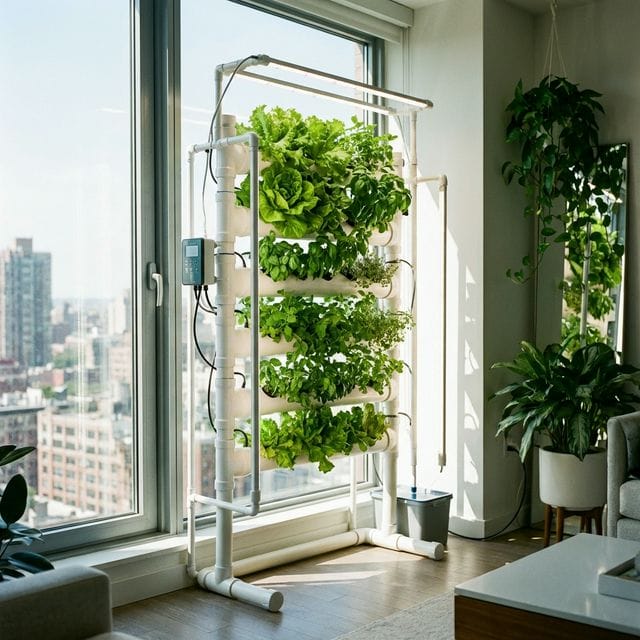
The biggest challenge in a small apartment isn’t a lack of desire to grow food; it’s a lack of horizontal surface area. Your counters are full of appliances, and your floors belong to your furniture.
If you want to grow a significant amount of food, you have to look up.
Vertical gardening DIY projects allow you to stack your garden toward the ceiling, utilizing the “wasted” air space in front of your windows. The most efficient, clean, and productive vertical system for an urban dweller is the PVC Pipe Lettuce Tower. This single 4-foot tower can hold up to 20 heads of lettuce while taking up less than one square foot of floor space. Or a vertical garden wall.
Here is how to build your own high-yield tower for under $50.
The Materials List
You can find all these items at any local hardware store.
- 4-inch PVC Pipe: A 4-foot or 5-foot section (ensure it is “Food Grade” or NSF certified).
- PVC End Cap: One 4-inch cap for the bottom.
- Large Bucket or Pot: This will act as the base/reservoir to keep the tower upright.
- Electric Drill & 2-inch Hole Saw Bit: For cutting the planting pockets.
- Heat Gun or Blowtorch: To soften the PVC for shaping.
- Potting Mix or Coco Coir: To fill the tower.
- Peper or Plastic Water Bottle: To create a “stamping” tool for the pockets.
Step-by-Step Construction
1. Marking the Pockets
Lay your PVC pipe flat. Use a measuring tape to mark “planting pockets” every 6 to 8 inches. Stagger the marks so the plants in the row above don’t block the light for the plants below.
2. Cutting the Slits
Instead of cutting a full circle, use your drill to make a single straight horizontal slit (about 3 inches wide) at each mark.
3. Shaping the Pockets
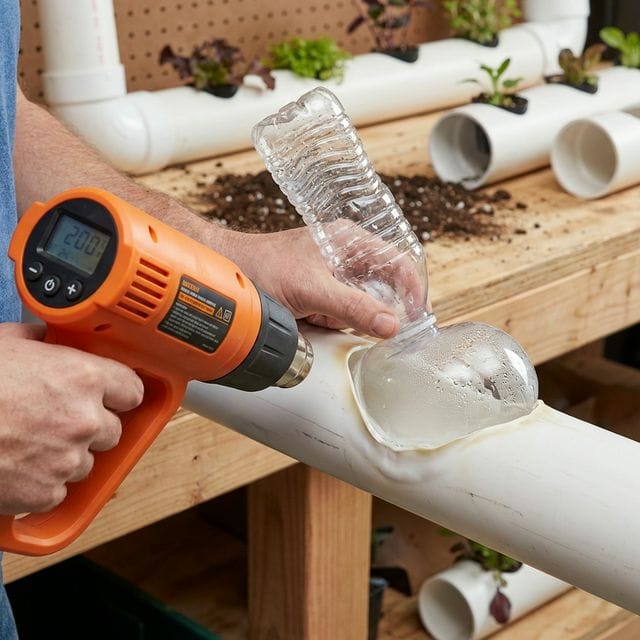
This is the “pro” trick of vertical gardening DIY. Use your heat gun to warm the PVC above the slit until it becomes soft and pliable. Use your “stamping tool” (the neck of a plastic water bottle works great) to push the softened PVC inward, creating a recessed pocket that can hold soil and a plant. Once it cools, it will hold this shape forever.
4. The Drainage Core
To ensure the plants at the bottom get water, you need an internal “distributor.” Take a thin 1/2-inch PVC pipe or a soaker hose, drill tiny holes along its entire length, and place it inside the large pipe before filling with soil. When you pour water into this core, it hydrates the tower evenly from top to bottom.
5. Stabilizing the Base
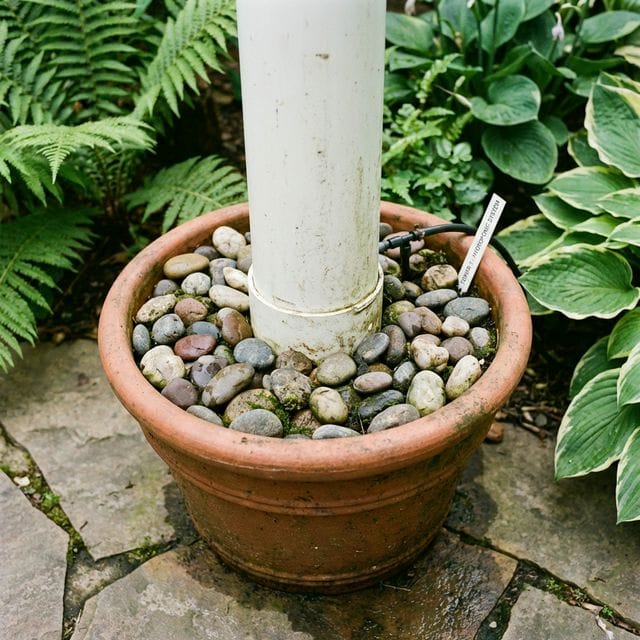
Place the end cap on the bottom. Stand the tower inside your large bucket and fill the gap between the tower and the bucket with heavy stones, bricks, or concrete. This prevents the tower from tipping over as the plants grow heavy with leaves.
Best Crops for Your Tower
While it’s called a “Lettuce Tower,” this vertical gardening DIY system can handle any shallow-rooted leafy green.
- Loose-Leaf Lettuce: Varieties like ‘Black Seeded Simpson’ or ‘Red Sails’ are perfect because you can harvest individual leaves daily.
- Spinach & Kale: Both thrive in the vertical orientation and love the high-drainage environment.
- Bushy Herbs: Mint, Basil, and Chives can be interplanted between the lettuce for a “one-stop” salad tower.
- Strawberries: If positioned in a very bright window, strawberries will trail down the sides of the tower beautifully.
Maintenance and Lighting
Because your tower is vertical, the plants at the bottom may receive less light than the ones at the top. To combat this:
- Rotate the Tower: Give it a quarter-turn every day so every side gets equal exposure to the window.
- Add Vertical Light Strips: If you find the bottom plants are “leggy,” attach a cheap LED light strip vertically to the side of the tower.
- Fertilizing: Liquid nutrients are essential. Use an organic seaweed or fish-based fertilizer mixed into your watering can once a week. Because the soil volume is small, the plants will use up nutrients rapidly.
Conclusion
Vertical gardening DIY isn’t just a hobby; it’s an engineering solution for the modern apartment. A PVC lettuce tower is an incredible conversation piece that provides you with a fresh salad every single day of the week.
By reclaiming the vertical space in your home, you prove that “no room” is never an excuse for “no garden.”
To take your tower to the next level, see our guide on the best LED grow lights for vertical setups, or learn about nutrient solutions if you want to turn your tower into a soil-less hydroponic system. Light it with LED grow lights. Feed with hydroponic nutrients.
Is PVC safe for growing food?
Yes, provided you use PVC that is labeled as ‘Potable Water’ or ‘NSF-61.’ This ensures no harmful chemicals like lead or phthalates will leach into your lettuce.
How heavy is the tower when filled with soil?
A 4-foot tower filled with damp soil can weigh 30 to 40 pounds. Ensure the floor or surface you place it on can handle the concentrated weight.
Can I use this system outdoors on a balcony?
Absolutely! PVC towers are excellent for balconies because they don’t blow over easily and utilize the sun from all angles.
