
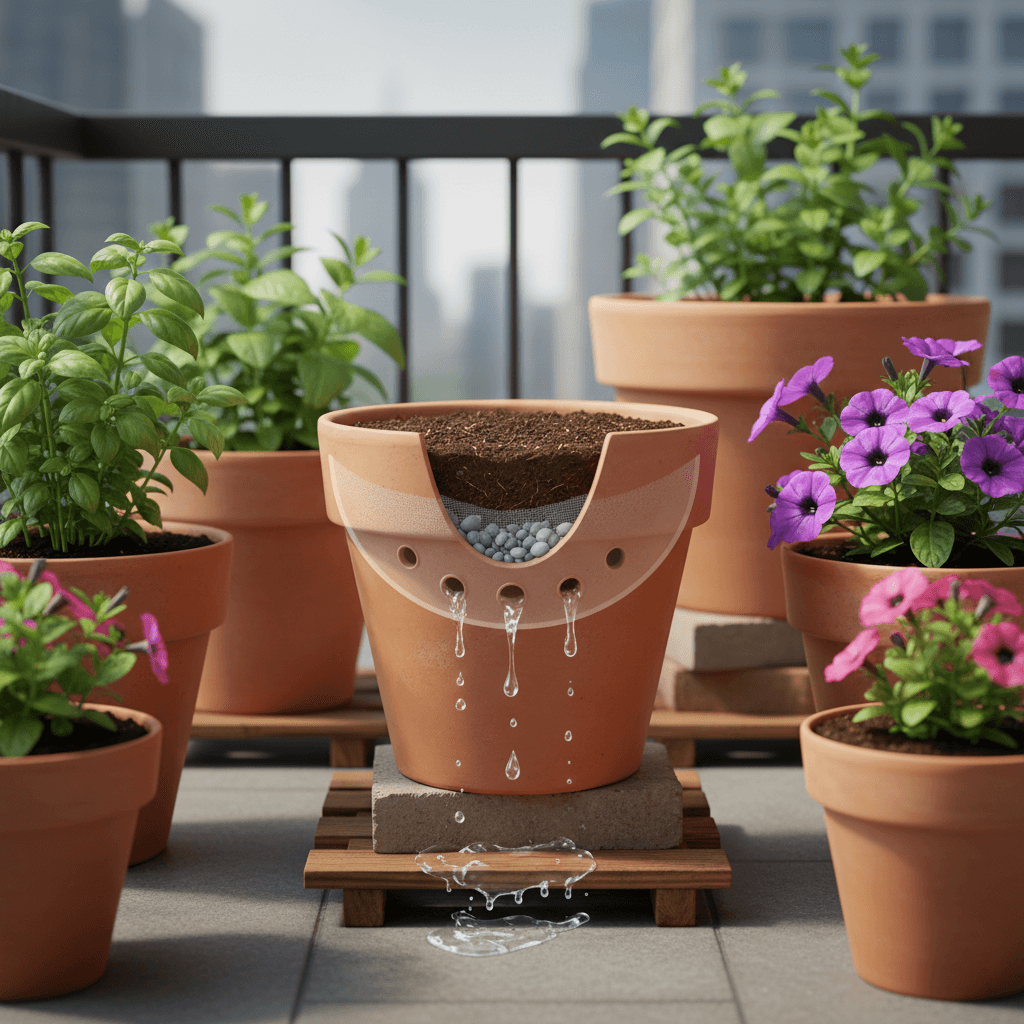
The most common way to kill a balcony plant isn’t underwatering. It’s root rot from a pot that doesn’t drain. Water that can’t escape pools around the roots, depletes oxygen in the soil, and triggers anaerobic decay — often before any visible symptoms appear on the leaves. By the time you notice yellowing, the damage is already established. For the full picture, see our balcony gardening hub.
This guide covers the specific drainage requirements for balcony containers: what to look for when buying pots, how to test whether your existing setup drains adequately, and how to fix containers that retain too much moisture.
Table of Contents
- Why Drainage Fails on Balconies
- The Drainage Hole Standard: Size, Number, Position
- Container Materials Compared
- The Gravel Myth (And What Actually Works)
- Pot Feet and Elevation: Why They Matter
- Soil Mix for Balcony Containers
- The Drainage Test: How to Check Your Setup
- My Experience with Container Drainage Failures
- FAQ
Why Drainage Fails on Balconies {#why-drainage-fails}
A balcony is a fundamentally different environment from garden soil. In the ground, excess water moves down and outward through surrounding soil. In a container, it has only one exit route: the drainage hole.
Balcony conditions make drainage more critical, not less:
– Hard surfaces underneath (concrete, tile) — standing water can’t absorb into anything; it sits until it evaporates
– Elevated wind exposure — the top 3–5cm of soil dries out quickly, creating a false sense that the pot needs water, while the lower zone stays saturated
– Heat reflection from concrete — the floor surface can reach 40–55°C on summer afternoons, accelerating top-layer evaporation while the root zone stays wet
Root rot (Pythium, Phytophthora) develops within 48–72 hours of continuous saturation. The roots turn brown and mushy, losing the ability to uptake water. Paradoxically, a plant with root rot shows wilting symptoms — the same as drought stress — leading many gardeners to water more, which accelerates the damage. Match them with drought-tolerant balcony plants that forgive dry spells.
Signs of drainage failure:
– Soil still wet 48 hours after watering
– Yellow leaves progressing from the bottom of the plant upward
– Musty or sour smell from the soil
– Mould on the soil surface
– Brown, soft roots when you remove the plant from the pot
The Drainage Hole Standard: Size, Number, Position {#drainage-holes}
Minimum hole diameter: 6mm for pots under 10L, 12–15mm for larger pots. Holes smaller than 6mm clog with fine soil particles within a few growing seasons and stop draining effectively.
Number of holes: One hole per 10 litres of pot volume as a minimum. A 20L pot needs at least 2 drainage holes; a 40L container needs 3–4. A single hole creates a bottleneck — one partial clog and you have stagnant water.
Position: Holes must be in the lowest accessible point of the pot — the base, not the sides near the base. Side holes near the bottom still allow a reservoir of standing water to accumulate below the holes.
Self-watering containers: These have a water reservoir below a false floor. They’re useful for frequent travellers or herbs that prefer consistent moisture, but the reservoir design creates the exact conditions that cause root rot in most plants. Use only for water-tolerant herbs (mint, basil in hot weather). Avoid for Mediterranean herbs (rosemary, thyme), succulents, or anything that tolerates dry periods.
Container Materials Compared {#container-materials}
| Material | Drainage | Weight | Durability | Price (US / Europe) |
|---|---|---|---|---|
| Unglazed terracotta | Excellent | Heavy | Good (cracks in hard frost) | $5–$20 / €4–€18 |
| Glazed ceramic | Poor–Medium | Heavy | Good | $15–$50 / €13–€45 |
| Plastic (thin) | Good | Light | Poor (UV degrades) | $2–$10 / €2–€9 |
| Plastic (thick-walled) | Good | Light | Medium | $8–$20 / €7–€18 |
| Fibreclay/lightweight stone | Good | Medium | Very good | $20–$60 / €18–€55 |
| Wood (cedar, acacia) | Good | Medium | Medium (requires treatment) | $15–$45 / €13–€40 |
| Metal (galvanised steel) | Good with added holes | Light–Medium | Very good | $15–$40 / €13–€35 |
Unglazed terracotta is the best material for drainage and root health. The porous walls allow air exchange and moisture evaporation through the sides — not just through the drainage hole. The main downsides: heavy when wet, cracks in hard frost (wrap with bubble wrap or store inside over winter in zones 6 and below), and expensive per litre compared to plastic.
Glazed ceramic looks better than terracotta but the sealed surface eliminates the side-wall moisture exchange. Treat it like plastic in terms of drainage: relies entirely on the drainage hole.
Thick-walled plastic is the practical choice for large containers on balconies with weight restrictions. A 40L terracotta pot filled with wet soil can weigh 25–35kg; the same volume in thick plastic weighs 12–18kg. Check the balcony weight guide before loading multiple large containers.
The Gravel Myth (And What Actually Works) {#gravel-myth}
The traditional advice of “put a layer of gravel at the bottom of the pot to improve drainage” is wrong and counter-productive.
Here’s what actually happens: water moves through soil by capillary action. When water reaches a layer of coarse gravel, it doesn’t drain freely into the gravel — it forms a saturated layer at the soil-gravel interface, which stays wetter than the soil above it. You’ve created a perched water table inside the pot. The plant’s roots in the lower soil zone sit in the wettest zone in the container.
Studies by container media researchers confirm this — a gravel layer raises the saturation point of the soil above it, it doesn’t lower it.
What actually improves drainage:
Better potting mix — add 20–30% perlite (volcanic glass particles) to standard potting compost. Perlite holds no water and creates permanent air pockets. A mix of 70% potting compost + 30% perlite drains reliably and doesn’t compact over time.
Mesh over the drainage holes — a small piece of weed membrane or mesh over each drainage hole prevents soil from washing out while keeping the hole open. Available in any garden centre. Not gravel, not broken pottery.
Pot feet or risers — the drainage hole needs clearance to actually drain. A pot sitting flat on a concrete surface creates a vacuum seal against the drainage hole. Even 2–3cm of elevation completely changes drainage rate.
Pot Feet and Elevation: Why They Matter {#pot-feet}
Pot feet are one of the most overlooked elements of container drainage. When a pot sits flat on a hard surface, the small area of the drainage hole creates negative pressure that slows or stops drainage — surface tension holds the water column in the hole.
Elevating the pot by just 2–3cm breaks this seal and allows free drainage. Options:
– Ceramic or terracotta pot feet (3 per pot, available at any garden centre, $3–$8 / €3–€7 for a set)
– Wooden blocks or offcuts
– Upturned matching saucers
– Acacia deck tile pieces
Saucers: Necessary on balconies to protect the floor surface and prevent neighbours below from receiving runoff. But a saucer that fills with water becomes a standing pool that wicks moisture back up through the drainage hole. Empty saucers after every watering, or use saucers elevated slightly on pot feet so the base of the pot doesn’t contact the pooled water.
Soil Mix for Balcony Containers {#soil-mix}
Standard potting compost from supermarkets is formulated for retention, not drainage. It works for moisture-hungry plants but fails for anything that prefers dry conditions between waterings.
The balcony standard mix:
– 70% quality potting compost
– 20–30% perlite or horticultural grit
This ratio retains enough moisture for herbs and vegetables while draining fast enough to prevent saturation. Perlite weighs almost nothing (good for weight-limited balconies) and lasts indefinitely in the mix.
For Mediterranean herbs (rosemary, thyme, lavender, oregano):
– 50% potting compost
– 50% horticultural grit or coarse sand
These plants evolved in rocky, near-sterile Mediterranean hillside conditions. In rich, water-retentive potting compost, they decline and eventually die from root rot. The higher grit ratio dries the mix faster after watering, replicating their native dry conditions.
Refresh or replace: Potting compost breaks down and compacts over 2–3 years, losing its structure and drainage capacity. If your soil drains poorly despite adequate drainage holes, it’s likely time to repot with fresh mix.
The Drainage Test: How to Check Your Setup {#drainage-test}
A simple pour test tells you whether your current setup is adequate:
- Water the pot thoroughly until you’d expect runoff
- Start a timer when watering stops
- Water should begin draining from the holes within 30 seconds
- The drainage should slow significantly within 5 minutes
- Soil should not be visibly wet on the surface 30 minutes after watering
If water takes more than 2 minutes to start draining: your drainage holes are clogged or inadequate, your soil mix is compacted, or your pot has no elevation clearance.
If the pot is still draining after 15 minutes: your soil mix is too water-retentive for the plant you’re growing.
My Experience with Container Drainage Failures {#my-experience}
In spring 2024 I planted two rosemary plants in identical glazed ceramic pots (25cm diameter, one drainage hole each). By July, one plant was thriving; the other was brown and collapsed. When I removed the failed plant, the roots were black and mushy below the 10cm mark — classic root rot.
The difference: the healthy plant’s pot was sitting on terracotta pot feet (3cm elevation). The failed plant’s pot was sitting directly on a ceramic saucer that had accumulated 2–3cm of standing water after each rainfall. The drainage hole was submerged in that standing water, so drainage had effectively stopped.
I’d emptied the saucer after deliberate watering but hadn’t noticed that the saucer was collecting rainwater between watering sessions.
The fix I now use for all balcony pots: a section of acacia deck tile pieces as a platform under large pots (4–5cm elevation, allows drainage and air circulation), and no saucers under pots that receive rainfall unless I’m checking them daily.
The second lesson: I’d been adding a 5cm gravel layer at the base of every pot based on advice I’d seen repeatedly online. After reading about the perched water table effect, I removed the gravel from three pots and replaced it with the 70/30 potting compost/perlite mix. Drainage improved immediately — the 30-second pour test went from 90+ seconds to under 20 seconds.
For related guides, see acacia deck tiles for balconies and balcony gardening for renters.
Safety Disclaimer
When repotting plants showing signs of root rot, wash your hands thoroughly after handling the soil and rotting roots — some soil-borne pathogens (Phytophthora, Pythium) can cause irritation to cuts or broken skin. Dispose of diseased soil in a bin, not in compost — these pathogens persist and can infect future plantings. Do not reuse the old potting mix from a root rot case.
FAQ
What size drainage holes do balcony pots need?
Minimum 6mm diameter for pots under 10 litres, 12–15mm for larger containers. Holes smaller than 6mm clog with fine soil particles within a season or two. A 20L container needs at least 2 holes; 40L needs 3–4.
Does gravel at the bottom of a pot help drainage?
No — this is a persistent gardening myth. A gravel layer at the base of a container actually raises the saturation zone in the soil above it (called a perched water table). The soil directly above the gravel stays wetter than the rest of the pot. Use perlite mixed into the potting compost instead.
How do I fix a pot that drains too slowly?
First, check the drainage holes aren’t blocked — clear with a chopstick or skewer. Second, elevate the pot on pot feet if it’s sitting flat on a hard surface. Third, if the soil has been in the pot for 2+ years, it’s likely compacted — repot with fresh mix containing 20–30% perlite.
Should I use saucers under balcony pots?
Yes, to protect surfaces and prevent runoff to floors below, but empty them after every watering. Standing water in a saucer wicks back through the drainage hole and causes root rot even in pots that would otherwise drain correctly. Elevate the pot on feet so the drainage hole is above the saucer level.
What potting mix is best for balcony containers?
70% quality potting compost + 30% perlite for most herbs and vegetables. 50/50 potting compost to horticultural grit for Mediterranean herbs (rosemary, thyme, lavender, oregano). Standard potting compost alone is too water-retentive for most balcony conditions.
How often should I replace potting mix in balcony containers?
Repot with fresh mix every 2–3 years for intensively used containers. Signs it’s time: slow drainage despite clear holes, soil that repels water (water pools on the surface briefly before absorbing), or visible compaction. Old compost loses its structure and becomes dense and poorly aerated.
