
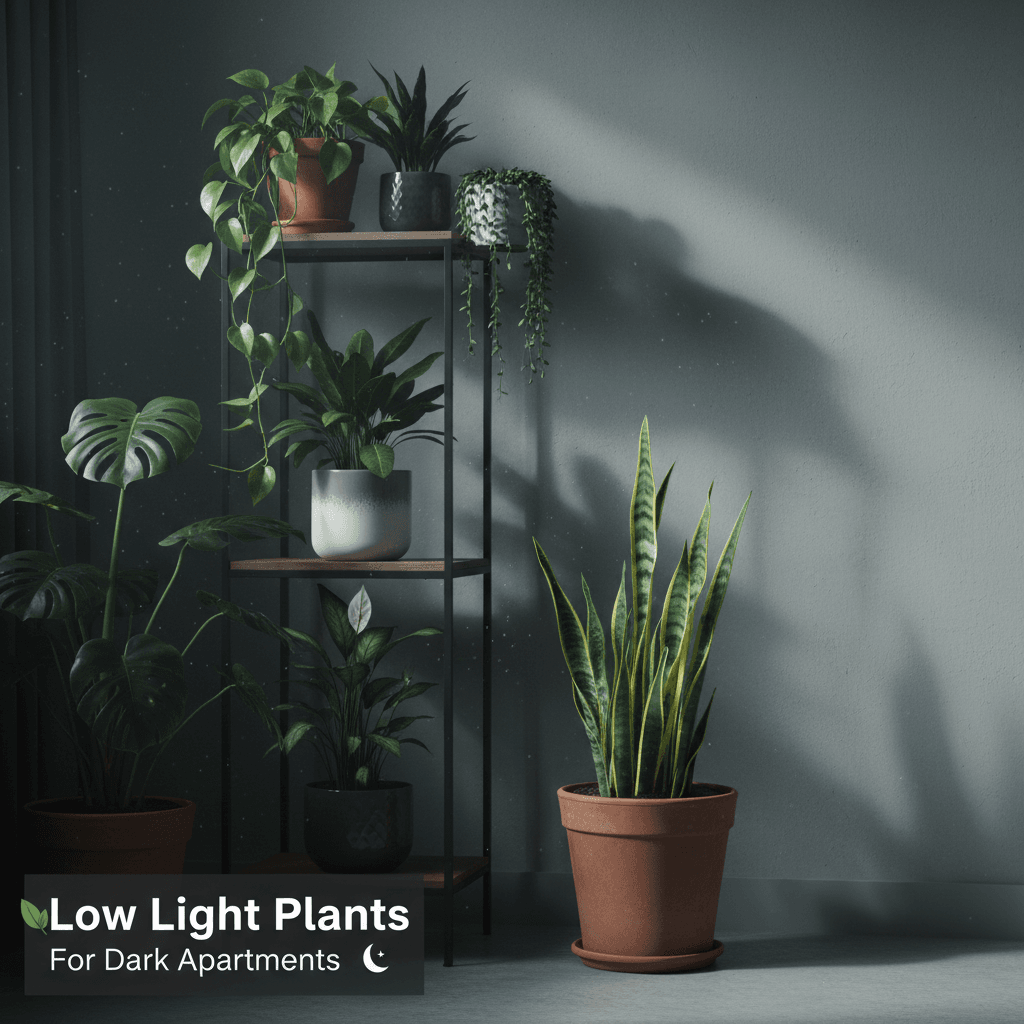
Most apartments in dense cities receive far less natural light than the average houseplant guide assumes. North-facing rooms, lightwell-adjacent windows, and spaces more than 3 metres from any window can all register under 500 lux — the threshold at which most common houseplants decline rather than grow. Even better, maximize natural light first.
The plants in this guide aren’t just “tolerating” low light — they’re genuinely adapted to shade environments and will grow, produce new leaves, and stay healthy in conditions where most houseplants stagnate and eventually die. Several of them also overlap with the standard list of low-light air-purifying plants.
Table of Contents
- Understanding Apartment Light Levels
- The 10 Best Low-Light Plants for Apartments
- Pairing Plants to Specific Low-Light Situations
- Why Low-Light Plants Often Die in Apartments (And How to Avoid It)
- Low-Light Plant Care Basics
- FAQ
Understanding Apartment Light Levels
“Low light” is frequently misused in houseplant marketing. It doesn’t mean “no light” — it means indirect, ambient, or filtered light at specific intensities. Here’s a practical framework:
| Light Level | Lux Range | What It Looks Like in Your Apartment |
|---|---|---|
| Bright indirect | 2,000–5,000 lux | 1–2m from an east or west window, comfortable reading without turning on a lamp |
| Medium | 1,000–2,000 lux | 2–4m from a window, or right beside a north window |
| Low light | 200–1,000 lux | Back corners, hallways, bathrooms with small windows |
| Too dark for most plants | Under 200 lux | Interior rooms with no windows, lightwell-adjacent rooms |
How to measure your light: A free lux meter app on your phone (Lux Light Meter by Elena Polyanskaya is reasonably accurate) gives a directional reading. Hold the phone camera-up at plant height and measure at midday on an overcast day — this gives you the baseline worst-case reading.
The plants below are specifically suited to 200–1,000 lux conditions — real low light, not bright-indirect conditions mislabelled as “low light.”
The 10 Best Low-Light Plants for Apartments
1. ZZ Plant (Zamioculcas zamiifolia)
The most reliable low-light plant in this list. ZZ stores water and nutrients in thick underground rhizomes, allowing it to survive extended periods of neglect and dim light. Grows slowly but steadily in as little as 200 lux. Toxic to pets and humans if ingested — keep away from children and animals. With pets around, check our pet-safe houseplants list.
Care: Water every 3–4 weeks. Tolerates infrequent watering better than any other plant on this list. Never let it sit in water — root rot is its only common killer.
2. Snake Plant (Sansevieria / Dracaena trifasciata)
Handles 300–800 lux without issue. Grows slowly in low light but maintains its form indefinitely. Available in compact varieties (Sansevieria ‘Hahnii’ stays under 20cm tall, ideal for shelves and bathroom windowsills). Snake plants also appear on most lists of formaldehyde-removing plants for small apartments.
Care: Water every 4–6 weeks in winter, every 2–3 weeks in summer. One of the few plants that genuinely tolerates being forgotten.
3. Pothos (Epipremnum aureum)
Fast-growing trailing vine that handles 200–600 lux. In low light it grows more slowly and the variegated forms (Marble Queen, Golden Pothos) produce less variegation, but the plant stays healthy. Excellent for hanging from shelves or trailing over bookcases. It is one of the more forgiving low-light hanging plants for apartment ceilings.
Care: Water when the top 2cm of soil is dry. Extremely forgiving. Propagates easily in water — one plant can become many.
4. Peace Lily (Spathiphyllum)
One of the few plants that blooms in low light (typically spring, sometimes twice per year). Tells you exactly when it needs water by drooping dramatically — then recovers within hours of watering. Handles 200–400 lux but produces more flowers closer to 800–1,000 lux.
Care: Water when leaves start to droop slightly. Toxic to pets.
5. Chinese Evergreen (Aglaonema)
Darker-coloured varieties (green, dark red) are better adapted to low light than bright variegated forms (which need more light to maintain their colour). Grows steadily at 300–600 lux. Compact and easy to fit in small spaces.
Care: Water every 10–14 days. Avoid cold draughts — these plants are sensitive to temperatures below 15°C.
6. Cast Iron Plant (Aspidistra elatior)
Named for its tolerance of extreme neglect, deep shade, irregular watering, and temperature fluctuations. Genuinely grows in as little as 150 lux — the most shade-tolerant plant on this list. Slow-growing (1–2 new leaves per year) but essentially indestructible.
Care: Water monthly. Tolerates dust on leaves better than most but appreciates an occasional wipe.
7. Heartleaf Philodendron (Philodendron hederaceum)
Fast-growing trailing plant similar in habit to Pothos but with slightly more glossy, heart-shaped leaves. Handles 300–600 lux well. In low light, nodes space out more (longer stem between leaves) but the plant stays vigorous.
Care: Water when top 3cm of soil is dry. Prune regularly to encourage bushy growth.
8. Dracaena (various species)
Dracaena marginata, Dracaena fragrans, and Dracaena compacta all handle 300–800 lux. These are slow-growing architectural plants — their structural form means one plant can serve as the visual anchor of a low-light room without additional décor.
Care: Water every 2–3 weeks. Sensitive to fluoride in tap water — use filtered or rainwater if leaf tips turn brown.
9. Boston Fern (Nephrolepis exaltata)
Thrives in humid, indirect light — making it ideal for bathrooms with adequate (if low) light. Handles 400–800 lux. The main challenge in apartments is low humidity — ferns need 50%+ RH to look their best. Place on a pebble tray with water, or in a bathroom.
Care: Keep soil consistently moist (not waterlogged). Mist occasionally. Trim brown fronds as they appear.
10. Spider Plant (Chlorophytum comosum)
Fast-growing, propagates itself by producing “spiderettes” (miniature offshoots). Handles 300–700 lux. Child and pet-safe. The variegated form (white-striped) is more common but the solid green variety adapts slightly better to lower light.
Care: Water when top 3cm of soil is dry. Fertilise monthly in spring and summer.
Pairing Plants to Specific Low-Light Situations
North-facing bedroom: ZZ Plant + Snake Plant — both handle the lowest light levels and require minimal watering (useful in a room you might forget to check daily).
Windowless bathroom: Boston Fern + Peace Lily — both enjoy the humidity. Add a small LED grow light strip above the shelf if the room has truly no natural light.
Hallway with no windows: Cast Iron Plant — the one plant genuinely adapted to this condition. Nothing else on this list will sustain long-term in a completely dark hallway.
Kitchen shelf 3 metres from window: Pothos + Chinese Evergreen — both handle the indirect, moderate-distance light and tolerate occasional drought if you forget during a busy week.
Office corner with overhead fluorescent: Snake Plant + ZZ Plant — fluorescent office lighting (typically 300–500 lux at desk height) is enough for these two.
Why Low-Light Plants Often Die in Apartments (And How to Avoid It)
Overwatering is the primary killer — by a large margin. In low light, plants photosynthesize and grow more slowly, meaning they consume water more slowly. A watering schedule appropriate for a bright-light plant will drown the same plant in a dim corner. Reduce watering frequency by 40–60% in low-light placements.
Compacted or poor-draining soil amplifies the overwatering problem. Repot into fresh well-draining potting mix (add 20–30% perlite) every 2–3 years. Old, compacted soil stays wet for too long after watering.
Pot size too large — a pot much larger than the root ball retains moisture in the empty soil volume around the roots, leading to root rot even with correct watering frequency. Low-light plants grow slowly; their pot should fit snugly rather than leaving room to “grow into.”
Cold draughts — many tropical low-light plants (Aglaonema, Peace Lily, Pothos) are sensitive to cold air from drafty windows in winter. Keep them away from window gaps when temperatures drop below 15°C outside.
Safety Disclaimer
ZZ plants, Peace Lilies, Pothos, and Philodendrons are toxic if ingested by pets or children. Place these plants out of reach if you have cats, dogs, or young children in the apartment. See the ASPCA Animal Poison Control database for a complete list of toxic houseplants before purchasing.
FAQ
Can any of these plants survive in a room with no windows at all?
The Cast Iron Plant and ZZ Plant can survive in very low light (under 200 lux) for extended periods, but “survive” means no growth and gradual decline. For long-term health in truly windowless rooms, supplement with a basic full-spectrum LED grow light (20–30W) for 12 hours/day.
How do I know if my plant is getting too little light?
Signs: new leaves are significantly smaller than older leaves, stems become elongated between leaves (etiolation), variegated plants lose their colour variation, growth completely stops for more than 3 months. Move the plant 1–2 metres closer to the nearest window.
Are these plants suitable for a grow light setup?
Yes, but low-light plants don’t need powerful grow lights. A basic LED strip or a low-wattage full-spectrum bulb (15–25W) at 12 hours/day is sufficient. High-intensity grow lights can actually cause light stress in shade-adapted plants.
How often should I fertilise low-light plants?
Once every 6–8 weeks during spring and summer (growing season). Not at all in autumn and winter when growth slows. Low-light plants growing slowly need fewer nutrients — over-fertilising causes salt build-up in the soil and root damage.
Do these plants actually purify air?
The original NASA Clean Air Study (1989) found that common houseplants remove trace amounts of VOCs in controlled lab conditions. In a real apartment, the number of plants required to meaningfully improve air quality is impractical (dozens). Plants are beneficial for wellbeing and humidity, but don’t replace ventilation for air quality. Pair them with other ways to optimize air quality.
