
7 Best Formaldehyde Removing Plants Small Apartment Guide (2026)
When you lock the door of your 25-square-meter micro-apartment, you are sealing yourself inside a highly concentrated chemical box. Most modern apartment building materials—from the cheap engineered wood laminate flooring to the fresh paint and the adhesives used in your flat-pack particleboard furniture—constantly “off-gas” highly toxic Volatile Organic Compounds (VOCs). The most notorious and dangerous of these invisible airborne chemicals is formaldehyde.
In a massive suburban house with central air conditioning and a dozen large windows, off-gassing eventually dissipates. But in a tiny, airtight studio apartment with a single window, these chemicals violently concentrate, causing chronic headaches, severe respiratory irritation, and long-term sleep disruption. If you cannot afford a massive, $500 HEPA air purification tower, you must immediately deploy a natural, biological defense grid: the ultimate formaldehyde removing plants small apartment strategy.
The best plants for removing formaldehyde in a small apartment are the Snake Plant (Sansevieria), Golden Pothos, and Boston Fern. According to NASA’s Clean Air Study, these species absorb formaldehyde through leaf stomata and break it down via root-zone microbes. For a 25 sqm studio, deploy 3–4 large pots (15 cm+ diameter) for measurable air quality improvement. Plants are one layer; see more ways to optimize air quality.
In this guide, we break down the most effective botanicals to remove toxins, ensuring your micro-studio becomes a breathable sanctuary.
Best Plants for Removing Formaldehyde: Quick Comparison
These are the six best plants for removing formaldehyde, with the trade-offs that actually matter in a small apartment: how much light they need, how easy they are to keep alive, and whether they are safe around a cat or dog.
| Plant | Formaldehyde removal | Light needs | Care level | Pet-safe |
|---|---|---|---|---|
| Boston Fern | High | Bright indirect | Moderate (wants humidity) | Yes |
| Bamboo Palm | High | Bright indirect | Easy | Yes |
| English Ivy | High | Bright indirect | Moderate | No (toxic) |
| Peace Lily | Medium-High | Low to medium | Easy | No (toxic) |
| Snake Plant | Medium-High | Any (low to bright) | Very easy | No (toxic) |
| Golden Pothos | Medium | Low to bright | Very easy | No (toxic) |
1. The Boston Fern: The Humidity Engine
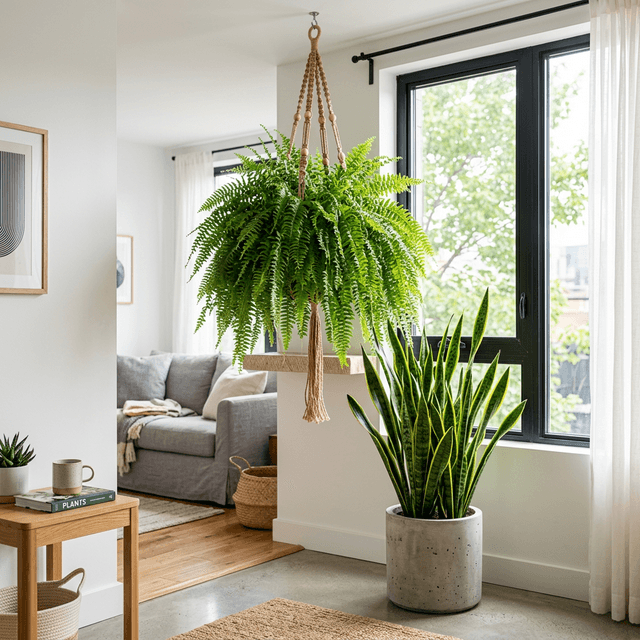
Ferns are an efficient biological filter. They pull chemical fumes from the apartment air, absorbing them through pores on their leaves, and moving them into the root system where bacteria break down the toxins. Furthermore, the Boston Fern acts as a natural humidifier, transpiring water vapor back into your apartment air. Formaldehyde removing plants small apartment collections should include at least one hanging fern. Hang it above your bed or sofa to create an area of purified oxygen.
2. The Unkillable Snake Plant (Sansevieria)
If you work 12-hour shifts, rarely remember to water anything, and live in a studio apartment that receives almost zero direct sunlight, the Boston Fern will die immediately. You need a brutal, indestructible biological workhorse.
The Snake Plant (Sansevieria trifasciata) is a sturdy succulent. Its thick, rigid, sword-like leaves are adept at scrubbing formaldehyde, xylene, and toluene from the air. While most plants release carbon dioxide at night, the Snake Plant performs a rare biological process (CAM photosynthesis) where it absorbs CO2 and releases oxygen in the dark. Place a pot of Snake Plants near your bed to improve your sleep quality.
3. The English Ivy: The Mold Killer
Airborne chemicals are not the only threat in a tightly sealed studio. If your micro-apartment bathroom lacks a powerful exhaust fan, massive humidity will violently spill into your living room after every shower, creating an invisible, highly toxic cloud of airborne mold spores.
English Ivy (Hedera helix) is an effective trailing vine that helps scrub the air of particles and reduce airborne mold spores within hours of placement. It is also an effective formaldehyde filter. Because it trails downwards, you can place a small pot on a high shelf, allowing the vines to cascade down without consuming your floor space.
4. The Golden Pothos: The Flat-Pack Furniture Fixer
If you recently furnished your entire studio apartment by purchasing a massive haul of incredibly cheap, flat-pack particleboard furniture from a big-box store, you are currently breathing in a staggering volume of fresh formaldehyde glue fumes.
The Golden Pothos (Epipremnum aureum) is a low-maintenance vine that metabolizes formaldehyde fumes directly out of the air. Because it grows quickly, its filtration capacity expands. You can drape the vines across the top of a bookshelf or wrap them around a bed frame, placing the organic filter near the source of off-gassing.
5. The Bamboo Palm (Chamaedorea seifrizii)
Sometimes, you need a plant that acts as a massive architectural statement piece while simultaneously acting as a heavy-duty industrial air scrubber.
The Bamboo Palm thrives in indoor shade and adds moisture into the air. In studies, it scored high for stripping both formaldehyde and benzene. If you have an empty corner in your studio, place a Bamboo Palm in a floor pot. It will add to your tropical aesthetic while filtering air in that area.
6. The Peace Lily (Spathiphyllum)
If you want an elite air scrubber that also produces beautiful, elegant white flowers entirely indoors, the Peace Lily is your only option.
This dark green plant specializes in neutralizing common apartment airborne toxins like formaldehyde and benzene. The Peace Lily is communicative; when it needs water, the plant sags, reminding you to water it. Within hours of a deep soaking, it stands back up, resuming its chemical filtration.
7. Maximizing the “Root Zone” Microbes
The microbes living on the plant roots help break down VOCs. If you cover the base of your plants with rocks or moss, the air cannot reach the root zone. Keep the topsoil bare and occasionally aerated. Furthermore, wiping dust off the leaves with a damp cloth helps maintain its filtration capability.
Evaluating the Botanical Air Scrubbers
Choose your living filters based on your apartment’s harsh conditions:
| Plant | Best For | VOC Specialty | Care Level | Light Needed | Pet Safe |
| Snake Plant | Dark corners & bedrooms | Formaldehyde, xylene, toluene | Zero (Ignore it) | Extremely Low | No (mildly toxic) |
| Boston Fern | Dry air & high formaldehyde | Formaldehyde #1 rated | High (Needs misting) | Medium/Indirect | Yes |
| Golden Pothos | New flat-pack furniture | Formaldehyde, benzene | Low | Medium/Low | No (toxic if eaten) |
| English Ivy | Damp, moldy bathrooms | Airborne mold + formaldehyde | Medium | Medium | No (toxic) |
| Bamboo Palm | Empty floor corners | Formaldehyde, benzene | Low | Low/Indirect | Yes |
| Peace Lily | Elegant flowering filter | Formaldehyde, benzene | Low (self-watering signals) | Low | No (toxic) |
Safety Disclaimer: While these plants are helpful for air quality, some of them (like the Peace Lily, Golden Pothos, and English Ivy) are toxic to cats and dogs if chewed and swallowed. If you have an urban pet, you should hang these plants out of reach, or stick to pet-safe filters like the Boston Fern and Parlor Palm. If pets share the space, cross-check our pet-safe houseplants list.
How to Maximize Formaldehyde Removal in a Sealed Studio [UPDATE 2026]
Owning plants is step one. Placement strategy is step two. Most people put plants on a windowsill and call it done — that is the least effective location for VOC filtration.
The highest-formaldehyde zones in a studio apartment:
- Under your desk and near your furniture — particleboard and MDF off-gas most at the edges and joints. Place a Golden Pothos directly on the desk shelf or hanging from the bookshelf above.
- Inside built-in wardrobes — pressed-wood interiors trap formaldehyde inside a sealed box. Place a small Snake Plant on the wardrobe shelf. Crack the door 5 cm for airflow.
- Near freshly painted walls — new paint off-gasses for up to 12 months. An English Ivy on a high shelf targeting that wall dramatically reduces absorption time.
- Bathroom — moisture + cheap MDF vanity = mold and VOC compound. A Boston Fern in the bathroom pulls double duty: formaldehyde and mold spores.
Root zone aeration protocol: Once per week, gently loosen the top 2 cm of soil with a chopstick. This oxygenates the root-zone bacteria that physically metabolize the formaldehyde. Without airflow, the microbes suffocate and filtration efficiency drops by up to 40%.
Conclusion
You do not have to accept the reality of breathing in toxic laminate glue fumes just because you rent a tiny, enclosed space. By strategically deploying a natural arsenal, you completely seize control of your indoor air quality. Implementing an aggressive formaldehyde removing plants small apartment strategy transforms your sealed urban box from a stagnant chemical hazard into a deeply oxygenated, profoundly healthy micro-jungle.
Ready to breathe better tonight? Consider getting a Snake Plant, place it near your bed, and experience the difference in air quality.
