

Balcony fire pit rules catch most renters off guard — not because the laws are hidden, but because they exist at three different levels at once: your city’s fire code, your building’s insurance policy, and your lease. Miss any one of them and you’re looking at a fine, a voided lease, or a property damage bill that ruins a good evening fast.
Short answer: open-flame fire pits are banned on most apartment balconies in the US. Tabletop bioethanol and electric fire pits exist in a legal gray zone that depends heavily on where you live and what your lease says. This guide breaks it all down so you know exactly what’s allowed before you buy anything. Consider an electric fire pit where flames are banned. Compare bioethanol vs propane.
Table of Contents
- Why Most Balcony Fire Pits Are Technically Illegal
- Rules by State and City: What the Fire Code Actually Says
- Your Lease Is a Separate Layer of Rules
- What Type of Fire Pit Is Actually Allowed?
- My Experience Navigating Balcony Fire Pit Rules
- How to Get Written Permission from Your Landlord
- FAQ
Why Most Balcony Fire Pits Are Technically Illegal
The International Fire Code (IFC), which most US cities adopt with local modifications, prohibits open-flame burning devices on balconies and decks of multi-family residential buildings. The key section is IFC 315.3, which restricts combustible materials and open flames in shared building structures.
Why balconies specifically? Three reasons stack up:
- Clearance requirements. Open flame devices typically need 10 feet of horizontal clearance from combustible surfaces — walls, railings, overhangs. A standard apartment balcony is 5–8 feet deep. The math doesn’t work.
- Shared structure risk. Your balcony ceiling is your upstairs neighbor’s floor. A fire on your balcony can spread vertically through the building faster than a ground-level fire.
- Sprinkler gap. Most balconies aren’t covered by the building’s fire suppression system. There’s no safety net.
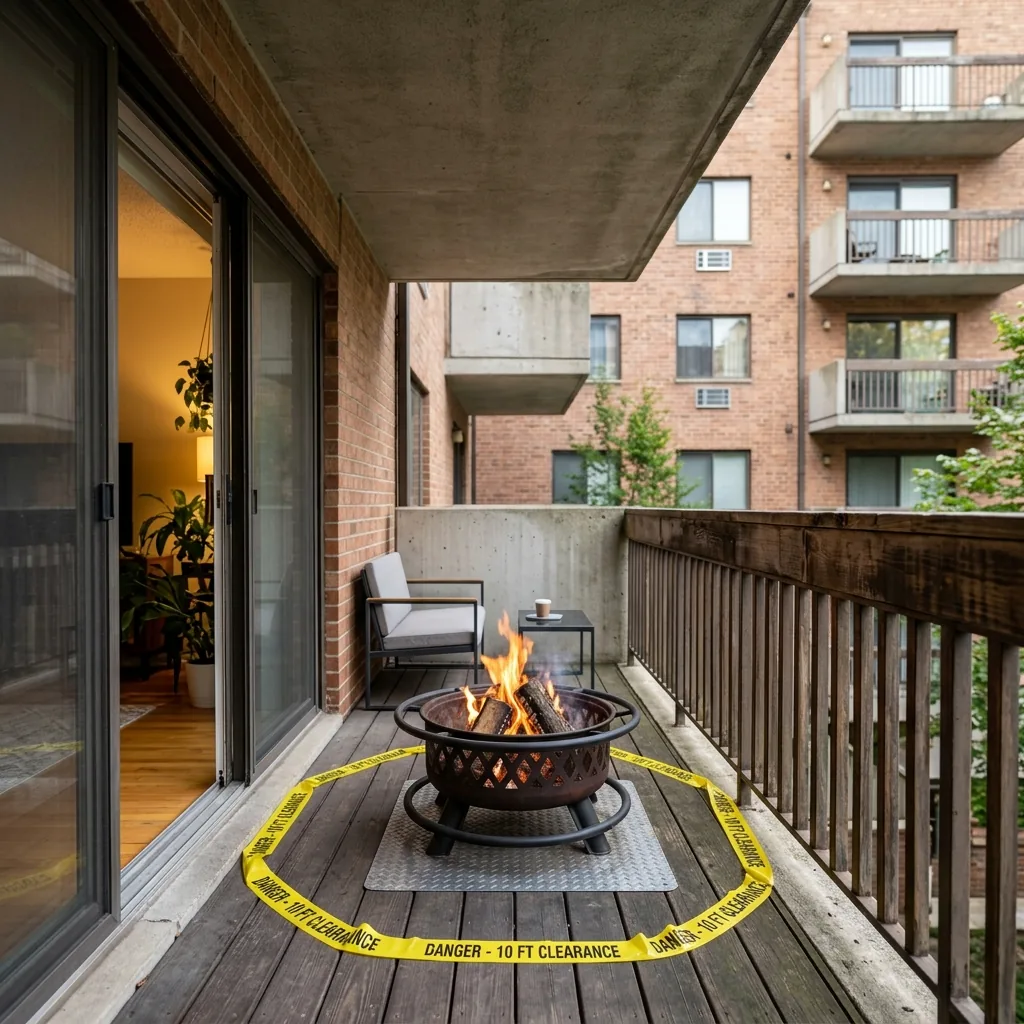
This applies to wood-burning fire pits, propane fire bowls, and charcoal-burning chimineas. Gel-fuel tabletop pits and bioethanol burners occupy murkier territory — some jurisdictions treat them like candles, others like open flames.
Rules by State and City: What the Fire Code Actually Says
State fire codes set the floor; cities can and do go stricter. Here’s what the rules look like in the places where most renters ask:
California
California Fire Code Section 315 prohibits open-flame devices on balconies of residential buildings of 3 or more units. This covers propane, wood, and charcoal. Bioethanol burners are not explicitly listed but fall under “open flame devices” in most county interpretations. Los Angeles Fire Department has issued specific guidance classifying tabletop bioethanol burners as open-flame devices — banned on balconies.
New York City
NYC Fire Code Section FC 313.1 bans the use of “portable heating and cooking equipment” using combustible gases or liquids on balconies. This includes propane fire pits explicitly. Bioethanol and gel-fuel burners are not specifically called out, but FDNY inspectors have cited them under the open-flame section. Electric fire pits with no real flame are generally not restricted by fire code.
Texas
Texas Fire Code follows the IFC more closely than California or NYC, but enforcement varies by city. Houston and Austin both prohibit open-flame burning on apartment balconies. Smaller Texas cities may have no specific ordinance — but your building’s insurance policy almost certainly does.
Florida
Florida adopted the 2021 IFC with amendments. Miami-Dade County has explicit balcony fire pit prohibitions. Orlando and Tampa follow general IFC restrictions. Electric and battery-powered “flame effect” fire pits are not restricted.
Illinois / Chicago
Chicago Municipal Code 15-28-060 prohibits open-flame devices on balconies of multi-unit residential buildings. The city has issued fines ranging from $500 to $1,000 per violation. Chicago is one of the stricter cities in the Midwest on this.
General Rule of Thumb
If your building has more than 2 units and was built after 1975, assume open-flame fire pits are prohibited by fire code. Verify with your local fire marshal’s office — most city websites have the relevant code sections searchable online.
Your Lease Is a Separate Layer of Rules
Even if your local fire code has a gray area around bioethanol, your lease may close it entirely. Most apartment leases include a clause like:
“Tenant shall not use any open-flame device, grill, or outdoor cooking equipment on any balcony, patio, or deck.”
This clause is typically triggered by the building’s property insurance policy, not the fire code. Insurers routinely require landlords to prohibit open-flame devices on balconies as a condition of coverage. If you violate this clause, the consequences are separate from any fire code enforcement:
- Lease termination with cause
- Loss of security deposit
- Liability for fire damage (your renter’s insurance may not cover willful policy violations)
Read your lease carefully. Look for terms like: “grill,” “open flame,” “combustible,” “cooking equipment,” “fire.” If you can’t find a specific clause, that doesn’t mean it’s allowed — ask your landlord in writing before buying anything.
What Type of Fire Pit Is Actually Allowed?
Here’s a practical breakdown based on what’s most commonly permitted:
| Type | Open Flame? | Typically Allowed on Balcony? | Notes |
|---|---|---|---|
| Wood-burning fire pit | Yes | ❌ No | Banned everywhere in multi-unit buildings |
| Propane fire pit | Yes | ❌ No | Banned by most fire codes + leases |
| Charcoal chiminea | Yes | ❌ No | Same as wood-burning |
| Bioethanol/gel fuel | Yes | ⚠️ Gray zone | Depends on city + lease; assume banned |
| Electric flame-effect | No | ✅ Usually yes | Check lease for “open flame” wording |
| Candles in hurricane glass | Yes, contained | ⚠️ Gray zone | Treated as candles in most codes |
Electric fire pits — LED flame simulation, sometimes with a small heating element — are the safest legal bet. They produce no combustion products, no spark risk, and are not classified as open-flame devices by any fire code I’ve found. If your lease says “open flame” specifically (not “heating device”), an electric unit clears that bar.
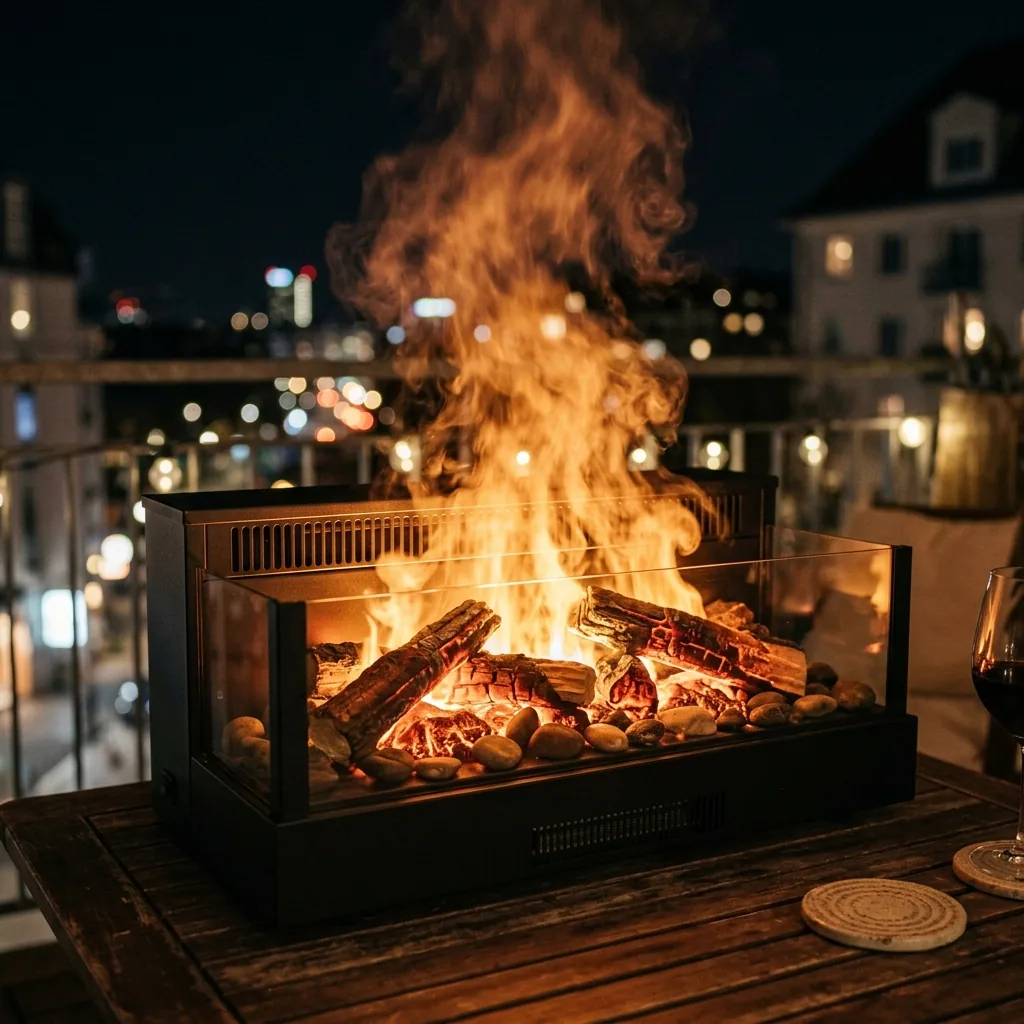
The electric fire pit for apartment balcony category has exploded since 2024. Units like the Dimplex Opti-Myst and various tabletop LED fire bowls look convincingly realistic at 8–10 feet away and cost $40–$200 for a decent one.
For a full breakdown of tested models that work on a small balcony, see the mini tabletop fire pit for apartment balcony guide — it covers dimensions, heat output, and what to look for if your primary goal is ambience over warmth.
My Experience Navigating Balcony Fire Pit Rules
I live in a sixth-floor unit in a Chicago building with a 2.5m × 1.2m east-facing balcony. I wanted a fire pit for exactly the reason everyone does: that specific feeling of sitting outside with something warm and flickering after a long day.
My first attempt was a small gel-fuel tabletop bowl — the kind you see on restaurant patios. I bought it, put it out once, and had a building manager knock on my door within 45 minutes. He didn’t cite the fire code specifically. He just said the lease. I went back and found it: “no open-flame devices including candles, torches, or decorative fire features.” Decorative fire features. That specific.
I returned the gel burner and spent two weeks researching. The short version: I now use a Dimplex tabletop electric flame unit, no combustion, no smoke, no violations. It doesn’t have the same draw as a real flame, but it does the job at 9pm when I want to sit outside without staring at my phone. On my specific balcony — south-facing with a glass railing panel — it looks genuinely convincing from inside the apartment.
The lesson wasn’t “fire pits are impossible for renters.” It was that the electric category is the only realistic path for most apartment situations, and that checking the lease before buying is a 10-minute task that saves a real headache.
How to Get Written Permission from Your Landlord
If you want to use a bioethanol or gel-fuel burner and your lease is ambiguous, getting written permission is the cleanest path. Here’s what to put in the email:
- Specify the exact product — brand, model, fuel type, BTU output if available
- Reference the safety specs — “produces no smoke, no sparks, self-extinguishing lid”
- Ask specifically — “I’d like written confirmation that using this product on my balcony does not violate my lease”
- Cc your own email for a timestamped record
Most landlords will check with building management or their insurer. If the insurer says no (which is likely), you’ll get a clear denial — and you’ve documented that you asked, which protects you if there’s ever a dispute.
If they say yes, get it in writing. An email counts. A text does not.
FAQ
Can you have a fire pit on an apartment balcony?
Are balcony fire pits legal in California?
What fire pits are safe for apartment balconies?
Am I allowed to have a grill on my apartment balcony?
What happens if you use a fire pit on an apartment balcony illegally?
Is bioethanol safe on a balcony?
Do I need to tell my landlord about an electric fire pit?
Safety Disclaimer
Balcony fire codes vary by city and are updated regularly. The information in this article reflects general IFC guidelines and selected city codes as of 2026. Always verify current rules with your local fire marshal’s office and read your lease before using any fire-related device on your balcony.
