
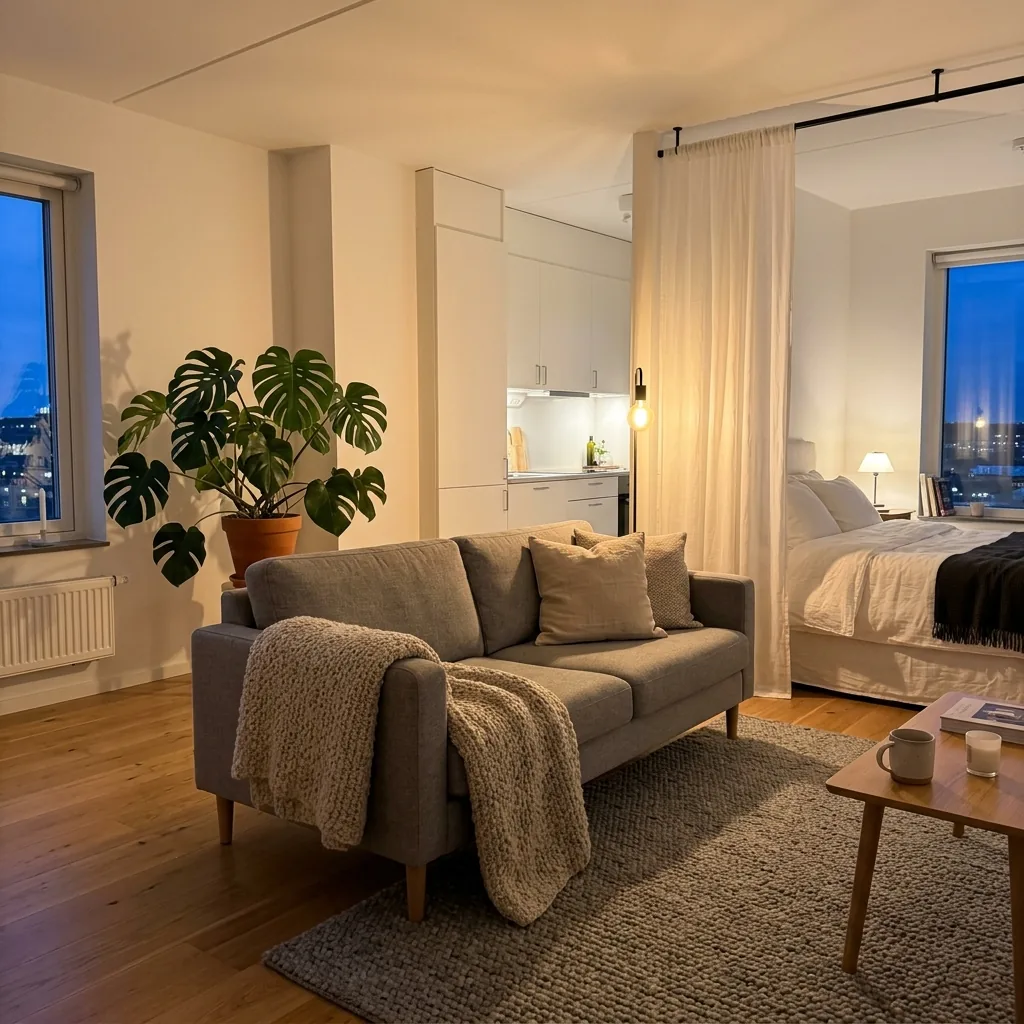
To make a studio apartment feel like home, address five sensory layers: lighting (replace harsh overhead with warm lamps, 2700K), scent (a consistent diffuser scent signals “this is my space”), textiles (layered rugs, throw blankets, cushions add warmth that furniture cannot), plants (one large plant in the corner is more impactful than six small ones), and a defined sleeping zone (separating the bed visually from the living area removes the “hotel room” feeling). These changes cost under $200 combined and require zero drilling. Keep it airy with furniture legs.
A studio apartment that feels like a hotel room — or worse, a storage unit with a mattress in it — is not a problem of size. It is a problem of identity. The space has no signal that tells your nervous system “you are home.” The fix is not buying more furniture or spending money on a renovation. It is layering the sensory and visual cues that trigger the psychological state of being home.
I have moved into six apartments since 2018, and the fastest I ever made a studio feel genuinely home was one weekend and €140. The slowest was 14 months of living in a space that felt temporary until I understood what was actually missing.
Why trust this guide? I have lived in studios ranging from 19 sqm to 34 sqm in three countries. The apartment that felt most like home was the smallest. What made it work had almost nothing to do with the space itself.
Why Studio Apartments Feel Temporary
Most studio apartments fail the “home feeling” test for three specific reasons:
1. One overhead light source. The ceiling fixture illuminates everything at the same intensity — it is the lighting equivalent of a hospital waiting room. There is no warm corner, no shadow, no variation that signals “evening” or “morning” or “this is the place I relax.”
2. No zones. Everything happens in one undifferentiated space. The desk is next to the bed is next to the sofa. When there is no visual boundary between sleeping and living, the brain cannot fully switch between modes — the bedroom never fully becomes a bedroom, the living room never fully becomes a living room.
3. No sensory signature. Every space that feels like home has a consistent scent, a characteristic light quality, and a predictable temperature feel underfoot. Rental apartments have none of these by default — they smell of fresh paint and previous tenants, feel cold underfoot on laminate, and look identical under white overhead light at all hours.
All of these are fixable within a weekend.
13 Ways to Make a Studio Apartment Feel Like Home
1. Replace Overhead Lighting with Lamps
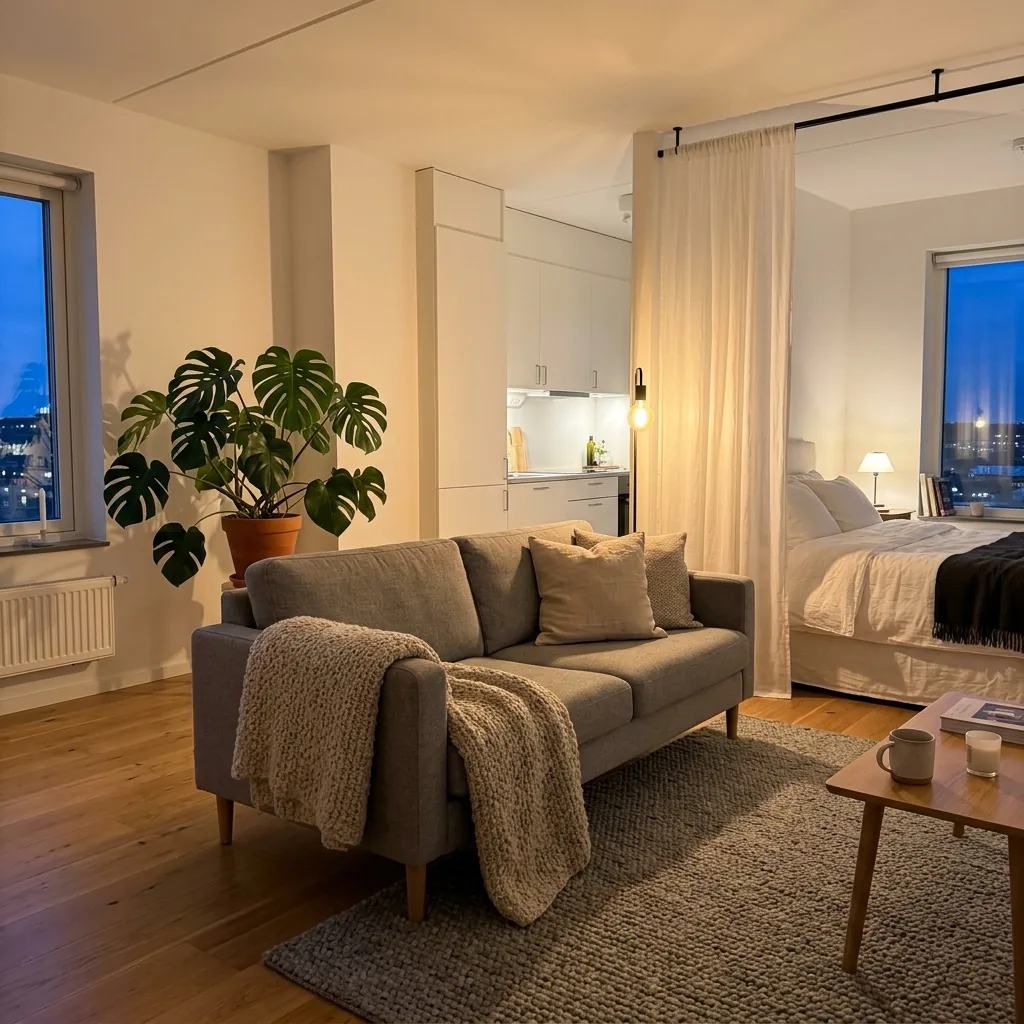
This is the single highest-impact change in any studio apartment. Turn off the overhead ceiling light permanently — or as often as possible — and replace it with three lamps at different heights: a floor lamp in one corner, a table lamp on the desk or side table, and a smaller lamp near the bed.
The target colour temperature: 2700K (warm white). Standard rental overhead fixtures run at 4000–6000K (cool white or daylight), which is energising and clinical. 2700K is the colour of candlelight and incandescent bulbs — warm, relaxing, and the visual signature of “home” in most Western residential contexts.
Budget: €40–€70 for a floor lamp, €15–€25 for a table lamp. Total: under €100 for both, and the effect on how the apartment feels in the evening is dramatic. This is the change most often cited by people who have transformed a studio — and the cheapest per unit of impact.
2. Establish a Consistent Scent
Scent is the fastest route to a psychological sense of home because it is processed by the olfactory bulb, which connects directly to the brain’s memory and emotion centres. A consistent scent in an apartment becomes associated with safety and belonging within 2–3 weeks of regular exposure.
The practical approach: a reed diffuser ($10–$20) with a scent you actively like — not one that is generically “neutral” — placed somewhere stable. Run it continuously. Within a few weeks, walking into your apartment and smelling that scent will trigger a genuine return-home response.
Avoid candles as the primary scent mechanism in a studio — they require active management, create fire risk, and cannot run while you are asleep or out. The reed diffuser is passive, consistent, and low-risk.
3. Add a Large Area Rug
A bare hard floor in a studio looks like a waiting room. A large area rug (200×290cm or larger) in the main living area does three things simultaneously: defines a zone, adds acoustic insulation (significant in hard-floor studios), and adds warmth underfoot that hard flooring cannot provide.
The critical sizing rule: the rug must be large enough that at least the front two legs of every piece of furniture in the zone sit on the rug. A rug that floats in the middle of the room with no furniture touching it looks like a bath mat in a gymnasium. Go larger than you think you need.
A 200×290cm polypropylene rug from IKEA costs €45–€85 and is the single most transformative furniture-adjacent purchase for a studio.
4. Layer Textiles Deliberately
The surfaces that feel warm in a home are soft. The surfaces in a rental apartment are almost entirely hard: laminate floor, painted plasterboard walls, synthetic upholstery, metal furniture legs. Adding textiles — throw blankets, cushions, a mattress cover on the daybed or sofa — changes the tactile character of the space fundamentally.
The principle: layer, not match. Two throw blankets of slightly different textures (one chunky knit, one thin woven) on the sofa look considered, not accidental. Three cushions in two related colours look intentional. One cushion on a sofa looks like you forgot to buy the other two.
Budget: €30–€60 for a throw blanket, €10–€20 each for cushions. IKEA, H&M Home, and Amazon all have good options in this range.
5. Create a Visual Sleeping Zone
The most common reason studio apartments feel like hotel rooms: the bed is visible from everywhere in the apartment, and there is nothing that signals “this is the sleeping area, separate from everything else.”
The fix does not require walls. It requires a visual boundary. Options in order of cost and effort:
- A ceiling-hung curtain panel ($30–$60 for curtains + IKEA ceiling track): a floor-to-ceiling curtain that can be drawn between the bed and the living area, closed at night, open during the day. The most effective and reversible boundary.
- A bookshelf as room divider: a KALLAX 4×2 positioned perpendicular to the wall creates a visual separation without blocking light.
- A different rug in the sleeping zone: a rug that only extends under and around the bed signals “this area has a different function” without any physical barrier.
6. Put One Large Plant in a Corner
Six small succulents on a windowsill do not make a studio feel alive. One large plant in a floor pot — a monstera, a fiddle-leaf fig, a bird of paradise, or a snake plant — creates a visual anchor in a corner that a lamp, a side table, or a bookshelf cannot replicate.
Large plants add organic scale to a room filled with rectangular furniture, introduce a living element that changes slightly every week, and signal long-term habitation — you do not keep a large plant alive for months in a place you consider temporary.
Budget: a 60–80cm monstera or snake plant costs €20–€45 at a garden centre or supermarket. A basic floor pot: €10–€20. Total under €65, and the impact per cost ratio is among the highest of any item on this list.
For which plants work in which light conditions and how to keep them alive in a small apartment, see our guide on low light indoor plants and formaldehyde removing plants for options that also improve air quality.
7. Define the Desk Zone
In a studio where the desk is also the dining table, the kitchen preparation surface, and the reading spot, nothing feels like anything in particular. Define the desk zone with three things: a desk lamp (not an overhead light), a small plant or personal object that is only at the desk, and — if space allows — a chair that is visibly different from the dining chairs. Add prep space with a kitchen island for a studio.
This is not about buying more furniture. It is about making the existing furniture signal its purpose through context. A desk lamp that is always on when you work and always off otherwise creates a conditioned association: lamp on = work mode. Lamp off = the space belongs to the rest of your life.
8. Control What You See From the Bed
In a studio, lying in bed means looking at the whole apartment. If what you see from the bed is the dirty dishes in the sink and the desk covered in work documents, your brain does not fully disengage in the evening.
The fix: orient the bed so the view from the pillow is the least visually stressful direction. In most studios, this means facing a wall, a window, or a bookshelf — not the kitchen or the desk. This single layout adjustment, which costs nothing and takes 20 minutes to try, consistently improves sleep quality in studio apartments.
9. Put Your Own Art or Objects on One Wall
Rental apartments have white walls, and most renters leave them white because they are afraid to damage them. The result is a space that looks transient and impersonal by default.
Command picture-hanging strips (rated to 7 kg per pair) hold framed art, shelves, and mirrors without drilling. A gallery wall of 4–6 framed prints in a cohesive palette costs €20–€60 in frames from IKEA + printed artwork and takes 2 hours to arrange. Command strips remove cleanly from most painted walls, leaving the surface undamaged. Add depth with mirrors.
The rule: one strong wall, not art scattered across all four. One intentional gallery wall with 4–6 pieces makes a stronger statement than a single print on every wall.
10. Invest in Good Bedding
The bed is the largest piece of furniture in a studio and the surface you interact with most intimately. A duvet cover and pillowcases in a fabric you actually like costs €30–€80 and is visible from most of the studio all day.
The baseline quality threshold: 200+ thread count cotton percale or cotton sateen. Below this, bedding pills, looks cheap, and feels like a hostel. Above this, the bed looks and feels like somewhere worth sleeping in.
This is not an aesthetic suggestion — it is a wellbeing one. The quality of your daily experience in a studio apartment is substantially determined by the quality of the surfaces you touch.
11. Clear Every Horizontal Surface Except One
Cluttered surfaces are the primary visual reason studios feel chaotic and small. In a 25 sqm apartment, a cluttered coffee table, covered desk, and loaded-up windowsill compress the visual space significantly.
The rule: every horizontal surface is allowed one “functional cluster” — the desk can have a laptop and a lamp; the coffee table can have a candle and one book; the windowsill can have a plant and nothing else. Everything else goes into storage.
This requires storage to put things into — but if you have any under-bed storage, over-door organizers, or kitchen cabinet organizers, it is almost always the case that the clutter is not “too much stuff” but “stuff that has no place.” Assign every item a place, and the surfaces clear themselves.
12. Make the Entrance Matter
The first thing you see when you walk into your apartment sets the psychological frame for the entire space. Most studio apartments have a 1–2 sqm entry area that is also the closet area, the shoe storage, and the place bags get dropped — a zone of maximum chaos that greets you every time you come home. Tame the entry with shoe storage cabinets.
Three no-drill fixes: a small wall mirror above eye height (opens the visual space), a hook strip for bags and jackets (the IKEA ENUDDEN over-door strip, €8, no drilling), and a small tray or bowl on any available surface for keys, wallet, and daily carry items. The entry zone takes 30 minutes and under €30 to fix — and the daily return-home experience changes immediately.
13. Adjust the Room Temperature Underfoot
Cold floors are one of the most underappreciated reasons apartments feel unwelcoming. Cork underlay under an area rug, or simply switching from bare laminate to a thick-pile rug in the morning and evening zones, changes the thermal experience of the space considerably.
If your apartment has laminate or tile floors, the area rug is doing double duty: visual and thermal. A 5–8mm thick pile rug in the area where you walk barefoot most often (beside the bed, in front of the sofa) is the cheapest thermal improvement available to a renter.
Conclusion
Making a studio apartment feel like home is not about the size of the space or the quality of the furniture already in it. It is about removing the sensory signals of temporariness — harsh overhead light, bare floors, white empty walls, undefined zones — and replacing them with the signals of occupancy and intention.
The fastest weekend transformation: floor lamp (€45) + large area rug (€55) + throw blanket and two cushions (€40) + one large plant (€30). Total: €170, one Saturday afternoon, and the apartment registers as a home rather than a rental unit.
For how these elements fit with larger layout decisions — where to put the bed relative to the window, how to create a desk zone in a 20 sqm studio — read our studio apartment layout ideas guide. For the furniture pieces that make a studio both functional and home-like — the daybed, the kitchen island, the sofa bed — start with our best daybed for studio apartment guide. Save space with a sofa bed.
Safety Disclaimer
Ceiling curtain tracks: if your lease prohibits ceiling screws, use the IKEA KVARTAL tension rod version, which fits between walls without drilling. Tension rod systems support up to 15 kg of curtain weight in a standard 2.4m ceiling apartment — adequate for a single curtain panel divider. Divide zones with tension rod dividers.
