
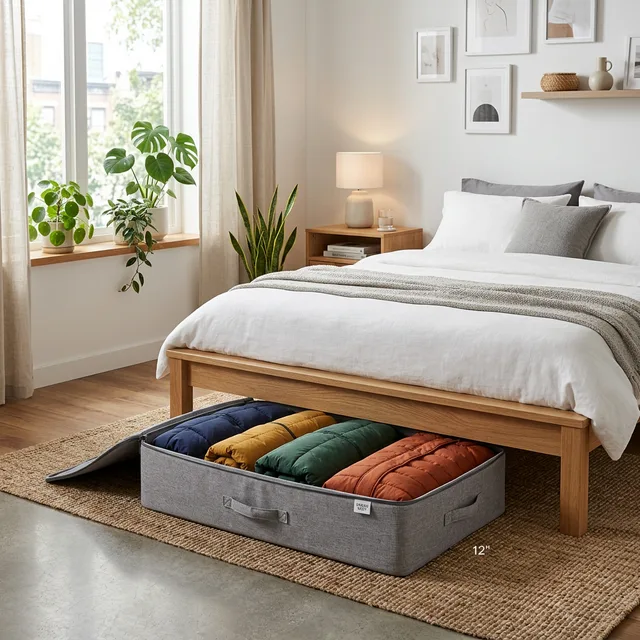
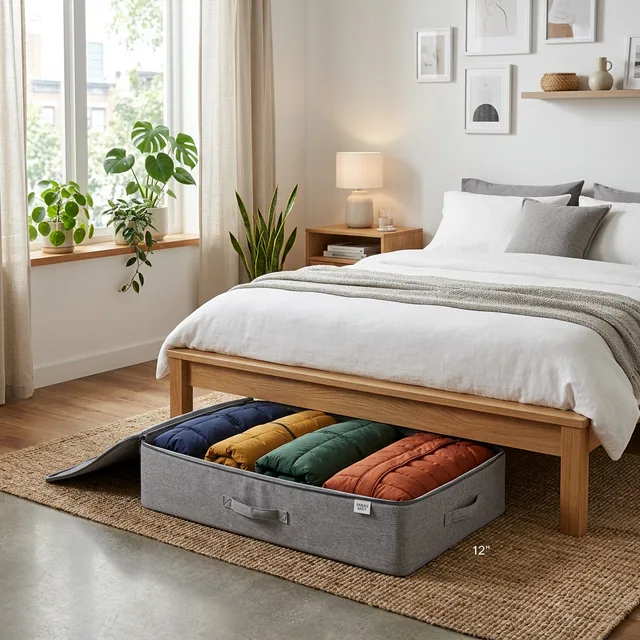
Finding the right under-bed storage for bulky winter coats is the single most important task for an urban renter when the first spring breeze hits. In a 300-square-foot studio, your closet is likely only 4 feet wide. Three heavy-duty winter parkas, two wool overcoats, and a few puffer jackets can easily consume 40% of your total wardrobe space. See more on storing winter clothes. More in our small-space living hub.
Leaving your winter gear hanging in the closet through June is a waste of prime real estate. It makes your summer clothes feel crowded, leads to permanent wrinkles, and prevents you from ever feeling truly organized. You need to migrate that seasonal bulk out of your sightline entirely.
However, under-bed storage in a tiny apartment is notoriously tricky. Standard plastic bins are often 6 inches tall, but many modern minimalist bed frames only have 5 inches of clearance. Furthermore, winter coats are “fluffy.” If you don’t use high-density compression or structured bins, you will only be able to fit two coats before the bin jams against the bed frame. You need a low-profile, breathable, and ideally dust-proof solution that turns the dead space under your bed into a high-capacity vault.
My Experience with Seasonal Storage in a Studio
In my third apartment, I had a beautiful platform bed that sat exactly 5.5 inches off the floor. Every spring, I tried to shove my heavy winter gear into the “standard” plastic storage tubs sold at big-box stores. They never fit. I would spend an hour wrestling a puffy North Face parka into a bin, only for the lid to pop off as soon as I tried to slide it under the bed.
Eventually, I gave up on rigid plastic and switched to soft-sided fabric bins with a low-profile skeleton. I learned that the secret to storing winter coats isn’t more space—it’s air removal. By using vacuum-seal bags inside a structured fabric bin, I managed to fit five heavy coats into a single 4.5-inch tall tray. I reclaimed my entire closet, and because the bins were fabric, they didn’t scuff my hardwood floors or rattle when I moved in bed.
The 3 Rules of Under-Bed Coat Storage
Before you buy a set of bags or bins, you must follow these renter-friendly guidelines:
- Strict Height Measurement: Measure the distance from the floor to the lowest part of your bed frame (the “apron”). If your bed is 5 inches high, buy a 4.5-inch bin. Do not trust the bin’s “soft” top to compress; the bulk of the coat will force the fabric upward, causing it to snag on the wood.
- Breadth over Depth: Since you lack height, you must go wide. Look for “Large” or “Extra Large” footprints (at least 30 inches long). This allows you to lay the coats flat and open, minimizing the “puffy” height of the folded collar and shoulders.
- Breathable vs. Airtight: If you live in a city with high humidity, avoid storing wool coats in 100% sealed plastic for six months. Natural fibers need to breathe to prevent dry rot and odors. Use fabric bins with mesh ventilation panels.
The 5 Best Storage Options for Bulky Gear
After testing dozens of configurations for height clearance and capacity, these five solutions are the most reliable for small studios.
1. StorageRight Underbed Storage Containers (Best Overall)
These are soft-sided fabric bins that offer a massive footprint but a very low profile. * Dimensions: Roughly 40″ x 20″ x 6″. * Capacity: Because the sides are fabric, they are more forgiving than plastic. You can fit 4 to 5 large puffers if you fold them carefully. * Why it Wins: Feature a clear plastic top window, allowing you to see which coat is where without having to pull three heavy bins out and unzip them all.
2. IRIS Weathertight Underbed Box (Best for Protection)
If your apartment has a history of moths, dust, or moisture (especially in older pre-war buildings), you need a hard-shell seal. * Design: High-quality, durable plastic with a thick urethane foam gasket in the lid. * Seal: Once you buckle the six latches, it is 100% airtight and bug-proof. * Trade-off: It is a rigid 6.5 inches tall. You must have a taller bed frame (or bed risers) for this to work.
3. Spacesaver Vacuum Storage Bags (Best for Maximum Capacity)
This is the ultimate hack for the ultra-tiny 200 sq ft micro-studio. * How it Works: You place the coats inside the heavy-duty plastic bag and use a vacuum cleaner hose to suck all the air out of the down feathers. * Compression: A bulky 8-inch thick parka will shrink to a flat 1-inch “pancake.” * Storage Hack: Once flattened, you can slide these bags directly under your bed, even if you only have 2 inches of clearance. Just ensure the floor is clean so you don’t puncture the bag.
4. Nestl Underbed Storage Bins (Best for Aesthetic)
If your bed frame doesn’t have a “skirt” or side rails, everyone will see your storage bins. These Nestl bins use a beautiful, high-end linen-style fabric. * Look: They look like high-end luggage rather than plastic junk. * Structure: Includes reinforced handles on three sides, making them easy to slide out from either the side or the foot of the bed.
5. Whitmor Rolling Underbed Cart (Best for Ease of Use)
If you have back pain or just hate the friction of sliding heavy bags across the floor, you need wheels. * Design: A wire metal frame sitting on four 360-degree casters. * Utility: Simply roll it out. It is the fastest way to access your gear. * Note: Because it sits on wheels, it uses up about 2 inches of height just for the clearance of the casters. This is only for bed frames with at least 8 inches of clearance.
Pro-Tips for Long-Term Coat Storage
- The Dry Clean Mandate: Never store a winter coat that hasn’t been cleaned. Body oils, perfumes, and food spills from the winter will set into the fabric over 6 months, becoming permanent stains. More importantly, moths are attracted to the smell of human sweat and spilled proteins.
- The Cedar Block Hack: Place two small blocks of aromatic red cedar (or a sachet of dried lavender) inside each storage bin. This provides a natural, chemical-free deterrent against moths and keeps your coats smelling fresh when you pull them out in November.
- The “Puffer Shake”: When you finally remove down-filled coats from vacuum bags in the fall, they will look sad and flat. Do not panic. Throw them in the dryer on a Low Heat (Air Fluff) setting for 10 minutes with three clean tennis balls. The balls will physically beat the feathers back into their lofted, warm state.
Compare Storage Solutions
| Storage Type | Max Compression | Height Needed | Material | Best For |
|---|---|---|---|---|
| Fabric Bins | Low | 6 Inches | Non-woven Fabric | Quick access / Wool |
| Hard Plastic | Zero | 6.5 Inches | Polypropylene | Moths / Moisture |
| Vacuum Bags | Extreme | 1-2 Inches | Multi-layer Plastic | Ultra-tight spaces |
| Rolling Cart | Zero | 8 Inches | Steel Wire | Heavy items |
Conclusion
Storing bulky winter coats is a non-negotiable part of micro-apartment maintenance. By utilizing the 60+ square feet of surface area underneath your mattress, you can reclaim your entire closet for your summer wardrobe. Evaluate your bed clearance, invest in a high-density fabric bin or vacuum-seal system, and hide your winter bulk away. You’ll breathe easier every time you open your organized closet.
Is it bad to vacuum seal down winter coats?
It is generally safe to vacuum seal down winter coats for a single season (approx 6 months), but you should not compress them past 50% for years at a time. Down feathers rely on “loft” to trap air and keep you warm. Extreme long-term compression can cause the quills of the feathers to snap or the delicate clusters to clump together permanently. However, for a standard seasonal rotation, as long as you “re-fluff” the coat in a dryer after opening it, the feathers will recover their insulation properties completely.
Safety Disclaimer
Avoid storing heavy winter gear in under-bed bins if you have an active floor-level heater or radiant floor heating. Sustained heat against the bottom of a plastic or fabric bin for six months can damage delicate wool fibers and may pose a fire risk if the bin is placed directly against the heating element.
