
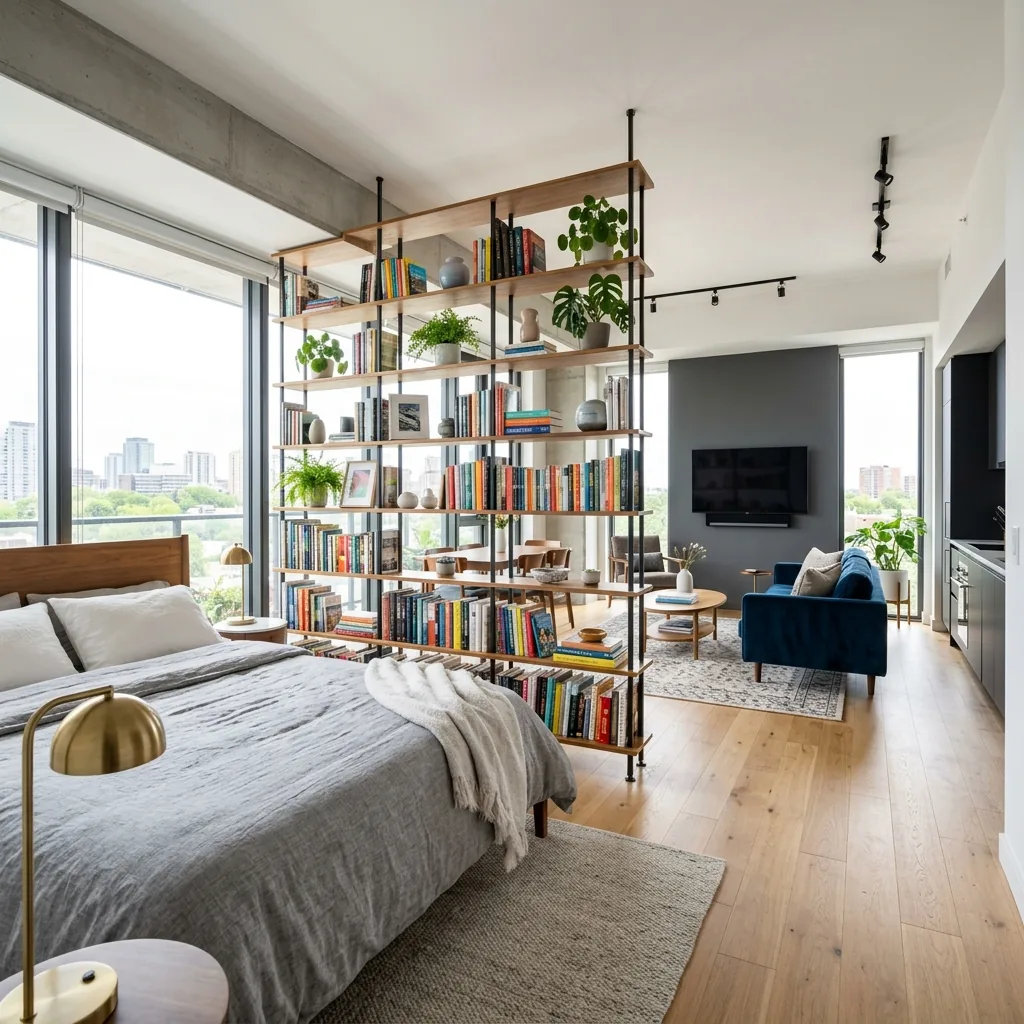
A 25m² studio is a single white box. Living, working, eating, and sleeping in the same visual space without separation creates real psychological strain — your brain struggles to shift between “work mode” and “rest mode” when every mode happens in the same unbroken room.
The solution isn’t construction. Soft zoning uses furniture, light, rugs, and scent to create distinct psychological areas without modifying a single wall. Here’s how to create 3–4 functional zones in one room that your brain will actually register as separate spaces. Reinforce zones with scent zoning.
Table of Contents
- Why Your Brain Needs Zones (And What Happens Without Them)
- Zone 1: The Sleep Zone — Separation and Darkness
- Zone 2: The Work Zone — Containing Productivity
- Zone 3: The Living Zone — Anchoring the Social Area
- Zone 4: The Dining Zone — Optional But Worth It
- The 7 Zoning Tools Ranked by Effectiveness
- The Lighting Layer: What Most Guides Miss
- FAQ
Why Your Brain Needs Zones (And What Happens Without Them)
Environmental psychology research shows that spatial cues — changes in light level, floor texture, furniture orientation — are among the strongest triggers for mental state transitions. When you enter a room with different characteristics, your brain shifts mode automatically. Without those cues, transitions become harder. More ways to divide a room without building anything are collected in these studio apartment zoning ideas that act as invisible walls.
In a studio apartment without zoning, the most common symptom is difficulty “switching off” after work. Your laptop is in the same visual field as your bed. The boundaries between work and rest are completely absent. This is a well-documented contributor to poor sleep quality in home-office workers — a 2021 study from King’s College London found that 62% of people working from home reported new or worsened insomnia.
Zoning creates the environmental differences your brain uses to make transitions automatically.
Zone 1: The Sleep Zone — Separation and Darkness
The sleep zone needs two characteristics: visual separation from the rest of the apartment, and the ability to get dark during the day.
Physical separation tools:
– Open bookshelf perpendicular to the wall — IKEA KALLAX or BILLY placed at the foot of the bed creates a visual boundary without blocking light. Fill lower cubbies with opaque boxes; leave upper sections open. The bookshelf should be 180–200cm tall to create genuine zone separation.
– Tension rod curtain divider — a ceiling-height tension rod (or two rods with a horizontal crossbar using tension pole system) with a floor-to-ceiling curtain. Can be pulled closed for privacy or pushed to one side. Zero drilling required.
– Bed canopy — a fabric canopy suspended from a single ceiling hook (one small hook, patchable) creates a contained sleeping space without any room divider. Split the room with tension rod room dividers.
Darkness: Use blackout curtains that can be drawn across the sleep area specifically. If your bed is far from the window, a portable blackout panel (tension-mounted or clipped to a freestanding frame) blocks light from the window side without affecting the rest of the room. Fabric does the dividing work as well as the blocking, and smart textiles used as fabric walls in a studio cover the weights and mounting options that hold up over time.
Rug: A high-pile rug under and around the bed — minimum 160cm × 230cm — anchors the sleep zone. The moment you step off the rug, your brain registers a transition.
Zone 2: The Work Zone — Containing Productivity
The work zone has one job: when you’re in it, you’re working. When you’re not in it, it should be visually contained enough that it doesn’t bleed into your leisure time.
Desk placement: Never put your desk facing the bed. The visual relationship between work and sleep degrades both. Place the desk perpendicular to or facing away from the bed, ideally in a corner or beside a window.
The “cloffice” technique: If you have a deep closet near the work area, remove the hanging rail and install a desk shelf at 75cm height. Keep the closet doors closed when not working — the folding doors become a physical “work is closed” signal. See the smart closet office setup guide for the full build.
Lighting: The work zone needs brighter, cooler light than the rest of the apartment. A dedicated desk lamp with adjustable colour temperature (cool white 4000–5000K for focus) keeps the work light separate from the ambient warm lighting of the living area. When the desk lamp is off, the zone visually recedes.
Scent: A diffuser with a sharp scent (peppermint, eucalyptus) running only during work hours creates an invisible boundary that operates through your olfactory system. When you finish work, turn it off and switch to a warmer scent elsewhere in the apartment. This sounds like pseudoscience but the mechanism is well-established — scent association is one of the fastest-acting conditioned response triggers.
Zone 3: The Living Zone — Anchoring the Social Area
The living zone — sofa, coffee table, the area for reading, watching, relaxing — is typically the largest zone in a studio. It needs to feel distinct from the sleep zone without being physically separated.
Rug: A flat-weave or low-pile rug in a different pattern or colour from the sleep zone rug anchors the living area. The sofa and coffee table should sit entirely on this rug — not partly on it. An undersized rug (front legs only on the rug) visually disconnects the furniture arrangement.
Furniture orientation: Point the sofa away from the bed. The back of the sofa to the sleep zone, the front toward the entertainment area. This simple orientation change means you’re never looking at the bed while you’re relaxing on the sofa.
Visual barrier options:
– Tall floor plants (Monstera, Dracaena, Fiddle Leaf Fig in a large pot) on the boundary between sleep and living zones
– A sofa table (a narrow console table behind the sofa) with objects on it that face the living zone, creating a “room edge” signal
Zone 4: The Dining Zone — Optional But Worth It
In a studio under 25m², a dedicated dining zone often isn’t practical. But even a small visual designation — a bar stool area at the kitchen counter, or a folding table that stays at a specific spot — helps separate eating from working and relaxing.
A rolling apartment kitchen island can do the same job, doubling as a movable divider between the cooking zone and the rest of the room.
If you have the space: a bistro table and two chairs (60cm × 60cm footprint) positioned under or near a window creates a dedicated eating zone. Meals eaten in a designated spot (rather than on the sofa or at the desk) are better for digestion and separate the eating ritual from other activities.
The 7 Zoning Tools Ranked by Effectiveness
| Tool | Cost | Renter-Friendly | Zone Impact |
|---|---|---|---|
| Open bookshelf divider | €60–€200 | ✅ Freestanding | High |
| Area rugs (contrasting) | €40–€150 per rug | ✅ No fixings | High |
| Lighting zones | €30–€80 per lamp | ✅ Plug-in | High |
| Curtain/tension divider | €50–€120 | ✅ No drilling | Medium-High |
| Tall floor plants | €30–€80 | ✅ Freestanding | Medium |
| Scent zoning | €15–€30 | ✅ No fixings | Medium |
| Colour/texture changes | €0–€50 (paint not allowed, textiles yes) | ✅ Removable | Medium |
Safety Disclaimer
Tall, freestanding bookshelves used as room dividers must be stable. An unsecured KALLAX can tip if heavily loaded on the top cubbies. Anchor to the wall with an L-bracket at the top rear corner if possible — most landlords consider this minor and reversible damage. Alternatively, position the unit in a corner or ensure the base is loaded heavier than the top to maintain the centre of gravity low.
FAQ
How do I zone a studio that’s only 20m²?
Focus on two zones: sleep and living. Use rugs as the primary separator — one high-pile rug at the bed, one flat-weave rug at the sofa. Add a single tall bookshelf or curtain divider between them. A full 4-zone setup doesn’t make sense at this scale.
Can I use a sofa as a room divider?
Yes — a sofa placed with its back facing the sleep area creates a functional boundary. Add a narrow console table behind it (facing the sleep zone) to add physical height to the division. This works particularly well if the sofa is 80+ cm tall at the back.
Does scent zoning actually work?
The mechanism is real: scent is processed by the olfactory bulb which connects directly to the limbic system (emotion and memory centres) without going through the thalamus relay. Conditioned scent associations form quickly (typically 3–7 repetitions). Whether you find this helpful depends on whether you’re consistent — using the same scent only in the work context and another only in the relaxation context.
My landlord won’t allow any drilling — how do I hang a curtain divider?
Tension pole curtain systems require zero drilling. Two floor-to-ceiling poles (like IKEA SPANST or a Storey system) with a horizontal crossbar hold a ceiling-height curtain panel. Tension poles can support up to 15–20kg each — more than enough for fabric. Alternatively, adhesive ceiling hooks rated for 4–5kg can support lightweight curtain fabric on a tension rod.
How do I stop the living zone and sleep zone from feeling claustrophobic after dividing?
The key is keeping both zones visually open toward the window. Don’t position the bookshelf or curtain so that either zone is cut off from natural light. An open bookshelf (not solid) and a sheer curtain that lets light through maintain brightness in both zones. Open it up by learning to maximize natural light.
