A mini balcony garden is not a compromise — it’s a different kind of gardening. When you’re working with 2–6 m² of outdoor space, every container placement is a decision, every plant earns its spot, and the result is almost always more intentional than a sprawling backyard ever gets. I’ve gardened on balconies ranging from a 1.8 m² fire-escape-style ledge to a relatively generous 5.4 m² south-facing slab, and the smallest ones taught me the most.
The first mistake I made on my smallest balcony was trying to scale down a normal garden. I bought the same plants, just fewer of them. Wrong move. A mini balcony garden needs its own logic — vertical thinking, weight-first planning, and plant choices built around production per square centimeter, not per square meter.
Here’s how to actually do it, starting from the tiniest possible space and scaling up.
Table of Contents
- Materials & Tools Needed
- Before You Start: The Weight and Space Audit
- Step 1: Map Every Centimeter
- Step 2: Go Vertical First
- Step 3: Choose Your Core Setup (by balcony size)
- Step 4: Pick Plants That Earn Their Place
- Step 5: Solve Watering Without a Tap
- Step 6: Make It Look Like a Garden, Not a Shelf
- What Is the Best Mini Balcony Garden Setup for Renters?
- My Experience with a Mini Balcony Garden
- Common Mistakes
- FAQ
Materials & Tools Needed
| Item | Approx Cost ($) | Notes |
|---|---|---|
| Railing planter with adjustable bracket | $12–20 | No drilling, clamps to railing |
| Fabric grow bags (3–5 gallon) | $8–15 for 5-pack | Lightweight, good drainage |
| Tension rod (floor-to-ceiling) | $15–25 | Vertical system, no wall damage |
| Hanging pocket planter (12 pockets) | $12–18 | Herbs and strawberries |
| Lightweight potting mix (perlite blend) | $14–20 | Half the weight of standard soil |
| Self-watering inserts or reservoir pots | $10–18 | Critical for small containers |
| Moisture meter | $8–12 | Prevents overwatering |
| Cable ties (pack) | $4 | Securing railing planters from wind |
Before You Start: The Weight and Space Audit
Two numbers matter before you buy anything: usable floor area and structural load limit.
Measure your actual usable space — exclude the area you need to stand in and move around. On a 3 m² balcony, your usable gardening area is more like 1.2–1.5 m² once you account for access. That’s the real footprint you’re planning for.
Then check your weight limit. Most European apartment balconies are rated 150–200 kg/m². Use 50% of that as your working garden limit to leave safety margin. A mini garden should never exceed 60–80 kg total — and in most cases you’ll be well under 40 kg. Full calculation method: how to calculate balcony weight limits.
Micro-Fail Warning: Wet soil weighs 2–3× more than dry. I once filled six railing planters with standard potting mix, watered them, and suddenly had a much heavier setup than I’d planned. Weigh your containers after a full watering, not before.
Step 1: Map Every Centimeter
Sketch your balcony — even a rough drawing on paper. Mark: – The door and swing radius (no containers can block this) – The railing (railing planters go here) – Corner against the building wall (heaviest containers here) – Ceiling height above (for tension rod calculation) – Sun direction and peak hours
This takes 10 minutes and prevents expensive mistakes. On a mini balcony, a 30 cm error in planning can mean you can’t open the door.
Pro-Tip Checklist: – Mark where the structural slab is strongest — always the zone closest to the building wall – Note any drainage grates in the floor — don’t place heavy containers directly over these – Check railing height and top rail width — determines which bracket types fit
Step 2: Go Vertical First
On a mini balcony, floor space is the scarcest resource. Every container on the floor costs you floor space. Every container in the air costs you nothing.
Before placing a single pot on the floor, install your vertical systems:
Tension rod column: A single floor-to-ceiling tension rod with S-hooks carries 4–6 hanging planters in 0.1 m² of floor footprint. That’s six herb pots in a space smaller than a sheet of paper. Mount against the building wall — it’s the most structurally stable point.
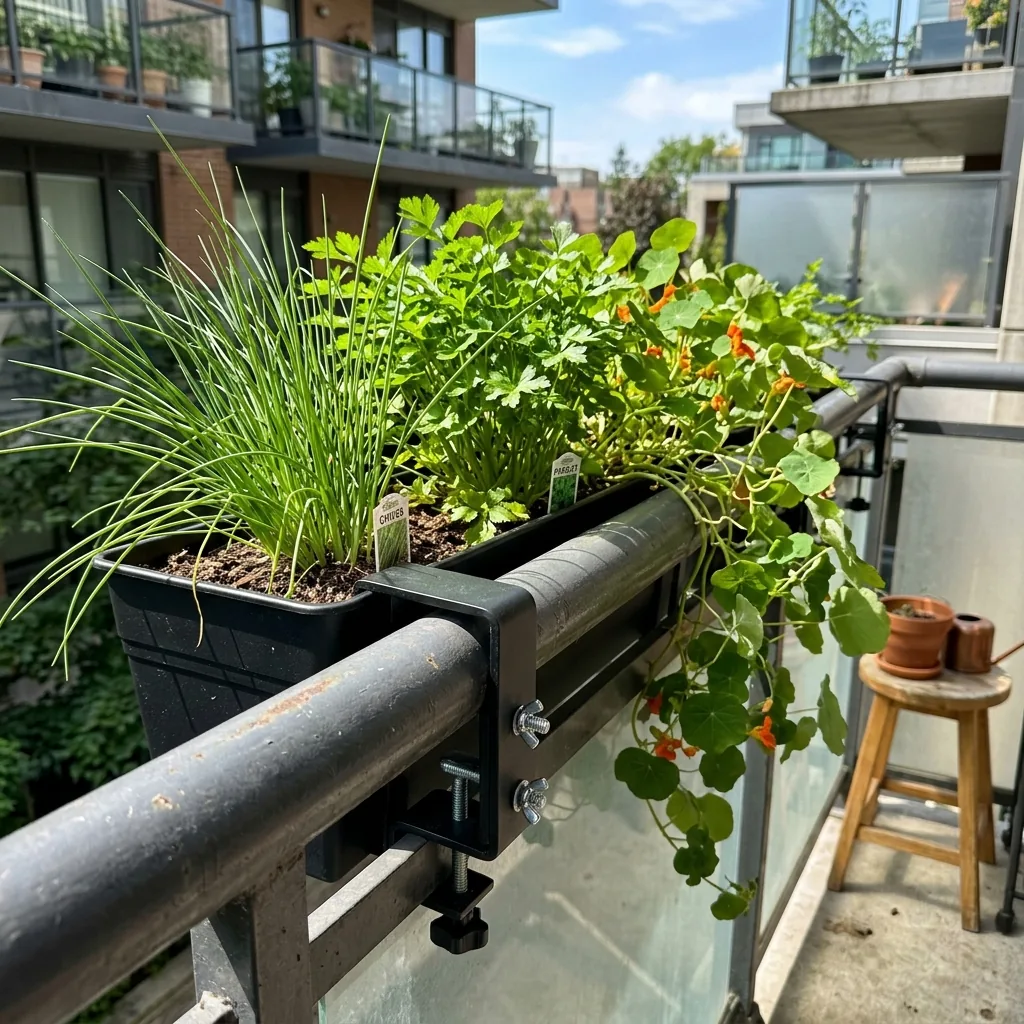
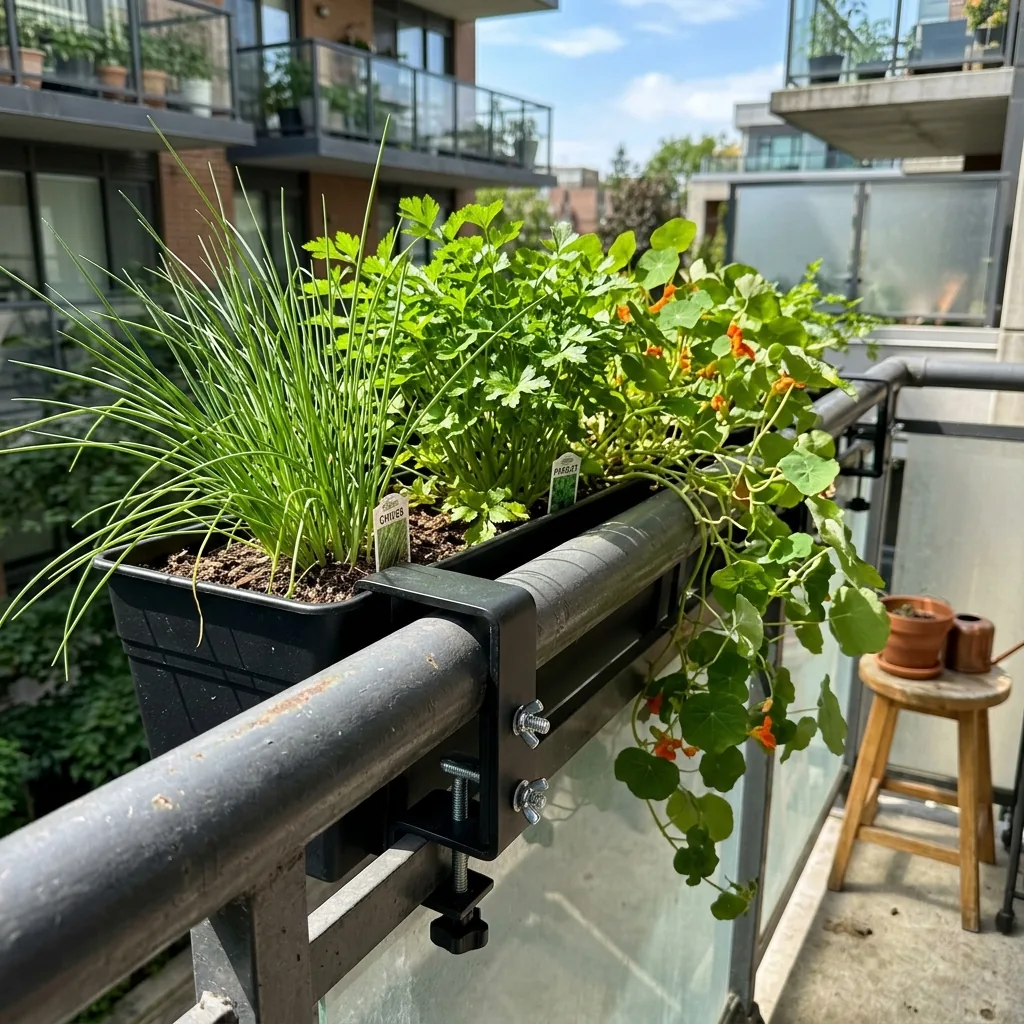
Railing planter row: Three railing planters along a 1.5m railing section hold 9–12 herb pots with zero floor weight. Secure each bracket with a secondary cable tie. This is your highest-productivity zone per square centimeter.
Pocket planter on railing: A vertical fabric pocket planter hung from the railing or tension rod holds 12 individual plants — strawberries, herbs, lettuce — in a single strip that’s 60 cm wide and 90 cm tall.
Only after these are installed do you decide what, if anything, goes on the floor.
Step 3: Choose Your Core Setup (by balcony size)
Tiny (under 2.5 m²) — Railing + One Tension Rod
The entire garden lives off the floor. Three railing planters (herbs), one tension rod with four hanging pots (trailing plants, strawberries), one pocket planter (lettuce mix). Total weight: under 15 kg. Total floor containers: zero.
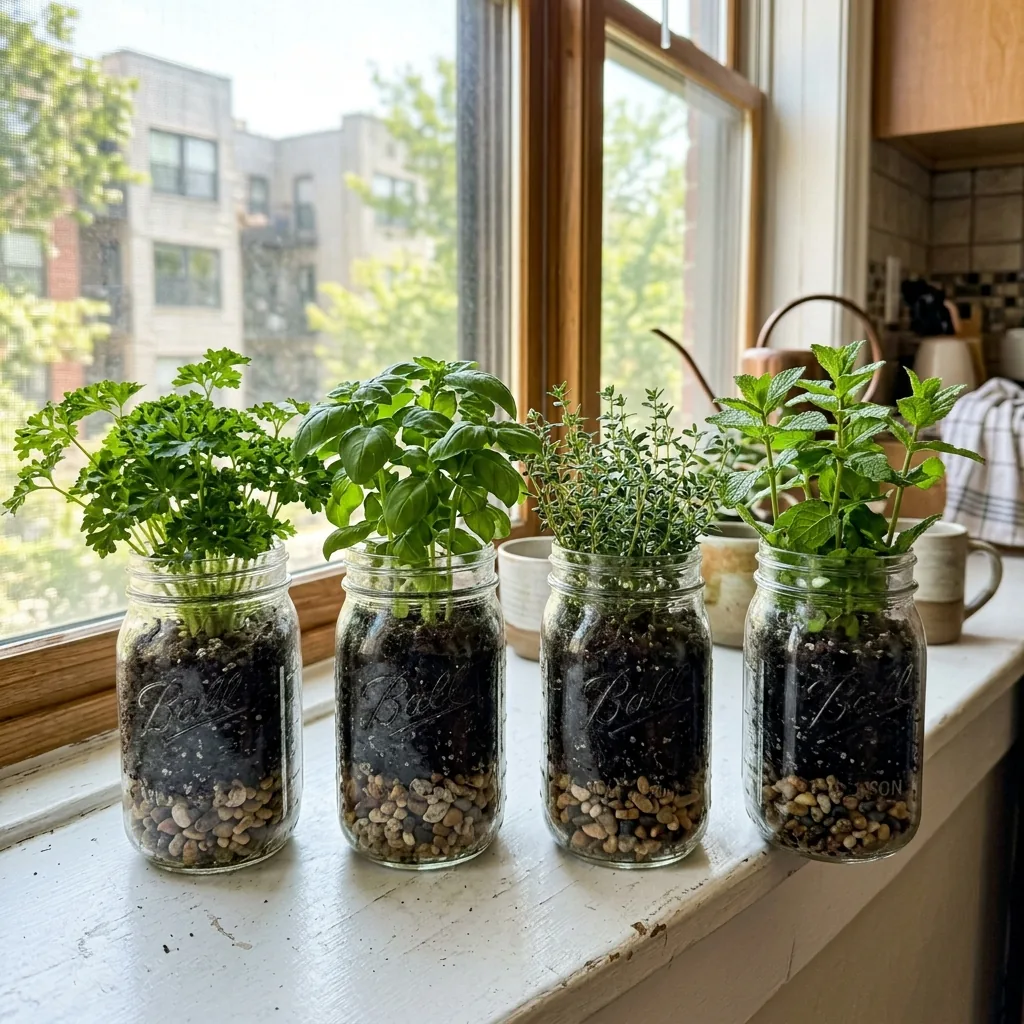
Plants: chives, parsley, thyme, oregano, mint, strawberries, trailing nasturtiums, lettuce.
Small (2.5–4 m²) — Railing + Tension Rod + One Floor Stand
Add a single 3-tier freestanding plant stand against the building wall. This handles 6–9 medium pots without significant floor footprint (0.3 m²). Now you can grow larger plants — tomatoes, peppers, chard.
Total weight fully planted: 25–40 kg. Easily within any balcony’s structural budget.
Medium (4–6 m²) — Full Three-Layer Setup
Railing planters, tension rod verticals, and 2–3 grow bags on the floor for your biggest plants. This is the setup in the complete balcony garden setup guide — scaled down to mini proportions.
Total weight: 50–70 kg. Productive enough for herbs, salads, tomatoes, and flowers simultaneously.
Step 4: Pick Plants That Earn Their Place
On a mini balcony, every plant needs to justify its container space. That means productivity, visual interest, or both. Single-purpose plants that just sit there take up space that could be working harder.
High earners (grow these first): – Cherry tomatoes — one plant per 25L bag, continuous harvest June–October, visual height, doubles as a privacy screen if trained up the tension rod – Cut-and-come-again lettuce — harvest outer leaves continuously, one railing planter yields enough for a side salad every 3–4 days – Herbs (thyme, oregano, chives, parsley) — low maintenance, constant use, compact root systems work in 15cm containers – Strawberries — trail beautifully from railing planters or pocket planters, fruit across a long season
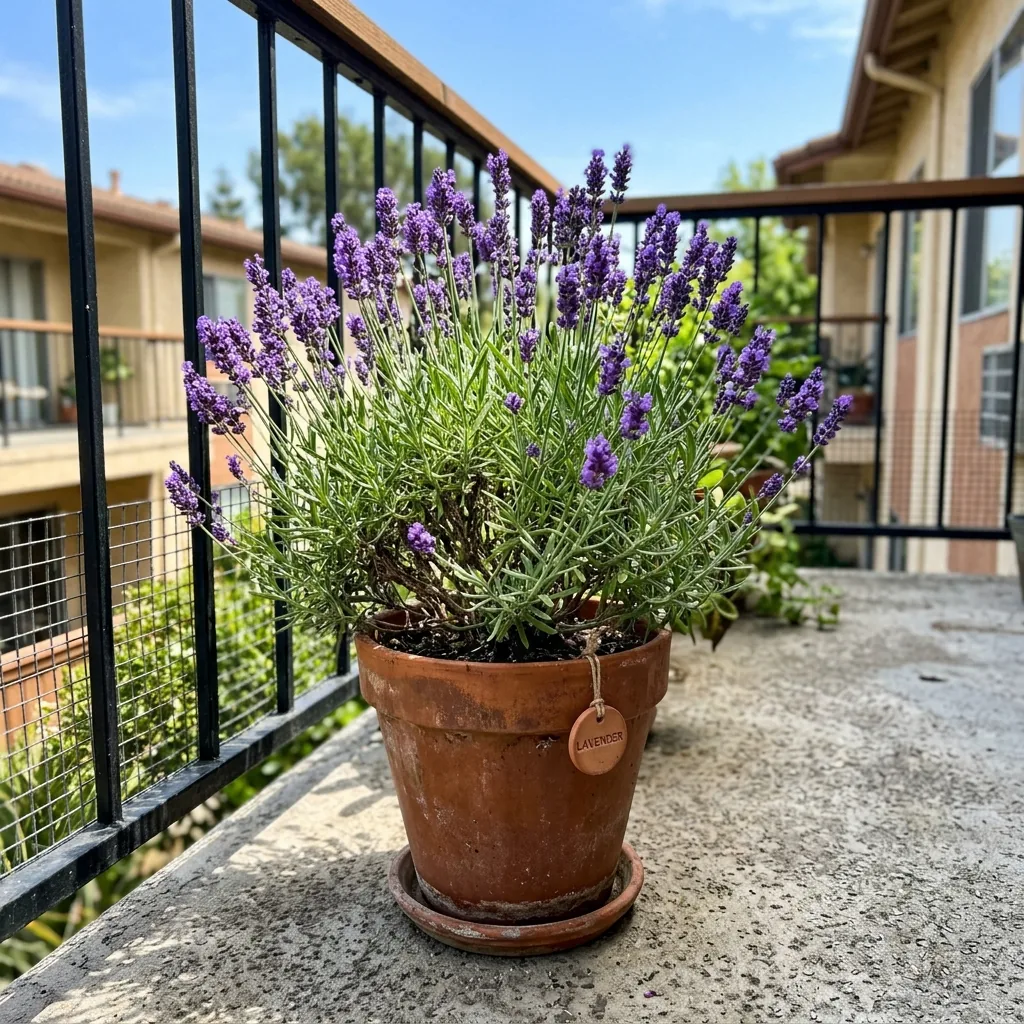
Visual anchors (earn their place aesthetically): – Trailing nasturtiums — edible flowers, fast growth, fills gaps attractively, extremely low cost – Compact lavender — drought-tolerant, fragrant, deters insects, looks good from spring through autumn – Dwarf sunflowers — single-season statement, no maintenance, bees love them
Avoid on mini balconies: courgette (too large), full-size sunflowers (too tall and heavy), any plant that needs more than a 30L container to fruit properly.
For full plant guidance including shade tolerance and wind resistance: smart balcony herb gardens.
Step 5: Solve Watering Without a Tap
Mini balcony gardens dry out fast — small containers, sun exposure, wind. On a 2 m² balcony with six railing planters, daily manual watering takes 8–10 minutes. On a full setup with fifteen containers, that’s 20–25 minutes every morning in summer.
The solution for mini setups: a gravity drip system using a 6–8L reservoir (smaller than the standard 15L, appropriate for a mini setup) elevated on a small stool or shelf. Connect 4mm tubing to each container. Fill every 2 days. Total watering time drops to 3 minutes.
For railing planters specifically, self-watering reservoir inserts ($10–15 for a set of five) hold enough water to bridge 24–36 hours between manual top-ups. In shade, this extends to 48–72 hours.
Full no-tap watering methods: smart watering systems for balcony without tap.
Step 6: Make It Look Like a Garden, Not a Shelf
The visual difference between a mini balcony garden and a collection of random pots is height variation and consistent containers.
Height variation: You need plants at three levels — floor/low (grow bags), mid (stand or railing planters), and high (hanging pots or climbing plants on the tension rod). Without all three levels, the setup looks flat regardless of how many plants you have.
Consistent containers: You don’t need matching pots, but you need a consistent material story. All terracotta, all black fabric bags, or all rattan-covered plastic — pick one and stick to it. Mixed ceramics, plastic bags, and metal buckets fight each other visually.
One statement plant: Choose one plant to be significantly larger than everything else — a climbing tomato, a tall rosemary, a trained climbing bean. This anchors the arrangement and prevents the “flat shelf” look.
Add one non-plant element: A small solar lantern, a ceramic figurine, a piece of driftwood. A mini garden that looks like a garden rather than a grow operation needs one object that isn’t a plant.
What Is the Best Mini Balcony Garden Setup for Renters?
The best mini balcony garden setup for renters uses three layers: railing-mounted herb planters for zero floor weight, a floor-to-ceiling tension rod for hanging planters and climbing plants, and lightweight fabric grow bags placed against the building wall for larger vegetables. This approach fits balconies as small as 2 m², requires no drilling, and stays well under typical structural load limits. A complete mini setup for 6–10 plants costs $50–80 in equipment and produces fresh herbs, salad leaves, and cherry tomatoes continuously from late spring through early autumn. The critical renter constraint is no-drill attachment methods and lightweight growing media — perlite-blend soil weighs approximately half of standard garden soil.
My Experience with a Mini Balcony Garden
My smallest-ever balcony was 1.8 m² — a 1.5m × 1.2m rectangle on a 3rd floor apartment with a west-facing orientation and a landlord who had specifically added “no permanent modifications” to the lease in handwriting.
I fit twelve plants on it. Two railing planters with herbs (chives, thyme, oregano). A tension rod with three hanging pots (trailing nasturtiums and a small fern). A pocket planter on the railing with six lettuce varieties. One 15L fabric grow bag in the corner with a cherry tomato.
The whole setup cost $52 and weighed approximately 18 kg fully watered. The tomato produced 1.8 kg that season — not a lot, but I ate it from a balcony the width of a large doormat.
The thing nobody tells you about mini balcony gardens: the constraint makes you more intentional. Every decision is deliberate. The plants you choose are the plants you actually want. Nothing is there by default. That’s worth more than the extra space.
Common Mistakes
Buying floor containers first. On a mini balcony, floor space is gold. Fill your vertical and railing zones completely before a single pot touches the floor.
Using standard potting soil. Standard soil is heavy. A 15L bag of standard potting mix weighs 8–10 kg wet. The same volume of perlite-blend mix weighs 4–5 kg. On a mini balcony where every kilogram counts, this is a significant difference.
Choosing plants by appearance in the shop. Plants at the garden center look appealing when small and compact. They won’t stay that way. Check the mature size of every plant before buying — courgette, pumpkin, and standard sunflowers will outgrow a mini balcony within weeks.
Neglecting wind. Even at the 3rd floor, a west-facing balcony gets afternoon wind. Railing planters without secondary cable ties will eventually fall. Secure everything before planting, not after losing a pot.
FAQ
What is the minimum balcony size for a garden? You can garden on a balcony as small as 1 m² using railing planters and a single hanging pocket planter — no floor containers needed. At this size, expect herbs and trailing flowers only. Vegetables need at least 1.5–2 m² of usable space.
What’s the best plant for a very small balcony? Cherry tomatoes (in a fabric grow bag) for productivity, or herbs in railing planters for the best yield-to-space ratio. Trailing nasturtiums for visual impact at almost no cost.
How many plants can I fit on a 3 m² balcony? Realistically 10–18 plants depending on species size, using vertical systems. Railing planters (6 pots), a tension rod (4 hanging pots), a pocket planter (8 slots), and 1–2 floor containers gives you 19–20 planting positions in a well-organized 3 m² setup.
Do I need permission from my landlord for a balcony garden? Container gardening in removable pots generally doesn’t require landlord permission — it’s not a structural modification. Check your lease for clauses about “balcony alterations” or “external modifications,” but container gardens are almost universally excluded from these restrictions.
How do I water a mini balcony garden if I travel? Self-watering reservoir inserts in railing planters hold 24–48 hours of water. A gravity drip system with a 6–8L reservoir covers a mini setup for 2–3 days per fill. For trips longer than 3 days, ask a neighbor or install a timer on an indoor pump-fed system.
Safety Disclaimer
Railing planters must be secured with secondary cable ties in addition to the bracket clamp — wind can displace bracket-mounted planters, particularly above the 2nd floor. Always calculate your total garden weight with saturated soil and place heaviest containers at the building wall, not the railing edge. Never exceed 80% of your balcony’s rated structural load.