
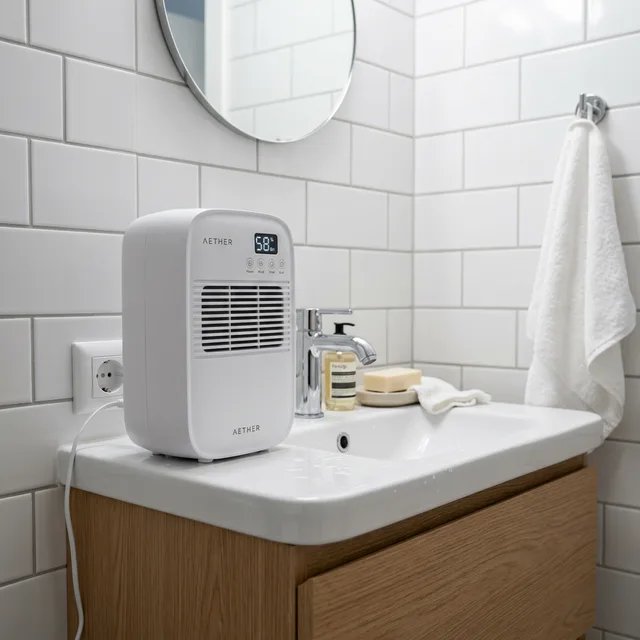
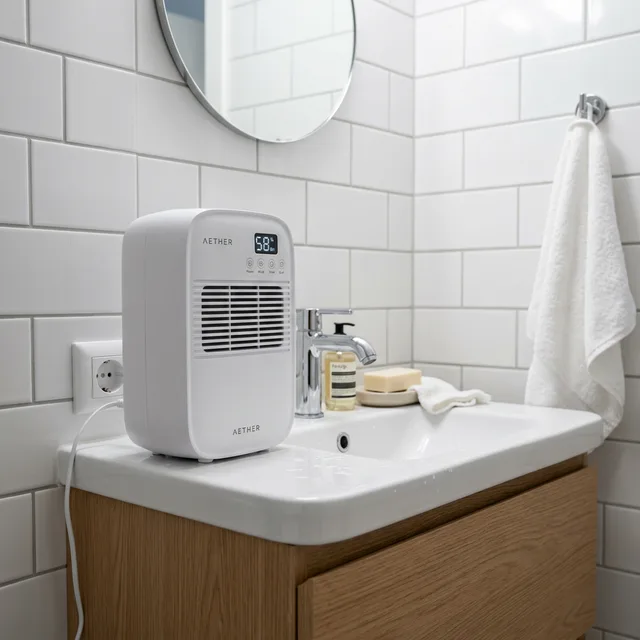
Finding a compact dehumidifier for apartment bathroom no vent setups is critical if you want to protect your health and your security deposit. In many older urban apartment buildings, landlords cut corners by building interior bathrooms with zero exterior windows and absolutely no mechanical exhaust fans.
When you take a hot shower in a 40-square-foot closed room, the relative humidity instantly spikes to 100%. Without an exhaust fan to physically pull that moisture out, the steam settles on your walls, mirrors, and ceiling. Within weeks, you will start seeing black mold spores blooming in the grout lines and on the ceiling paint. Leaving the bathroom door open to vent the steam into your tiny studio apartment just transfers the moisture problem to your mattress and clothing. You need an active, electronic dehumidifier that is aggressively powerful but small enough to sit on a narrow vanity or the back of a toilet tank.
My Experience with Windowless Studio Bathrooms
When I moved into my second apartment, I thought the tiny, windowless bathroom was charming—until I took my first shower. The mirror stayed completely fogged over for three hours. The towels on the hook never fully dried, developing a permanent, sour mildew smell. By month two, a terrifying constellation of black mold spots started spreading across the drywall above the showerhead.
My landlord refused to install an exhaust fan, claiming it would require rerouting the building’s central ductwork. I tried using massive tubs of “DampRid” (calcium chloride crystals), but they filled up within a week and cost me a fortune to constantly replace.
I finally bought a small thermoelectric (Peltier) dehumidifier. It was the size of a toaster. I plugged it in on my vanity, closed the door, and turned it on while I showered. I left it running for an hour afterward. When I came back, the water tank had pulled an entire cup of liquid straight out of the air. The mirror was crystal clear, the towels dried rapidly, and the mold stopped growing instantly.
Compressor vs. Thermo-Electric (Peltier) Tech
When shopping for micro-dehumidifiers, you will see two distinct types of technology. Understanding the difference is the key to preventing mold in a small space.
- Compressor Dehumidifiers: These are heavy, loud, and use chemical refrigerant (like a window AC). They pull gallons of water per day, but they are massive. They belong in wet basements, not on your bathroom sink.
- Thermo-Electric (Peltier) Dehumidifiers: These use no moving parts other than a small fan. An electric current passes between two plates, making one side freezing cold. As the bathroom fan blows humid air over the cold plate, the moisture instantly condenses into water droplets and falls into a tank. They are whisper-quiet, lightweight, and perfect for bathrooms under 150 square feet.
The 5 Best Compact Bathroom Dehumidifiers
After testing multiple units in unventilated, high-humidity micro-bathrooms, these five models proved capable of rapidly clearing steam without hogging your counter space.
1. Eva-Dry Edv-1100 Electric Petite (Best Overall)
Eva-Dry is the undisputed champion of the micro-dehumidifier market. This specific model is a workhorse designed specifically for high-humidity closets and windowless bathrooms. * Extraction Rate: Pulls up to 8 ounces of water per day. * Tank Capacity: 16-ounce reservoir (meaning you only have to dump it every two days). * Footprint: It measures roughly 6×4 inches. It fits perfectly on the back of a standard toilet tank if you have zero counter space. * Why it Wins: It features an automatic shut-off sensor. When the tank is full, a yellow LED turns on and the machine stops, guaranteeing it will never overflow onto your floor.
2. Pro Breeze Electric Mini Dehumidifier (Best Aesthetic)
If you want a machine that looks like a piece of modern tech rather than a medical device, Pro Breeze is the sleekest option. * Extraction Rate: Pulls 9 ounces per day. * Design: Clean white plastic with a bright blue LED interior light that makes the water tank glow (which actually doubles as an excellent bathroom nightlight). * Noise: Operates at under 30dB, which is quieter than a desktop computer fan.
3. SEAVON Electric Dehumidifier (Best for Heavy Steam)
If you take incredibly long, hot showers and need a bit more power without upgrading to a massive compressor unit, the SEAVON utilizes a dual-semiconductor Peltier setup. * Extraction Rate: Extracts up to 16 ounces per day (double the standard petite models). * Tank Size: 35 ounces. * Trade-off: It is slightly larger (about the size of two large cereal boxes pushed together), so it requires actual counter space, but it clears a fogged mirror twice as fast.
4. TABYIK 35 OZ Small Dehumidifier (Best Budget Power)
A highly effective, no-frills option if you need to solve the mold problem immediately on a strict renter’s budget. * Extraction Rate: 16 ounces per day. * Feature: Features a dedicated “sleep mode” that turns off all the bright LED display lights while keeping the fan running on its lowest, quietest setting.
5. Afloia Q10 Dehumidifier (Best Cylinder Design)
Most dehumidifiers are boxy. The Afloia Q10 is a sleek, vertical cylinder that takes up significantly less horizontal surface area. * Air Intake: Uses a 360-degree air intake design instead of a single front vent, meaning it pulls moisture from every corner of the tiny bathroom simultaneously. * Operation: Features a single one-touch button on top. Incredibly simple to use with wet hands stepping out of the shower.
Pro-Tips for Maximizing Bathroom Extraction
- Pre-Turn On: Do not wait until after your shower to turn the machine on. Turn the dehumidifier on before you step into the shower. Getting the cold plate chilled and the fan moving prevents the heaviest steam from adhering to the walls in the first place.
- Keep the Door Closed: When running the dehumidifier after a shower, keep the bathroom door shut for at least 45 minutes. If you open the door, the small machine will try (and fail) to dehumidify your entire studio apartment instead of focusing on the dense bathroom moisture.
- Deep Clean the Tank: Once a month, fill the water collection tank with a 50/50 mix of white vinegar and water. Let it sit for 20 minutes to kill any pink bacterial slime that naturally builds up in standing water.
Compare Compact Dehumidifiers
| Brand & Model | Daily Extraction | Tank Size | Best Feature | Placement |
|---|---|---|---|---|
| Eva-Dry Edv-1100 | 8 oz | 16 oz | Toilet tank footprint | Toilet / Very Small Sink |
| Pro Breeze Mini | 9 oz | 16 oz | Built-in LED nightlight | Sink Vanity |
| SEAVON Dual | 16 oz | 35 oz | Extreme rapid extraction | Floor / Large Sink |
| Afloia Q10 | 11 oz | 20 oz | 360-degree cylindrical pull | Tight Corners |
Conclusion
A bathroom without an exhaust fan or a window is a ticking time bomb for toxic mold and ruined drywall. You cannot rely on passive moisture absorbers to handle the daily steam load of a shower. Investing $40 to $60 in a compact thermo-electric dehumidifier is the smartest, most renter-friendly insurance policy you can buy. Choose a model that fits your vanity, plug it in, and never deal with a sour-smelling damp bathroom towel again.
Does a small dehumidifier really prevent bathroom mold?
Yes, a small thermo-electric dehumidifier effectively prevents bathroom mold by actively dropping the relative humidity below 50% after a shower. Mold spores require sustained high-moisture environments (like damp drywall or constantly wet grout) to germinate and spread. By physically pulling the airborne water vapor out of the tiny, enclosed bathroom space and dumping it into a collection tank, the dehumidifier rapidly dries out the walls and towels, removing the essential biological requirement for mold and mildew growth.
Safety Disclaimer
Because a dehumidifier is a 110v electrical appliance operating in a “wet zone,” it MUST be plugged directly into a modern GFCI (Ground Fault Circuit Interrupter) outlet. Never use extension cords or power strips in a bathroom, and place the unit as far away from the active spray of the showerhead as physically possible to prevent fatal electrocution or short-circuiting.
