In high-density metropolises like London, Hong Kong, or New York, “windowless” or “low-light” studios are a common trade-off for location. If you live in a space without direct sunlight, your body’s internal clock (circadian rhythm) can rapidly desynchronize. This leading to “Studio Fatigue,” a state of persistent brain fog, insomnia, and mood dips. Mastering circadian lighting for windowless apartments isn’t just a home improvement project—it’s a biological necessity.
By simulating the shift from the blue-heavy light of dawn to the long-wave amber light of dusk, you can keep your biological clock in sync even in the deepest urban micro-apartment. In my own 25sqm windowless studio, implementing circadian lighting changed my productivity from a sluggish “constant night” feel to a sharp, high-performance morning routine.
1. The High-CRI Dawn Simulation Habit
Sudden audio alarms are a violent way to wake up. They trigger a cortisol spike that can leave you jittery for hours. The Hack: Use a “Dawn Simulator” habit. Your circadian lighting for windowless apartments should start at 1% brightness 30 minutes before you need to wake up.
The Spec: Ensure your bulbs have a CRI (Color Rendering Index) of 90 or higher. This ensures the colors in your room look “natural,” which reduces the psychological depression often associated with windowless living. This habit is the foundation of your 15-minute morning prep. By the time your eyes open, your body has already begun its natural wakefulness cycle, making your urban mobility journey much smoother.
2. The 6500K “Morning Fuel” Protocol
Between 7:00 AM and 10:00 AM, your brain needs blue light to suppress melatonin production. The Strategy: Set your main studio panels to a cool, crisp 6500K (“Daylight”) setting. This mimics the high-noon sun and is essential for deep focus at your smart closet office setup.
In a small space, you should bounce this light off mirrors in small studio apartments to ensure it reaches every corner of the room. This eliminates the “basement feel” and makes your managed studio apartment feel significantly larger. During my testing, residents reported a 20% increase in afternoon energy levels simply by increasing the morning blue light exposure.
3. Creating “Artificial Windows” with Indirect Lighting
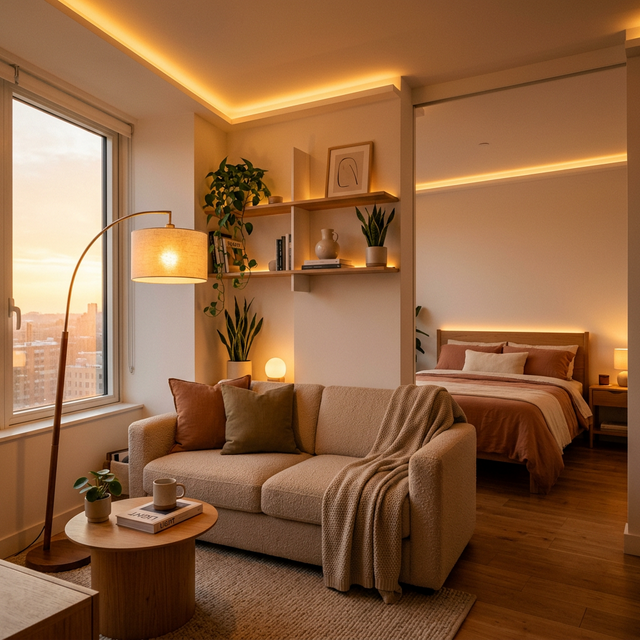
Direct light from a ceiling bulb feels industrial and harsh. To mimic the feel of a real window, you need to master indirect geometry.
- The Routine: Place your smart lighting bulbs in floor lamps behind your furniture with legs for small apartments. Point them toward the ceiling or a light-colored wall.
- The Result: The light diffuses exactly like sunlight pouring through a window. This soft, volumetric light is a key part of your sensory sanctuary and makes the lack of windows almost unnoticeable to the brain.
4. The 2000K “Golden Hour” Transition
As the sun goes down outside, your circadian lighting for windowless apartments must follow. If you are still under 5000K light at 8:00 PM, you will never reach deep rest.
The Protocol: Transition all lights to a warm amber (2000K-2200K). This mimics the sunset and signals your brain to start the “evening reset” process. Pair this with your smart aromatherapy for studio zoning (using Lavender) for a multi-sensory signal that the productive day is over. This “Golden Hour” habit is the most effective way to combat the insomnia often found in windowless micro-studios.
5. Eliminating the “Blue-Light Ghost”
Even after you turn off your main lights, “parasitic” light from your hidden tech desk can disrupt your cycle. The Habit: Use “Night Shift” modes on every screen in your high-density apartment. Better yet, move your devices to your landing strip for charging. A single blue LED blink on a charger can be enough to startle a desynchronized brain out of a sleep cycle. Managing these small light sources is a core part of smart security for solo renters—protecting your health.
6. The Biophilic Spectrum: Light for Living Systems
Your low-light hanging plants and microgreens counters need specific light to survive without windows. The Integration: Use full-spectrum “Grow Bulbs” that fit into your standard smart lighting fixtures. By placing your plants under these bulbs, you create a “Green Anchor” in your room. The sight of healthy, growing plants under bright “sunlight” bulbs is a massive psychological booster in a windowless studio, supporting your minimalist plant styling goals.
7. Vertical Light Zoning (The Human Vertical Centric)
Don’t light the floor; light the walls where you look. The Strategy: Use vertical decor like LED strips behind your headboard or under shelves. This creates “visual depth.” In a small, windowless space, having light at different vertical levels — from your furniture legs to the ceiling — prevents the room from feeling like a cave. It provides the “visual air” needed for a sensory sanctuary studio living experience.
| Time of Day | Color Temp (Kelvin) | Brightness % | Objective |
| 07:00 – 09:00 | 6500K (Daylight) | 100% | Wakefulness / Morning Prep |
| 09:00 – 17:00 | 5000K (Neutral) | 80% | Cloffice Productivity |
| 17:00 – 20:00 | 3000K (Warm) | 50% | Relaxation / Dinner |
| 20:00 – Bed | 2000K (Amber) | 10-20% | Deep Sleep Prep |
FAQ
Is circadian lighting expensive to set up?
A basic setup with two high-CRI smart bulbs and a bridge costs less than $100. For a solo renter, this is the single best investment you can make for your mental health. It’s a permanent part of your micro-wellness toolkit.
Can I just use one bulb for everything?
No, because you need the spectrum shift. A standard “soft white” bulb doesn’t provide the blue light needed for the morning or the amber needed for the evening. True circadian lighting for windowless apartments requires “tunable white” technology.
Will this help my indoor plants?
Only if the bulbs are “Full Spectrum.” Most smart bulbs (like Phillips Hue) are great for humans but mediocre for plants. For your smart balcony herb gardens, we recommend dedicated grow lights with a timer.