
How Much Weight Can a Balcony Hold?
Most apartment balconies hold 40–60 lbs per square foot (195–295 kg/m²). On a standard 4×10 ft balcony, the total capacity is 1,600–2,400 lbs (730–1,090 kg). For safe use with plants and furniture combined, keep the load under 15–20 lbs per square foot (73–98 kg/m²). Wood-frame balconies have lower limits: 30–40 lbs/ft² (145–195 kg/m²).
A balcony garden is the ultimate urban dream — a slice of outdoors where you can grow herbs, sip coffee, and escape the city noise. But if you rent, that dream often comes with a quiet worry: you look at your heavy terracotta pots and bags of wet soil and wonder, “Can my balcony actually handle all this weight?”
This guide explains exactly how much weight a balcony can hold, how to check your specific setup, and practical ways to build a lush garden without risking the structure or your security deposit.
Quick Answer: How much weight can an apartment balcony hold?
Most modern apartment balconies are engineered for a live load of 40–60 lbs per square foot (195–295 kg/m²). On a standard 4×10 ft balcony, that is a theoretical maximum of 1,600–2,400 lbs total. In practice, because people and furniture share that budget, keep your plant load under 15–20 lbs per square foot (73–98 kg/m²). Older buildings and wood-frame balconies typically have lower limits — see the table below.
Balcony Weight Limits by Building Type
Not all balconies are equal. The answer to “how much weight can a balcony hold” depends heavily on construction type and building age. Use this as a starting reference — always confirm with your property manager for the exact live load specification.
| Balcony Type | Typical Load Limit | Safe Plant Budget* | Notes |
|---|---|---|---|
| Modern concrete (post-2000) | 50–60 lbs/ft² | 15–20 lbs/ft² | Most common apartment type |
| Older concrete (pre-2000) | 40–50 lbs/ft² | 10–15 lbs/ft² | Check for cracks first |
| Steel-frame with deck boards | 40–60 lbs/ft² | 12–18 lbs/ft² | Distribute weight evenly |
| Wood-frame (houses/townhouses) | 30–40 lbs/ft² | 8–12 lbs/ft² | Most conservative limit |
| Juliet balcony (no real floor) | Railing only | Hanging baskets only | No floor load capacity |
*Safe plant budget = live load minus estimated weight of people + furniture (assumed 25–30 lbs/ft²)
European Renters (kg / kN/m²): Under Eurocode EN 1991-1-1, most residential balconies are rated 2.5–4.0 kN/m² (255–408 kg/m²). On a typical 4 m² balcony rated at 3.0 kN/m², the theoretical maximum is ~1,224 kg — but your practical plant budget is around 60–80 kg/m² once you account for furniture and people. Older Plattenbau and Haussmann buildings sit at the lower end (2.5 kN/m² = 255 kg/m²). See our full European balcony weight guide (kg/kN) for Plattenbau, Haussmann, and modern concrete ratings with the step-by-step metric formula.
US Renters — Step-by-Step Calculator: Want to calculate your exact limit in square feet and pounds? Our balcony weight limit calculator guide walks you through the 3-step PSF formula with a printable pot audit checklist.
Real Weight of Common Balcony Items
The biggest mistake renters make is calculating weight based on dry soil. After watering or rain, a pot can weigh 1.5–2× more. Here is what common balcony items actually weigh fully loaded:
| Item | Dry weight | Wet weight | Tip |
|---|---|---|---|
| 12″ terracotta pot + soil | 18–22 lbs | 30–40 lbs | Switch to resin to save 60% |
| 12″ plastic/resin pot + soil | 8–12 lbs | 16–22 lbs | Best weight/cost ratio |
| Grow bag (10 gal) + soil | 12–16 lbs | 20–28 lbs | Lightest option for tomatoes |
| Concrete/ceramic planter (large) | 40–80 lbs | 70–120 lbs | Place against wall only |
| Folding bistro chair | 8–12 lbs | — | Plus person: add 150–200 lbs |
| Small bistro table | 15–25 lbs | — | Spread over 4 legs |
Understanding Your Apartment Balcony Load Capacity
Most modern residential balconies are designed to handle a live load — the weight of people, furniture, and movable items. In many regions, common design values are roughly 40–60 pounds per square foot (psf) (about 195–295 kg per square meter).
What that means in practice: cluster four 12-inch ceramic pots filled with wet soil in one corner, and you are putting 120–160 lbs onto roughly one square foot of slab. Even on a well-built modern balcony, that is pushing the limit for that single point. As a renter, you rarely have access to the original structural drawings, so the safest approach is to stay well below any estimated limit and spread the weight out.
Balcony Load Capacity in kg/m² — EU & International Standards [UPDATE 2026]
If you are outside the US — or simply prefer metric — here is the same data converted to kg per square metre (kg/m²). European balconies are typically designed to Eurocode EN 1991-1-1, which specifies a minimum live load of 2.5–4.0 kN/m² (roughly 255–408 kg/m²) for residential balconies. In practice, your usable budget after accounting for people and furniture is much lower.
| Balcony Type | Live Load (kg/m²) | Safe Plant Budget (kg/m²) | Standard |
|---|---|---|---|
| Modern concrete (post-2000, EU) | 255–408 kg/m² | 75–100 kg/m² | Eurocode EN 1991-1-1 |
| Modern concrete (post-2000, US) | 195–295 kg/m² | 73–98 kg/m² | IBC 40–60 lbs/ft² |
| Older concrete (pre-2000) | 195–244 kg/m² | 50–75 kg/m² | Check for corrosion |
| Steel-frame with deck boards | 195–295 kg/m² | 60–90 kg/m² | Spread load evenly |
| Wood-frame (houses/townhouses) | 146–195 kg/m² | 40–60 kg/m² | Most conservative |
Safe plant budget = live load minus ~120 kg/m² reserved for people + furniture. When in doubt, stay under 50 kg/m² for plants.
How to Calculate Your Balcony Load Capacity [UPDATE 2026]
What is the formula for balcony load capacity?
Balcony load capacity formula:
Safe plant load (kg) = Balcony area (m²) × Safe plant budget (kg/m²)
Example: A 2 m × 1.5 m concrete balcony (3 m²) in a post-2000 EU building:
3 m² × 75 kg/m² = 225 kg total safe plant load
That is roughly 8–10 medium resin pots fully watered, or 4–5 large grow bags.
Use this 3-step method to calculate your specific limit:
- Measure your balcony — length × width in metres = total m²
- Find your building type from the table above — use the “safe plant budget” column
- Multiply: area × safe budget = your maximum plant load in kg
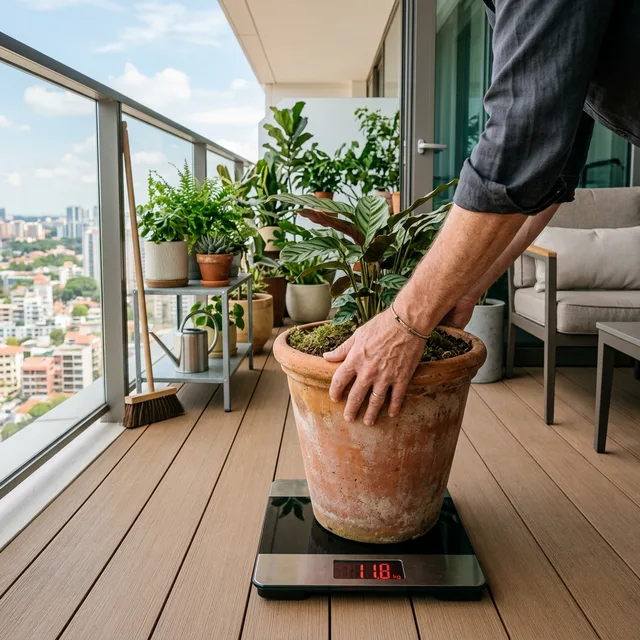
Always weigh your pots after watering, not dry. A kitchen scale works for pots up to 10 kg. For heavier planters, use a luggage scale with a strap around the pot.
Important Safety Disclaimer
This article is for general information only and cannot replace local building codes, engineering calculations, or advice from a licensed structural engineer. Always check your lease and, when in doubt, talk to your landlord or building management before adding heavy items to a balcony.
3 Warning Signs Your Balcony Is Overloaded
Before you buy “just one more” planter, do a quick visual check. If you notice any of these, stop adding weight and seek professional advice:
1. Cracks in the concrete
Not just tiny hairline surface lines, but deeper cracks — especially where the balcony slab meets the main wall of the building.
2. Pooling water or a visible dip
If the balcony used to drain well but now has a low spot where water collects after rain, the slab may be bowing slightly under load.
3. Loose or wobbly railings
Railings are often anchored into the outer edge of the slab. If they start to wobble or the anchors look stressed, that edge may be under too much strain. Remove weight immediately and report to building management.
How to Build a Safe Balcony Garden Without Giving Up Greenery
You do not have to choose between a bare balcony and a structural nightmare. You just need smart weight distribution and lighter materials.
1. Keep heavy pots near the building wall
The strongest part of most balcony slabs is where they connect to the main structure. Place your heaviest containers — small trees, large shrubs, big ceramic planters — against the apartment wall, not along the outer railing. Use only lighter planters or hanging baskets on the balcony edge. This reduces bending forces on the outer part of the slab significantly.
2. Switch to lightweight pot materials
The fastest way to lower your balcony load is to change materials, not cut your plant collection:
- Instead of terracotta or concrete: choose quality plastic, resin, or fibre-clay pots — they are dramatically lighter with no visual trade-off.
- Instead of heavy garden soil: use a container potting mix with perlite or vermiculite. It drains better and weighs 30–40% less when wet.
- Instead of a thick gravel layer: use pot feet, lightweight drainage inserts, or mesh to improve drainage without extra kilos at the bottom.
3. Think vertical, not just horizontal
Some of your plants can move into the vertical plane, keeping floor load low while maximising greenery:
- Wall-mounted planters and trellises (if allowed by your lease)
- Lightweight hanging planters fixed to beams or ceiling hooks
- Multi-tier plant stands that spread weight across a larger floor area
The One-Hand Caddy Test (Practical Renter Rule)
If you cannot comfortably push a pot across the balcony on a plant caddy with one hand, it is probably too heavy for a typical rental balcony — especially if you plan to group several like it together.
Plant caddies do three things at once: protect the balcony surface, make heavy pots movable, and act as a rough weight sensor. If it feels immovable, rethink the size or material.
Calculate Your Balcony Load Before You Buy More Pots
Trying to estimate balcony weight limits in your head is both stressful and inaccurate. Our Balcony Plant Calculator lets you enter your balcony dimensions, choose pot materials and plant types, and see your total estimated load — flagged green, amber, or red against a safe limit. It also shows a 3D layout view so you can plan before you buy.
→ Try the free Balcony Plant Calculator to check your current setup
Frequently Asked Questions
How much weight can an apartment balcony hold?
Most modern apartment balconies are built to a live load of 40–60 lbs per square foot (195–295 kg/m²). On a typical 4×10 ft balcony, the structural maximum is 1,600–2,400 lbs. In practice, your safe plant budget is much lower — roughly 15–20 lbs/ft² — because people and furniture share that total load.
What is the weight limit for a balcony?
For residential apartment balconies built to modern building codes (IBC in the US, Eurocode in Europe), the standard live load is 1.5–2.0 kN/m² (31–42 lbs/ft²) for small balconies and up to 4.0 kN/m² (83 lbs/ft²) for larger terraces. For a conservative safe plant load, use 15 lbs/ft² (73 kg/m²) as your working maximum.
How do I find the specific balcony weight limit for my apartment?
The most reliable method is to ask your property manager for the building’s structural live load specification. This is usually listed in the original building drawings. Most landlords will provide this on request — especially if you explain you are planning a balcony garden.
Does wet soil weigh significantly more than dry soil?
Yes. Saturated potting mix can weigh 1.5–2× more than dry mix. A 12-inch terracotta pot that weighs 18 lbs dry can reach 38–40 lbs after heavy watering. Always calculate your balcony load based on fully watered weights, not the dry figures on bag labels.
Can a balcony collapse from too many plants?
While structural failures from plant weight alone are rare, overloading causes progressive damage — hairline cracks in the slab, fatigue in anchor points, deterioration of the waterproofing layer. Over time this leads to expensive repairs and potential safety risks. Distribute heavy pots near the building wall rather than clustering them at the railing.
What is the lightest pot material for balcony gardening?
Lightweight fabric grow bags are the lightest option — a 10-gallon bag weighs under 1 lb empty and uses much lighter potting mix than hard pots. High-quality resin and fibre-clay pots are the next best option: similar visual appeal to terracotta at 40–60% of the weight.
How much weight can a balcony hold in kg?
Most modern apartment balconies are rated for 195–295 kg/m² (US) or 255–408 kg/m² (EU Eurocode). On a typical 4 m² balcony rated at 250 kg/m², the structural maximum is around 1,000 kg — but your practical plant budget is roughly 60–100 kg total once furniture and people share the load. Always use fully watered pot weights, not dry figures.
What is the load capacity of a typical balcony?
Balcony load capacity varies by building type. Modern concrete balconies carry 40–60 lbs/ft² (195–295 kg/m²) as a live load. Wood-frame balconies sit lower at 30–40 lbs/ft² (145–195 kg/m²). Your safe usable capacity — after subtracting people and furniture — is typically 15–20 lbs/ft² (73–98 kg/m²) for plants and accessories. Check your lease or ask your property manager for the exact structural rating.
What is a typical residential balcony live load in kg per square metre?
Under Eurocode EN 1991-1-1, the minimum live load for residential balconies is 2.5–4.0 kN/m², which equals roughly 255–408 kg/m². In the US, the International Building Code (IBC) specifies 40–60 lbs/ft² (195–295 kg/m²) for the same category. In both cases, your practical plant budget — once people and furniture are factored in — is around 60–100 kg/m².
Read more: See our Complete Balcony Gardening Guide for Renters for more expert tips on building a safe, lush balcony garden.
