
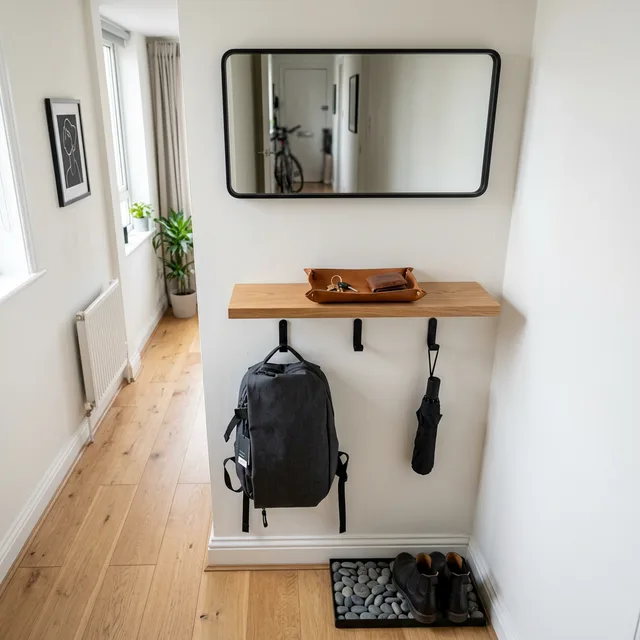
When you unlock the front door of a studio apartment, there’s no hallway, no mudroom, no buffer zone — you step directly into your kitchen or living space. Without a system at the threshold, your daily commuter chaos (wet umbrellas, dirty shoes, mail, heavy coat) bleeds immediately into the apartment you just spent the weekend tidying. See more in our small-space living hub.
The solution is what urban designers call a landing strip: a tight, functional zone at the entry that intercepts clutter before it spreads. You don’t need extra square metres to build one. You need a specific set of objects in specific positions.
Table of Contents
- The Landing Strip Concept: What It Is and Why It Works
- Component 1: Ultra-Slim Shoe Cabinet
- Component 2: Boot Tray With River Stones
- Component 3: Catch-All Tray for Daily Carry
- Component 4: Curated Hook Rail (3 Hooks Max)
- Component 5: Full-Length Mirror
- Component 6: Paper Sorter for Mail
- Component 7: Ambient Entry Lighting
- Full Component Summary
- FAQ
The Landing Strip Concept: What It Is and Why It Works
A landing strip is a deliberate sequence of storage and drop-zones compressed into whatever wall space exists beside your front door — often as little as 80–120cm. Marking that zone visually helps it read as a separate area: a single panel of renter-friendly peel-and-stick wallpaper behind the strip defines the boundary and comes off cleanly at move-out.
The psychological mechanism: when objects have a designated spot at the threshold, they stop there. When they don’t, they migrate — shoes to the living room floor, coats to the sofa back, keys to wherever your hands happened to be. The landing strip converts an unconscious habit (dropping everything randomly) into an automatic one (depositing items in their place before moving into the apartment).
Minimum wall depth required: 20cm (just enough for a slim cabinet and wall hooks). Ideally 30–40cm.
Component 1: Ultra-Slim Shoe Cabinet
A pile of shoes beside the front door is the most common entryway problem in small apartments. The fix is a tilt-out shoe cabinet that projects only 15–20cm from the wall — the depth of a thick book. Apartments with no hallway at all need a different approach, covered in the guide to shoe storage in apartments with no entryway.
The IKEA TRONES (17cm deep) and HEMNES 3-section (30cm deep) are the standard choices. TRONES is shallower but each compartment holds only one pair. HEMNES holds more per unit but needs more floor depth.
The top surface matters: The flat top of the shoe cabinet becomes your primary drop zone. Make sure it’s at a usable height — 75–90cm is ideal. Too low and you have to bend to deposit items; too high and it becomes a visual ledge.
Anchoring: Tall, narrow shoe cabinets with heavy shoes in the top compartment can tip forward. Anchor to the wall with a single screw and wall plug — most landlords consider this negligible damage and some leases explicitly allow it. Alternatively, wedge the cabinet into a corner so it can’t fall forward.
Component 2: Boot Tray With River Stones
During wet or winter months, wet boots saturate the floor and warp laminate within hours. A rubber boot tray with a raised lip (60cm × 40cm is the standard) contains the mess to a defined rectangle.
The river stone trick: Fill the bottom of the tray with smooth river stones. Water drains below the stones, keeping boots and shoes elevated above the puddle. This keeps footwear drier and prevents the tray from becoming a standing water problem. Cost: a bag of decorative stones from a garden centre, €3–€5.
Position the boot tray to one side of the shoe cabinet — not in front of it, which blocks access.
Component 3: Catch-All Tray for Daily Carry
Keys, wallet, phone, sunglasses, transit card. These items leave your pockets every time you enter the apartment. Without a designated landing spot, they scatter across kitchen counters, sofa cushions, and coffee tables.
Place a ceramic, leather, or cork catch-all tray (15–20cm diameter is enough) on top of the shoe cabinet, within reach of the door. The rule is simple: pocket items go in the tray before you take another step into the apartment.
What makes this work: proximity to the door. If the tray is even 2 metres away, compliance drops significantly. Position it so you can deposit items before you’ve fully closed the door.
Component 4: Curated Hook Rail (3 Hooks Max)
Coat hooks solve the outerwear problem — but only if you curate them ruthlessly. Three hooks maximum: daily jacket, dog lead or bag, reusable shopping tote. The bulky winter coat you wear twice a month belongs in the wardrobe.
Renter-friendly installation:
– Command Large Utility Hook (rated 3.6kg) — holds up to a heavy winter coat, no damage
– Over-door hook rail — hangs over the door itself, zero wall impact
– Tension rod with S-hooks — works in narrow hallway alcoves Split the space with tension rod dividers.
The moment hooks accumulate more than 3 items, they stop functioning as a system and become a pile. Monthly clear-out: anything you haven’t worn in 4 weeks goes back to the wardrobe.
Component 5: Full-Length Mirror
A narrow entryway feels like a corridor. A full-length mirror on the wall opposite the door or beside the shoe cabinet doubles perceived width by reflecting the room behind you. It also serves the practical purpose of a final check before leaving. Make it feel bigger with mirrors.
Renter-friendly mounting:
– Command Picture Hanging Strips (Large) — rated for mirrors up to 5.4kg. Verify your mirror’s weight first.
– Lean-against-wall: frameless full-length mirrors can lean rather than hang, requiring zero fixings. Position a small piece of rubber mat under the base to prevent sliding.
Size: 40cm × 120cm minimum to see a full outfit. Frameless versions are cheaper and look larger in small spaces.
Component 6: Paper Sorter for Mail
Mail, delivery notes, and flyers create a persistent clutter problem. If an envelope makes it past the threshold, it sits on the kitchen table until the weekend.
Mount a small wall-mounted mail sorter (two or three slots) directly above the catch-all tray. Immediate habit: sort the mail before putting the key in the tray. Junk goes in a small recycling bag kept beside the door. Bills and important items go in the sorter.
The 24-hour rule: anything in the sorter for more than 24 hours must be dealt with or filed. Don’t let it become a pile.
A magazine file holder attached to the side of the shoe cabinet with adhesive strips works as well as a dedicated wall-mounted sorter.
Component 7: Ambient Entry Lighting
Walking into a dark apartment and hitting an overhead switch is a jarring transition. Ambient, automated lighting at the entry makes arriving home feel calmer.
Options:
– Motion-sensor LED strip along the baseboard — triggers on entry, turns off automatically after 2 minutes
– Smart plug + table lamp on the shoe cabinet — set to turn on at sunset, off at bedtime
– Battery-powered push light inside the shoe cabinet — illuminates when you open the door
Warm white (2700–3000K) is the right colour temperature for an entry. Cool white (5000K+) is energising, not welcoming.
Full Component Summary
| Component | Problem It Solves | Drill Needed | Approximate Cost |
|---|---|---|---|
| Slim shoe cabinet | Shoe pile on the floor | Optional anchor | €40–€130 |
| Boot tray + stones | Wet floor damage | No | €10–€20 |
| Catch-all tray | Lost keys/wallet | No | €5–€20 |
| Hook rail (3 hooks) | Coats and bags | No (Command or over-door) | €10–€30 |
| Full-length mirror | Dark, narrow feel | No (lean) | €20–€60 |
| Mail sorter | Paper clutter | Optional | €10–€25 |
| Ambient light | Harsh entry transition | No | €15–€40 |
| Full system | €110–€325 |
Safety Disclaimer
Anchor tall, narrow shoe cabinets to the wall if they’ll hold heavy items in upper compartments. A 39cm-wide unit loaded with boots can tip. Most tenancy agreements allow a single screw for safety purposes — check yours, but this is generally considered minor and reversible. Use wall plugs appropriate for your wall type (plasterboard vs masonry).
FAQ
What if my door opens directly into the kitchen with no wall space at all?
Build a micro landing strip on the door itself and the adjacent wall corner. An over-door hook rack handles coats. A magnetic key holder on the door face handles keys. A small rubber tray on the floor just inside the door handles shoes. Minimal but functional.
How do I handle wet umbrellas?
A wall-mounted umbrella hook near the door with a small drip tray underneath is the neatest solution. Alternatively, a tension rod umbrella stand takes 5cm of floor depth and no wall fixings.
Will Command hooks hold heavy winter coats?
Command Large Utility Hooks are rated 3.6kg each. A typical winter coat weighs 1.5–2.5kg. This is within spec if the hook is applied to clean, smooth-painted plasterboard. On textured or older walls, reliability decreases — test with a single hook for 72 hours under load before trusting all your outerwear to it.
How do I stop the catch-all tray from becoming a dumping ground?
Clear it once per week — Sunday evening works well. Everything that’s accumulated (receipts, old tickets, spare change) gets sorted or thrown. The tray should only ever hold daily carry items.
Is it worth getting a smart entry lock for a small apartment?
Yes, if you regularly arrive home with full hands or forget to lock the door. An over-the-thumbturn smart lock (August, Yale, Nuki) auto-locks after 30 seconds, requires no drilling, and gives you access logs. It’s also a useful landing strip element — arriving home triggers auto-unlock, and leaving triggers auto-lock.
