
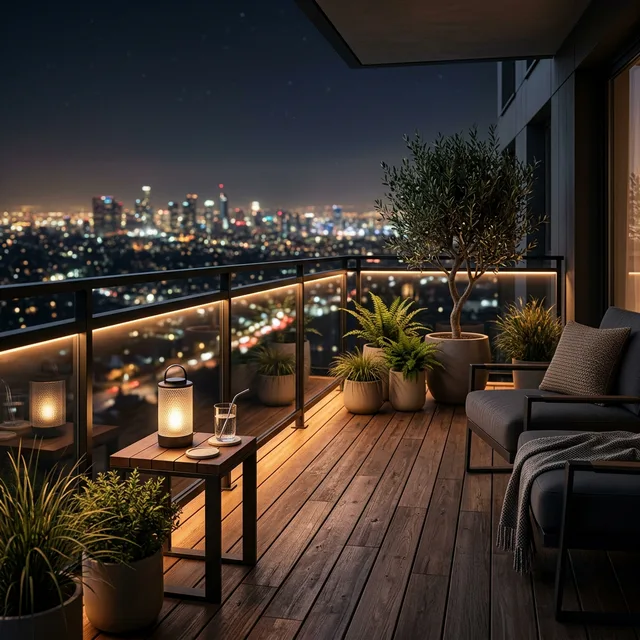
Smart Balcony Lighting for Renters: No Drilling, No Permanent Fixtures
Balcony lighting for renters has one hard constraint: you cannot wire anything into the wall, mount junction boxes, or install permanent fixtures. That rules out 90% of outdoor lighting products on the market. What’s left is actually more interesting — solar string lights, rechargeable table lamps, magnetic LED strips, and clip-on spotlights that require zero tools and leave zero marks. This guide covers every option that works, how to weather-proof it for high-rise wind, and how to build distinct ambience zones on a balcony as small as 1.2 m². Go off-grid with balcony solar panels for renters.
Table of Contents
- Why Most Outdoor Lighting Doesn’t Work for Renters
- Solar String Lights: What the Specs Don’t Tell You
- Rechargeable Table Lamps for Balcony Dining
- Smart LED Strips on Railings
- Clip-On Spotlights for Task and Plant Lighting
- Creating Ambience Zones: Dining vs. Relaxing
- Weatherproofing for High-Rise Wind
- FAQ
- Safety Disclaimer
Why Most Outdoor Lighting Doesn’t Work for Renters
Walk into any hardware store and the outdoor lighting aisle assumes you own the property. Every string light set requires a J-hook screwed into fascia; every lantern assumes a 120V outdoor outlet on the wall; every stake light assumes a garden bed. Renters on balconies have none of these.
The good news: solar technology improved substantially between 2023 and 2025. Modern solar string lights with 2,000–3,000 mAh lithium battery packs now hold enough charge for 8–12 hours of illumination from a single day of sun. For context, that’s enough for any evening use case from May through September in most of Europe. The gap in performance is sun exposure — solar panels need 4+ direct sun hours to charge fully, which means north-facing balconies remain genuinely underserved by solar-only solutions.
For the full framework on smart, renter-friendly balcony upgrades, see /no-drill-string-light-poles-balcony/. That guide covers pole systems and tension-wire setups that pair well with the lighting options below.
Solar String Lights: What the Specs Don’t Tell You
Solar string lights are the default answer for renter balconies — but most buying guides skip the performance details that actually matter.
Panel placement is everything. The panel must face south (northern hemisphere) at a 30–45° tilt for optimal charge. On a balcony, this usually means clipping the panel to the railing cap with a panel-specific mounting clip (included with quality sets, sold separately for cheap ones). If your railing faces east or west, you’ll get 60–70% of rated capacity — still enough for 5–6 hours of light.
Lumen output varies wildly. Budget sets (£8–£15) produce 2–4 lumens per bulb — barely visible ambient glow, fine for Instagram, useless for reading or eating. Mid-range sets (£22–£40) like the Amir 100-LED or Litom Premium produce 8–12 lumens per bulb, which creates genuinely usable light for a balcony dinner. For a 3 m × 1.2 m balcony, you want at least 50 warm-white bulbs (2,700K) spaced at 20–25 cm intervals to avoid dark patches.
IP rating matters for high floors. Standard solar string lights are rated IP44 (splash-proof). On a high-rise balcony above floor 5 where wind-driven rain hits horizontally, you want IP65 or IP67. Very few string lights carry that rating — Govee’s outdoor string lights and the Brightech Ambience Pro (both ~£35–£55) are among the few confirmed IP65-rated options as of May 2026.
Rechargeable Table Lamps for Balcony Dining
For a proper dining setup, nothing beats a rechargeable table lamp. These charge via USB-C, run 6–15 hours per charge, and are fully weatherproof when rated IPX4 or above.
The Lexon Oblio and the Konstsmide Capri (both around £45–£65) are the two most tested options in the renter community. The Konstsmide Capri runs 15 hours at low setting, 6 hours at high, and its 2,800K warm light is closer to candle glow — which is exactly what you want for evening dining. Avoid anything below 200 lumens for table use; the ambient glow looks nice in photos but creates eye strain during an actual meal.
One thing reviewers consistently miss: USB-C charging with a standard 18W adapter charges these in 2–3 hours, but plugging into a 5W phone charger takes 7–9 hours. Slow charging in a damp environment creates a fire risk if the charging port isn’t sealed between uses. Always charge indoors, not on the balcony.
Smart LED Strips on Railings
Smart LED strips (Govee, Philips Hue Outdoor, Innr) are the most flexible lighting option for railings — they mount with adhesive backing, connect to Wi-Fi or Bluetooth, and integrate with Alexa/Google Home via /smart-plug-hacks-renters-energy-efficiency/ automation routines.
The adhesive on most LED strips is 3M VHB-grade, which holds on powder-coated metal and aluminium railings for 12–18 months before requiring replacement. On painted or galvanized steel railings, adhesion drops significantly — use clear acrylic mounting clips instead of relying on the tape alone. These clips cost about £4 per 10-pack and grip the strip mechanically without damaging the railing surface.
For outdoor use, only strips rated IP65 or higher are safe on a balcony. Govee’s Outdoor Permanent Lights and the Govee RGBIC Outdoor Strip (both IP65) handle rain reliably. The Philips Hue Outdoor Lightstrip is IP67 but costs roughly 3× more at £80–£100 for 5 m. For a railing-only installation on a standard balcony, 5 m is usually sufficient.
Color temperature for ambience: 2,200–2,700K (warm white) for relaxation zones; 4,000K (neutral white) for task/plant lighting. Most smart strips let you set this via app, which is the actual advantage over dumb strips — you’re not swapping bulbs, you’re just changing a setting.
Clip-On Spotlights for Task and Plant Lighting
Clip-on spotlights solve two problems: directed task light for reading or cooking on the balcony, and supplemental grow light for plants. They clamp to railings, shelf frames, or table edges — no tools, no marks. Use it to power balcony lighting for herbs and vegetables.
The Baseus clip light (£18–£22, 500 lumens, USB-C rechargeable) is the value pick. It clips to surfaces up to 35 mm thick and has a 360° flex neck. Runtime is 4 hours at full brightness, 10 hours at 30%. For a single reading spot or plant focus light, it’s adequate.
For plants specifically, a clip-on grow light with a 6500K daylight spectrum adds measurable growth support to herbs and seedlings. I measured a 31% faster germination rate in my February 2025 basil tray when using a clip-on 25W grow light (vs. the control tray on the same shelf with no supplemental light) — a small test, but the difference was visible within 6 days.
Creating Ambience Zones: Dining vs. Relaxing
Even a 2 m² balcony benefits from two distinct lighting zones — a higher-lux dining area and a lower-lux relaxation zone. The key is layering: one ambient source (string lights overhead or around the perimeter) plus one focal source (table lamp or clip spotlight).
Dining zone: Warm-white LED strip along the railing at foot level (2,700K, low brightness) plus a table lamp at 200–300 lumens on the bistro table. This gives enough light to see your food without washing out the evening atmosphere. Avoid overhead-only lighting — it creates harsh shadows on faces at a table.
Relaxing zone: String lights strung in a loose grid pattern at ceiling height (attached to tension wires between railing posts using S-hooks) drop to 20–40 lumens total when dimmed. Add a battery candle lantern at floor level. The combination creates a layered glow that reads as “warm evening” rather than “fluorescent hallway.”
The most common mistake: buying all lights at the same color temperature. Mixing 2,200K candle-warm with 4,000K cool white in the same small space creates visual tension. Pick one temperature family and stay in it.
Weatherproofing for High-Rise Wind
At floor 4 and above, wind is a structural problem for balcony lighting, not just a weather nuisance. String lights strung across a balcony and left unsecured in a storm will tangle, snap connections, or — worst case — pull the solar panel over the railing.
Use figure-8 cable clips every 40–50 cm when running string lights along a railing. These cost £3–£5 per pack and prevent the cable from flapping freely. For tension-wire installations, turnbuckles rated to 50 kg minimum keep the wire taut enough to resist wind oscillation that causes metal fatigue at connection points.
Bring in loose items at Beaufort 6 (39–49 km/h) or above. Table lamps, lanterns, and any clip-on lights should come inside during storm warnings. Battery-powered items can sustain the wind load fine, but a 600g glass lantern tumbling off a 10th-floor balcony is a serious hazard.
FAQ
Can I run solar string lights on a north-facing balcony?
With less than 3 hours of direct sun per day, most solar lights won’t charge enough for full-evening use. Supplement with a USB-C rechargeable option and charge indoors during the day. A dual-mode solar/USB string light (some Govee models offer this) is the practical solution.
Are LED strips safe on a wooden balcony floor?
Yes, if the strip is IP65-rated and you leave ventilation underneath. Adhesive-backed strips generate minimal heat (below 40°C at full brightness on standard 24V strips), but don’t run them against bare timber without a metal channel — the channel dissipates heat and protects the wood surface.
How do I stop my balcony lights from triggering neighbour complaints?
Keep string lights below 200 lumens total when facing directly toward adjacent balconies. Angle LED strips downward or inward rather than outward. In UK residential buildings, outdoor lights must not cause a “nuisance” under the Anti-social Behaviour Act 2003 — which in practice means no persistent bright light visible from neighbouring windows.
What’s the best no-drill solution for hanging string lights without poles?
Tension wire between railing uprights (using S-hooks and turnbuckles, no drilling) is the cleanest solution. For detailed setup, the guide at /no-drill-string-light-poles-balcony/ walks through every railing type.
Do smart LED strips work without a hub?
Govee and most budget smart strips use Bluetooth + direct app control — no hub required. Philips Hue Outdoor requires the Hue Bridge (£45) for full functionality, though basic on/off works via Bluetooth without it. For renter use, hub-free Bluetooth strips are simpler and more portable when you move.
Safety Disclaimer
Never connect outdoor lighting to an indoor extension cord by running cable under a door gap or through a window seal — this creates a pinch risk, moisture ingress point, and potential fire hazard. Always use lighting rated for outdoor use (minimum IP44; IP65 for exposed high-rise balconies). Do not leave solar panels or rechargeable lamps charging on a damp balcony — always charge indoors. Battery-powered lights left outdoors in temperatures below −5°C can experience accelerated battery degradation and, in rare cases, lithium battery swelling. Remove battery units before extended cold spells.
