
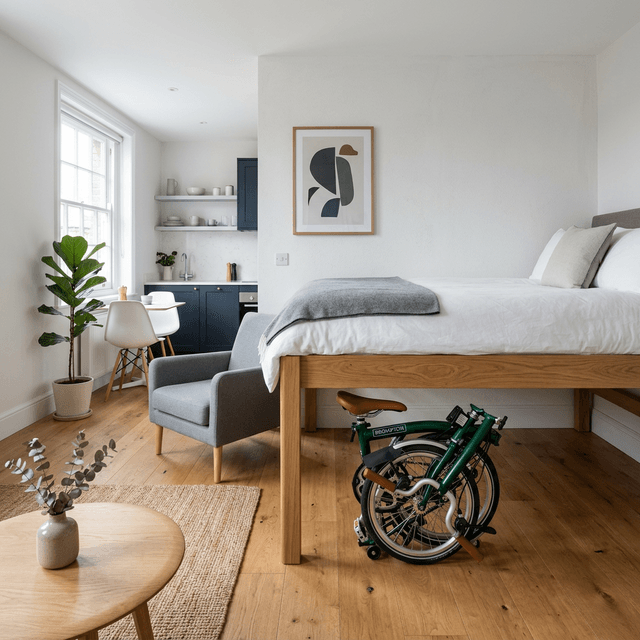
For the modern urbanite, a folding bike is the ultimate tool for urban mobility. It bridges the gap between your sensory sanctuary and the subway, providing a healthy form of vertical fitness during your daily commute. However, even when folded, a bike is a significant object. In a 25sqm studio, simply leaning a bike against a wall creates visual noise and a “functional obstacle” that destroys the flow of your home. To truly master folding bikes in micro-spaces, you must treat your bike as a piece of architectural gear. Work out with vertical fitness.
Storing a bike in a micro-flat requires moving beyond the floor. If it’s on the floor, it’s in your way. By utilizing “Hidden Zones” and “No-Drill” vertical solutions, you can keep your bike accessible for your 15-minute morning prep without sacrificing the clean lines of your managed studio apartment. In my own journey of studio living, I found that the right storage hack was the difference between riding every day and leaving the bike to collect dust. Pair with a morning prep routine.
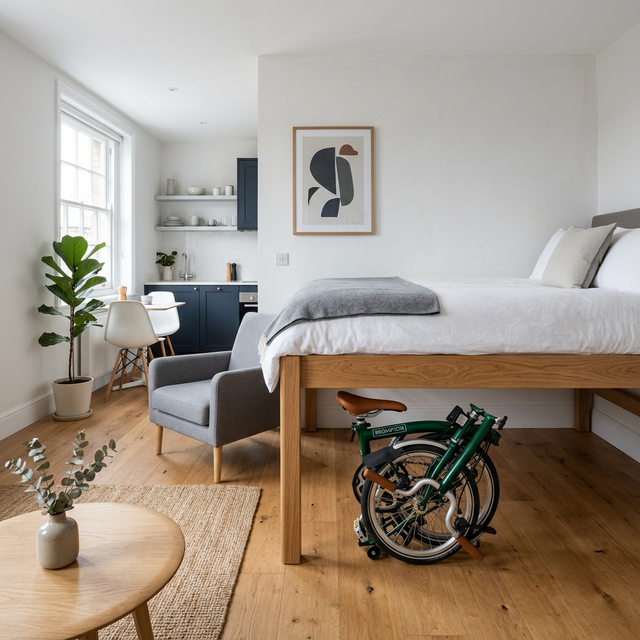
1. The “Under-Bed” Stealth Zone
Most folding bikes (like the Brompton or Tern) fold into a “package” that is roughly 60cm x 60cm x 30cm. This is small enough to fit under most beds that have furniture with legs for small apartments.
The Hack: Use a low-profile plastic tray or a heavy-duty natural fiber rug to act as a “Bike Garage” under your bed. The Benefit: This keeps the bike completely out of your line of sight. It eliminates the “Mechanical Eye-Sore” factor, ensuring your sensory sanctuary studio living remains focused on rest and recovery. This is the #1 rule for folding bikes in micro-spaces: if it’s invisible, it’s organized.
2. The Multi-Purpose “Entryway Bench” Locker
If your landing strip has room for a bench, why not make that bench the bike’s home? The Strategy: Use a hollow ottoman or a custom-built wooden bench with a hinged lid. The Routine: As you return from your urban mobility commute, you fold the bike and drop it directly into the bench. It provides a seat for your evening reset routine while hiding your primary transit tool. This is “High-Density Logic” at its finest: one object, two functions.
3. No-Drill Vertical “Clamping” Poles
As a solo renter, you often cannot drill heavy hooks into your studio walls. The Hack: Use a “Floor-to-Ceiling” compression pole (like the Minoura Bike Tower). The Value: These poles use a spring-loaded mechanism to wedge between your floor and ceiling. They can hold two folding bikes in micro-spaces vertically. By lifting the bike even 10cm off the floor, you reclaim the floor space for your vertical fitness workout or a meditation nook. It’s the ultimate renter-friendly studio hack. Add a meditation nook.
4. The “Furniture Gap” Gravity Stand
In every studio apartment setup, there is “dead space”—the 40cm gap between your wardrobe and the wall, or the space behind a door. The Strategy: Use a “Gravity Stand” that leans against the wall without screws. The Placement: A folding bike can be hung vertically by its frame or wheel. By tucking it into a “Furniture Gap,” you use existing visual noise (the side of a cabinet) to mask the bike. This maintains the “managed” look of your sensory sanctuary.
5. Utilizing Your Balcony: The “All-Weather” Zone
If you have a small balcony garden, it can serve as your “Garage.” The Caution: Urban air is corrosive and rain will destroy your chain. The Hack: Use a heavy-duty, UV-rated “Bike Tent” or a specialized folding bike bag. The Routine: Store the bike on the balcony to keep the “Urban Dirt” out of your micro-living air quality zone. Just ensure it’s secured with a smart lock that is part of your digital identity kit alerts.
6. The “Acoustic Shielding” Cover
A folding bike is made of metal and rubber—materials that don’t fit the biophilic texture design of a cozy studio. The Hack: Use a custom-fitted “Bike Sock” or a canvas cover. The Benefit: A cover not only protects your smart textiles and rugs from grease but also hides the “Industrial” look of the bike. To your brain, the bike becomes a soft, neutral shape rather than a complex machine, supporting the “Soft Fascination” required for deep sensory recovery.
7. The “Ceiling Hoist” (For Long-Term Storage)
If you only use your bike on weekends, it shouldn’t be taking up daily real estate. The Strategy: In apartments with high ceilings (3m+), use a “Pulley Hoist” system. The Result: Your folding bike is hoisted to the ceiling, completely clearing the living area. This is a common strategy in “Tiny House” design and is highly effective for a managed studio apartment. It keeps your urban mobility gear safe and out of the way until you’re ready for your next micro-travel adventure.
| Storage Method | Renter Friendliness | Visual impact | Accessibility |
| Under-Bed | 10/10 | Invisible | 6/10 |
| Pantry Bench | 9/10 | Zero (Hidden) | 9/10 |
| Vertical Pole | 10/10 | High | 10/10 |
| Ceiling Hoist | 5/10 | Modern / Industrial | 4/10 |
| Gravity Stand | 10/10 | Minimal | 9/10 |
FAQ
Will my folding bike get stolen from a hallway?
Never store your bike in a shared hallway. Even a smart lock can be cut. The goal of folding bikes in micro-spaces is to keep the bike inside your private sensory sanctuary.
How do I keep the apartment clean with a bike inside?
Use your 15-minute morning prep to wipe the tires with a damp cloth if it’s raining. Maintaining a clean bike is part of micro-wellness—it prevents city grime from affecting your air quality.
Does folding/unfolding every day damage the bike?
Quality brands (Brompton, Dahon) are designed for 10,000+ folds. As long as you maintain the pivots during your evening reset, it will last for a decade of urban mobility commuting.
