
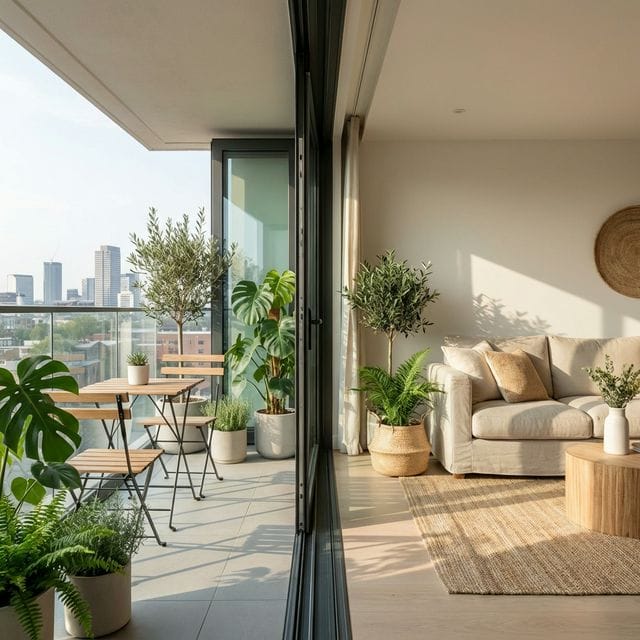
In a high-density urban environment, your balcony—no matter how small—is your only “Pressure Valve.” For many renters, the balcony is treated as a separate, exterior zone for storage or a single chair. But if you shift your mindset from “Exterior/Interior” to a unified indoor-outdoor flow for small apartments, you can effectively trick your brain into perceiving the balcony as an extra room, rather than a separate ledge.
Creating a “Seamless Transition” across the threshold of your glass door is the ultimate hack for micro-living. When you successfully blur the line between your sensory sanctuary and the city air, your 25sqm studio feels significantly more expansive and high-end. In my own managed studio apartment, implementing these flow hacks turned a “claustrophobic box” into an airy, garden-centric sanctuary.
1. The “Level-Floor” Continuity Hack
The biggest visual break in indoor-outdoor flow for small apartments is the threshold. Most balconies have a small “step-down” or a metal rail that marks the end of the home.
The Strategy: Use “Decking Tiles” (IKEA Runnen or stone versions) to raise the height of your balcony floor to match the level of your interior floor.
The Value: When the floor material looks and feels continuous, the “Psychological Border” disappears. Your eye doesn’t “stop” at the door; it travels all the way to the balcony railing. This is a core studio apartment zoning ideas for depth. Define areas with studio zoning.
2. Palette Mirroring: Color Continuity
If your interior is minimalist white/oak and your balcony is dark grey concrete/plastic, the transition is jarring.
The Hack: Use the same color palette across both zones.
The Implementation: Use the same natural fiber rugs inside and out (ensure the balcony version is all-weather). Use the same material for your furniture with legs for small apartments inside and your balcony bistro set outside. This “Color Mirroring” creates a unified “Visual Plane” that supports your sensory sanctuary.
3. The “Glass Boundary” Cleaning Protocol
A dirty glass door is a physical wall. Dust, rain spots, and smudge marks on the glass remind you that there is a barrier between you and the outside.
The Routine: Clean your sliding doors twice a week using a zero-waste cleaning vinegar spray.
The Benefit: Crystal-clear glass “disappears.” It allows the natural light and the view of your smart balcony herb gardens to pour into the room. This is the simplest and most effective indoor-outdoor flow hack for renters. Grow a balcony herb garden. Pull in natural light.
4. “Cross-Border” Plant Clustering
We usually keep “Indoor Plants” inside and “Outdoor Plants” outside. To achieve flow, you need to break this rule.
The Strategy: Cluster similar-looking greenery on both sides of the glass.
The Hack: Place a large Monstera or Snake Plant just inside the door, and another large, hardy plant (like a Laurel or Boxwood) just outside the door on the balcony.
The Result: Your eyes treat the greenery as a singular “Green Hub.” This is the pinnacle of biophilic texture design, making your micro-apartment feel like it has a private courtyard.
5. Lighting the “Transitional Depth”
At night, a balcony usually becomes a “Black Void,” making the interior feel smaller and “boxed in” by the dark windows.
The Strategy: Use smart lighting for studios on the balcony.
The Hack: Use low-voltage LED “Puck Lights” or strips hidden under your balcony railing or behind vertical gardening planters.
The Benefit: By lighting the balcony to the same color temperature as your interior (warm 2000K-3000K), you pull the “Visual Horizon” outward. Even in the middle of the night, your sensory sanctuary studio living area feels 2-3 meters deeper.
6. Scent Migration: The Unified Air Volume
If your balcony is filled with fragrant herbs, that scent should enter your home.
The Integration: Use your smart apartment climate control to create a slight cross-breeze when the door is open.
The Synergy: Your smart aromatherapy for studio zoning can be reinforced by the real lavender or rosemary growing on your balcony vs. indoor garden. This “Olfactory Flow” is a powerful psychological anchor that tells your body you are in a spacious, natural environment.
7. The “Open-Door” Furniture Layout
How you position your furniture with legs inside determines if you can see the “flow.”
The Rule: Never block the path to the door with a sofa or a shelf.
The Strategy: Create a clear “Sight-Line” from your bed or your smart closet office setup straight to the balcony.
The Value: This allows you to constantly check in with the outside world, supporting your mental clarity and reducing the feeling of “Urban Enclosure.” This is the final step in your managed studio apartment expansion.
| Flow Element | Tool / Strategy | Psychological Gain | Micro-Wellness Gain |
|---|---|---|---|
| Floor | Decking Tiles | Perceived Depth | Reclaimed Space |
| Glass | Regular Cleaning | Invisible Boundary | Natural Light / Mood |
| Greenery | Cross-Border Clusters | Biophilic Peace | Fresh Air / Oxygen |
| Light | Balcony LEDs | Nighttime Depth | Reduced Anxiety |
| Scent | Aromatic Herbs | Sensory Sanctuary | Relaxation |
How do I handle bugs with an open-door policy?
Use a ‘Magnetic Screen Door.’ These are 100% renter-friendly and allow for indoor-outdoor flow for small apartments while keeping the city’s insects out of your sensory sanctuary.
What if my balcony is too small for furniture?
A balcony doesn’t need to be ‘used’ to provide flow. Even if it’s just 50cm deep, the matching floor and lighting will still provide the ‘Visual Expansion’ your 25sqm needs.
How do I protect my indoor rugs from outdoor dirt?
Use a ‘Transition Washable Rug’ or a low-profile natural fiber rug made of polypropylene. These can be hosed down and are the perfect ‘bridge’ between the city and your home.
—
