
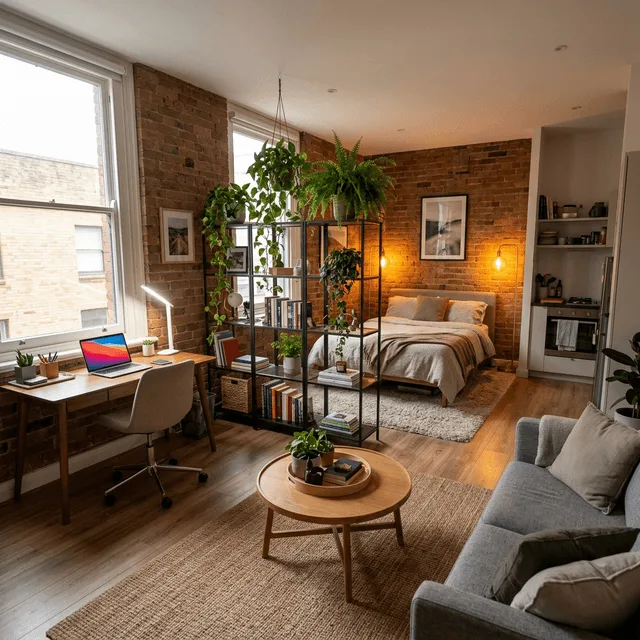
Living in a one-room apartment doesn’t mean you have to live in a “one-zone” box. When your bed is three feet from your kitchen and your desk is in your living room, the boundaries of your life become blurred, leading to “Spatial Fatigue”—a psychological state where you never feel fully at work or fully at rest. To maintain your mental clarity and micro-wellness, you must implement the studio apartment zoning ideas we call the “Invisible Wall Strategy.” See concrete ways to create zones in a studio without walls. All of it helps a studio feel like home.
The secret to a high-performance managed studio apartment is creating specialized hubs for different neurological states. You want your “Work Zone” to feel distinct from your “Sleep Zone,” even if they share the same floor space. By utilizing light, texture, and vertical decor, you can divide your life without building a single physical wall. In my own 24m² sensory sanctuary, these zoning hacks transformed a chaotic room into a multi-functional habitat. Define areas with smart lighting for windowless studios. Balance it using vertical decor over clutter.
1. The “Acoustic Floor” rugs
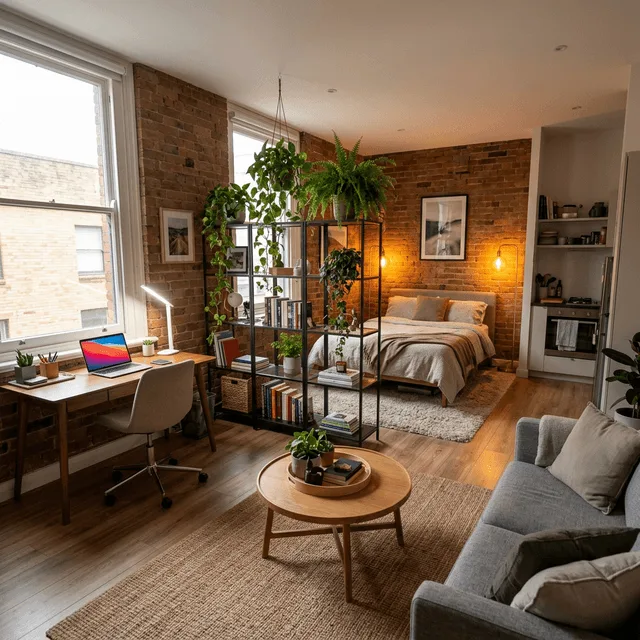
Traditional walls block sound. In a studio, you must use “Tactile Sound Zoning.” The Idea: Use different smart textiles and rugs for each zone.
- Sleep Zone: A high-pile, plush wool rug. It absorbs footfall and creates a “Soft Landing” for your feet.
- Living Zone: A low-profile, patterned natural fiber rug. It defines the “Social” boundary. The Benefit: By changing the floor texture, you provide a somatic signal to your feet (and brain) that you have moved into a new “room.” This is a core part of your studio apartment zoning ideas.
2. Circadian “Light-Walls”
Light is the most powerful “Invisible Wall” you have. The Strategy: Use circadian lighting for windowless apartments to define zones with color temperature.
- Cloffice Zone: Bright, cool 5000K light focused only on the desk.
- Sleep Zone: Soft, warm 2000K amber lighting from floor-level lamps. The Value: At 8:00 PM, you can “turn off” the Work Zone by dimming its lights. The darkness acts as a physical barrier. This supports your smart sleep setup and helps maintain your biological clock.
3. The “Transparent Divider” Paradox
If you use a solid bookcase as a divider, you block the light and make your 25sqm feel like 10sqm. The Idea: Use “See-Through” dividers.
- The Gear: A minimalist metal shelving unit or a series of low-light hanging plants.
- The Strategy: Use vertical decor vs clutter logic. By keeping the divider “airy,” you maintain the shared light of the room while still creating a “Visual Border.” This is the pinnacle of the invisible wall strategy.
4. Vertical Zoning: The Ceiling Script
The floor is usually occupied by furniture with legs, but the ceiling is free real estate. The Idea: Use hanging elements to drop “Invisible Curtains.”
- The Hack: Hang a row of minimalist plant styling pots or a sheer, high-end linen curtain from a ceiling track.
- The Result: It creates a “Sense of Enclosure” for your bed area without taking up a single centimeter of floor space. It’s a primary studio apartment zoning ideas for those on a minimalist budget.
5. The “Landing Strip” Transitional Hub
Every home needs a “Decompression Point.” In a studio, this is your entryway organization landing strip. The Idea: Physically define the entrance with a different wall color or a vertical wood panel. The Function: This is where your urban edc system lands. By making the entryway feel like a separate “chamber,” you prevent the outside world from “leaking” directly into your sensory sanctuary. It supports your anti-theft strategies by keeping jewelry and tech organized and in sight.
6. Olfactory Zoning: Scent as a Divider
You can use smart aromatherapy for studio zoning to differentiate air volumes. The Hack: Use a “Focus Scent” (Lemon/Rosemary) only at your smart closet office setup and a “Recovery Scent” (Lavender) near your bed. The Benefit: Your brain is highly sensitive to scent anchors. By keeping the scents localized, you create an invisible “Zone Barrier” that helps you switch mental states in seconds. This is a core part of the sensory sanctuary studio living experience.
7. The “Furniture-Leg” Sightline
If your furniture sits flat on the floor, it creates a “weighty” visual block that stops the eye. The Idea: Use furniture with legs for small apartments. The Strategy: When you can see the floor continuing under your sofa and bed, the room feels like one open, continuous volume. You then use the “Invisible Walls” above (light and plants) to divide it. This keeps your micro-apartment feeling expansive rather than partitioned into “boxes.” Soften the divide with minimalist plant styling.
| Zone Type | Division Tool | Primary Sense | [Micro-Wellness](https://urbanmicrotips.com/micro-wellness-habits-studio-living) Impact |
| Work | Task Lighting | Sight | Focus / Productivity |
| Sleep | [Textured Rug](https://urbanmicrotips.com/smart-textiles-zoning-studios) | Touch | Recovery / Calm |
| Social | Acoustic Art | Sound | Connection / Privacy |
| Prep | [Valet Tray](https://urbanmicrotips.com/small-entryway-organization-studio-landing-strip) | Order | Efficiency / Safety |
FAQ
How do I zone a studio without buying new furniture?
Use your smart lighting. By simply pointing a lamp toward a wall in your “Living Zone” and keeping your “Sleep Zone” in shadow, you create a convincing division for $0. Lighting is the most cost-effective of all studio apartment zoning ideas.
Can I use plants as walls?
Yes, this is called “Bio-Zoning.” A row of tall snake plants or a vertical gardening tower can act as a sound-absorbing, air-filtering wall. This supports your biophilic texture design goals.
For more on making a studio feel like separate rooms, see how noise-proofing techniques double as zone dividers — bookshelves and rugs that absorb sound also define visual boundaries. And if you share the space with plants, our Balcony Plant Calculator helps you plan the outdoor zone without overloading weight limits.
Will zoning make my apartment feel smaller?
No, if you use the invisible wall strategy. Solid dividers make a room smaller; “sensory dividers” (light, scent, and rugs) make a room feel like it has “more rooms” without losing the open-plan airiness.
