
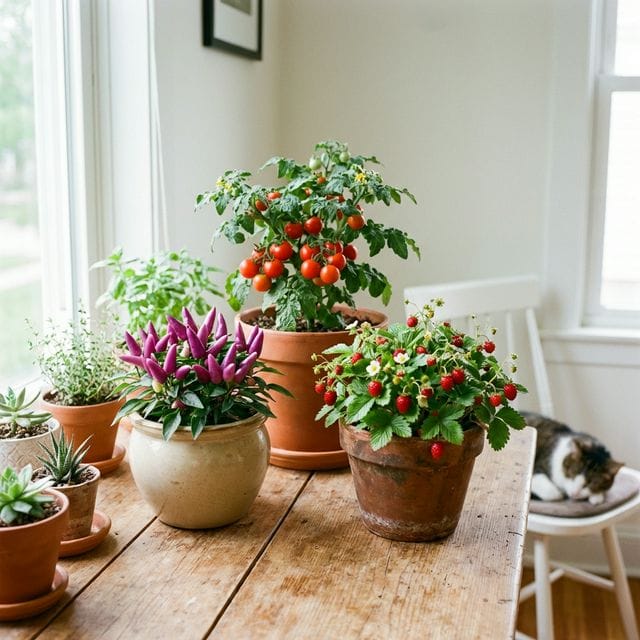
Dwarf vegetable varieties are compact cultivars bred to produce real harvests in 4–10 inch pots — no garden, no trellis, no outdoor space needed. The best options stay under 12 inches tall, fruit on a south-facing windowsill, and cost under $15 to set up per plant. Time to first harvest: 3–8 weeks depending on variety. This guide covers 6 dwarf vegetable plants that actually work in a small apartment, plus a quick-reference table so you can match each plant to your windowsill conditions. When they crop, our notes on harvesting and storing edibles help.
1. Micro tomatoes: The King of Small Spaces
Standard tomatoes are divided into “Determinate” (bush) and “Indeterminate” (vining). For an apartment, you want something even smaller: Micro-Dwarf Tomatoes.
- ‘Micro Tom’: Often called the world’s smallest tomato. It grows only 6 to 8 inches tall. You can grow it in a 4-inch pot next to your coffee maker. It produces dozens of small, tart cherry tomatoes.
- ‘Tiny Tim’: A slightly larger variety reaching about 12 to 15 inches. It is incredibly prolific and handles lower light levels better than most tomatoes.
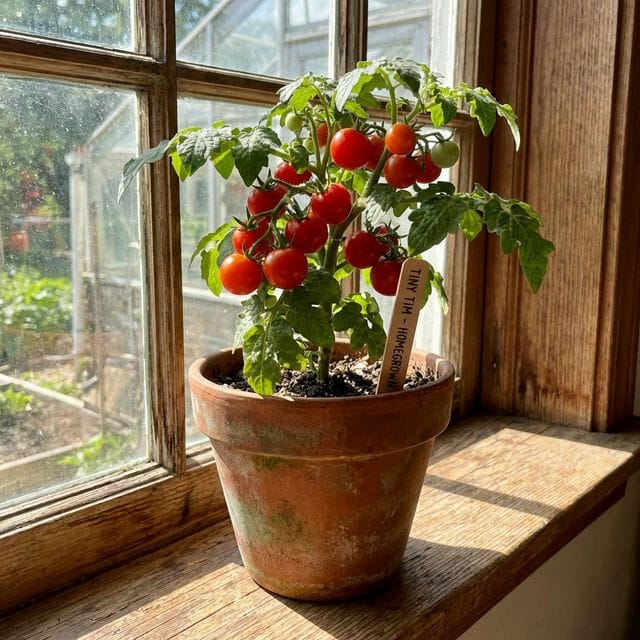
- ‘Venus’: A beautiful micro-dwarf that produces bright orange cherry tomatoes with a sweet, low-acid flavor.
2. Compact Peppers: Color and Spice
Peppers are naturally well-suited for indoor life because they are perennials that love warm apartment temperatures. The best dwarf vegetable varieties for peppers focus on “ornamental” styles that are also delicious.
- ‘Thai Hot’: A very compact plant that produces hundreds of small, upright, intensely spicy peppers. It looks like a beautiful bonsai tree.
- ‘Mohawk’: A trailing dwarf sweet pepper. Instead of growing tall, the branches hang down, making it perfect for a hanging basket near a window. It produces small, sweet orange bell peppers.
- ‘Medusa’: If you want the look of peppers without the heat, ‘Medusa’ produces non-spicy, multi-colored fruit that look like snake-hair. It stays under 8 inches tall.
3. Indoor Strawberries: Year-Round Sweetness
Most strawberries need a cold winter to produce fruit, but Day-Neutral varieties will flower and fruit as long as the temperature is between 15°C and 25°C (60°F – 77°F)—exactly the temperature of your living room.
- ‘Alpine Strawberries’ (Alexandria): These don’t produce runners (clones), so they stay in a neat, compact clump. The berries are small but have a much more intense, wild flavor than grocery store berries.
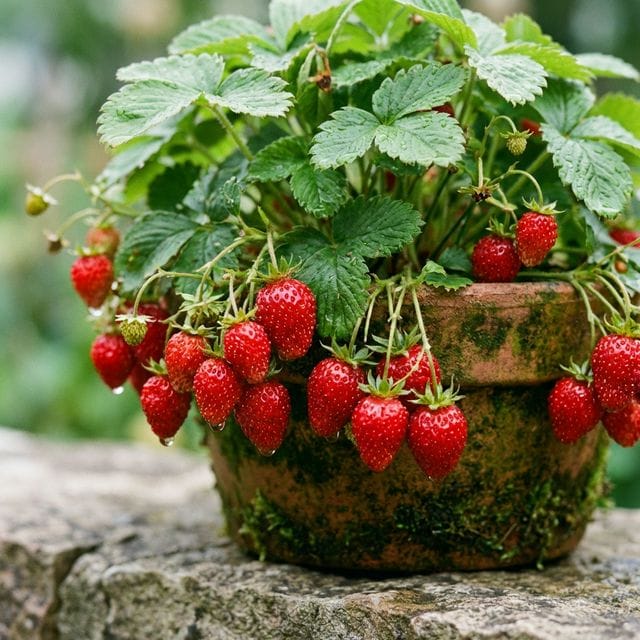
- ‘Mignonette’: A classic French alpine variety that thrives in small pots and produces fruit continuously for months.
4. Leafy Greens: The Quick Win
While not technically “dwarf” in the same way as a tomato, certain leafy green cultivars are bred for “cut-and-come-again” harvesting in tiny containers.
- ‘Tom Thumb’ Lettuce: A true heirloom dwarf lettuce. It produces a head the size of a tennis ball. You can grow 4 of them in a standard window box.
- ‘Little Gem’ Cos: A compact romaine-style lettuce that is heat-tolerant and stays small and crunchy even in a warm kitchen.
Choosing the Right Container for Dwarf Plants
Even the best dwarf vegetable varieties will fail if their roots are suffocated.
- Depth Matters: For micro-tomatoes and peppers, aim for a pot at least 6 inches deep.
- Drainage is Non-Negotiable: Ensure your pots have holes. Indoor plants are far more likely to die from “wet feet” (root rot) than from drying out.
- Aeration: Use a high-quality “potting mix” with added perlite or vermiculite. Never use “garden soil” or “topsoil” from outside; it is too heavy and will compact into a brick inside a small pot.
5. Radishes: The Fastest Dwarf Vegetable for Beginners
If you have never grown food indoors, start with radishes. They are the fastest dwarf vegetable plant you can grow — from seed to harvest in 22–28 days. No transplanting, no special care, no waiting. Sow seeds directly into a 4-inch deep container, thin to 2 inches apart, water when the top inch of soil dries out.
- ‘Cherry Belle’: Classic round red radish, ready in 22 days. Fits 4 plants in a standard mug planter.
- ‘French Breakfast’: Elongated, mild flavour. Ready in 25 days. Needs slightly more depth — 5-inch pot minimum.
- ‘Watermelon Radish’: Green outside, bright pink inside. Takes 60 days but the visual payoff in a salad is worth it.
Light requirement: 4–6 hours of direct sun or a basic LED panel for 10 hours. Radishes bolt (go to seed without forming a root) under too much heat — keep away from radiators and heating vents in winter.
6. Mini Cucumbers: Compact Varieties That Actually Produce
Standard cucumbers need 6-foot trellises. Mini cucumber varieties stay compact, self-pollinate, and produce full-flavoured fruit in a 6–8 inch pot. They need more light than radishes — a south-facing window or a grow light for 14–16 hours — but reward you with harvests over 8–10 weeks. Pair them with the best LED grow lights for indoor yields. Fruiting types need a hand, so learn to hand-pollinate indoor vegetables.
- ‘Bush Pickle’: Stays under 24 inches, produces 3–4 inch cucumbers. True bush habit — no trellis needed.
- ‘Spacemaster’: Classic compact cucumber bred for containers. Handles lower light better than most cucumbers. Ready in 60 days.
- ‘Patio Snacker’: Bred specifically for containers and patios, extremely compact. Fruit ready in 52 days.
Hand-pollinate by transferring pollen between flowers with a small paintbrush — in a sealed apartment, there are no bees to do it for you.
Dwarf Vegetable Plants: Quick-Reference Table [UPDATE 2026]
All 6 dwarf vegetable plants above, ranked by how beginner-friendly they are. The smallest vegetable plant by pot size is the radish — it works in a 4-inch pot. The fastest to harvest is also the radish at 22 days. Use this table to match plants to your available light and patience level.
| Plant | Min Pot | Light | Difficulty | First Harvest | Smallest Variety |
|---|---|---|---|---|---|
| Radish | 4 inch | 4–6h | Easy | 22 days | Cherry Belle |
| Lettuce | 4 inch | 3–4h | Easy | 30 days | Tom Thumb |
| Micro Tomato | 4 inch | 6h+ | Medium | 55–70 days | Micro Tom (6 inch tall) |
| Alpine Strawberry | 6 inch | 6h+ | Easy | 90 days (from seed) | Alexandria |
| Compact Pepper | 6 inch | 6h+ | Medium | 70–90 days | Medusa (8 inch tall) |
| Mini Cucumber | 8 inch | 8h+ | Hard | 52–60 days | Patio Snacker |
Conclusion
Feeding yourself in the city doesn’t require an allotment or a rooftop garden. By selecting the best dwarf vegetable varieties, you turn your windowsill into a productive agricultural zone.
Start with a single ‘Micro Tom’ tomato or a pot of Alpine strawberries. Once you taste a sun-warmed berry or tomato grown just inches from where you sleep, you’ll never go back to supermarket produce.
Ready to start? Combine these varieties with our guide on how to hand-pollinate indoor vegetables to ensure every flower turns into a harvest, and use the best LED grow lights if your windows don’t get 6 hours of direct sun.
Where can I buy these dwarf seeds?
Look for specialized seed companies (like Baker Creek, Johnny’s, or Renaissance Seeds) and search specifically for terms like ‘Micro-Dwarf,’ ‘Patio,’ or ‘Container’ varieties.
Do dwarf plants need less fertilizer?
Actually, they often need more consistent feeding. Because they are in small pots, they quickly exhaust the nutrients in the soil. Feed them a half-strength liquid organic fertilizer every two weeks once they start flowering.
Can I save seeds from my dwarf vegetables?
If the variety is an ‘Heirloom’ or ‘Open-Pollinated’ type (like Tom Thumb lettuce), yes. If it is labeled as an ‘F1 Hybrid,’ the seeds you save likely won’t grow into the same small, dwarf plant next year.
What are the best dwarf vegetable plants for a small apartment?
The best dwarf vegetable plants for a small apartment are: radishes (fastest, 22 days, 4-inch pot), Tom Thumb lettuce (30 days, 4-inch pot), Micro Tom tomatoes (6 inches tall, 4-inch pot), Alpine strawberries (continuous fruit, 6-inch pot), and compact peppers like Medusa (8 inches tall, 6-inch pot). Radishes and lettuce are best for beginners. Micro tomatoes and peppers need 6+ hours of direct sun or a grow light.
What is the smallest vegetable plant you can grow indoors?
The smallest vegetable plant by height is ‘Micro Tom’ tomato at 6–8 inches tall — it fits in a 4-inch pot next to a coffee maker and produces dozens of cherry tomatoes. For smallest pot requirement, radishes win: they germinate and produce a harvest in a 4-inch container in 22 days. ‘Tom Thumb’ lettuce also fits 4 plants in a standard 6-inch window box.
Can I grow mini vegetable plants without natural sunlight?
Yes, with a basic LED grow light. Most dwarf vegetable plants need the equivalent of 6–8 hours of direct sun. A 20–40W full-spectrum LED panel placed 10–15 cm above the plants for 12–14 hours daily replaces a south-facing window. Cost: $20–35. Best candidates for low-light growing: radishes, lettuce, and mint. Tomatoes and peppers need more intensity — look for LEDs rated at 2000+ lumens.
How long do dwarf vegetable plants take to harvest?
It depends on the vegetable: radishes 22–28 days, lettuce 30–45 days, mini cucumbers 52–60 days, micro tomatoes 55–70 days from transplant, compact peppers 70–90 days, alpine strawberries 90 days from seed (but produce continuously once established). Start with radishes or lettuce if you want fast results — both are forgiving and harvest before most problems develop.
