
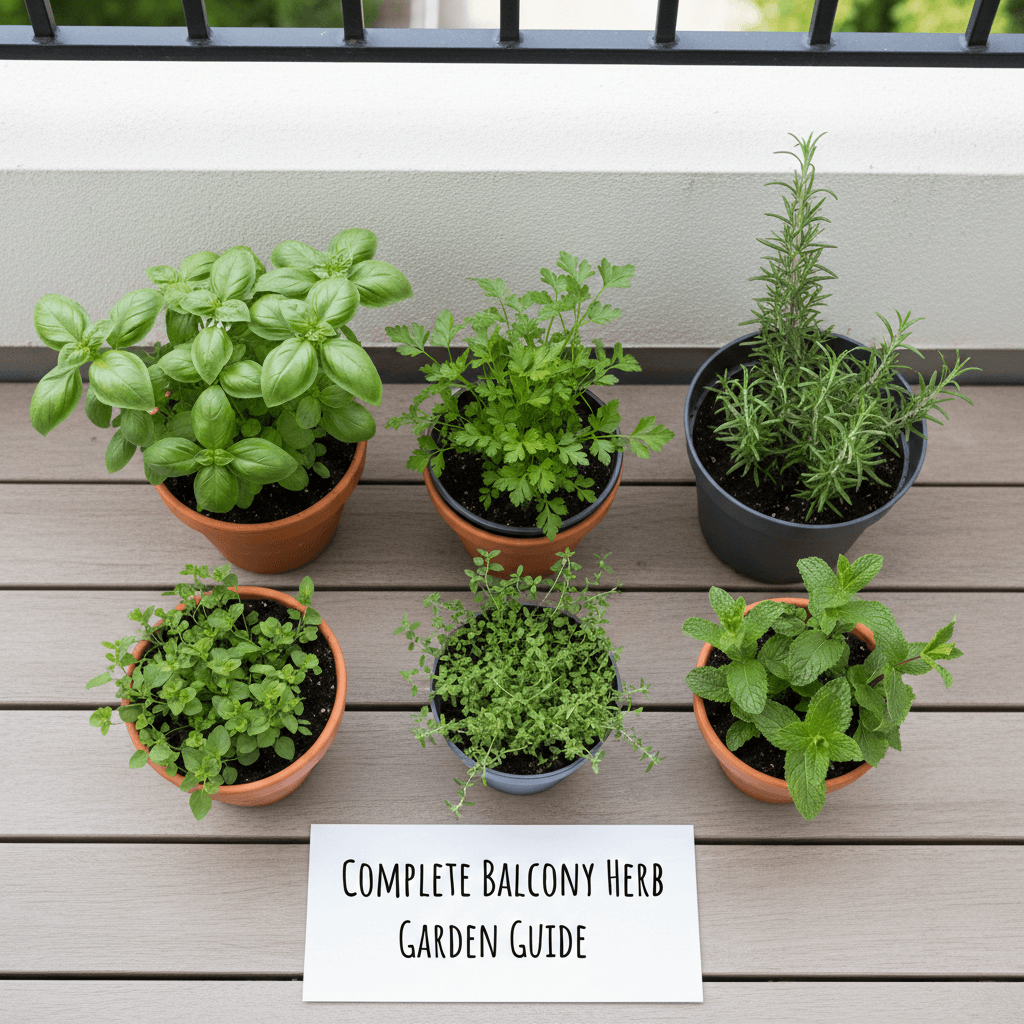
A balcony herb garden is one of the highest-return projects you can do as a renter. You don’t need a large balcony, drilling permissions, or a green thumb. You need the right herbs for your actual sun conditions, containers that drain correctly, and a basic harvesting routine.
This is the complete setup guide: sun assessment, container selection, herb-by-herb care, common failure points, and what a productive balcony herb garden looks like month-to-month. For everything beyond herbs, see our balcony gardening hub.
Table of Contents
- Step 1: Assess Your Sun Hours
- Step 2: Match Herbs to Your Balcony
- Step 3: Choose Renter-Safe Containers
- Step 4: Soil Mix for Balcony Herbs
- Step 5: Planting and the First Watering
- Step 6: Watering Schedule by Season
- Step 7: Harvesting to Encourage Growth
- Common Balcony Herb Problems and Fixes
- My Experience: 3 Years of Balcony Herb Growing
- Starter Kit Cost Breakdown
- FAQ
Step 1: Assess Your Sun Hours
The single most important factor in balcony herb growing is sun hours — not soil, not containers, not fertiliser. Buying the wrong herbs for your sun conditions is the most common reason balcony herb gardens fail.
How to measure: Track which part of your balcony receives direct sun at three times — 9am, 12pm, 3pm — on a sunny day. Count total hours of direct sun at the spot where you’ll place herbs. This gives you a reliable baseline.
Quick estimation by direction: – South-facing (Northern Hemisphere): 6–8 hours direct sun, hottest microclimate – West-facing: 3–5 hours afternoon direct sun – East-facing: 3–5 hours morning direct sun – North-facing: 0–2 hours indirect only Match your herb choices to your aspect with our guide to a south or north-facing balcony.
High-rise balconies (above 6th floor) add wind exposure, which increases water demand by 30–50% and can damage tender herbs (basil, cilantro) in gusts. If keeping up with watering is a struggle, lean on drought-tolerant balcony plants.
Step 2: Match Herbs to Your Balcony
| Balcony Direction | Best Herbs | Avoid |
|---|---|---|
| South-facing (6–8h sun) | Basil, rosemary, thyme, oregano, sage, lavender, chives | Nothing — best conditions |
| West-facing (3–5h afternoon) | Basil, thyme, sage, chives, parsley | Mint (burns in direct afternoon heat) |
| East-facing (3–5h morning) | Chives, parsley, mint, cilantro/coriander, lemon balm | Basil (needs afternoon heat to develop flavour) |
| North-facing (0–2h indirect) | Mint, chives, lemon balm, Vietnamese coriander | Basil, rosemary, thyme, oregano — all will fail |
The north-facing solution: A 20–30W LED grow light running 14 hours/day on a timer supplements the missing sun and makes a north-facing balcony productive for most herbs except rosemary and thyme. Cost: $20–$40 / €18–€35. See balcony lighting for herbs and vegetables for grow light options.
Mint rule: Always grow mint in its own separate container. It spreads by underground runners and takes over any pot it shares within one season. A dedicated 20cm pot per variety.
Step 3: Choose Renter-Safe Containers
Everything in this guide is drilling-free, adhesive-free, and completely reversible.
| Container Type | Cost | Capacity | Notes |
|---|---|---|---|
| Railing clip-on planters | $15–$30 / €13–€27 per unit | 2–3 herbs per box | Hook over railing; check weight rating before loading |
| Freestanding tiered stand | $30–$60 / €27–€54 | 6–12 pots | Move indoors in winter, no disassembly |
| Terracotta pots (20–25cm) | $5–$12 / €4–€11 each | 1–2 herbs per pot | Best drainage; heavy when wet |
| Fabric grow bags | $8–$15 / €7–€13 for 5-pack | 1 herb per bag | Lightweight, excellent air pruning of roots |
| Window box (freestanding) | $15–$25 / €13–€22 | 4–5 herbs in a row | Place on balcony floor against wall |
Minimum pot sizes: 15cm diameter for mint, chives, parsley. 20–25cm for basil, cilantro, thyme. 30cm+ for rosemary (deep tap root).
Weight consideration: A 25cm terracotta pot filled with wet potting mix weighs approximately 5–7kg. A 40cm self-watering planter can reach 15–20kg when full. Check the weight rating of railing planters before loading — most clip-on planters are rated for 3–5kg per unit. For heavy containers, place on the balcony floor, not the railing. Lightweight reusable grow bags cut that load if weight is tight.
Step 4: Soil Mix for Balcony Herbs
Standard potting compost from supermarkets is too water-retentive for balcony conditions. On an exposed balcony, the top layer dries quickly while the lower root zone stays saturated — a perfect setup for root rot.
The standard balcony herb mix: 70% potting compost + 30% perlite (volcanic glass particles). Perlite holds no water, creates permanent air pockets, and adds minimal weight. Available at any garden centre or hardware store: $8–$12 / €7–€11 for a 10L bag (enough for 6–8 herb pots).
For Mediterranean herbs (rosemary, thyme, lavender, oregano): 50% potting compost + 50% horticultural grit. These plants evolved in thin, rocky soil that dries completely between rains. Rich, moisture-retentive potting mix causes root rot within one or two seasons.
Avoid “moisture-control” or “water-retaining” potting mixes for balcony use. These are formulated for plants that sit in unventilated indoor conditions — on a wind-exposed balcony, the retained moisture has nowhere to go.
Step 5: Planting and the First Watering
From nursery seedlings (recommended for beginners): Plant at the same depth as the nursery pot — don’t bury the stem deeper. Water thoroughly until water runs from the drainage holes, then don’t water again until the top 2cm of soil is dry.
From seed: Press seeds to a depth of 2–5mm (not deeper — most herb seeds need light to germinate). Cover lightly with a thin layer of soil or vermiculite. Keep moist but not wet until germination (7–21 days depending on herb). Basil germinates in 5–7 days at 20°C+; parsley takes 14–21 days.
After planting: Water in gently, then place in the correct sun position. Don’t move pots frequently — herbs established in one spot acclimate to that light level. Moving from shade to direct sun without hardening off causes leaf scorch.
Step 6: Watering Schedule by Season
Balcony herbs die from overwatering more often than underwatering. The finger test is the only reliable method: push a finger 3–4cm into the soil. If dry at that depth, water thoroughly. If still moist, wait.
Approximate schedule (varies by pot material, wind, temperature):
| Season | Terracotta pots | Plastic/ceramic pots |
|---|---|---|
| Summer (25°C+, windy) | Every 1–2 days | Every 2–3 days |
| Spring/autumn | Every 2–4 days | Every 3–5 days |
| Winter (outdoor herbs) | Every 7–14 days | Every 10–14 days |
Railing planters dry faster than floor pots — they’re more exposed to wind on all sides. In peak summer, check them daily.
Self-watering containers (with a water reservoir below a false floor) extend the interval to every 3–7 days — useful if you travel or forget to water. Fill the reservoir, not the soil surface, once established.
When going on holiday: Move pots to the shadiest spot on the balcony (reduces water demand by 40–50%), water thoroughly before leaving, and group them together to raise local humidity. For trips of 5–10 days, this is usually sufficient. For longer trips: a basic drip irrigation timer ($25–$45 / €22–€40) connected to an outdoor tap runs automatically. You can also set up balcony drip irrigation without a faucet for longer trips.
Step 7: Harvesting to Encourage Growth
Correct harvesting is what keeps a herb garden productive. Most beginners harvest too little, too infrequently — the plant flowers, sets seed, and stops producing usable leaves. Once you have a surplus, our notes on harvesting and storing your herbs help you use it.
Basil: Cut stems from the top, always leaving 2 node pairs (sets of leaves) on the plant below the cut. Remove flower buds immediately as they appear — once basil flowers, leaf production declines and flavour weakens. Harvest regularly (every 5–7 days in summer) even if you don’t need the herb — this delays bolting.
Mint: Cut stems back to 5–8cm above soil level. It regrows fully within 10–14 days and is more productive after hard cutting than light trimming. One mint plant can supply more mint than most kitchens can use.
Chives: Cut to 3–5cm above soil level with scissors. Regrows in 2–3 weeks. The more you cut, the more they produce.
Parsley: Take outer stems from the base of the plant, leaving the inner crown to continue growing. Never remove more than one-third at once.
Rosemary and thyme: Harvest soft tip growth only — never cut back to old, woody growth (it won’t regrow from brown wood). Take 5–10cm from the tips and use them fresh or dried.
Common Balcony Herb Problems and Fixes
Basil wilting despite watering: Usually root rot from overwatering or waterlogged soil, not drought. Check the roots — mushy brown roots confirm root rot. Improve drainage (add perlite, ensure holes are clear), reduce watering frequency.
Herbs growing tall and leggy: Insufficient light. The plant is stretching toward the nearest light source. Move to a sunnier position or add a grow light.
Yellow leaves from the bottom up: Overwatering. Reduce frequency. Check that the pot has drainage holes and they’re not blocked.
Mint taking over the pot: Normal — mint spreads aggressively. Either divide and repot, or cut back hard (to 5cm). In a shared pot, mint will outcompete all other herbs within one season.
Cilantro/coriander bolting (going to seed) rapidly: This is genetic — in warm weather, cilantro bolts fast regardless of care. Harvest leaves continuously, sow new seeds every 2–3 weeks for succession. Use slow-bolt varieties (labelled “slow bolt” or “Calypso”).
Aphids on basil: Common in summer. Wash off with a strong water jet, or spray with diluted dish soap solution (1 teaspoon in 500ml water). Avoid chemical pesticides on edible herbs — observe the pre-harvest interval if you do use any approved product.
My Experience: 3 Years of Balcony Herb Growing
My balcony is west-facing, 1.8m × 3.2m, 4th floor. I’ve been running a continuous herb garden since spring 2023.
Current setup: 6 terracotta pots (20–25cm) on a freestanding wooden plant stand, 2 railing clip-on planters for mint varieties, one 35cm fabric grow bag for rosemary. Where floor space runs out, vertical garden planters for balcony walls add room.
What’s consistently worked: – Chives: the single most reliable and productive herb on my balcony. Cut hard every 3 weeks, regrows reliably, never diseased, never bolts. – ‘Corsican’ basil (small-leaf variety): handles the afternoon wind better than large-leaf Genovese. More compact, less likely to snap at the stem base. – Greek oregano: almost zero maintenance — I water it once a week and harvest whenever I need it. Has survived two winters in the same pot without repotting.
What’s failed or been difficult: – Cilantro in July/August heat — bolts within 2 weeks regardless of anything I do. I now only grow it April–June and again September–October. – Large-leaf Genovese basil in the railing planter — wind damage split two plants at the stem. I moved basil to the sheltered floor-level pots. – Rosemary in the first year — planted in standard potting compost, developed root rot by November. Replanted in a 50/50 grit mix in the fabric grow bag; now on year two and thriving.
The cost over 3 seasons: Initial setup (stand, pots, soil, plants) approximately €85. Annual ongoing cost: €20–€30 in new seedlings, soil refresh, and occasional replacement pots. Total spend: approximately €165 over 3 years. Value of herbs harvested at supermarket prices: roughly €320–€380.
For related guides, see balcony containers and drainage and the balcony plant calendar for monthly timing.
Starter Kit Cost Breakdown
Minimal starter (3–4 herbs, one tiered stand):
| Item | US | Europe |
|---|---|---|
| Freestanding 3-tier plant stand | $30–$50 | €27–€45 |
| 4× terracotta pots (20cm) | $16–$28 | €14–€25 |
| Potting compost (10L) | $8–$12 | €7–€11 |
| Perlite (3L) | $5–$8 | €4–€7 |
| Herb seedlings (4 plants) | $8–$16 | €7–€14 |
| Total | $67–$114 | €59–€102 |
Year 2 ongoing cost: seedlings and soil refresh only — $15–$30 / €13–€27.
[UPDATE 2026] How to Start a Balcony Herb Garden: The Shortcut Method
Most guides recommend starting from seed. Skip that. Buy established seedlings from a garden centre — they are 4–6 weeks ahead of seeds and cost $2–$4 per plant. For a first balcony herb garden, four plants is the right starting point: one basil, one chives, one mint (in its own pot — it spreads), and one parsley or thyme depending on your sun hours.
Fastest setup: a 3-tier freestanding plant stand ($30–$50), four 20cm terracotta pots, standard potting compost mixed with 20% perlite, and four seedlings. Total setup time: 45 minutes. First usable harvest: 2–3 weeks for chives and basil, 4–6 weeks for parsley and thyme. No drilling, no landlord sign-off, no specialist knowledge required. This is the core of the no-drill balcony herb garden approach.
The one thing that determines success or failure is matching herbs to your sun hours — not the containers, not the soil, not the fertiliser. South and west balconies can grow anything. North and east balconies are limited to shade-tolerant herbs (mint, chives, parsley). Get this right first and the rest is maintenance.
Safety Disclaimer
When using any pesticide, fungicide, or plant treatment on edible herbs, check the pre-harvest interval on the product label — the number of days that must pass between application and safe harvest. Organic sprays (neem oil, insecticidal soap) generally have no or minimal pre-harvest interval. Never use systemic insecticides (absorbed into plant tissue) on herbs you intend to eat — these chemicals remain in the plant regardless of washing.
