
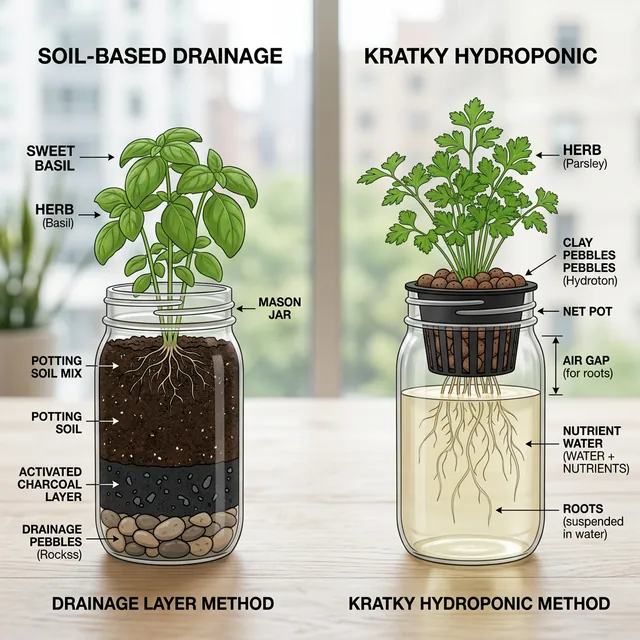
A mason jar herb garden for a windowsill costs under $30 to start, fits in 18 inches of window ledge, and produces harvestable herbs within 3–4 weeks of setup. The catch is that most people kill their first attempt because mason jars have no drainage — which is the single biggest difference between a mason jar garden and a normal container garden. Go bigger with our complete balcony herb garden guide.
Here is the complete setup, including the drainage fix that keeps herbs alive past week two.
Table of Contents
- Mason Jar Herb Garden: Two Approaches
- Soil-Based Setup: Step by Step
- Hydroponic Mason Jar Setup
- Best Herbs for a Mason Jar Windowsill Garden
- My Windowsill Setup: 6 Jars, North-Facing Window
- What Kills Mason Jar Herbs (And How to Prevent It)
- FAQ
Mason Jar Herb Garden: Two Approaches
There are fundamentally two ways to grow herbs in mason jars:
Soil-based: standard potting mix in a jar, with a drainage modification to prevent root rot. Grows all standard culinary herbs. Works without any special equipment. Cheaper and simpler.
Hydroponic (water-based): herbs rooted in water with added liquid nutrients. No soil at all. Works best for herbs that root easily in water — basil, mint, green onions. The mason jar hydroponics guide covers this in detail; this article focuses on the soil-based approach with hydroponic notes.
For a kitchen windowsill where you want herbs for cooking, soil-based is the better long-term system. Hydroponic jars look beautiful and work for propagation, but they produce less growth per jar than soil and require weekly nutrient management.
Soil-Based Setup: Step by Step
What You Need
- Mason jars (wide-mouth quart jars work best — the wider opening accommodates plant roots better than narrow-mouth)
- Potting mix (not garden soil — garden soil compacts in containers)
- Small stones or gravel (0.5–1 inch deep layer at the bottom of each jar for drainage)
- Herb seeds or nursery starts
- A sunny windowsill (south or east-facing preferred)
Total cost: $15–$25 for 4–6 jars if you’re starting from scratch. Lower if you’re reusing jars you have.
The Drainage Layer (Critical)
Mason jars have no drainage holes. This is the reason most mason jar herb gardens fail. Without drainage, water sits at the bottom and roots rot within 2–3 weeks of regular watering.
The fix: a 1-inch layer of small stones or gravel at the bottom of each jar before adding soil. Water percolates down through the soil and collects in the gravel layer rather than saturating the soil from the bottom up. This creates a reservoir below the root zone.
Some gardeners add a thin layer of activated charcoal (aquarium charcoal) on top of the gravel before adding soil. The charcoal absorbs bacterial and fungal compounds that accumulate in closed, undrained containers. Not required, but extends the time before soil degradation becomes an issue.
Filling and Planting
- Add 1 inch of gravel to the bottom of the jar
- Optional: add 0.25 inch of activated charcoal over the gravel
- Fill with potting mix to within 1.5 inches of the top
- Plant nursery start or seeds at normal depth for the herb (seeds: 0.25 inch; nursery starts: same depth as they were in the nursery pot)
- Water gently — enough to moisten the soil without saturating it
- Label each jar (this sounds obvious; you will mix up chives and parsley if you don’t)
Ongoing Care
Watering: the most common mistake is overwatering. Stick your finger into the soil 1 inch deep before watering. If it feels moist, don’t water. Water when it feels dry at 1 inch. Most herbs in mason jars need watering every 2–3 days in a warm room with direct sun, less in lower light.
Feeding: potting mix has nutrients for 4–6 weeks. After that, add a half-strength dose of liquid fertilizer (fish emulsion or balanced NPK) every 2–3 weeks during active growth.
Rotation: if your window is directional (light from one side only), rotate the jars 180 degrees every 3–4 days to prevent one-sided growth.
Hydroponic Mason Jar Setup
For the hydroponic approach — herbs rooted in water, no soil — the basic mason jar setup works for basil, mint, lemon balm, green onions, and chives. These root in water readily. Parsley, thyme, and oregano are more difficult to keep alive long-term in pure water.
Basic water rooting: take a cutting 4–6 inches long from a healthy herb plant (either from your own plants or from grocery store herbs — grocery store basil propagates in water surprisingly well). Strip leaves from the lower 2 inches. Place in a mason jar with 2–3 inches of room temperature water. Cover the jar with dark paper or put it in a dark jar to prevent algae growth. Change the water every 3–5 days.
Roots appear in 7–14 days for basil; 14–21 days for mint.
Sustained hydroponic growth (beyond just rooting) requires added nutrients — plain water doesn’t contain nitrogen, phosphorus, potassium, or micronutrients. A few drops of hydroponic nutrient solution per jar per week maintains growth. Without nutrients, rooted cuttings in plain water stay alive but grow very slowly and become pale.
Best Herbs for a Mason Jar Windowsill Garden
| Herb | Approach | Difficulty | Harvest Timeline | Notes |
|---|---|---|---|---|
| Chives | Soil | Very easy | 3–4 weeks from seed | Most forgiving, regrows after cutting |
| Basil | Soil or hydroponic | Medium | 4–6 weeks | Needs 6+ hours sun; pinch flower buds |
| Mint | Soil or hydroponic | Easy | 2–3 weeks from cutting | Must have its own jar — invasive |
| Parsley | Soil | Easy | 6–8 weeks from seed; buy nursery start | Slow from seed |
| Cilantro | Soil | Medium | 3–4 weeks | Bolts quickly in warm windows |
| Green onions | Soil or water | Very easy | 1–2 weeks (regrowth from store bulbs) | Fastest return; regrow store-bought bulbs |
| Thyme | Soil | Easy | 4–5 weeks from nursery start | Drought-tolerant; water less |
| Lemon balm | Soil or hydroponic | Easy | 3–4 weeks | Spreads; keep in its own jar |
Beginner recommendation: start with chives, mint (in its own jar), and green onions (regrowing store-bought). All three produce results within 2–3 weeks, don’t require much sun, and are nearly impossible to kill. Once you have a rhythm for the mason jar setup, add basil and parsley.
My Windowsill Setup: 6 Jars, North-Facing Window
My kitchen window is north-facing — under 2 hours of direct sun daily, mostly indirect light. That’s below the threshold for basil, rosemary, and most full-sun herbs.
Current jar lineup: – 2 × chives (quart jars, planted March 2025, still producing) – 1 × mint (wide-mouth pint jar — mint doesn’t need a full quart) – 1 × Vietnamese coriander (shade-tolerant cilantro alternative; excellent on north-facing windowsill) – 1 × lemon balm (for tea; thrives in indirect light) – 1 × green onions (regrowing from store-bought; refreshed every 3 weeks)
What I don’t grow on this windowsill: basil (moved it to the balcony where it gets more sun), parsley (it grows but very slowly — barely worth the space), thyme (grows, but it’s leggy and weak in low light). Short on sun? Try low-light indoor plants.
The biggest surprise: Vietnamese coriander as a cilantro substitute in a north-facing window. It has a similar flavor profile (slightly more lemony, slightly less sharp than cilantro) and grows vigorously in indirect light. I found it at a local Asian grocery store and propagated it from a grocery bunch by rooting cuttings in water — it rooted in 10 days.
The second surprise: regrowing green onions from store-bought bulbs gives you harvestable product in 5–7 days, which is faster than any other option in this setup. Cut the green tops, leave 1 inch of bulb in soil, and they regrow. One batch of $1.50 store-bought green onions has been producing continuous harvests for 8 weeks in a mason jar on my windowsill.
What Kills Mason Jar Herbs (And How to Prevent It)
Overwatering is responsible for about 70% of mason jar herb deaths. No drainage means mistakes accumulate. Water less than you think you need to — check soil moisture with your finger before watering every time.
Insufficient light causes leggy, pale growth. Herbs lean toward the window and grow spindly. On a north-facing windowsill with very little direct light, add a small clip-on LED grow light ($15–$25) for 4–6 hours per day. Even a weak grow light dramatically improves growth in low-light windows.
Not harvesting regularly causes the plant to focus energy on producing seeds instead of leaves. For basil, pinch off any flower buds the moment they appear. For chives and green onions, cut to 1 inch above soil level every 3–4 weeks to encourage continuous regrowth.
Planting too many herbs in one jar. A quart mason jar holds one herb plant at mature size. Two herbs in one jar compete for nutrients and one will dominate. Keep each jar to one species.
Using garden soil instead of potting mix. Garden soil compacts in containers and blocks airflow to roots. Always use a potting mix specifically designed for container growing.
