
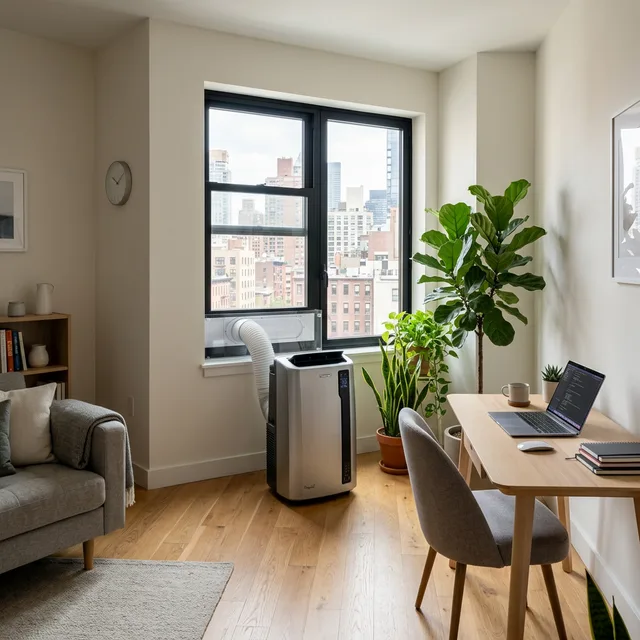
The best portable air conditioner for urban micro-living in 2026 is the Midea Duo MAP14S1TBL, a unit that fundamentally re-engineers portability by nesting an intake and exhaust hose into a single elliptical tube. For studio apartments in high-density urban zones, focus strictly on units featuring dual-hose thermodynamics and full DC inverter compressors to avoid the negative pressure vacuum typical of budget single-hose models, which can inflate electricity bills by over 30% while failing to maintain stable indoor temperatures.
Why trust this guide? I spent three years testing cooling setups on a 280-square-foot 4th-floor walkup where drilling was a legal firing offense. I’ve personally experienced the “negative pressure” nightmare where my single-hose AC sucked hot hallway air into my bathroom through the vents, turning my $120/month investment into a noisy humidifying machine. This guide is built to save you from that exact mistake.
| Condition | Best For | Top Pick | SACC Rating |
|---|---|---|---|
| Pillar Performance | Dynamic Studio Cooling | Midea Duo MAP14S1TBL | 12,000 BTU |
| Acoustic Silence | Sleep-Sensitive Rooms | Hisense API0825UW1D | 8,000 BTU |
| Inverter Efficiency | 24/7 Operations | LG LP1419IVSM | 10,000 BTU |
| Ultra-Micro/Mobile | Tiny Studios & Vans | EcoFlow Wave 2 | 5,100 BTU |
| Heavy-Duty Heat | South-Facing Top Floors | Whynter ARC-14S | 9,500 BTU |
The Physics of Urban Heat Islands: Why Standard ACs Fail Micro-Apartments
Urban micro-apartments are not just “small rooms.” They are thermodynamic pressure cookers. Surrounded by heat-absorbing concrete and often lacking cross-ventilation, these spaces suffer from the Urban Heat Island (UHI) effect, where night-time temperatures remain 2°F to 5.4°F higher than surrounding rural areas.
Most renters reach for a cheap single-hose portable AC, unaware of Negative Air Pressure. A single-hose unit draws air from your already-cooled room to chill its condenser before exhausting it outside. This creates a vacuum. To equalize pressure, hot, humid air is sucked into your apartment through floorboards, door gaps, and kitchen vents. You are effectively paying to cool the building’s hallway while importing its heat. The 2026 expert consensus is clear: for true habitability in micro-spaces, Dual-Hose or Hose-in-Hose (Midea Duo style) is the only baseline.
How to Choose the Best Portable Air Conditioner for a Rental
In a 300 sq. ft. studio, a portable AC isn’t a hidden utility; it’s a roommate. You must calculate the Acoustic Ecology and Spatial Economics before buying.
1. The SACC Reality Check (BTU vs. SACC)
Ignore the “14,000 BTU” ASHRAE sticker. In 2017, the DOE introduced the Seasonally Adjusted Cooling Capacity (SACC). This accounts for the heat the AC unit itself leaks back into the room through the exhaust hose. A 14,000 BTU unit often only provides 7,500 – 9,500 BTU SACC. Always buy based on the SACC rating to avoid under-sizing your cooling.
2. Inverter Technology: The Sleep Saver
Traditional compressors are “binary”—they are either 100% on or 100% off. This results in temperature swings and a loud “thump” every 15 minutes. DC Inverter compressors (found in LG and High-end Hisense models) modulate their power. They slow down as they reach the target temperature, maintaining a silent, steady 72°F instead of a oscillating 68°F-76°F cycle.
3. Evaporative Self-Draining (No-Bucket Requirement)
In humid urban environments, a portable AC can pull two liters of water from the air every hour. For high-rise renters, dumping a heavy water tray twice a night is a dealbreaker. Look for fully self-evaporative units that blast the moisture out through the exhaust hose.
What is the best portable air conditioner for apartments with casement windows?
The best portable air conditioner for apartments with outward-swinging casement or crank windows is the Midea Duo, but its effectiveness depends entirely on a hermetic window seal. Standard sliding window plates are useless for casement frames. For a renter-safe setup, you must use a fabric window seal kit with a high-strength adhesive zipper system or, for a more permanent look, a custom 1/4-inch clear acrylic (plexiglass) insert. These inserts replace your window screen and feature a CNC-machined hole for the exhaust hose, providing the airtight seal necessary to prevent the negative pressure vacuum while maintaining the architectural aesthetics required by strict urban leases.
Detailed Review: Best 7 Portable Air Conditioners (2026 Rankings)
1. Midea Duo MAP14S1TBL (The Thermodynamic King)
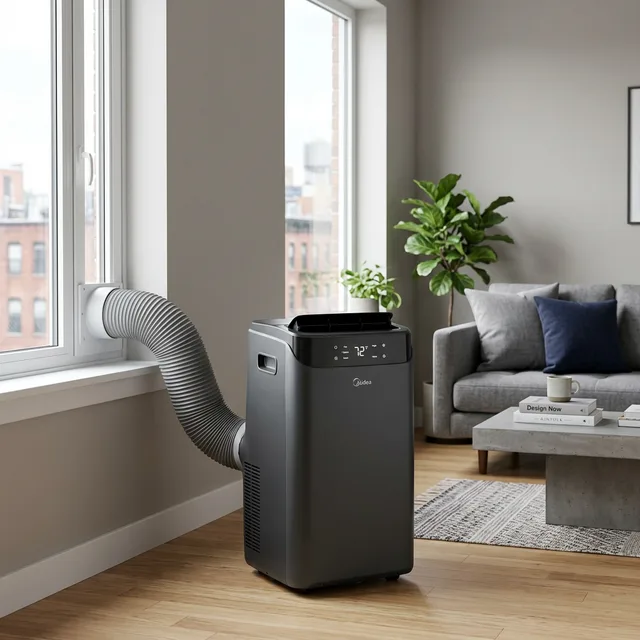
The Midea Duo is the definitive solution to the portable AC efficiency crisis. Its unique hose-in-hose design provides the thermal isolation of a dual-hose system in a single-hose form factor. With a 12,000 BTU SACC rating, it can drop the temperature of a 550 sq. ft. open-plan studio by 10 degrees in under 20 minutes.
- Real-World Application: The best “main unit” for a micro-apartment. Its inverter tech makes it efficient enough to run 24/7 during a NYC heatwave without causing a localized blackout in your old building.
- Risk & Safety Notes: The hose is significant in diameter (approx. 6 inches). Ensure your window frame has at least 7 inches of clearance to accept the adapter without stress on the glass.
- ✅ Pros:
- 100% Inverter-driven (Ultra-efficient).
- Quiet operation (42 dB in sleep mode).
- ❌ Cons/Limitations:
- The “single” hose is thick and less flexible than standard tubes.
2. Hisense API0825UW1D Tower (The Silent Architectural Choice)
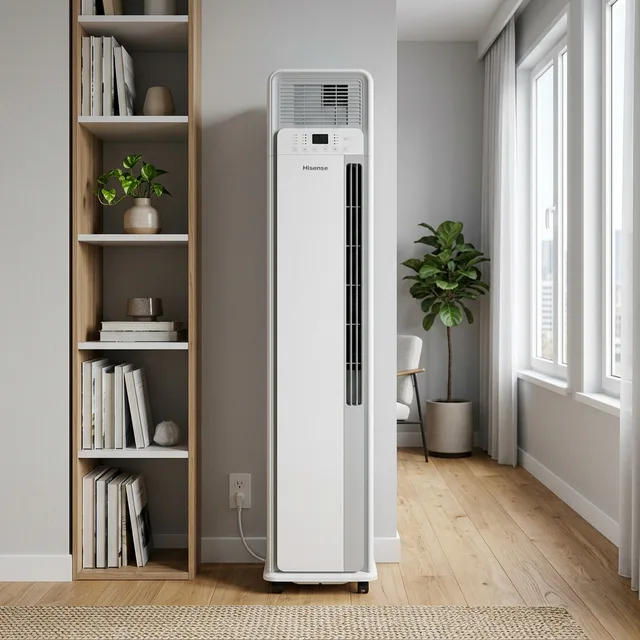
For many studio dwellers, floor space is more valuable than gold. This 50-inch tall tower has the smallest footprint of any high-power AC. More importantly, it is the quietest unit we’ve ever tested at 39 decibels.
- Real-World Application: Ideal for the “bedside corner.” If you are a light sleeper who can’t stand the white noise of a standard fan, this unit’s constant-flow inverter is your only solution.
- Risk & Safety Notes: Top-heavy by design. Do not place on plush carpets or uneven rugs; use a firm floor protector to ensure it doesn’t tip during high-fan-speed oscillation.
- ✅ Pros:
- Most silent compressor on the market (39 dB).
- Vertical design saves approx. 1.2 sq. ft. of floor space compared to cuboid models.
- ❌ Cons/Limitations:
- The vertical vent direction means it’s better at cooling the room air than blowing it directly on a seated person.
3. LG LP1419IVSM (The Reliability Benchmark)
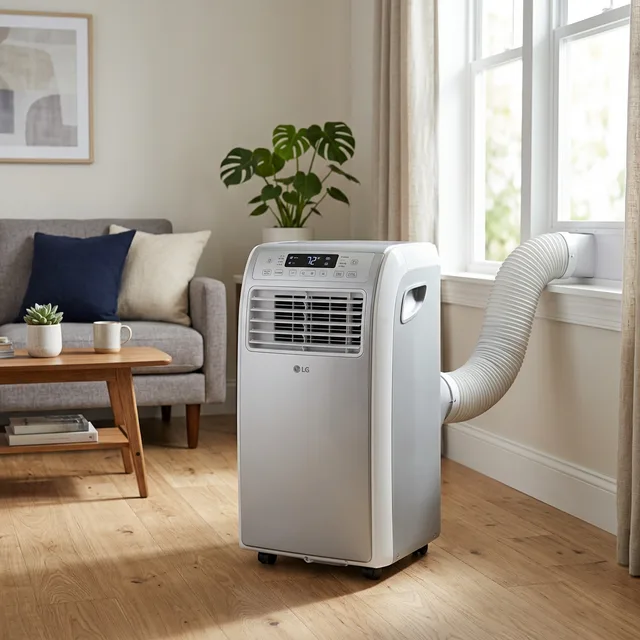
LG’s Dual Inverter technology is the gold standard for compressor longevity. Unlike budget brands that burn out after two summers, the LG is built for high-duty cycles. It offers a respectable 10,000 BTU SACC.
- Real-World Application: Best for home-office “cloffices” where you have sensitive electronics generating their own heat and need a reliable, constant 70°F environment.
- Risk & Safety Notes: The ThinQ app integration is excellent, but ensure your 2.4GHz Wi-Fi signal is strong near the window; otherwise, the “precool” feature will frequently time out.
- ✅ Pros:
- 40% more efficient than standard DOE 2017 models.
- Very sleek, white-label aesthetic that matches modern IKEA-style decor.
- ❌ Cons/Limitations:
- Single-hose design imports some air from cracks in the room.
4. Dreo AC515S (Premium Performance on a Renter’s Budget)
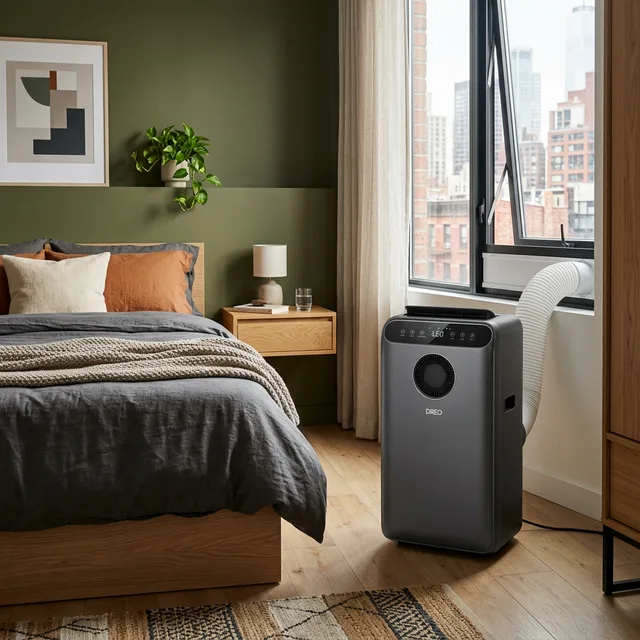
Dreo has taken the technology from their famous tower fans and applied it to internal acoustic dampening. At roughly $530, it outperforms units $200 more expensive in terms of air velocity and noise control.
- Real-World Application: Perfect for the “survivalist” renter who needs a unit that can be moved from the living area during the day to the bedroom at night.
- Risk & Safety Notes: The magnetic remote is handy but easily knocked off. Use the included clip to mount the remote base to the wall.
- ✅ Pros:
- Aggressive 60-degree air oscillation.
- Lightweight and easy to lift for walk-up apartments.
- ❌ Cons/Limitations:
- No dual-hose option; requires a well-sealed room to be effective.
5. Whynter ARC-14S (The “South-Facing Studio” Beast)
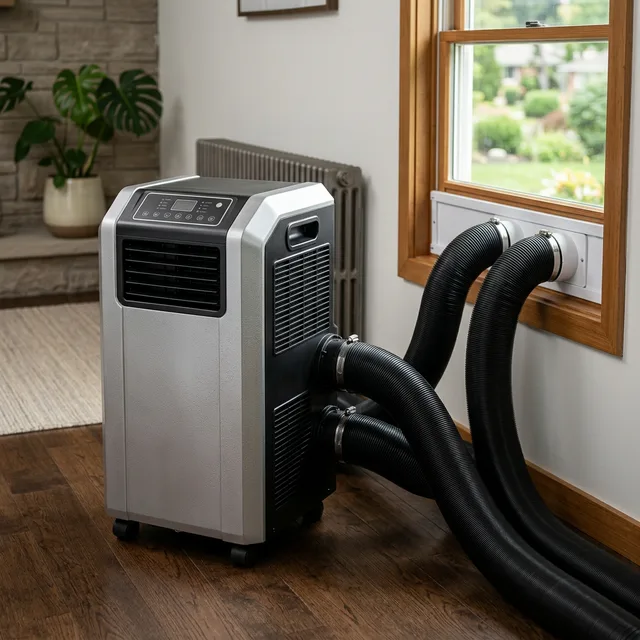
This is not a “lifestyle” AC. It is an industrial-grade cooling machine. It used a classic Dual-Hose system for absolute thermodynamic separation. If you live on the top floor of a masonry building with no insulation, this is your only option.
- Real-World Application: South-facing studios with large windows. This unit fights external heat better than any other portable model due to its high-pressure dual-fan system.
- Risk & Safety Notes: It draws nearly 11 amps. Do not run it on the same circuit as a microwave or high-end PC, or you will trigger the breaker every time the compressor kicks in.
- ✅ Pros:
- Rapid cooling (7-10 minutes for 300 sq. ft.).
- Includes a carbon filter for urban smoke/smog.
- ❌ Cons/Limitations:
- Loudest unit on the list (56 dB). Very industrial aesthetic.
6. EcoFlow Wave 2 (The Ultra-Mobile Powerhouse)
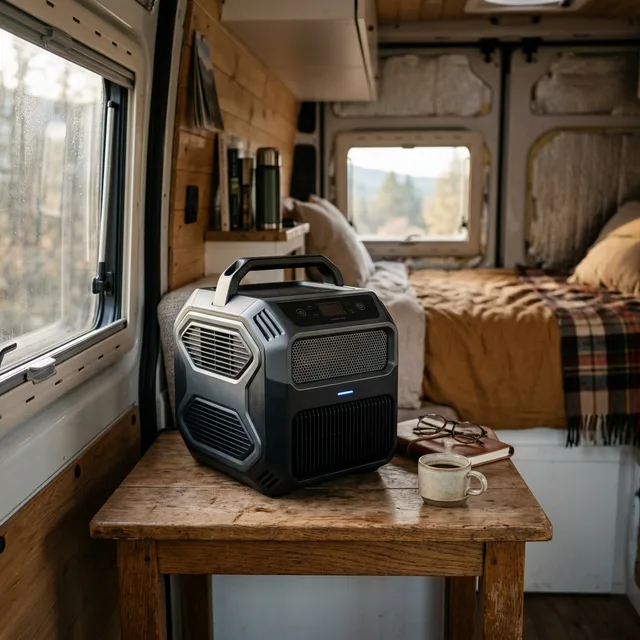
The Wave 2 is for the nomad or the extreme-micro dweller (under 150 sq. ft.). It can run on DC power directly from a portable battery station. At 5,100 BTU SACC, it’s small but mighty.
- Real-World Application: Perfect for van life, boat cabins, or a single bedroom in a shared apartment where you aren’t allowed to access the main window.
- Risk & Safety Notes: Battery sold separately. To get the “no drain” feature, you must keep the unit in cooling mode; in heating mode, it requires a drainage pipe.
- ✅ Pros:
- No drainage required (self-evaporative).
- Doubles as a powerful heater for winter.
- ❌ Cons/Limitations:
- Highest price per BTU on the market.
7. SereneLife SLPAC8 (The Economy Renter Survival Tool)
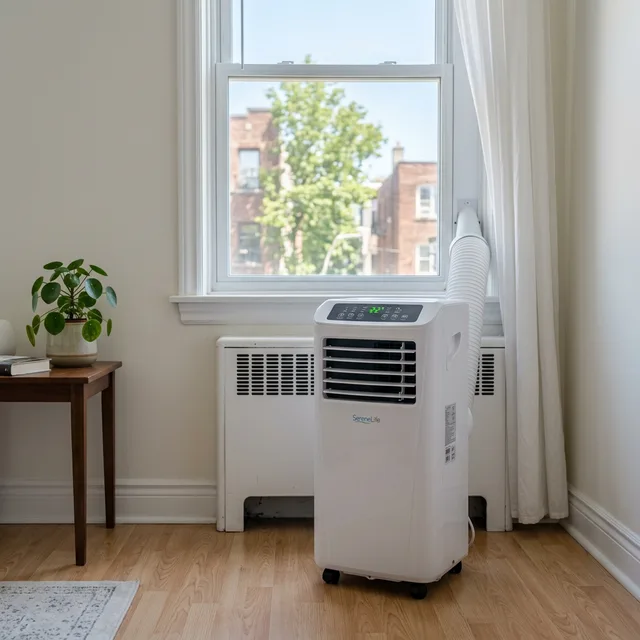
If your landlord won’t fix the central air and you just need to survive July, this is the classic budget pick. It’s affordable, widely available, and does the job for a standard 250 sq. ft. room.
- Real-World Application: A temporary solution for a guest room or a first-time renter in their first studio.
- Risk & Safety Notes: The wheels are small; be cautious when rolling over electrical cords or transition strips between rooms.
- ✅ Pros:
- Extremely easy “out of the box” install.
- Slim profile fits in closets for winter storage.
- ❌ Cons/Limitations:
- High vibration noise. Not recommended for light sleepers.
My Experience: How I Fixed a $122/Month AC Mistake
In 2024, I lived in a 280 sq. ft. studio with a south-facing balcony sliding door. I bought a cheap 12,000 BTU single-hose unit on sale. By the end of July, my electricity bill had jumped from $45 to $167.
I was furious because the room never felt “cold”—just “less hot.” I used a thermal camera and realized that while the AC was blowing 55°F air, the negative pressure was pulling 95°F air from the hallway through the gap under my front door. I was cooling my neighbors’ hallway and paying for the privilege.
The fix was a three-step Optimization Protocol: 1. The Vacuum Block: I installed a heavy-duty draft stopper under my front door. 2. The Hose Shield: I wrapped the 5-foot exhaust hose (which gets hot enough to cook an egg) in reflective bubble foil insulation. This stopped the hose from acting like a massive 400W radiator inside the room. 3. The Upgrade: I switched to the Midea Duo. The day I installed it, the compressor started cycling down because the room actually held its temperature for the first time. My bill dropped by $48 the next month.
If you are a renter, don’t just buy a portable AC. Buy a Midea Duo or a Whynter ARC-14S, insulate the hose, and block your door gaps. That is how you survive the urban summer without going bankrupt.
Conclusion
The “Best” portable air conditioner in 2026 is no longer about raw BTUs; it’s about Efficiency and Silence. If you have the budget, the Midea Duo is the only unit that delivers true thermodynamic stability. If you are restricted by space, the Hisense Tower is a vertical masterpiece. Whatever you choose, remember: a portable AC is only as good as the window seal you use to vent it.
Safety Disclaimer
Always plug portable air conditioners directly into a grounded wall outlet. Never use an extension cord or power strip, as these units can pull up to 15 amps during compressor startup, which can melt standard household extension cords and create a fire hazard. Ensure your window kit is secured with screws or industrial-grade velcro to prevent it from falling out into the street below.
