
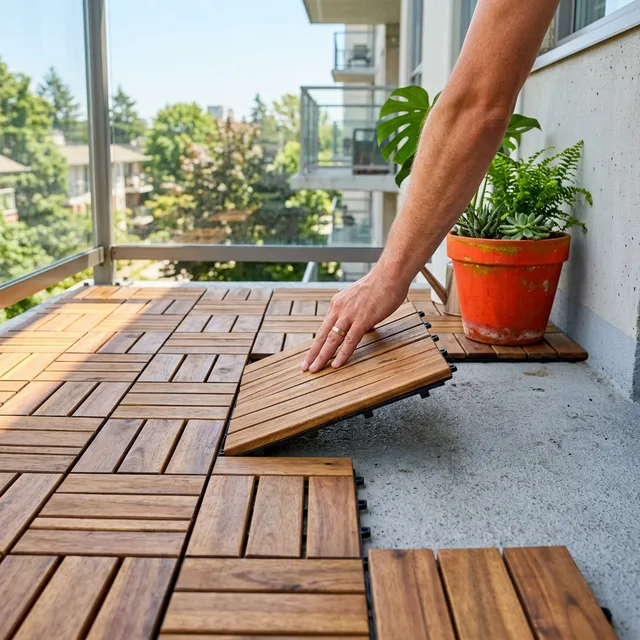
Most apartment balconies are raw grey concrete — visually depressing and thermally brutal. In peak summer, that slab absorbs UV radiation all day and radiates it back into your apartment through the evening, raising indoor temperatures by 2–4°C. In winter, it’s cold underfoot and visually bleak.
Interlocking acacia deck tiles are the fastest, most reversible fix available to renters. They snap together on plastic risers, create a 12–15mm air gap over the concrete, drain freely in rain, and come up in 45 minutes when you move out. No drilling, no adhesive, no landlord conversation required. The same reversible logic applies vertically, where no-drill balcony trellis options use tension fittings and railing clamps instead of wall anchors.
Table of Contents
- Why Acacia Specifically (Not Pine, Not Composite)
- What You Need to Know Before Buying
- Step-by-Step Installation Guide
- The 3 Rules That Determine Whether Your Floor Lasts 1 or 10 Years
- Annual Maintenance: What Actually Needs Doing
- Acacia vs Composite (WPC) vs Bamboo: Honest Comparison
- FAQ
Why Acacia Specifically (Not Pine, Not Composite)
Acacia is a tropical hardwood with natural oil content that makes it resistant to rot, moisture, and insects without chemical treatment. Its Janka hardness rating is around 1700 lbf — comparable to teak and significantly harder than cedar (900 lbf) or pine (380 lbf).
This hardness matters for balcony tiles because they’re walked on barefoot, dragged with patio chair legs, and subjected to freeze-thaw cycles in winter. Pine and softwood alternatives develop surface checking (small cracks) within one season on an exposed balcony. For the full setup, see our balcony gardening hub.
The thermal performance advantage: Acacia’s low thermal conductivity means it stays close to air temperature rather than absorbing and re-radiating heat like concrete. On a 35°C summer afternoon, bare concrete can reach 55–60°C surface temperature (painful and dangerous barefoot). Acacia tiles on the same surface peak at 38–42°C — warm but walkable.
What You Need to Know Before Buying
Tile size: The most common size is 30cm × 30cm, 9 slats per tile. Some manufacturers offer 50cm × 50cm tiles — these cover ground faster but are harder to cut for the final row and heavier to transport.
Weight per tile: A standard 30cm × 30cm acacia tile weighs approximately 0.9–1.1kg. For a 4m² balcony, you need ~45 tiles, adding roughly 50kg to the balcony load. Check your balcony weight rating if you’re also adding heavy planters — the balcony weight calculation guide explains how to do this. Stay within your balcony weight limits.
How many boxes to buy: Measure your balcony’s longest dimension and shortest dimension. Multiply to get area in m². Add 10% for cuts and edge pieces. Each box typically covers 0.5–1m² depending on the brand.
Oil-finished vs unfinished: Buy pre-oiled tiles. Unfinished acacia arrives paler and requires a coat of teak or outdoor furniture oil before use — otherwise it greys within 2–3 months of sun exposure. Pre-oiled tiles look better immediately and need less first-year maintenance.
Step-by-Step Installation Guide
Tools required: None. Seriously — just scissors or a handsaw for trimming the final row.
Step 1: Clean the concrete thoroughly
Sweep, then scrub the concrete with a vinegar-water solution (1:4 ratio). Rinse and let dry completely — at least 4 hours in sun. You’re sealing whatever is on that surface under a floor you’ll be walking on for years.
Check that your balcony drains properly. Pour a cup of water near the wall — it should flow toward the balcony edge within 30 seconds. If water pools, address the drainage with your landlord before laying tiles.
Step 2: Choose your pattern and starting corner
Parallel pattern: All slats run in the same direction. Creates a clean, elongated look that makes narrow balconies feel wider when slats run perpendicular to the longest dimension. Maintain them by learning to clean a balcony without a hose.
Checkerboard pattern: Alternate tiles 90°. More forgiving for irregular-shaped balconies because small alignment errors are less visible. Most popular for balconies under 6m².
Start from the corner most visible from indoors — usually the corner opposite the door. This ensures that corner is all full tiles, with any cut pieces hidden against the wall.
Step 3: Click and lay
Line up the plastic peg of one tile with the loop of the adjacent tile and press down. You should hear a definite click. Continue row by row, working away from your starting corner.
If tiles resist snapping together: Don’t force them with metal tools. Use the heel of a rubber-soled shoe or a rubber mallet. Forcing with a hammer can crack the plastic connector tabs.
Step 4: Handle the final row
Unless your balcony is an exact multiple of 30cm, you’ll have a gap at one or two edges. Options:
- Cut the final row: Use a handsaw or a jigsaw for a clean cut. Mark with a pencil and cut one slat at a time rather than the whole tile.
- Fill with river stones or white pebbles: The most popular renter solution — fill the remaining gap with decorative stone. Looks intentional and saves cutting.
- Buy half-tiles: Some brands sell 15cm × 30cm tiles specifically for edge finishing.
Step 5: Leave expansion gaps
Leave 6–8mm between the tile edge and the wall or railing. Wood expands when wet and hot — on a south-facing balcony in full summer, surface temperatures can reach 38–42°C, causing 1–2mm of thermal expansion per tile row. Without the gap, the floor buckles upward in the centre.
The 3 Rules That Determine Whether Your Floor Lasts 1 or 10 Years
Rule 1: Respect the drainage direction. The plastic riser base has channels moulded into it. These should align with your balcony’s natural drainage slope, not block it. If water is channelled toward the wall instead of the drain, you’ll have a mould problem within one season.
Rule 2: Oil annually. Acacia without UV protection greys within one summer. The greying is cosmetic (the wood remains sound), but many renters mistake it for damage. One coat of teak oil in spring, applied with a cloth, takes 20 minutes and keeps the warm honey tone for the season.
Rule 3: Store in winter if you’re above the freeze line. In climates that freeze, repeated freeze-thaw cycles cause checking in any wood, even acacia. Stack the tiles in a dry indoor space from November to March, or accept that you’ll re-oil every spring to manage the surface cracking.
Annual Maintenance: What Actually Needs Doing
Spring (April):
– Lift all tiles, sweep the concrete underneath, and scrub off any mould or algae that developed over winter
– Inspect tiles for cracked connector tabs (replace individual tiles as needed — they’re interchangeable)
– Apply one coat of teak or outdoor furniture oil to the top surface
Summer:
– Hose down occasionally — water drains freely through the slats and dries quickly
– No other maintenance required during the season
Autumn:
– If leaving tiles out over winter: apply a second coat of oil before the first frost
– If storing: clean tiles, stack in a dry space
Total annual maintenance time: approximately 45 minutes. Total annual cost: one bottle of teak oil (€8–€15), which lasts 2–3 seasons.
Acacia vs Composite (WPC) vs Bamboo: Honest Comparison
| Feature | Acacia Wood | Composite (WPC) | Bamboo |
|---|---|---|---|
| Surface temperature in sun | Low | Very high | Low |
| Thermal conductivity | Low | High (plastic core) | Low |
| Maintenance | Annual oiling | None | Semi-annual sealing |
| Cost | €25–€45/m² | €30–€60/m² | €20–€35/m² |
| Durability (untreated) | 5–10 years | 15–25 years | 3–7 years |
| Aesthetics | Warm, premium | Industrial | Natural but less varied |
| Renter-friendly | ✅ Fully | ✅ Fully | ✅ Fully |
Composite tiles are maintenance-free and last longer, but they get significantly hotter in direct sun than wood — surface temperatures 8–12°C higher than acacia in afternoon summer sun. For a south-facing balcony, this is a meaningful comfort difference.
Bamboo tiles are cheaper and look good initially, but they’re less dense than acacia and more susceptible to surface damage and greying. In high-traffic urban balconies, they show wear faster.
Safety Disclaimer
Do not install deck tiles over a balcony with active water ingress, significant concrete spalling, or structural rust staining (indicating rebar corrosion). These are landlord responsibilities and covering them with a floor can mask deterioration and create safety hazards. Inspect the concrete before laying, and flag any structural concerns before installation.
FAQ
Can I take acacia deck tiles with me when I move?
Yes — that’s the core benefit. They snap apart in the same time it took to install them. Stack in the original boxes or flat in a car boot. Bring them to your next apartment.
Do I need to seal or oil them before first use?
If buying pre-oiled tiles: no, they’re ready to use. If buying unfinished (raw) tiles: apply one coat of outdoor furniture oil and let dry 24 hours before use. Unfinished tiles placed in direct sun without oiling will start to grey within 4–8 weeks.
What happens if one tile breaks or cracks?
Acacia tiles are individual and interchangeable. Remove the damaged tile, replace it with a new one from the same brand (check the connector tab system matches). Most major brands maintain stock continuity across years.
Are acacia deck tiles slippery when wet?
Less slippery than smooth concrete due to the slat texture, but not as grippy as brushed or anti-slip concrete. If you’re concerned, add an outdoor anti-slip rug in the main walking area, particularly near the doorway.
How do I prevent mould growing underneath?
Mould under tiles is caused by standing water trapped against the concrete. Ensure your balcony slope drains freely before installation, and lift all tiles once per season to clean the concrete surface underneath.
