
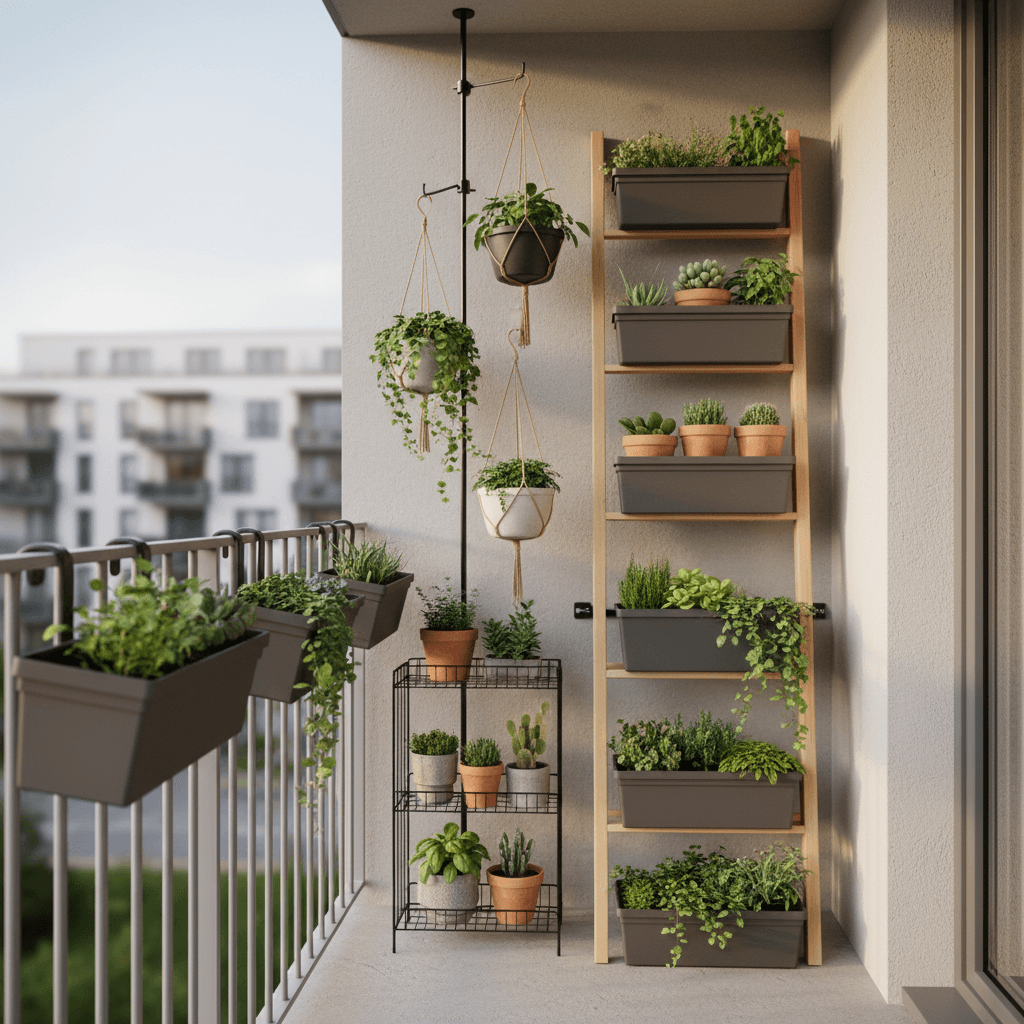
You’re a renter. You have a balcony. You also have a lease that strictly forbids drilling into exterior walls. Meanwhile, that big blank concrete wall or sturdy metal railing keeps whispering: “Imagine how much greenery could live here.”
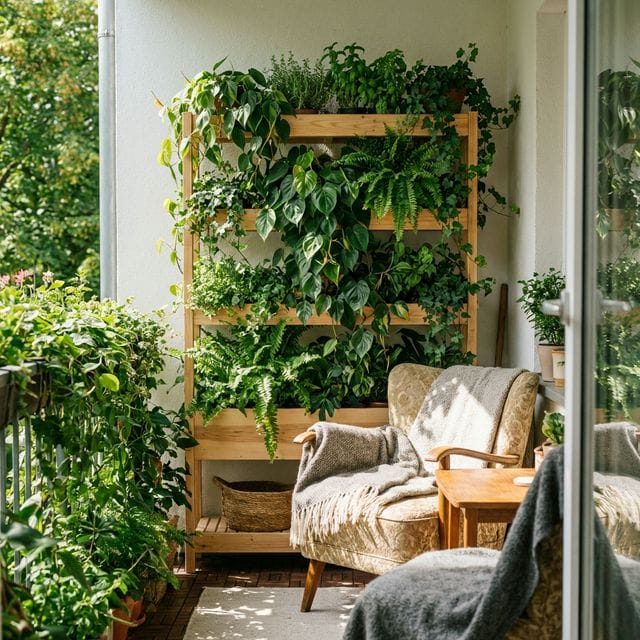
For small apartments and studio flats, growing up isn’t a style choice; it’s a survival tactic. When floor space is taken up by one chair and a drying rack, vertical space is the only way to build a real garden.
The challenge is gravity. How do you hang heavy pots of soil with no masonry drill? The answer lies in tension, leverage and smart hardware. Here are five renter‑friendly vertical garden ideas that won’t cost you your security deposit. Build a vertical garden wall.
1. Railing “Saddle” Planters (Over‑the‑Rail)
The easiest vertical space to claim is the railing itself.
- Idea: Planters that straddle the railing like a saddle on a horse. They balance on top and hang over both sides.
- Cost: About $15–30 per planter.
- Why it works: No screws or drills. Good models have adjustable arms to fit different railing widths.
- Safety tip: Always add zip ties or extra straps to secure them against high winds.
Use them for herbs, flowers and low‑growing strawberries where you want eye‑level greenery.
2. Floor‑to‑Ceiling Tension Rod Columns
If you have a balcony above you — i.e. a solid ceiling — you’re sitting on a vertical goldmine.
- Idea: Heavy‑duty outdoor tension rods that wedge between balcony floor and ceiling. Clamp pot rings or hooks onto the rod to hang planters or baskets.
- Cost: Roughly $30–50 for a sturdy rod system.
- Why it works: Vertical compression holds everything tight, leaving walls untouched.
- Limit: Always check the weight rating and don’t hang 20 kg of soil on a cheap $20 rod.
Great for trailing plants like pothos or strawberries, or several small herb pots stacked in a column.
3. Leaning Ladder Shelf
If you can’t hang it, lean it.
- Idea: A ladder‑style shelf that leans against the wall. Pots sit on the steps; their weight presses the legs down and back into the wall.
- Cost: Around $20–40, often cheaper second‑hand.
- Why it works: Gravity does the work. You use “dead” wall space while the footprint stays small (about 30 cm deep).
- Safety: Add rubber pads or grippers on the feet so it doesn’t slide on smooth tiles.
Mix herbs on the top shelves and heavier veg or shrubs on the lower ones to keep it stable.
4. Zip‑Tie Grid and S‑Hooks
If you already have a metal grille or mesh railing, you basically own a built‑in trellis.
- Idea:
- Hang small pots directly from the railing bars with S‑hooks, or
- Zip‑tie a wire grid (office organizer, wire shelving panel) to the railing and use that as a hanging surface.
- Cost: Often under $15 for grid + hooks + ties.
- Why it works: Extremely cheap, modular and easy to move or remove.
Use light metal buckets or plastic pots with drilled drainage holes for herbs and small flowers to keep total weight low.
5. Free‑Standing Wire Rack
Sometimes the simplest answer really is “add shelves.”
- Idea: A tall, narrow wire shelving unit, similar to pantry or bathroom racks. Look for powder‑coated or outdoor‑rated versions.
- Cost: About $30–50 depending on size.
- Why it works: Completely self‑supporting. You can fit 12–16 pots into the footprint of one narrow shelf.
- Safety: Put the heaviest pots on the bottom shelf to anchor the rack against wind and wobble.
This works well for a mix of herbs, lettuces and decorative plants when you want maximum volume in minimum floor area.
Use a Balcony Plant Calculator to Plan Your Layout
Vertical gardening is amazing for space — but it concentrates weight in small areas. Ten pots on one tension rod or a heavily loaded ladder shelf can add up fast. Or a DIY PVC lettuce tower.
The Balcony Plant Calculator helps you:
- Estimate how much total weight each vertical element adds.
- Visualize where racks, ladders and columns should sit so weight spreads across the balcony instead of creating one overloaded corner.
- Check how many pots you can realistically support before buying hardware.
Open the Balcony Plant Calculator to make sure your vertical dream stays structurally safe as well as beautiful.
Comparison of Vertical Solutions
| Method | Best for | Approx. cost | Difficulty |
|---|---|---|---|
| Railing planters | Herbs, flowers | ≈ $20 per pot | Very low |
| Tension rods | Hanging vines, baskets | ≈ $40 | Medium |
| Leaning ladder | Mixed pots, small veg | ≈ $35 | Low |
| Zip‑tie grid | Small herbs, minis | ≈ $15 | Low |
| Wire rack | High pot volume | ≈ $45 | Very low |
Safety: The “Shake Test”
Before you walk away, stress‑test every vertical element:
- Give planters, rods and shelves a firm shake. If they wobble in your hands, the wind will move them.
- Use zip ties or straps as extra insurance, even when something already feels stable.
- Keep heavier pots low and lighter hanging baskets high so the center of gravity stays close to the floor.
If anything feels questionable, re‑position or remove it — better a smaller garden than a falling planter.
Conclusion
You don’t need a drill to conquer the vertical plane. With tension rods, leaning ladders, railing planters, simple grids and wire racks, you can easily triple your growing space without touching the building fabric. Your landlord stays happy, your deposit stays safe — and your basil finally gets a balcony view.
When you’re ready to turn those vertical structures into a living screen, look for ideas in a guide on balcony privacy with plants for natural green walls that also block views. Add balcony privacy plants.
How can I build a vertical garden without drilling holes?
Use renter-friendly solutions like tension rod shelving, leaning ladder racks, or over-the-railing saddle planters to utilize vertical space safely.
Are vertical gardens expensive to set up in an apartment?
No, you can set up a sturdy vertical balcony garden for under $50 using simple zip-tie grid panels and S-hook hanging pots.
Do vertical gardens help with small balcony space?
Yes, moving plants into the vertical plane frees up your limited floor space for furniture while creating a lush, immersive green wall.
