
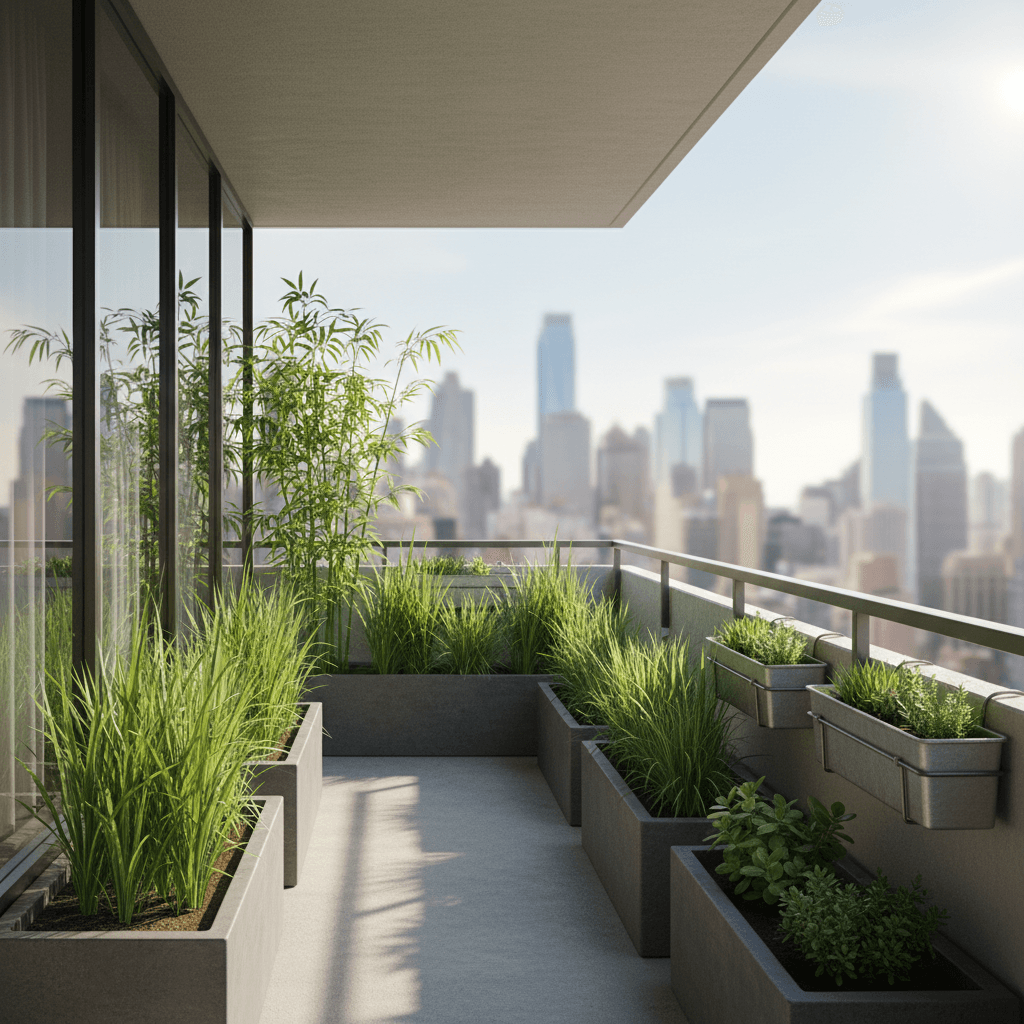
Up on the tenth floor, the skyline looks great — but the wind never really leaves you alone. You try to grow a few herbs in containers, then wake up to the sound of a cheap pot bouncing across the floor. Worse, your best tomato seedling is suddenly snapped in half after one random gust. It happens more often than most people admit. Pick wind-resistant plants.

On a tiny balcony high above the street, air moves differently. Wind doesn’t just drift through — it funnels, speeds up and changes direction without warning. What feels calm at sidewalk level can rip leaves apart several floors up. Height turns gentle airflow into something sharp and unpredictable. For the full setup, see our balcony gardening hub.
Strong gusts don’t make balcony gardening impossible, but they do force different choices. The goal isn’t to fight the weather, but to work with it. You need ways to keep pots stable when drilling is off‑limits, plants that tolerate moving air, and a few safety habits that matter more than ever when your home sits far above the ground.
The Science Behind Tall‑Building Gardens and Strong Winds
Heavy pots might look safe until you notice how wind behaves around towers. Tall buildings stand like cliff faces cutting through the air. When gusts hit their walls, airflow splits — rushing upward, diving below and curling around edges.
- Corners and edges concentrate force. Gaps between buildings can act like wind tunnels, speeding things up.
- Wind speeds shown in a weather app for ground level are often lower than what actually hits your railing ten floors up.
Two key zones on most balconies:
- Danger zone: corners and the strip right along the rail, where gusts twist hardest and hit from odd angles.
- Safer zone: low to the floor and tight against the interior wall, where the building itself blocks a lot of the flow.
Start with this mental map — it will guide where containers and plants should actually sit.
1. Hardware Choices for Non‑Invasive Anchoring
Floor space might be yours, but leased walls are usually off‑limits. That means balance and weight distribution become your main tools for keeping everything in place.
The “Low and Heavy” Rule
Most tip‑overs are balance problems. Cone‑shaped planters — narrow underneath, wide up top — catch wind instead of slicing through it. They behave more like little flags than stable bases.
- Avoid: V‑shaped containers, ultra‑light empty plastic pots, tall pedestals and narrow plant stands.
- Choose: long trough planters, thick tube‑shaped pots or low square planters with a broad footprint.
A wide, low base keeps things steady. If you love a tall planter:
- Nest a smaller inner pot inside.
- Fill the bottom of the outer container with heavy stones or bricks.
That way the visual stays tall, but most weight sits low where it resists tipping.
Securing Railing Planters
Anything that relies only on gravity to stay on the rail is one strong gust away from falling.
Zip‑tie strategy
UV‑resistant cable ties are a renter’s best friend. For over‑the‑rail boxes:
- Fasten brackets to the railing bars with at least two ties per side.
- Trim the ends so they don’t catch clothing.
They’re cheap, removable and far stronger than friction alone.
Built‑in ballast
For plastic railing planters:
- Add a layer of river stones or broken brick at the bottom before soil.
- Then fill with potting mix.
This ballast layer keeps the center of gravity low even when the soil dries out.
After installation, give each planter a firm shake. If your hands can make it wobble, imagine what wind will do.
2. Plant Selection: Survivors vs. Victims
Some plants simply don’t belong on a windy high‑rise balcony.
- Victims: big‑leaf plants like bananas, tall alocasias and large hostas catch wind like sails. Strong gusts tear edges, rock root balls loose and can pull whole stems sideways.
- Survivors: plants with flexible stems and small or narrow leaves let air slip through them. They bend instead of breaking and offer less surface for wind to grab.
Small Balcony Wind‑Resistant Choices
Ornamental grasses (fescue, miscanthus, carex)
Evolved on open grasslands, they’re built to sway. A breeze moves through them with soft sound instead of harsh snapping.
Woody herbs (rosemary, thyme, lavender)
Sturdy woody stems plus tiny leaves mean low wind resistance. When air passes through, they move gently and release more scent.
Flexible flowering stems (cosmos, coreopsis, some daisies)
Tall, thin stems bend down in strong gusts and spring upright again. They look fragile but recover shape instead of snapping.
Low‑growing succulents (sempervivum, sedum, small echeverias)
Only a few centimeters tall, they cling close to the soil and mostly ignore the wind. Perfect for exposed ledges and the front row of railing planters.
If you want one dramatic plant — like a fiddle leaf fig — treat it as an indoor plant that only visits the balcony on very calm mornings. Its “real home” should still be inside.
3. Using Plants and Furniture as a Windbreak
When you can’t build a solid wall, you can still build a living one.
- On the side where wind usually comes from, place your bulkiest greenery: big bamboo pots, dense shrubs, tall grasses.
- Just behind that line, keep softer plants like basil, cilantro and tender blooms tucked in the calmer pocket of air.
Think in zones:
- Front line: the heaviest containers and most wind‑tolerant plants together along the edge.
- Middle zone: medium‑sized pots with herbs and compact vegetables, arranged close but not packed solid.
- Sheltered back zone: small pots and young, fragile plants that would snap if exposed.
A sturdy bench or storage box can be part of the barrier too — as long as it’s heavy enough not to shift.
Plan Your Balcony Layout with a Plant Calculator
In a place where air moves fast and gravity always wins, guessing layout and weight is a bad strategy. One heavy clay pot might feel secure; a whole line of them along the rail on one side can quietly overload and unbalance the structure.
The Balcony Plant Calculator helps you plan instead of guess. You can:
- Enter your balcony length and depth.
- Choose planter sizes and materials.
- See a simple 3D view of how many plants fit and their combined estimated weight.
It gives a clear snapshot of space use and load: how many containers, where they sit and how weight spreads across the surface. Most residential balconies are designed for roughly 40–60 pounds per square foot of live load, depending on local rules. Keeping under that range gets much easier when you can actually see the total.
Use the Balcony Plant Calculator to test layouts before you line your railing with heavy pots. It helps you spread weight instead of stacking it in one risky zone.
4. Care Adjustments That Counter Wind‑Drying
Strong wind pulls moisture from soil the way a hot dryer pulls it from clothes. A container that would stay damp for days in a sheltered courtyard can be dry by midday on an exposed high‑rise ledge.
How to adapt
Mulch is mandatory
Cover the soil with bark chips, gravel or even pine cones. This slows evaporation and keeps the surface from forming a hard, cracked crust.
Deep but efficient watering
Water until you see flow from the drainage holes, then stop and let the excess drip away fully. On windy days, press a finger 3–4 cm into the soil once a day; water again only when it feels dry at that depth.
Group pots together
Clustered containers shield each other from gusts. Close spacing slows air between them, holds a bit more humidity and keeps potting mix moist longer than if every pot stood alone.
Safety Check: “Before the Next Storm” Checklist
Storm coming? Run through this ten‑step check. A few minutes now can prevent flying objects and broken pots later.
- Save this list in a notes app and tick items off when the sky turns dark.
| Item | Action | Checked? |
|---|---|---|
| Hanging baskets | Take them down and place them on the floor. | [ ] |
| Railing planters | Check brackets, hooks and zip ties for movement. | [ ] |
| Tall plants | Move them against the building wall (into the wind shadow). | [ ] |
| Furniture | Fold or stack chairs; turn light tables on their side. | [ ] |
| Empty pots | Nest them or bring them indoors. | [ ] |
| Loose saucers | Remove any saucers not clipped to pots. | [ ] |
| Trellises | Retie loose vines; confirm trellis anchor points are solid. | [ ] |
| Solar stake lights | Pull them from loose soil if they wobble easily. | [ ] |
| Watering can | Don’t leave it empty on a table; store or fill it. | [ ] |
| Balcony door | Check that the latch closes fully and won’t slam. | [ ] |
A Note on Safety and Liability
When you rent, whatever sits on your balcony usually counts as your responsibility. If a planter, chair or décor item blows off, it can damage property or injure someone below.
- Never balance items directly on the railing edge.
- Avoid perching objects on very narrow ledges.
- If a storm with gale‑force winds is forecast, move as many plants as possible indoors — even a spot by a bright window is safer than an exposed balcony.
If you’re unsure, err on the side of bringing items inside.
Conclusion
Even high above the street, nature still fits. Use low, chunky planters, wind‑tolerant greenery and a few strong zip ties, and your balcony starts to feel different. Instead of broken ceramic hitting concrete, you get soft leaves and grasses moving in controlled rhythm.
When wind picks up, check how damp the soil feels where your plants stand. Shifting air often means it’s time to bring the fiddle leaf fig inside and tighten up anything loose. Secure the boundaries first — then enjoy the small changes other people never see.
How do I protect balcony plants from high winds?
Push containers directly against the apartment wall, group pots tightly together, and use low-growing, sturdy plants rather than tall, brittle ones.
Should I bring plants inside during a storm?
Yes, if severe gusts are predicted, bring delicate or top-heavy plants indoors, as high-rise winds can easily snap stems or launch light pots over the edge.
What plants survive best on windy balconies?
Ornamental grasses, tough Mediterranean herbs like rosemary, and sturdy succulents are naturally adapted to handle buffeting winds without damage.
