
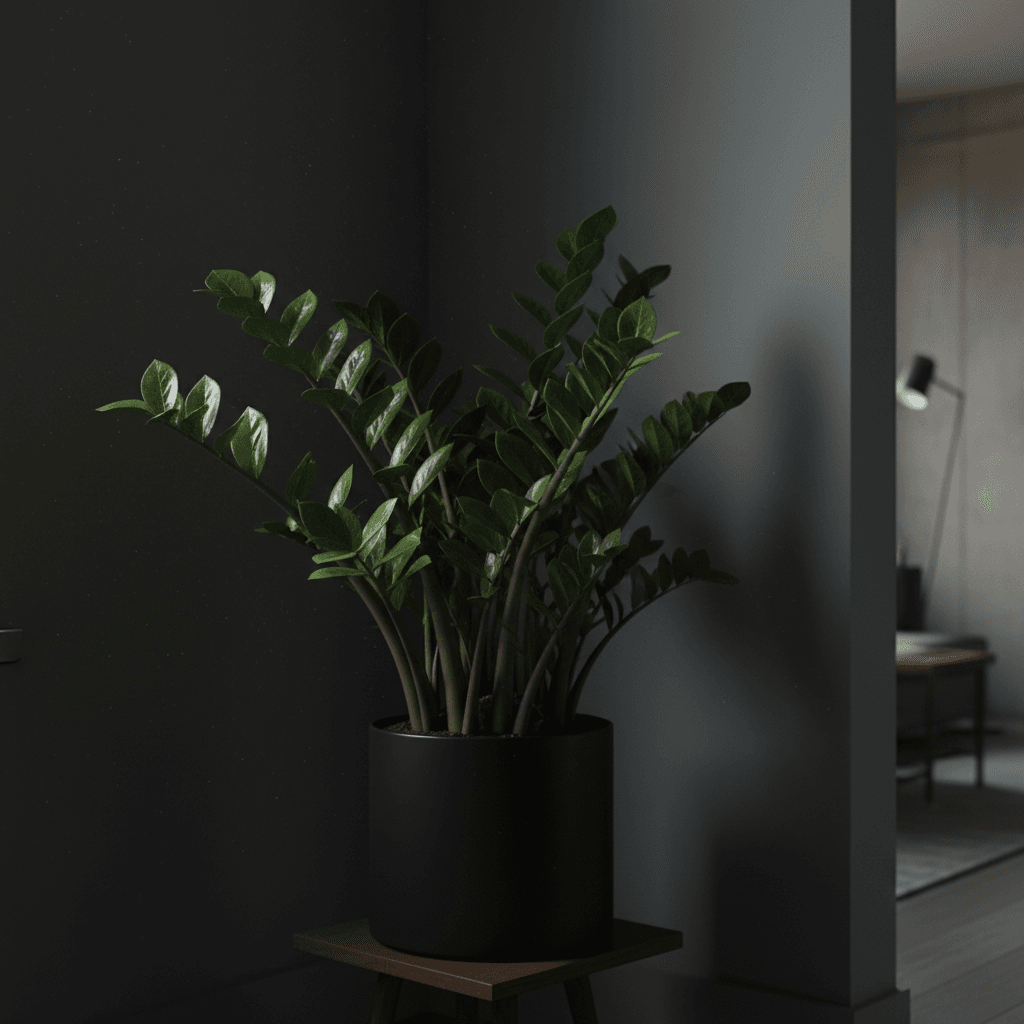
The best low light air purifying plants thrive in north-facing rooms, windowless corners, and apartments where direct sun never reaches — exactly the conditions that kill most houseplants. The 7 plants in this guide survive on 2–4 hours of indirect light, need watering once every 1–2 weeks, and actively filter VOCs, formaldehyde, and benzene from indoor air. All are available for under $15–25 at any garden centre. The two most forgiving for complete beginners: ZZ Plant and Snake Plant — nearly impossible to kill even with neglect. Browse more low-light indoor plants for dim rooms. Several also do formaldehyde-removing duty.
1. The Unkillable ZZ Plant (Zamioculcas zamiifolia)
Shiny, thick leaves in a rich green shade cover this plant, almost as if someone buffed them smooth. What makes it fit small spaces so well? Its roots swell like tubers underground, holding moisture for weeks on end — so dim corners won’t faze it, nor will skipped watering days.
Few plants clean indoor air quite like this one. Research finds it tackles harmful substances such as benzene and ethylbenzene with surprising efficiency. Its natural filtering ability stands out in controlled tests, processing pollutants others leave behind.
2. Vibrant Shadows: Aglaonema for Better Air Quality
Shimmering in silver, soft pink, or creamy swirls. Even when light fades, this plant doesn’t dull — its bold markings hold strong where others would dim. Small enough to tuck into tight spots, like beside a stack of books or along a slim shelf edge.
One plant on NASA’s clean air list pulls formaldehyde from the room. It also handles carbon monoxide, quietly working while taking up little space in your urban home.
3. The Midnight Ribbon: Snake Plant (Sansevieria)
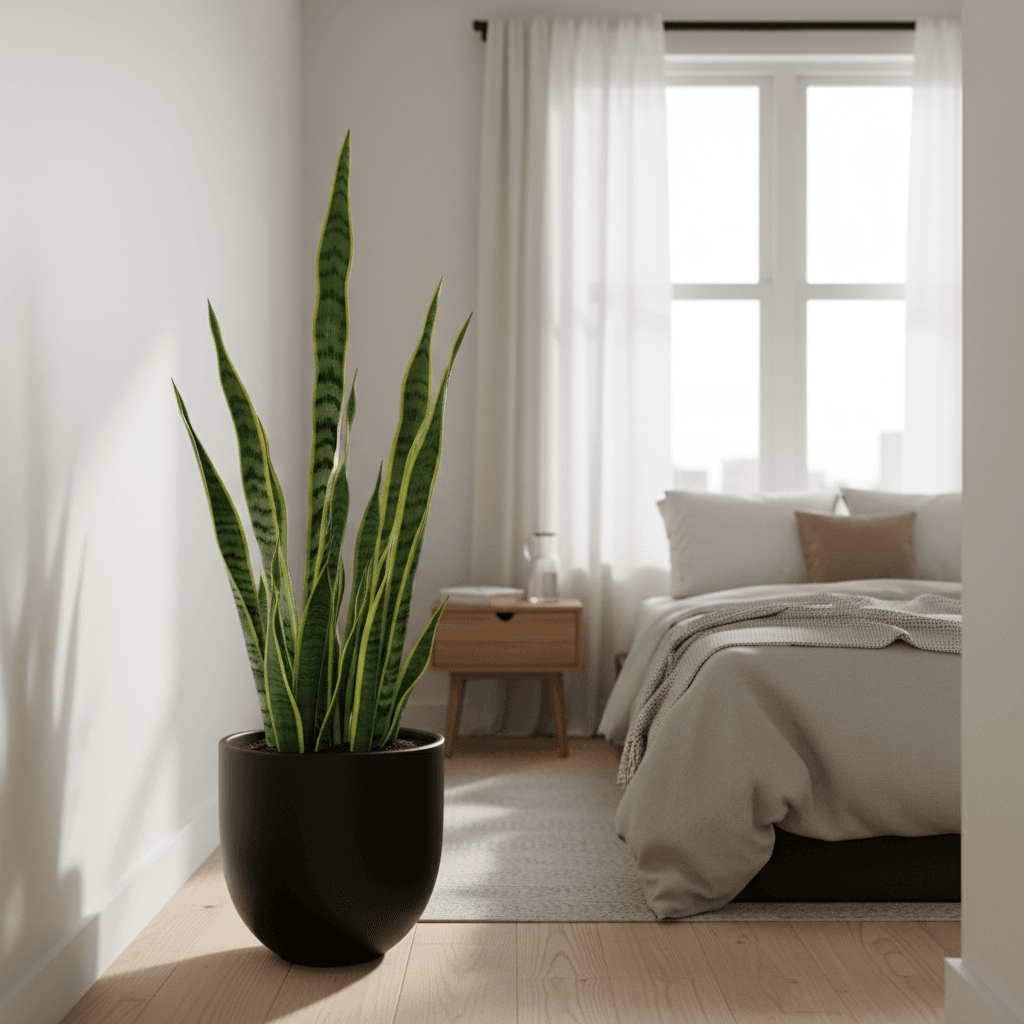
Standing tall like blades, its slim leaves stretch upward instead of spreading wide — ideal when floor area is tight. This plant handles dim spots without complaint, offering a vertical solution for urban micro spaces. Since it reaches skyward, not sideways, you get greenery without the clutter.
While many plants (even your beloved balcony herbs) release oxygen when the sun is up, the Snake Plant switches on after dark. That nighttime breath turns it into a quiet ally for your sleeping space.
4. The Dramatic Survivor: Peace Lily (Spathiphyllum)
A single leaf dips low, a quiet signal thirst has arrived. White flowers stand crisp, almost ceremonial, among thick green leaves. After watering, life returns fast — full perkiness in under sixty minutes. Tiny spaces gain depth, a whisper of jungle calm, just from its presence.
What makes it stand out for air purification? This plant tackles each of the major five pollutants — formaldehyde, benzene, trichloroethylene, xylene, and ammonia. Not flashy, just effective.
5. The Living Art: Prayer Plant (Calathea)
Midnight folds the leaves into delicate shapes, almost like lace drawn by wind. Because it lives low under jungle canopies, bright light feels wrong to it. City homes often hold moisture in corners — places where it settles without asking. Instead of sun, it leans toward steamy air, making it a perfect wellness addition to a bathroom or shaded desk.
Moisture levels stay balanced because the plant quietly releases water while filtering out particles. Freshness sticks around longer thanks to its quiet leafy presence.
6. The Indestructible Trailing Vine: Pothos (Epipremnum aureum)
Pothos is the most forgiving low light air purifying plant on this list. It tolerates fluorescent office lighting, intermittent watering, and temperatures as low as 10°C — conditions that kill almost everything else. In a renter’s apartment, it works on a high shelf, in a hanging planter, or cascading from a bookcase with zero maintenance weeks between waterings.
Air quality benefit: NASA’s Clean Air Study found Pothos removes benzene, formaldehyde, xylene, and toluene from sealed test chambers. Practical caveat — you need roughly one plant per 10 sqm for a measurable effect. In a 25 sqm studio, 2–3 Pothos in different corners is a realistic, low-effort setup. Toxicity note: mildly toxic to cats and dogs if ingested. Pair them with other ways to optimize air quality.
7. The Classic Low-Light Filter: Spider Plant (Chlorophytum comosum)
Spider Plant is the entry-level low light air cleaning plant for renters who have killed every plant before. It produces small offshoots (“spiderettes”) that can be propagated into new plants for free — useful if you want to fill multiple dark corners without buying more. Watering: once every 10–14 days. Light requirement: as low as 1–2 hours of indirect light.
It filters carbon monoxide and formaldehyde — the two VOCs most associated with gas cookers and synthetic flooring, both common in rental apartments. Pet-safe: one of the few air purifying plants with no toxicity to cats or dogs. If you have pets, check our pet-safe houseplants list.
Low Light Air Purifying Plants: Quick-Reference Table [UPDATE 2026]
All 7 plants above — matched to light level, watering schedule, pet safety, and the specific pollutants they filter. Use this table to pick the right plant for your exact apartment conditions.
| Plant | Min Light | Watering | Pet Safe? | Filters |
|---|---|---|---|---|
| ZZ Plant | 2h indirect | Every 2–3 weeks | No | Benzene, ethylbenzene, toluene |
| Aglaonema | 2h indirect | Every 1–2 weeks | No | Formaldehyde, CO |
| Snake Plant | 2h indirect | Every 2–6 weeks | No | Benzene, formaldehyde, VOCs (night) |
| Peace Lily | 2–3h indirect | Weekly | No | Formaldehyde, benzene, ammonia, xylene |
| Prayer Plant | 3h indirect | Every 1–2 weeks | Yes | Particulates, humidity balance |
| Pothos | 1–2h indirect | Every 1–2 weeks | No | Benzene, formaldehyde, xylene, toluene |
| Spider Plant | 1–2h indirect | Every 10–14 days | Yes | CO, formaldehyde |
Urban Micro-Tip: In low-light homes, dust acts like a blindfold for your plants. Once a month, wipe the leaves with a damp cloth. It’s a 5-minute ritual that helps them breathe, ensuring they continue to improve air quality at peak performance.
What are the best low light air purifying plants for apartments?
The 3 best low light air purifying plants for apartments are: (1) Snake Plant — survives 2h of indirect light, filters benzene and formaldehyde, nearly indestructible. (2) ZZ Plant — the most drought-tolerant, thrives on neglect, handles very dim corners. (3) Pothos — fastest-growing, filters 4 pollutants, works in hanging planters or on high shelves. All three require watering every 1–2 weeks and cost under $20 at a garden centre.
Do low light air purifying plants actually clean the air?
Yes, with caveats. NASA’s 1989 Clean Air Study found that common houseplants remove VOCs (benzene, formaldehyde, toluene, xylene) in sealed test chambers. The practical limit: you need roughly 1 plant per 10 sqm for a measurable improvement. In a 25 sqm studio, 3 plants in different corners provides real but modest air quality support — not a replacement for ventilation or an air purifier, but a meaningful supplement.
Which air purifying plant needs the least light?
The ZZ Plant and Pothos can survive on as little as 1–2 hours of indirect light per day — equivalent to a north-facing room with no direct sun. Spider Plant is the only common air purifying plant that is also pet-safe AND tolerates near-darkness. For windowless rooms with only artificial light (LED panels or fluorescent tubes), Snake Plant and Pothos adapt best.
What are the best low light air cleaning plants for a north-facing apartment?
For a north-facing apartment with minimal natural light: ZZ Plant, Snake Plant, Pothos, and Spider Plant are the top 4. All tolerate indirect light under 2 hours daily. Place them near the room’s light source (even a desk lamp or ceiling LED counts). Wipe leaves monthly to remove dust — dusty leaves absorb 30–40% less light, which matters when you’re already light-limited.
Can air plants survive in low light?
Air plants (Tillandsia) are not the same as low-light air purifying plants — they are a separate genus. Most Tillandsia need moderate indirect light (3–5 hours) and will slowly decline in very dim conditions. For genuinely low light situations (north-facing rooms, interior corners), ZZ Plant, Snake Plant, and Pothos are far more reliable than air plants.
Are air-purifying plants safe for pets?
Most popular air purifying plants are toxic to cats and dogs: Snake Plant, Pothos, Peace Lily, ZZ Plant, and Aglaonema are all mildly to moderately toxic if ingested. The pet-safe exceptions in this guide are: Prayer Plant (Calathea) and Spider Plant — both non-toxic to cats and dogs according to the ASPCA. If you have pets, start with these two.
How many low light plants do I need to improve air quality in a studio?
For a practical improvement in a 25–35 sqm studio: 3–5 plants distributed across the room. One large Snake Plant or Peace Lily in the living area, one Pothos in the kitchen (to absorb cooking VOCs), one Spider Plant near a low-light corner. This does not replace an air purifier for PM2.5 or wildfire smoke, but it consistently lowers VOC and formaldehyde levels from furniture, flooring, and cleaning products.
