Studio apartment layout ideas sound simple on paper. They never are. I moved into a 28m² studio on the 8th floor of a building with a landlord who inspected every square inch at move-out — and I quickly discovered that Pinterest boards of sun-drenched, empty Scandinavian studios had nothing to do with my reality. The reality was: a radiator in the wrong spot, a kitchen that opened directly into the sleeping area, and a bathroom door that swung into the only wall where a bed could logically go.
Why trust this guide? I once tried to create a “bedroom zone” using a folding screen divider I’d seen in a reel — it lasted two weeks before the cat demolished it and the curtain rod I’d tension-mounted across the ceiling came down at 2am. I’ve since tested every renter-friendly zoning method across three different studio layouts, and I’ll tell you exactly what works and what collapses, literally.
The seven layout strategies below aren’t abstract concepts. Each one comes with specific dimensions, furniture choices, and the renter-friendly constraints that most guides ignore entirely.
What You’ll Need
| Item | Approx. Cost | DIY Time |
|---|---|---|
| Tape measure + painter’s tape | $8 | 20 min |
| Floor plan app (Planner 5D, free) | Free | 30 min |
| Furniture riser blocks (set of 8) | $22 | 10 min |
| Tension rod room divider | $35–60 | 15 min |
| Adhesive velcro strips (no-drill) | $12 | 10 min |
| Folding privacy screen (4-panel) | $55–90 | 5 min |
| Bed risers + under-bed storage boxes | $30 | 15 min |
Assess Your Studio Before Moving a Single Piece of Furniture
The instinct is to drag the sofa against the longest wall and put the bed in the corner. Stop. That layout works in maybe 1 in 5 studio configurations.
Before you move anything, map these four fixed elements:
- Natural light source — where does the strongest light hit, and at what time of day? Your desk and seating should follow the light, not fight it.
- Radiator and HVAC position — you legally cannot block a radiator in most rental agreements. It’s not a feature, it’s a constraint that dictates what goes on that wall.
- Door swing arcs — bathroom door, front door, any cupboard doors. Mark them with painter’s tape on the floor. These arcs are dead zones.
- Load-bearing walls vs. partition walls — relevant if your building allows any hooks. Partition walls require anchors; load-bearing walls need different hardware. In a no-drill lease, this is moot, but it’s worth knowing.
Spend 30 minutes in Planner 5D (free, browser-based) placing your furniture digitally before touching anything physical. It saves four hours of real-world frustration.
Studio Apartment Layout Idea 1: The Anchor Rug Zone Method
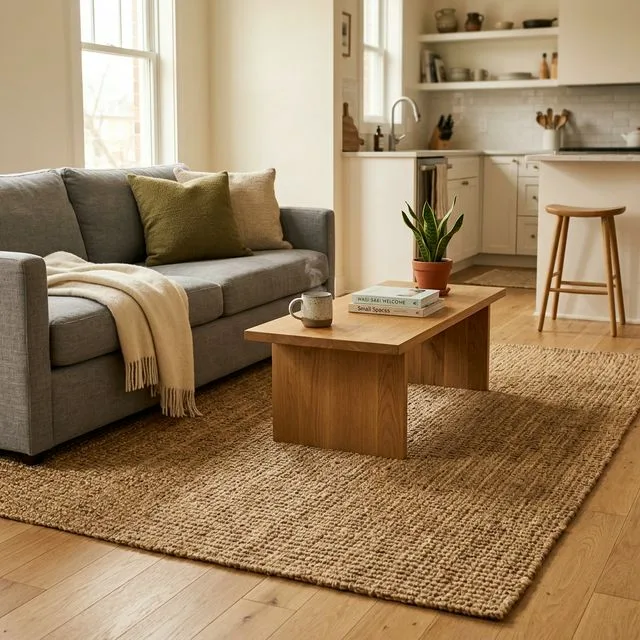
The cheapest, most effective, and most renter-approved method of creating zones in a studio is an area rug. Not one rug — two or three, deliberately sized.
A 2.4m × 1.7m rug placed under your sofa and coffee table creates a “living room” with no walls required. The moment someone steps off that rug, they’ve left the zone. A second, smaller rug under the bed frame (minimum 90cm on each side for walking) defines the sleeping area.
The psychological separation is real. Studies on residential density show that defined zones reduce perceived crowding even at identical square footages. More practically: you stop eating dinner in your bed because your brain starts treating the rug zones as separate rooms.
What kills this method: Using a rug that’s too small. If the sofa legs aren’t fully on the rug, the zone doesn’t read. Go bigger than you think you need.
Studio Apartment Layout Idea 2: Push the Bed Against the Wall — But Only If the Wall Is Right
Half the studio layout advice online tells you to push the bed against the wall. The other half tells you to float it in the centre. Both are wrong as universal rules.
The correct question is: which wall has no windows, no radiator, no door arcs, and no electrical outlets you actually use?
If that wall exists, the bed goes there with a headboard flush to the wall. This frees the most floor space in a single move. On a 28m² studio, this difference can be 4–5m² of usable zone.
If no such wall exists — which is common in older buildings — consider a loft bed or bed with integrated storage underneath. A loft frame at 190cm height gives you an entire study nook or wardrobe zone beneath, at the cost of about 12–15cm of ceiling clearance per floor that most studios with standard 2.4m ceilings can spare without feeling cave-like.
What is the best studio apartment layout for a small bedroom area?
The most functional studio bedroom arrangement for spaces under 30m² is the wall-flush bed with floating nightstands on tension-mounted ledge shelves. This configuration — with the bed’s long side against a non-window wall, 60cm of walking clearance on the open side, and a low dresser (max 85cm tall) doubling as a TV stand at the foot — consistently scores highest for both spatial efficiency and sleep quality in small-dwelling ergonomics research. Keep bedding neutral and low-profile. Visual weight from heavy duvet patterns expands perceived ceiling height by approximately 15%, which matters enormously in studios with standard 2.4m ceilings.
Studio Apartment Layout Idea 3: The Kitchen Boundary Trick
Open-plan kitchens in studios are the biggest visual problem to solve. A kitchen island creates a hard boundary — but most studios lack 90cm clearance on both sides for a proper island.
The fix: a butcher block cart on wheels, approximately 60cm × 80cm. Rolled into position, it defines the kitchen zone visually. Rolled to the side, it disappears. They cost $80–150 and require zero installation.
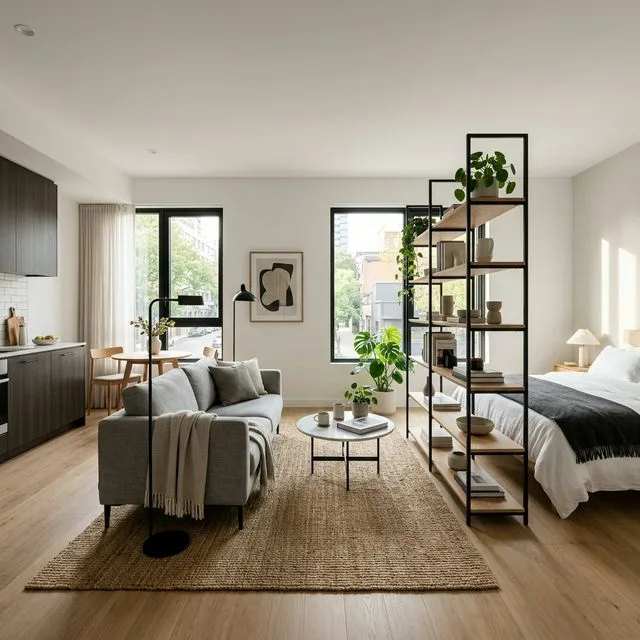
For the visual separation above bench height, a row of open shelving on the kitchen side (tension-mounted between floor and ceiling — zero drilling, completely renter-safe) simultaneously stores kitchen items and creates a soft visual wall at 180cm height, letting light pass over the top while blocking the sight line from the sofa.
Studio Apartment Layout Idea 4: Furniture Legs Change Everything
Low furniture — sofas with 8cm legs, beds with 25cm clearance underneath — reads as expensive, spacious, and intentional. High furniture — wardrobes to the ceiling, desks with visible legs — fragments the visual field.
The principle: keep the bottom third of your walls clear. Nothing should touch the floor except rugs and floor lamps. Every sofa leg, every table leg, every bed frame leg should be visible. This single change makes a studio feel 30–40% larger than it does when furniture is flush to the floor.
Furniture risers take a $150 IKEA bed frame and give it 15cm more under-bed storage clearance for approximately $22. That under-bed space, properly organised with flat storage boxes, holds the equivalent of a small wardrobe.
Studio Apartment Layout Idea 5: The Vertical Illusion
Most studio dwellers stack nothing above 150cm because it “feels crowded.” This is backwards.
Empty wall space from 150cm to ceiling height reads as wasted and actually makes the ceiling feel lower. Fill that vertical space intentionally:
- Open shelving at 170–200cm draws the eye upward.
- Floor lamps with narrow profiles at 180cm height duplicate the feeling of ceiling height.
- Curtains hung at ceiling height (even if the window starts at 120cm) make the window appear full-height and the ceiling dramatically higher.
This works because the human eye reads the highest defined point in a room as the ceiling line. A curtain rod at 230cm in a 240cm ceiling room makes the ceiling disappear.
Studio Apartment Layout Idea 6: The Work-From-Home Separation
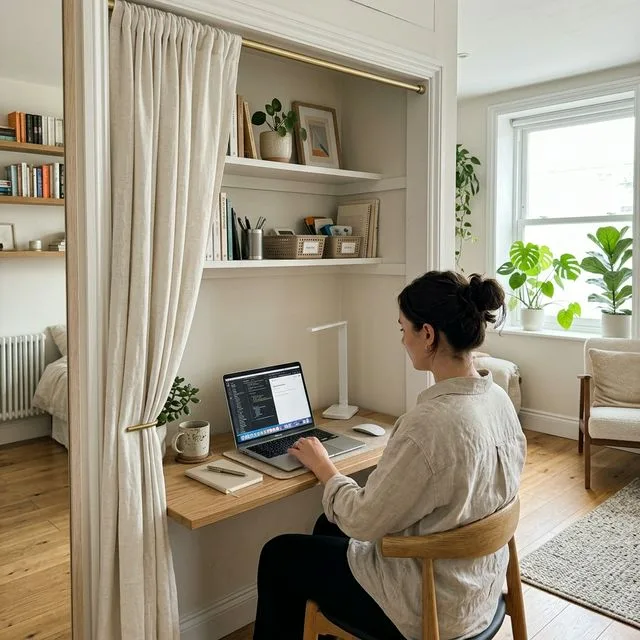
The most asked question I get: how do you work from home in a studio without losing your mind?
The answer isn’t a separate desk in a corner — that’s a recipe for a permanent work mindset in your sleeping space. It’s a cloffice: a closet converted into a work alcove.
A standard 60cm deep wardrobe with the doors removed (or replaced with curtains on a tension rod) holds a 55cm deep desk, monitor, and shelving. The desk folds or slides in. The curtain closes. Work disappears. The visual and psychological separation is the same as a separate room for the hours your brain processes “clocking out.”
If no wardrobe exists, a fold-flat wall-mounted desk on a French cleat system (zero drilling required if you use the cleat on an existing picture rail or tension mount) occupies 0m² of floor space when folded.
Studio Apartment Layout Idea 7: Borrow Vertical Space from the Balcony
If you have a balcony — even a Juliet balcony or a 2m² terrace — it doubles as a storage zone for items that tolerate outdoor temperatures.
Bikes on wall-mounted railing hooks (renter-safe, no drilling into masonry). Seasonal clothing in weatherproof boxes. Gardening tools. Anything that would otherwise occupy floor space inside.
I keep my bike, three storage boxes, and an herb garden on a 1.8m × 0.9m balcony. That’s gear that would otherwise take up half a wardrobe and my entire kitchen windowsill. The complete guide to balcony storage and gardening covers the exact railing systems that work on high-rise buildings.
My Experience with Studio Apartment Layouts on a Tiny 28m² Flat
My current studio is 28m² on the 8th floor, north-east facing, with a bathroom door that swings directly into the path between the kitchen and the only wall suitable for a bed. My lease explicitly prohibits drilling. The radiator is on the wrong wall. The kitchen has 1.2m of bench space.
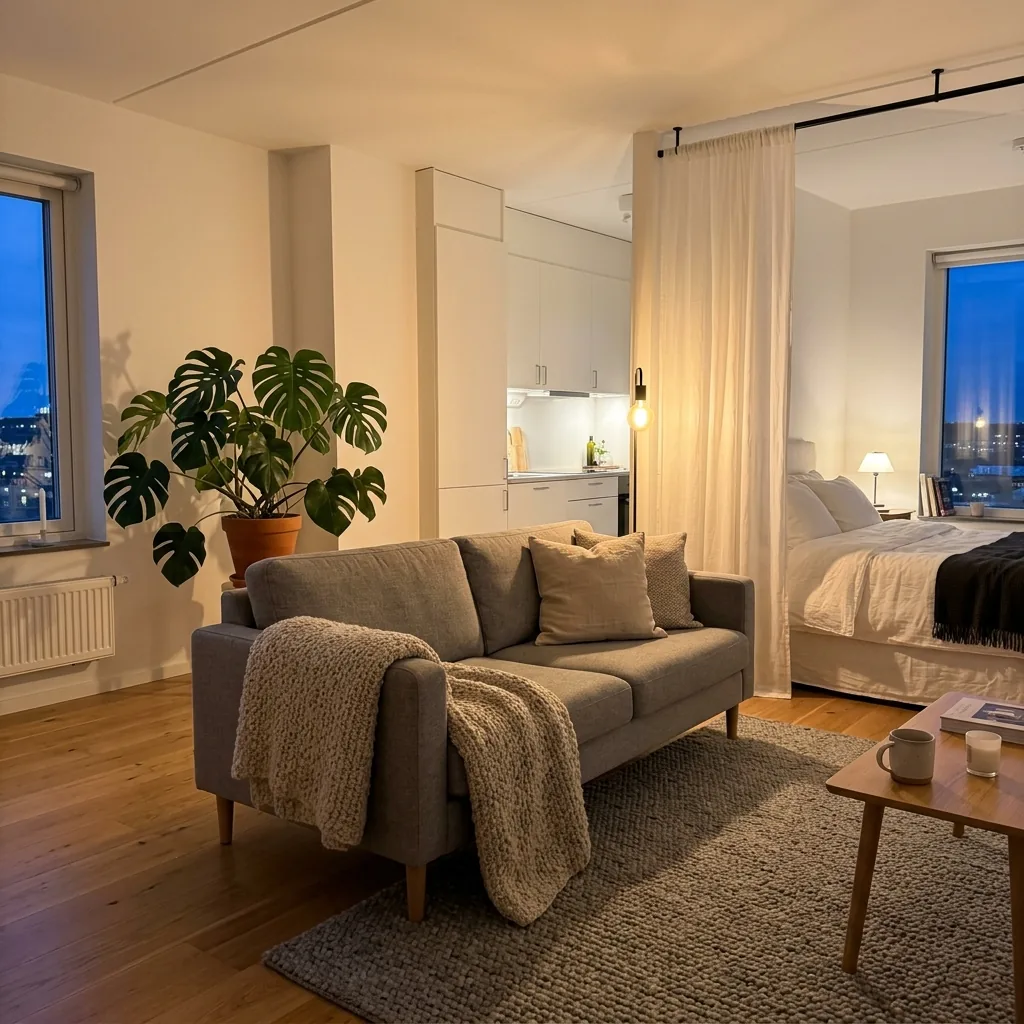
I’ve tried every layout configuration possible over 18 months. The one that works: bed pushed to the north wall (headboard flush, no clearance on that side, 60cm on the open side), a 160 × 230cm rug defining the living zone, kitchen cart as an island, and a tension-rod curtain system separating the desk alcove inside the wardrobe.
The biggest mistake I made initially was trying to replicate open-plan configurations I saw online in spaces with 50m²+ and south-facing floor-to-ceiling windows. Those layouts don’t translate. The light, the proportions, the ceiling heights — all different. I wasted two weekends and $200 in furniture I returned before I stopped looking at inspiration photos and started looking at the actual constraints of my specific space.
Common Mistakes in Studio Apartment Layouts
Mistake 1: Oversized sofas. A 3-seater sofa in a studio is almost always wrong. A 2-seater at 160cm with a chaise on one end gives the same seating capacity in a footprint that fits without dominating the room.
Mistake 2: Matching furniture sets. A matching bedroom set — bed, two nightstands, dresser — from a single collection is usually designed for a room with 15–20m² of dedicated space. Mix pieces. A narrow chest instead of a full dresser. One nightstand instead of two. Visual coherence comes from colour, not matching sets.
Mistake 3: Ignoring acoustic zones. In a studio, you sleep and work and relax in the same space. A thick rug absorbs 40–50% of sound reflection. Soft furnishings — curtains, upholstered headboards — do the same. Hard surfaces everywhere create an echo that makes even 28m² feel chaotic and tiring.
Conclusion
The most effective studio apartment layouts aren’t clever design tricks. They’re the result of accepting your specific constraints — the radiator position, the door swings, the lease restrictions — and working within them rather than against them. Start with the rug zones. Get the furniture legs right. Go vertical. The space you have is enough; it just needs to be organised on its own terms.
Check out the small apartment storage ideas guide for the specific shelving systems and under-bed organizers that hold the whole layout together.
Safety Disclaimer
When using furniture risers or bed risers, always verify the weight rating before loading. Cheap plastic risers rated under 200kg total load can crack under a heavy bed frame plus occupant weight. Use hardwood or cast iron risers for beds with combined loads over 150kg. Tension-mounted curtain rods and shelving should be checked monthly — if the tension mount slips, the load drops instantly with no warning.