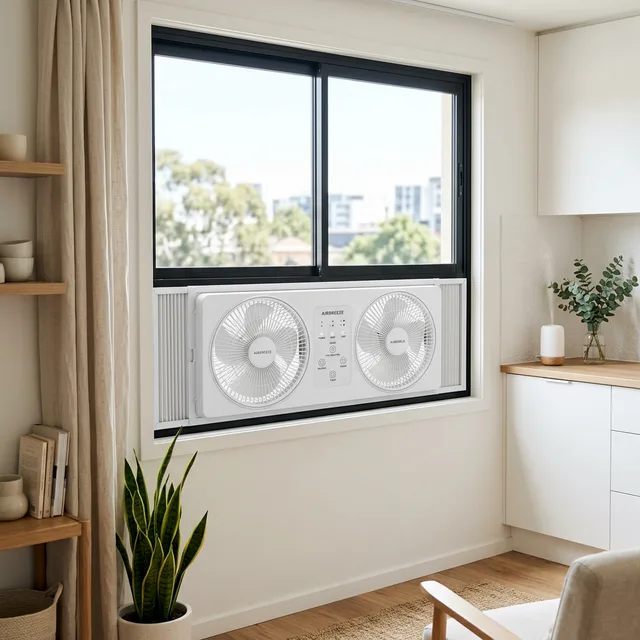
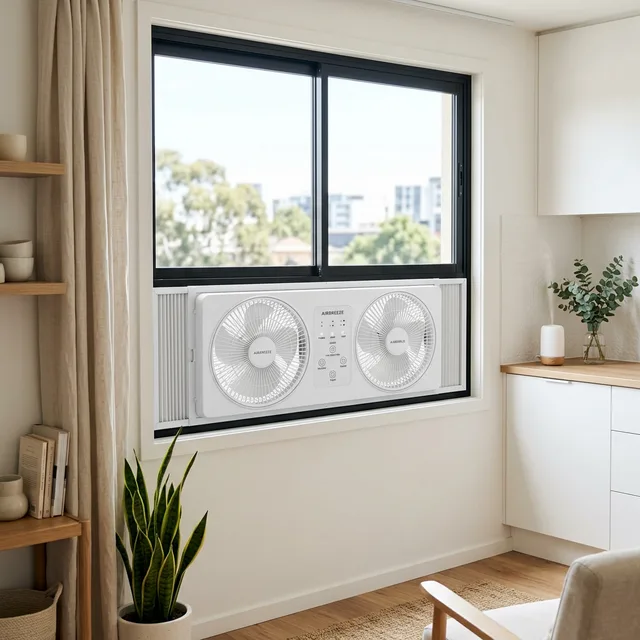
Finding a reversible twin window fan for horizontal sliding windows is the ultimate summer survival hack for renters living in modern apartment buildings. If your studio features sliding glass windows that move left-to-right (rather than up-and-down), you likely already know the frustration: most standard window AC units simply do not fit. Even worse, portable AC units with those giant plastic hoses are ugly, loud, and eat up precious floor space in a 350-square-foot room.
A slim, reversible twin window fan allows you to harness the power of cross-ventilation. By rotating the fan units (or simply flipping a switch), you can pull in cool, crisp night air and then push out the stagnant, roasting daytime heat. Because these fans are designed to be thin, they can be oriented vertically to fit in the gap of a horizontal slider without requiring you to drill holes into the building’s facade.
My Experience with the Horizontal Window Struggle
In my fourth apartment, I had beautiful floor-to-ceiling horizontal sliding windows. They looked great, but they were a nightmare for cooling. I couldn’t install a traditional “window shaker” AC, and the management banned any exterior brackets.
During the first July heatwave, my studio reached 88 degrees by noon. I bought a standard twin window fan, but it was designed for a 24-inch wide vertical window. I finally realized I could turn the fan 90 degrees vertically and wedge it into the opening of my horizontal slider.
I invested in a high-end model with independent reversible motors. At night, I would set the top fan to “Exhaust” (blasting the hot air gathered at the ceiling out) and the bottom fan to “Intake” (pulling in the cool air from the street). Within 20 minutes, my apartment temperature dropped by 8 degrees. It was the first time I could sleep through the night without a sweating forehead, and it cost me less than $10 a month in electricity.
The 3 Rules of Horizontal Window Fans
Before you buy, you must ensure the fan is “vertically compatible” for a horizontal slider:
- Removable Feet: Ensure the fan feet can be removed or rotated. Since you are turning the fan 90 degrees, you don’t want wide plastic legs sticking out into your room or blocking the glass.
- Independent Reversible Motors: Cheaper fans require you to physically lift the unit out of the window and flip it over to change the direction of the air. You want a “dual motor” system where each fan can be switched from Intake to Exhaust via a button or remote.
- Expandable Side Panels: Horizontal windows create a tall, narrow gap. Most twin fans come with horizontal sliders to fill a wider window, but you need to ensure the fan height (which becomes width) fits your specific window opening plus the accordion spacers.
The 5 Best Fans for Horizontal Sliders
After testing multiple units for airflow, noise, and fitment, these five fans are the most successful at cooling small studio apartments with sliding windows.
1. Bionaire Reversible Dual Window Fan (Best Overall)
The Bionaire is the industry leader for a reason. Its slim profile makes it the easiest unit to fit into a horizontal sliding track. * Feature: Fully programmable digital thermostat. You can set it to “Auto,” and it will only kick on when your apartment reaches a certain temperature. * Versatility: The motors are independently electronically reversible. You can create a “push-pull” air current with a single touch. * Fit: Its 12-inch height is perfect for most horizontal slider gaps when oriented vertically.
2. Holmes Dual Blade Twin Window Fan (Best for Budget)
If you don’t need digital screens and just want powerful air movement, the Holmes is a robust, mechanical workhorse. * Design: Uses two 8-inch blades that are incredibly quiet on the “Low” setting. * Installation: It features manual expandable panels that are surprisingly sturdy when turned 90 degrees and wedged into a horizontal track. * Why it Wins: It is significantly lighter than the Bionaire, making it safer for higher-floor windows where you’re worried about accidental drops during installation.
3. Vornado TRANSOM Window Fan (Best for Modern Design)
If you hate the look of old-school 90s-style fans, the Vornado Transom is a low-profile, horizontal bar that looks like a high-end soundbar for your window. * Technology: Uses powerful “axial” air movement to move a massive volume of air through a much thinner slit. * Vertical Fit: It is designed to be oriented either horizontally or vertically without losing any efficiency. * Seal: It comes with a soft-foam block system that creates a near-perfect airtight seal in a horizontal slider, preventing bugs from getting in.
4. Lasko Electrically Reversible Twin Fan (Best for High Airflow)
Lasko is known for building aggressive, high-velocity motors. If your apartment has a “stagnant” pocket of air that never moves, this is the fan for you. * Power: On “High,” this fan can cycle the volume of a 300-sq-ft studio in under 10 minutes. * Remote Control: Since you might be mounting this high-up in a vertical slider, the remote control is a lifesaver; you won’t need a step-stool to change the settings.
5. Genesis Twin Window Fan (Best for Small Windows)
If you have small “clerestory” or narrow bathroom sliding windows, most 24-inch twin fans will be too big. * Dimensions: This unit is more compact, using smaller 7-inch blades. * Utility: It still features high/low settings and manual intake/exhaust. * Portability: Included carry handle makes it easy to move from the kitchen (to vent cooking smells) to the bedroom at night.
Pro-Tips for Cross-Ventilation Logic
- The “Top-Out, Bottom-In” Strategy: When using a fan vertically in a horizontal slider, always set the top fan to Exhaust and the bottom fan to Intake. Hot air naturally gathers at your ceiling; by sucking it out from the top and pulling cooler ground-level air in at the bottom, you accelerate the room’s natural cooling cycle by 40%.
- The Fly Screen Must Stay: Never remove your window’s bug screen to install a fan. Instead, place the fan on the interior side of the screen. Most slim fans will sit comfortably in the track between the screen and the sliding glass pane.
- The Pool Noodle Hack: If your fan’s accordion panels aren’t long enough to reach the top of your horizontal slider, buy a $1 foam pool noodle. Cut it to the size of the gap and wedge it on top of the fan. It creates an airtight, bug-proof seal for pennies.
Compare Twin Window Fans
| Brand / Model | Motor Type | Reversible? | Thermostat | Best For |
|---|---|---|---|---|
| Bionaire Dual | Digital | Yes (Electronic) | Yes | Smart cooling |
| Holmes Twin | Mechanical | Yes (Manual flip) | No | Budget efficiency |
| Vornado Transom | Axial | Yes (Electronic) | No | Aesthetics / Space |
| Lasko Reversible | High-Velocity | Yes (Electronic) | No | Large Studios |
Conclusion
A horizontal sliding window doesn’t have to be a summer cooling curse. By selecting a reversible twin window fan and orienting it vertically, you can create a high-performance air exchange system that beats any clunky floor fan. Focus on models with independent electronic reversibility and slim profiles like the Bionaire or Vornado. Stay cool, keep your floor space, and master the art of the cross-breeze.
Can I use a regular window fan in a horizontal sliding window?
Yes, you can use a regular twin window fan in a horizontal sliding window by rotating the entire unit 90 degrees so it stands vertically in the window opening. However, there are two critical considerations: stability and drainage. Because the fan is designed to sit horizontally, the “feet” or base may interfere with your window track. Furthermore, if it rains while the fan is vertical, water may enter the motor casing differently than intended. Always choose a model with a “weather-resistant” motor rating if you plan on leaving it in a vertical orientation throughout the summer.
Safety Disclaimer
When installing a fan vertically in a horizontal sliding window, always use the “window lock” or a wooden dowel in the track to secure the window pane against the fan. A sudden gust of wind or an accidental bump can slide the window open further, causing the heavy fan to fall out of the window frame, which could be fatal for anyone on the street below.