Living in a 25sqm urban studio often means living with your neighbors’ lifestyles. Whether it’s the hum of the hallway elevator, the thud of footsteps from above, or the late-night sirens of the city, “Acoustic Intrusion” is the primary enemy of micro-wellness. For many, the answer is just to wear earplugs, but true noise mitigation for studio apartments requires a more sophisticated, multi-layered approach that targets both incoming and internal sounds.
A sensory sanctuary cannot exist in a state of constant auditory chaos. Research shows that consistent “low-level” noise (like a neighbor’s TV) can spike cortisol levels and prevent the brain from ever reaching a state of deep recovery. In my own 22m² studio near a busy subway line, implementing a dedicated noise mitigation protocol transformed the space from a “loud box” into a high-performance recovery hub.
1. Active vs. Passive Acoustic Shielding
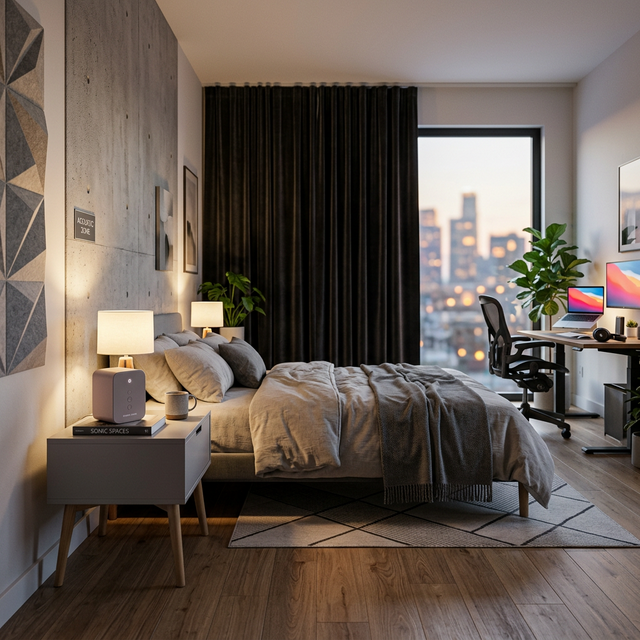
Most renters rely solely on passive shielding—think heavy smart textiles and curtains. While these are great for absorbing echoes, they do very little to block low-frequency sounds like traffic. The Strategy: Combine your heavy velvets with “Active Masking.”
The Gadget: Use a high-fidelity Pink Noise generator. Unlike “white noise,” which can be harsh, “Pink Noise” drops in volume as the frequency increases, mimicking the natural sound of rainfall or the rustle of leaves. This provides a smoother “Acoustic Floor” that effectively hides the sharp spikes of a slamming door or a car horn. This is a core component of your smart sleep setup, ensuring your biological clock remains undisturbed.
2. Decoupling Your Interior: Silent Furniture Hacks
In a high-density apartment, sound travels through solids faster than through air. If your furniture with legs is touching a shared wall, every vibration from your neighbor’s unit will be amplified into your living space.
The Hack: Move your bed and your smart closet office desk at least 3 inches away from any shared walls. Use vibration-dampening pads (often made of rubber or cork) under the legs of your bed and sofa. This “Decoupling” prevents the wall from acting as a giant speaker for your neighbor’s noise. It’s a small, zero-cost adjustment that has a massive impact on your sensory sanctuary studio living experience.
3. The “Sealing the Gaps” Protocol
Sound is like water; it will flow through any opening. The #1 noise entry point in a small studio apartment setup is the gap under the front door or the space around aging window frames.
The Strategy: Use heavy-duty, silicone door sweeps and window seals. This isn’t just about micro-living air quality or energy efficiency; it’s about “Acoustic Sealing.” The Value: Closing a 1-inch gap under your door can reduce incoming hallway noise by up to 10 decibels. It’s the difference between hearing a neighbor’s conversation and having complete privacy. This supports your smart security for solo renters by ensuring your privacy isn’t compromised by auditory leakage.
4. Acoustic Art: Visual and Auditory Harmony
Standard acoustic panels look like they belong in a recording studio, which can ruin your minimalist plant styling aesthetic. The Hack: Use “Acoustic Art”—high-density foam panels wrapped in canvas prints. The Placement: Place these on the wall directly opposite your hidden tech desk. This prevents “Sound Bounce,” making your voice sound clearer on calls and reducing the overall “hollowness” of the room. By treating your walls as a biophilic texture design element, you improve the room’s psychology while lowering its noise floor.
5. The “Audio Zoning” Habit
In a one-room studio, your kitchen noises (like the fridge hum or a dishwasher) are always with you. The Routine: Use your smart home health dashboard to schedule “Quiet Zones.” Program your power-hungry (and loud) devices to run when you are out on your urban mobility commute.
Pro Tip: If your fridge is loud, consider adding a layer of high-density mass-loaded vinyl (MLV) to the cabinet surrounding it. This is a common trick in high-density kitchen design that ensures your kitchen doesn’t sabotage your evening reset activities.
| Noise Type | mitigation strategy | Recommended Gadget / Hack |
| High Frequency (Speech/Siren) | Passive Shielding | Heavy Acoustic Curtains |
| Low Frequency (Bass/Traffic) | Active Masking | Pink Noise Generator |
| Impact Noise (Footsteps) | Decoupling | Anti-Vibration Pads |
| Leaking Noise (Hallways) | Sealing | Silicone Door Sweeps |
| Internal Echo (Hollow Room) | Absorption | Acoustic Canvas Art |
FAQ
Is pink noise better than a fan for sleeping?
Yes. A fan provides inconsistent frequencies and can move dust around, affecting your micro-living air quality. A dedicated pink noise generator provides a pure, medical-grade soundscape designed for deep sleep recovery.
Can I soundproof a rental without losing my deposit?
Absolutely. All the hacks we recommend (tension-mounted curtains, anti-vibration pads, and acoustic art) are 100% non-invasive. They represent the pinnacle of renter-friendly studio hacks.
Does “Noise Mitigation” help with focus?
Significantly. Reducing “Acoustic Static” allows the prefrontal cortex to stay in “Deep Work” mode longer. It is the invisible partner to your smart aromatherapy for focus.