
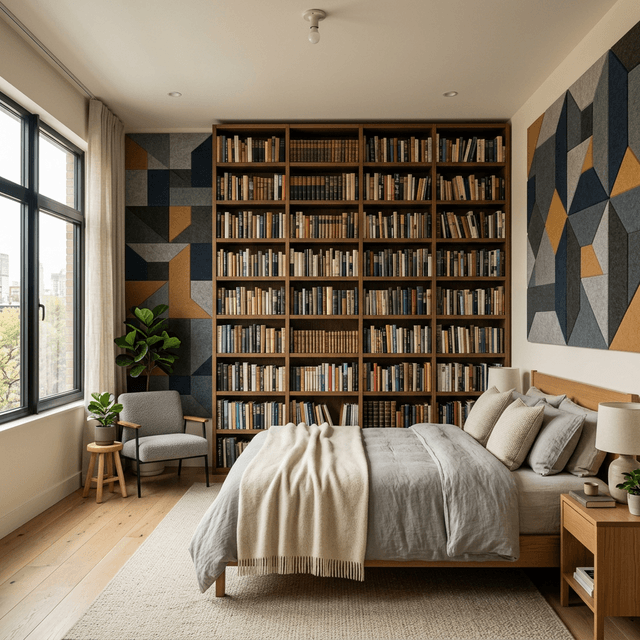
Renting a beautiful pre-war apartment usually comes with one horrific reality: the walls are practically cardboard. When your bedroom shares a surface with a neighbour who streams action movies at 2 AM, you face a specific renter’s dilemma — you can’t rip out drywall, you can’t drill into the structure, and moving isn’t free.
The good news: you don’t need construction to cut noise transmission by 60–70%. You need mass, decoupling, and absorption — three acoustic principles you can deploy entirely with furniture, tension rods, and adhesive.
Table of Contents
- Why Renter Walls Are So Loud: The Physics in 90 Seconds
- Method 1: The Floor-to-Ceiling Bookshelf Wall
- Method 2: Tension-Rod Acoustic Curtains
- Method 3: Mass Loaded Vinyl on a Temporary Frame
- Method 4: Acoustic Panels Without Drilling
- Layering Methods: What to Combine
- What Doesn’t Work (And Why)
- Budget Breakdown by Noise Type
- FAQ
Why Renter Walls Are So Loud: The Physics in 90 Seconds
Most apartment dividing walls are single-stud drywall construction — two sheets of 12mm plasterboard with an air cavity in between, and nothing else. The total mass is roughly 25kg per square metre.
Sound transmission is governed by the Mass Law: doubling the mass of a wall reduces sound transmission by approximately 6 decibels. A conversation is around 60dB. To drop that to a barely audible 40dB at your side of the wall, you’d need to add enormous mass — which is exactly what the methods below do, without touching the structure.
The three principles that actually work:
1. Mass — heavier material blocks more sound
2. Decoupling — an air gap between surfaces prevents vibration transfer
3. Absorption — soft materials kill reflections and echo
Method 1: The Floor-to-Ceiling Bookshelf Wall
The most underrated soundproofing method in any renter’s toolkit. A fully loaded floor-to-ceiling bookcase placed against a shared wall adds 200–400kg of mass per running metre — far more than any acoustic panel.
The setup that actually works:
– Use IKEA BILLY bookcases (201cm tall, available in 40cm and 80cm widths)
– Push them to within 2–3cm of the wall but don’t touch it — that air gap is your decoupling layer
– Fill every shelf with heavy hardcover books, packed tightly. Leave no empty shelves.
– Seal the top gap between the bookcase and ceiling with a foam draught excluder strip
What you get: STC (Sound Transmission Class) improvement of approximately 8–12dB for mid-frequency sounds (voices, TV). That’s roughly halving the perceived volume.
Cost: €150–€300 for three BILLY units. You also get storage.
Limitation: Ineffective against low-frequency bass and subwoofer noise below 100Hz. For bass, you need mass AND decoupling — see MLV below.
Method 2: Tension-Rod Acoustic Curtains
When the shared wall is too long for bookcases, or you need to cover a specific problem area (behind a sofa, beside a bed), acoustic curtains on a tension system are your best tool. Floor-to-ceiling drapes also cut the daylight reaching the room, which matters in a space that already depends on smart lighting to imitate sunlight in a windowless studio.
What you need:
– A floor-to-ceiling tension pole (like the IKEA SPANST or Umbra Twilight) rated for at least 8kg
– Heavyweight acoustic curtains — look for minimum 1.5kg per linear metre of fabric. Moondream and Nicetown both make verified acoustic drapes (they’re tested to STC standards, unlike generic “blackout” curtains which just block light)
Setup: Position the tension pole 5–7cm away from the wall, not touching it. The air gap is essential. Hang the curtains so they run floor to ceiling with no gap at the top or bottom.
Performance: 5–8dB reduction for voice frequencies. Combined with a bookshelf, you can reach 15–18dB total — the difference between clearly audible conversation and muffled indistinct noise.
Cost: €60–€100 for a 2-metre wide section.
Method 3: Mass Loaded Vinyl on a Temporary Frame
Mass Loaded Vinyl (MLV) is a dense synthetic rubber engineered to behave acoustically like sheet lead, but it’s flexible and hangable. At 5.5kg per square metre, it’s the most mass-efficient material available without construction.
Since you can’t drill, you build a temporary freestanding frame:
Frame option A — Tension poles: Two Stolmen-style floor-to-ceiling tension poles on either side of the wall section, with a horizontal wooden dowel between them. Hang MLV sheets over the dowel. Cost: ~€80 for the frame.
Frame option B — Lean-against: For walls in corners, lean a lightweight timber frame (no fixings required) against the wall and attach MLV to it with S-hooks. Remove when you leave.
MLV performance: STC improvement of 12–17dB per layer for mid frequencies. Two layers (with a 2cm air gap between them) can achieve 20+dB improvement.
Cost: MLV runs about €15–€25 per square metre. A 2m × 2.4m wall section costs €70–€120 in materials.
Where to buy: TMS Mass Loaded Vinyl (US), Acoustiblok (EU), or Soundproofing Store.
Method 4: Acoustic Panels Without Drilling
Acoustic foam panels (like Audimute or Auralex) absorb reflections and reduce echo — but they don’t block sound transmission. This is a common and expensive mistake.
If your problem is echo and reverb in your own room (recording audio, gaming, music), panels help. If your problem is noise coming through the wall from next door, panels on your side do almost nothing.
When panels are useful:
– You’re on a Zoom call and your voice bounces around your studio
– You’re recording audio or instruments
– Your room has a hollow, echoey quality that makes concentration difficult
Hanging without drilling: Audimute makes panels with a fabric loop system that hangs from a picture rail hook or adhesive hook rated for 4–5kg. One panel covers roughly 60cm × 90cm. For a full wall treatment, you need 8–12 panels.
Cost: €25–€45 per panel. For a full room treatment, budget €200–€400.
Layering Methods: What to Combine
No single method reaches the 20+dB improvement you actually want. The system works when layered:
| Combination | Approximate dB Gain | Cost Range |
|---|---|---|
| Bookshelf only | 8–12 dB | €150–€300 |
| Acoustic curtains only | 5–8 dB | €60–€100 |
| MLV frame only | 12–17 dB | €150–€250 |
| Bookshelf + curtains | 14–18 dB | €200–€400 |
| Bookshelf + MLV frame | 18–25 dB | €300–€550 |
| All three | 22–28 dB | €400–€700 |
For most renters dealing with voice and TV noise, bookshelf + curtains hits the sweet spot of cost and performance.
What Doesn’t Work (And Why)
Egg cartons: Almost zero mass, no meaningful STC improvement. A persistent myth.
Standard foam packing: Adds absorption (reduces echo) but almost no mass. Useless for blocking transmission.
Door draft stoppers on walls: Only useful at the gap under actual doors.
Thin “soundproof” wallpaper: Claims up to 3dB improvement. Real-world testing shows 1–2dB. Barely perceptible.
White noise machines: Don’t reduce transmission — they mask it. Useful for sleep, not for concentration or calls. Masking noise belongs with the other micro-wellness upgrades for small apartments, which improve comfort without changing the wall.
Budget Breakdown by Noise Type
| Noise Type | Frequency Range | Best Method | Budget |
|---|---|---|---|
| Voices, TV | 300–3000Hz | Bookshelf + curtains | €200–€400 |
| Bass, subwoofer | 40–150Hz | MLV + air gap | €150–€300 |
| Footsteps (above) | Impact noise | Thick area rug + underlay | €80–€200 |
| Echo in your room | All frequencies | Acoustic panels | €200–€400 |
Safety Disclaimer
Freestanding bookcases loaded with books are heavy. Ensure they rest on level flooring and cannot tip — use an anti-tip strap anchored to a furniture foot (not the wall) or position them in a corner. Never stack above the maximum load rating of the shelving unit.
FAQ
Will these methods fully soundproof my apartment?
No. Complete soundproofing requires structural decoupling — floating floors, resilient channels, double-stud walls. What these methods do is reduce noise by 15–25dB, which is the difference between “clearly audible conversation” and “barely perceptible murmur.”
Does acoustic foam actually block sound?
No. Acoustic foam absorbs reflections within your room. It does not block transmission through walls. For blocking, you need mass (books, MLV, dense curtains).
Can I use these methods on a ceiling for footstep noise?
Mass strategies don’t work well on ceilings due to weight. For footstep (impact) noise from above, thick area rugs with a dense underlay on your floor are more practical than treating the ceiling.
How do I know if my wall is hollow or solid?
Knock on it. A hollow sound means single-stud drywall — mass methods will have the most impact. A solid thud means masonry — you already have significant mass, and your noise problem is likely coming through flanking paths (around the wall, through the floor/ceiling junction).
Is Mass Loaded Vinyl safe indoors?
Yes. MLV is inert — it contains no volatile compounds and doesn’t off-gas. It’s used in hospital and studio construction. The main concern is weight — at 5.5kg/m², a 3m² piece weighs 16.5kg and needs a secure hanging system.
