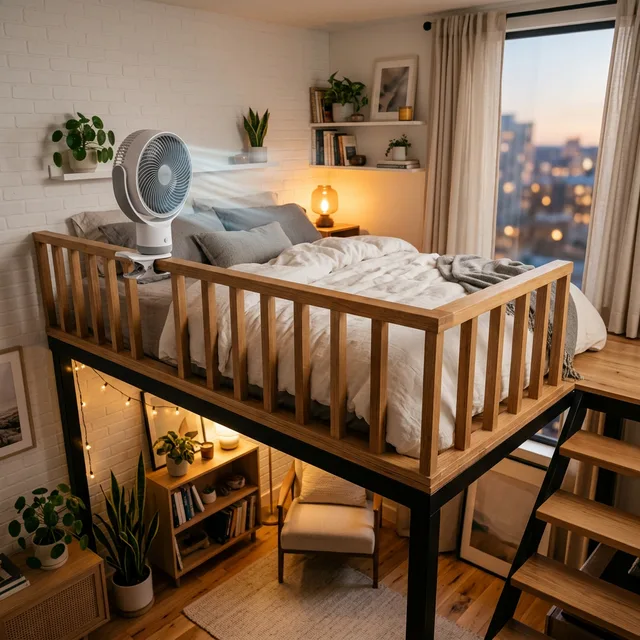
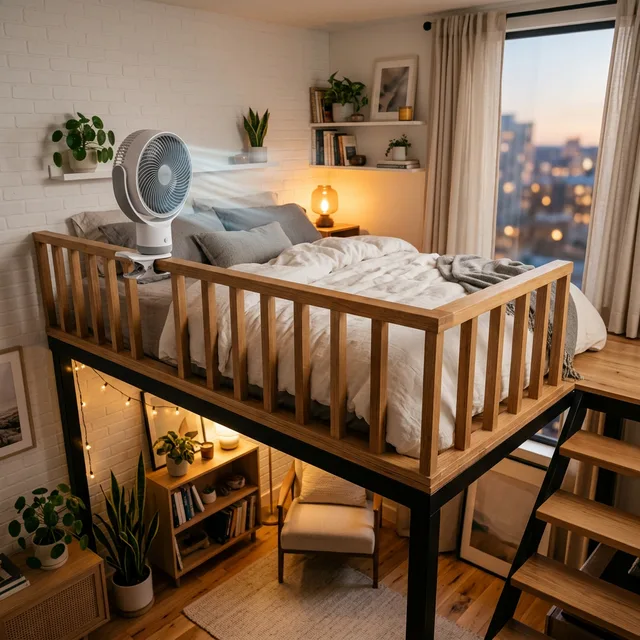
Understanding how to cool a loft bed in summer without ac is the ultimate test of renter survival. Heat rises. If you sleep 6 feet off the ground in a studio apartment, you are directly in the invisible trap where stagnant, humid, hot air pools. It is suffocating, and no amount of opening a low window solves the physics of thermal stratification. I know because I sweat through an entire July trying to sleep in my first lofted micro-apartment before engineered a real airflow system.
You do not need to install an expensive permanent air conditioner or damage your rental property to drop your sleeping temperature. By manipulating air pressure, targeting body heat directly, and using smart portable tech, you can completely neutralize the “heat trap” effect. Here is the exact physics-based, renter-friendly strategy to survive the summer months in your loft bed.
My Experience with How to Cool a Loft Bed on a Tiny Studio
In 2023, I moved into a 22-square-meter studio with a brilliant custom-built loft bed. I loved the space it saved below for my desk. Then, June hit. The high ceiling was exactly 9 feet tall. My mattress sat at 6.5 feet. That left 2.5 feet of space where all the heat in the apartment gathered.
My first mistake was buying a standard oscillating floor fan and pointing it upward. This completely failed. It just pushed warm air from the living area directly into my mattress. I was essentially baking myself in a convection oven. I tracked the temperature: it was 81°F (27°C) at the floor and 89°F (31.5°C) at the ceiling level where I slept.
I realized I needed to stop treating the room as one zone and start treating the 2.5-foot gap above my bed as an isolated micro-climate. I switched to targeted evaporation and exhaust tactics. Within two days, I dropped my sleeping temperature by 8 degrees using zero construction tools.
1. The High-Velocity Clip-On Exhaust Strategy
Stop aimed fans at yourself first. You must break the pocket of hot air.
The Strategy: Buy two high-velocity, industrial-grade clip fans (not weak USB desk fans). The Setup: Clip Fan A to the foot of your loft bed railing, aiming away from you and toward the nearest open window or the open room. Clip Fan B to the opposite side, aimed across your body. The Physics: Fan A acts as an exhaust. It physically forces the trapped hot air out of your ceiling corner. Fan B replaces it with circulating air. You are creating a miniature wind tunnel across your mattress.
2. Invest in Active Cooling Bedding
Cotton holds moisture. When you sweat in a hot loft, you sleep in a damp microclimate.
- Bamboo or Tencel Sheets: These fibers are naturally hydrophilic. They pull moisture away from your skin and dry 3x faster than cotton.
- The ChiliPad / Cooling Mattress Pad: This is the most effective piece of tech for a loft. It pumps cold water through a matrix of tubes under your fitted sheet. It targets your core body temperature rather than trying to cool the entire volume of air in the ceiling space.
3. The “Swamp Cooler” Evaporation Trick
If you live in a dry climate (under 40% humidity), use evaporative cooling.
- Take two 2-liter plastic bottles of water. Freeze them solid during the day.
- At night, place them in a shallow plastic tray directly in front of your clip-on fan.
- As the ice melts, the fan blows across the incredibly cold surface, cooling the air immediately before it hits your body.
- This drops the localized temperature by 5 to 10 degrees for roughly 4 hours—enough time to fall into deep sleep.
4. Master the “Chimney Effect” Cross-Ventilation
You must use your apartment windows strategically.
- The Setup: Open a window on the shaded (cooler) side of your apartment just 4 inches (10 cm). Place a strong box fan in the window on the hot side of your apartment, blowing OUTWARD.
- The Result: You create negative pressure. The fan violently sucks the hot air out of your apartment, forcing cool air to pull through the small gap in the shaded window. This entirely cycles the air in a small studio every 20 minutes.
5. Automate with Smart Outlets
Do not wake up at 3 AM freezing because the ambient temperature dropped but your fans are still blaring. Hook your clip-on fans to a simple smart plug. Set an automation routine on your phone: Fan turns ON at 10:00 PM and OFF at 4:30 AM. This saves energy and improves your smart studio apartment setup.
Compare Cooling Setups for Lofts
| Cooling Method | Cost Estimate | Noise Level | Best Climate | Effectiveness (Temp Drop) |
|---|---|---|---|---|
| Dual Clip-On Fans | $40 – $70 | Medium | Any | High (Breaks stagnant air) |
| Ice Bottle “Swamp Cooler” | $5 | Low | Dry / Desert | Moderate (3-5°F drop) |
| Cooling Mattress Pad | $200 – $500+ | Very Low | Any | Extreme (Cools core body) |
| Negative Pressure Window | $30 (Box Fan) | High | Any | High (Cycles whole room) |
Conclusion
A loft bed does not have to be a miserable sauna from June to August. By understanding that you need to exhaust the trapped hot air rather than just blowing it around, you can gain complete control over your sleeping environment. Upgrade your sheets, master the window exhaust fan, and strategically mount your clip-on fans. Implement these hacks tonight to reclaim your rest.
What is the fastest way to cool down a hot loft bed without AC?
The fastest way to cool down a hot loft bed without AC is to utilize negative pressure exhaust combined with point-source evaporation. First, place a high-velocity box fan in your window blowing facing outward to suck the stagnant hot air out of the studio. Simultaneously, clip a fan directly to your bed frame facing your torso, and place a frozen bottle of water directly in the fan’s airstream. This rapidly replaces the hot air ceiling pocket while instantly delivering chilled, evaporating air directly to your skin, lowering your perceived body temperature within minutes.
Safety Disclaimer
Always ensure clip-on fans are securely fastened to a sturdy structural rail, not weak decorative elements, to prevent them from falling onto your face during sleep. Keep all electrical cords tightly managed and away from the mattress area to prevent strangulation or fire hazards. Use GFCI outlets if placing melting ice or water near electronics.