Getting boho apartment decor right in a rental is one of the more frustrating design challenges I’ve faced. Not because bohemian style is hard — it’s layered, warm, imperfect by nature. It’s forgiving. The problem is that every tutorial assumes you own the walls. Macramé nails, gallery wall grids hammered into plaster, terracotta shelves bolted above the radiator. Beautiful. Also a $300–$500 deposit claim waiting to happen.
I learned this firsthand when I tried to replicate a boho Pinterest board in my 320 sq ft studio in 2022. I put 14 nails into the accent wall. The landlord charged me $420 at move-out. The wall was white again within 45 minutes — my “boho gallery wall” existed for exactly 11 months.
Here’s what I do now. Everything you’ll read below is renter-legal, removable, and — most importantly — it actually looks like intentional boho design, not a compromise.
Table of Contents
- What Actually Makes Decor “Boho”
- Materials & Budget Tiers
- Step 1: Build Your Color Base Without Paint
- Step 2: Layer Textiles — Floor First
- Step 3: Hang Things Without Nails
- Step 4: The Plant Situation
- Step 5: Lighting Is 40% of Boho
- Step 6: Thrifted Objects Over New Ones
- Step 7: Create a Focal Corner, Not a Full Room
- My Experience with Boho Decor in a Tiny Studio
- What Does Boho Apartment Decor Actually Cost?
- Common Mistakes
- FAQ
What Actually Makes Decor “Boho”
Before buying anything, understand the three pillars of bohemian interior design. Without this, you end up with mismatched stuff that just looks messy.
Texture contrast — rough next to smooth. A jute rug under a velvet cushion. Rattan beside a ceramic pot. The friction between surfaces is the visual interest.
Warm earth tones as the base layer — terracotta, rust, ochre, sand, sage, cream. Everything else is an accent. If you start with cool grays or stark whites, the boho pieces fight the room instead of landing in it.
Organic shapes over geometric ones — curves, asymmetry, handmade irregularities. This is why mass-produced IKEA grids can undermine a boho setup: too precise, too even.
You don’t need to buy much. You need to buy the right category of things.
Materials & Budget Tiers
| Item | Budget ($50) | Mid ($100) | Full ($150+) |
|---|---|---|---|
| Layered rug | Thrifted flatweave | IKEA STOCKHOLM jute | Vintage kilim, eBay |
| Textiles | 2x charity shop throw | Linen curtain panels | Handwoven blanket + cushions |
| Wall art | Printed art, command strips | Macramé wall hang | Framed vintage prints |
| Plants | 2x pothos cuttings | 3x medium pots + stands | Full plant corner incl. hanging |
| Lighting | Fairy lights on tension rod | Paper lantern pendant | Rattan floor lamp |
| Ceramics/objects | 1x charity shop haul | Mix new/thrifted | Curated shelf vignette |
Step 1: Build Your Color Base Without Paint
Boho needs a warm base. In a rental, you almost certainly have white or magnolia walls. Don’t fight them. Instead, layer warmth at ground level and mid-height — the eye reads color from furniture and textiles before it notices the wall color.
Start with the largest surface area you can change without permission: the floor. A large jute or flatweave rug in camel, rust, or undyed natural fiber immediately pulls the room toward warm-earthy territory. Go big — minimum 5×8 ft for a studio, 8×10 ft for a one-bed. Small rugs under sofas look like bath mats.
If you have a sofa, throw a textured blanket over one arm. Ochre. Rust. Anything warm. This costs $15–$30 from a charity shop and shifts the entire room’s temperature palette without touching a wall.
Micro-Fail Warning: Don’t mix warm and cool tones in the base layer. A cream jute rug with a cool-gray sofa creates visual discord that no amount of terracotta pots will fix. Commit to warm or cool first.
Step 2: Layer Textiles — Floor First
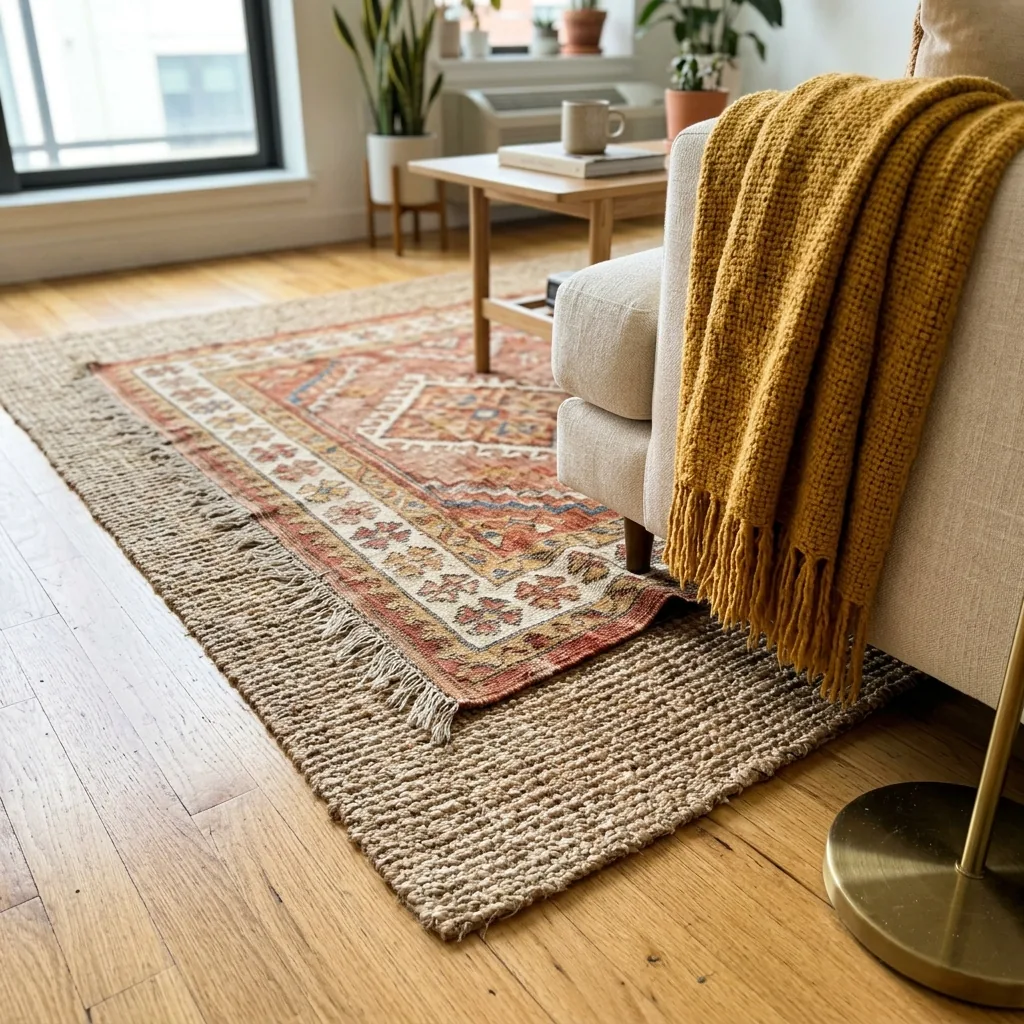
Boho layering is literal. Rug on rug is not a mistake — it’s the technique.
A flatweave kilim or printed cotton runner laid over a jute base rug adds pattern without furniture cost. The layers also work acoustically in hard-floor apartments: less echo, warmer sound.
Curtains matter enormously. Most rental apartments come with no curtains or horrible plastic blinds. Floor-to-ceiling linen or cotton curtains in off-white or terracotta make a 9 ft ceiling feel like 11 ft. No drilling needed — use a tension rod inside the window recess, or command-strip curtain hooks rated for the fabric weight.
Pro-Tip Checklist: – Iron or steam your curtains before hanging — wrinkled linen kills the look – Hang the rod as high as physically possible, even above the window frame (command strips) – Go wider than the window: at least 8 inches on each side so the curtains frame the window when open
For cushions: odd numbers, varying sizes. Three or five looks intentional. Two looks like a hotel room.
Step 3: Hang Things Without Nails
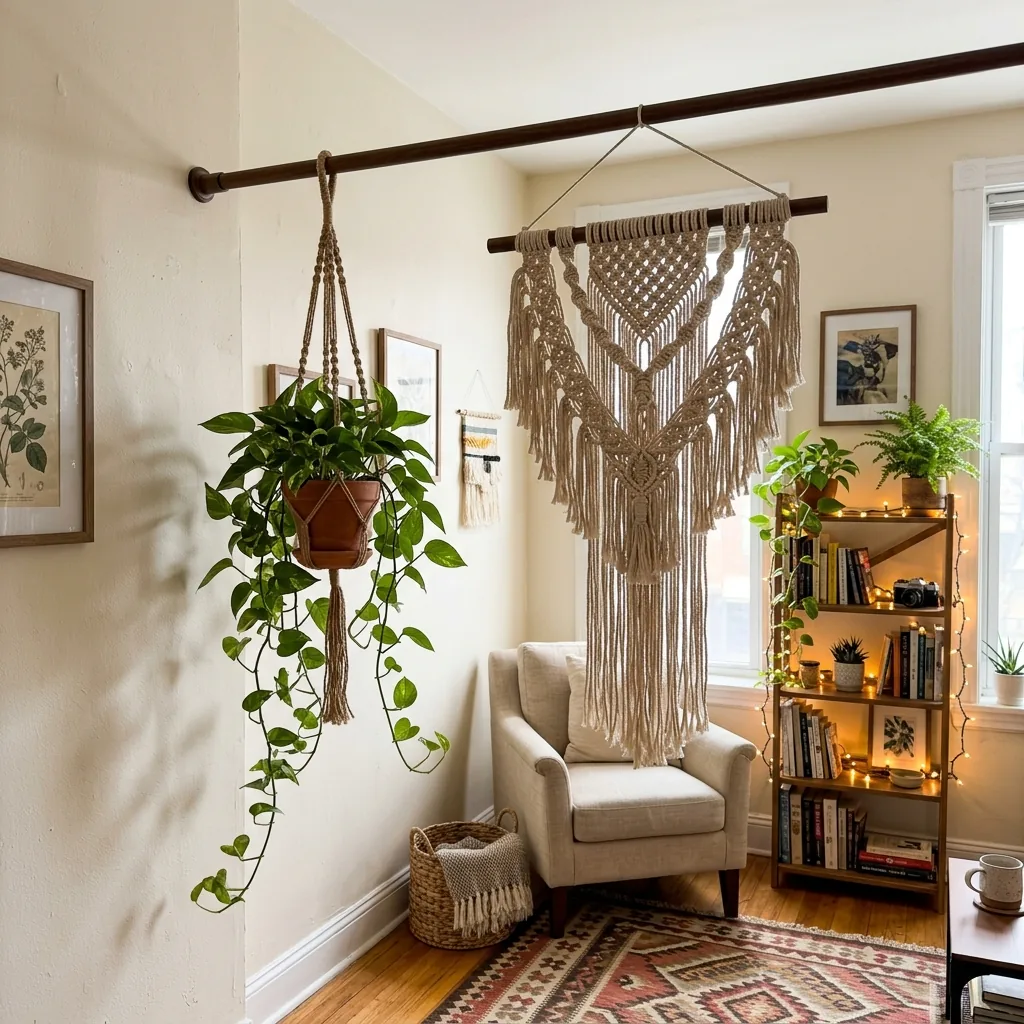
This is where most renter boho attempts collapse. The usual fallback is command strips, used wrong. Here are the actual methods that hold:
Tension rod across a wall alcove or between two walls. Hang macramé, fabric panels, dried grasses, trailing plants in baskets. A $12 tension rod carrying a $35 macramé wall hanging creates the single strongest boho focal point you can make without tools.
Leaning frames. Large art prints leaning against the wall on the floor — or on a shelf ledge — look more intentional in a boho context than they do in a contemporary one. The slight disorder is appropriate to the style.
Command Picture Hanging Strips (the large ones, rated 16 lbs). Use them correctly: press for 30 seconds, wait 1 hour before hanging. A 2.5 kg framed print on two pairs of large strips has held through three apartment moves for me without a single mark.
Shelving via tension poles (IKEA OBSERVATÖR or similar). Floor-to-ceiling tension shelf poles with added wooden planks. Zero wall damage. Load capacity up to 33 lbs per shelf when installed correctly. This is also how I display ceramics without a nail in sight — see the full guide to no-drill shelving options.
Step 4: The Plant Situation
Plants are non-negotiable in boho decor. But the way you display them matters more than the species.
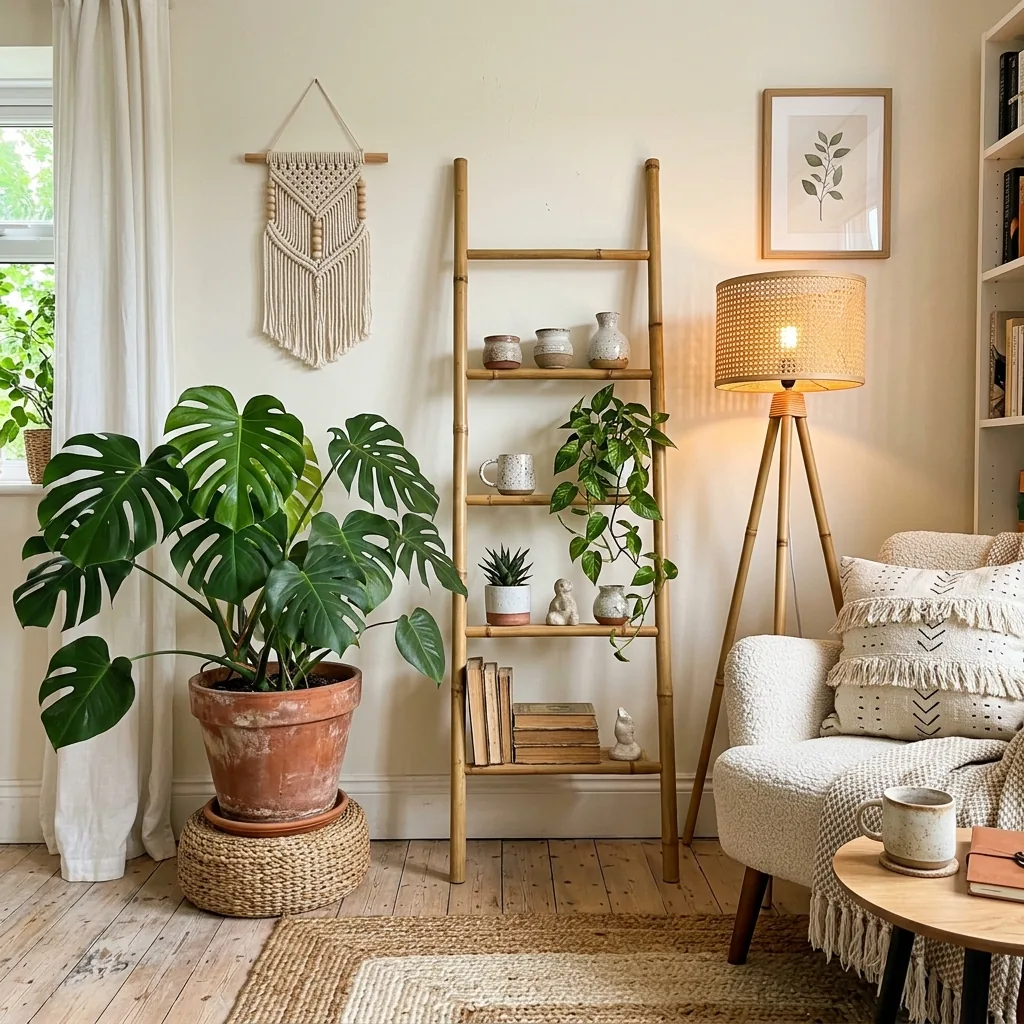
Height variation is the key. You want plants at three levels: floor (large pot, at least 12-inch diameter — a fiddle leaf, a bird of paradise, a tall monstera), mid-height (table or shelf — trailing pothos, ceramic-potted sansevieria), and hanging (macramé plant hanger from the tension rod or ceiling hook via removable adhesive).
For hanging specifically: a 3M Command Ceiling Hook rated 5 lbs holds a small hanging planter with a pothos or string of pearls easily. Test the weight first with a luggage scale.
One mistake I see constantly: too many small pots scattered everywhere. It reads as clutter, not boho. Instead, fewer larger plants with deliberate spacing. A single $25 monstera in a terracotta pot on the floor creates more impact than ten small succulents across a windowsill.
Step 5: Lighting Is 40% of Boho
Overhead fluorescent or cool-white LED lighting will destroy any boho setup immediately. The warm, slightly dim glow of soft incandescent-spectrum bulbs is not optional — it’s structural to how the style reads.
Change the bulb first. A 2700K or warmer LED bulb (warm white) in your existing fitting costs $4. It will improve the room more than any decor purchase.
Then add layers: – Fairy lights draped over a tension rod or along a bookshelf edge: $8–15 – A rattan or paper pendant lamp shade slipped over the existing ceiling fitting (no wiring, just a shade swap): $20–40 – A thrifted floor lamp with a warm bulb in the corner: often $5–15 at charity shops
For balcony spillover or studio corners, no-drill string light poles work indoors too — tension-mounted between floor and ceiling, they carry Edison-bulb strands without a single hole.
Step 6: Thrifted Objects Over New Objects
Boho is the one interior style where brand-new, perfectly matched objects actively undermine the look. The aesthetic relies on objects having different histories — different patinas, different origins.
A $3 charity shop ceramic vase with a slight glaze imperfection looks better on a boho shelf than a $45 new one from a home store. Genuinely.
What to thrift specifically for boho: – Ceramic and pottery — any warm-toned piece, even if you don’t know what it originally held – Woven baskets — any size, for plant cachepots, toilet roll storage, blanket storage – Wooden objects — small stools, frames, candleholders – Fabric — sari fabric, embroidered runners, patterned tablecloths repurposed as wall hangings
What not to thrift: anything plastic, anything with cool metallic finishes (chrome, bright silver), anything with stark geometric patterns in cool tones.
Step 7: Create a Focal Corner, Not a Full Room
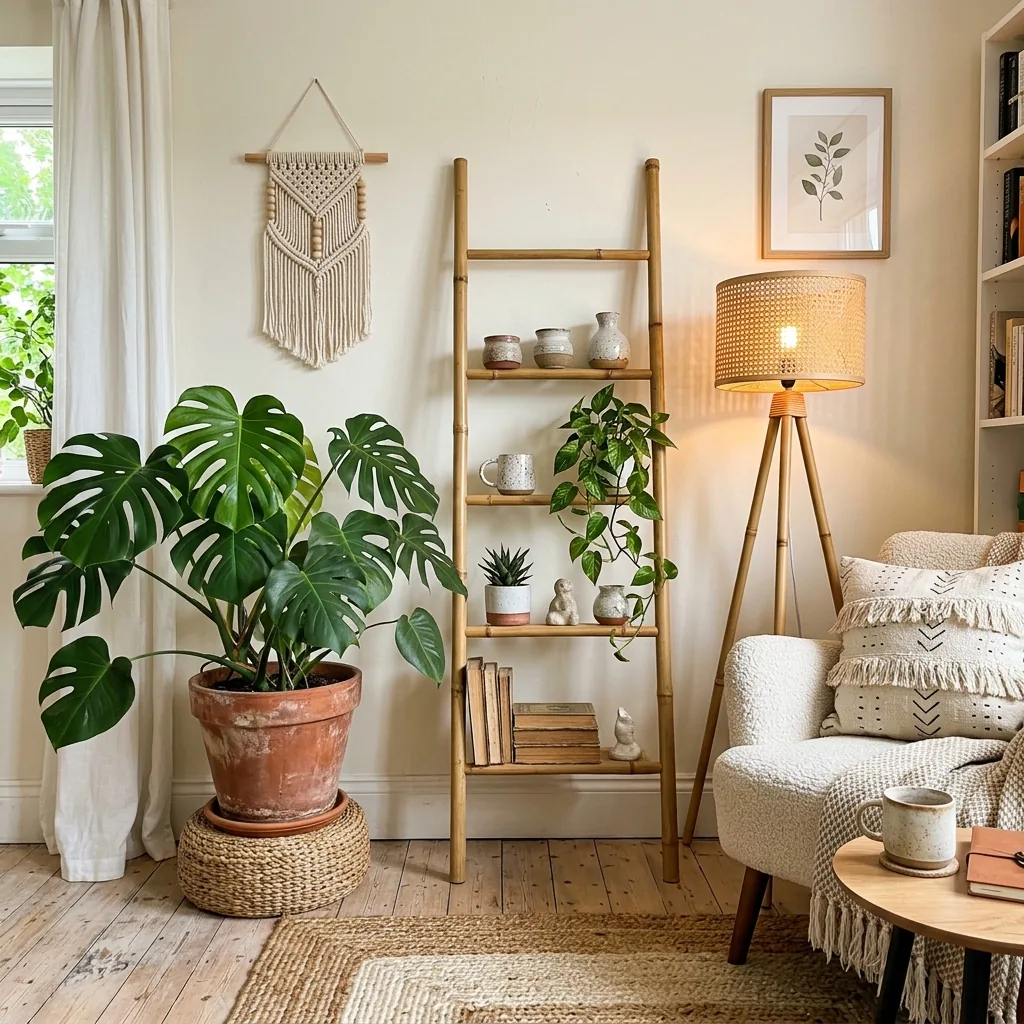
The biggest mistake in small apartment boho: trying to do every surface. A 320 sq ft studio cannot sustain full-room boho without becoming chaotic. Instead, designate one corner as your boho focal point and let the rest of the room breathe.
A typical focal corner setup: 1. Tall plant on the floor (left or right of the corner) 2. Tension shelf or leaning ladder shelf holding ceramics, books, a trailing plant 3. Macramé or fabric panel hung via tension rod above 4. Floor cushion or pouffe in front 5. Warm lamp nearby
This corner does all the visual work. The eye lands there. Everything else — sofa, desk, bed — can be simpler and more neutral. This approach also means you’re spending $60–$100 total instead of $400 trying to cover the whole space.
For the full layout strategy that complements this approach, the studio apartment layout guide covers how to zone a single room so each corner has a distinct purpose.
My Experience with Boho Decor in a Tiny Studio
My current apartment is a 285 sq ft studio on the 8th floor, north-facing windows, strict no-drill lease. When I moved in, the walls were brilliant white and the floors were laminate the color of a Band-Aid.
I built the entire boho setup in one weekend with $87 total. The breakdown: $22 for a large jute rug from a closing-down furniture shop. $11 for a secondhand macramé hanging from Facebook Marketplace. $18 for two linen curtain panels from IKEA (tension rod already owned). $8 for a paper lantern shade. $14 for three terracotta pots at a garden center. $14 for a monstera cutting from a local plant swap.
The north-facing window is the hard part. Natural light is limited, which means the warm lighting layer is doing even heavier lifting than it would in a south-facing flat. I run the fairy lights during the day. It’s not a cheat — it’s a tool.
One thing that surprised me: the rattan floor lamp I picked up for $8 at a charity shop had more visual impact than anything else in the room. It created a second light zone in the corner and pulled the whole setup together. I’ve moved apartments twice since then. It came with me both times.
What Does Boho Apartment Decor Actually Cost?
Boho apartment decor for a rental starts at around $50–$90 for a focused corner setup, using thrifted items and no-drill methods. A full studio refresh — including rug, curtains, lighting, plants, and wall art — typically runs $120–$180 when sourcing a mix of new and secondhand items. You do not need to spend more than this. The aesthetic specifically rewards restraint and imperfection over spending.
Key cost anchors: – Jute or flatweave rug (5×8 ft): $25–$55 (IKEA, charity shops) – Macramé wall hanging: $15–$40 (marketplace, Etsy, charity shops) – Linen curtains (per panel): $9–$20 (IKEA, Amazon) – Tension rod: $8–$15 – 3–4 plants + pots: $20–$45 – Warm lighting (bulb + shade): $12–$30
Common Mistakes
Buying everything at once from the same shop. If your boho decor all came from one online retailer in one order, it will look like a costume, not a home. Buy in pieces over a few weeks. Different sources.
Ignoring the existing furniture color. A charcoal-gray IKEA sofa is a cool, hard surface. Boho textiles can warm it up — but not without effort. Start with the largest warm-toned throw you can find before buying anything else.
Overcrowding every surface. Boho includes negative space. Not every shelf needs to be full. Leave 30–40% of any shelf surface empty. The objects you do place read better against breathing room.
Picking the wrong plants. Cacti and succulents are desert plants — they read as Southwestern or minimalist, not boho. Go for lush, leafy, trailing plants: pothos, monstera, tradescantia, heartleaf philodendron. These create the abundant-but-intentional growth that reads as bohemian.
Safety Disclaimer
No-drill hanging solutions have specific weight limits — always check the manufacturer’s rating before hanging heavy objects. Command ceiling hooks are rated for **5 lbs maximum**; exceeding this risks damage to ceilings and injury. For hanging planters, weigh the pot with wet soil before installing any adhesive hook.
—