Your kitchen counter is the perfect place to grow fresh herbs, but it is notoriously dark. Most kitchens are tucked away from large living room windows, and even if you have a window over the sink, it rarely provides the 6 to 8 hours of intense, direct sunlight that sun-loving plants like basil and cherry tomatoes demand.
If you want to stop buying wilted plastic packages of herbs at the supermarket, you must bring the sun indoors.
You need to understand the best LED grow lights available for small spaces. The days of massive, hot, purple-glowing high-pressure sodium bulbs are over. Modern LED technology has completely revolutionized indoor gardening. It is now incredibly cheap, energy-efficient, and visually pleasing to grow a massive amount of food directly under your kitchen cabinets.
This guide breaks down exactly what you need to look for when choosing the best LED grow lights for a compact kitchen setup, ensuring your plants actually grow instead of just stretching weakly toward the ceiling.
Understanding the “Blurple” Myth
Walk down the aisle of any cheap home goods store, and you will see “grow lights” that emit an intensely bright, harsh purple light (often called “blurple”).
For years, manufacturers pushed the idea that plants only absorb red and blue light wavelengths for photosynthesis. While red and blue are critical for leaf growth and flowering, plants have evolved under the full spectrum of natural sunlight, which appears white to the human eye.
The best LED grow lights on the market today use “full-spectrum” white diodes. These sophisticated chips emit every color of the rainbow, perfectly mimicking natural daylight. Not only do full-spectrum lights produce healthier, bushier plants with better root development, but they also look like normal, bright kitchen under-cabinet lighting. You no longer have to live in a kitchen that looks like a neon nightclub.
The 3 Key Metrics of the Best LED Grow Lights
Before you buy a panel for your kitchen counter, you must ignore the marketing hype and focus on three essential metrics that actually determine a light’s effectiveness.
1. Actual Wattage Draw vs. “Equivalent” Wattage
This is the biggest trick in the industry. A manufacturer will advertise a “1000W LED Grow Light.” If you look at the fine print, the light actually draws only 100 watts of real electricity from the wall. They are claiming it is “equivalent” to a 1000-watt old-school bulb. Always judge a light by its actual power draw. For a standard 2-foot kitchen counter herb garden, an actual draw of 20 to 50 watts is entirely sufficient.
2. PPFD (Photosynthetic Photon Flux Density)
Lumens measure how bright a light appears to the human eye. Plants do not care about lumens. They care about PAR (Photosynthetically Active Radiation). The measurement of how much PAR actually hits the leaves of your plant every second is called PPFD.
The best LED grow lights will clearly list a PPFD map in their documentation.
- Low-Light Herbs (Mint, Parsley): Need a PPFD of 100-200.
- High-Light Herbs (Basil, Rosemary): Need a PPFD of 300-400.
- Fruiting Plants (Micro Tomatoes): Need a PPFD of 400-600.
3. Color Temperature (Kelvin)
Full-spectrum white LEDs come in different color temperatures.
- A 3000K bulb looks warm and yellowish. It is heavier in red wavelengths, encouraging plants to flower and fruit.
- A 5000K to 6500K bulb looks stark, crisp white/blue. It encourages dense, bushy, leafy growth.
If you are only growing leafy herbs like basil and cilantro on your counter, a 5000K to 6500K spectrum is ideal.
Form Factors for the Kitchen
The traditional square, hanging panel light is often too bulky and blinding for a kitchen counter. You need sleek, low-profile designs that integrate seamlessly into your existing backsplash and cabinets.
Halo and Stake Lights
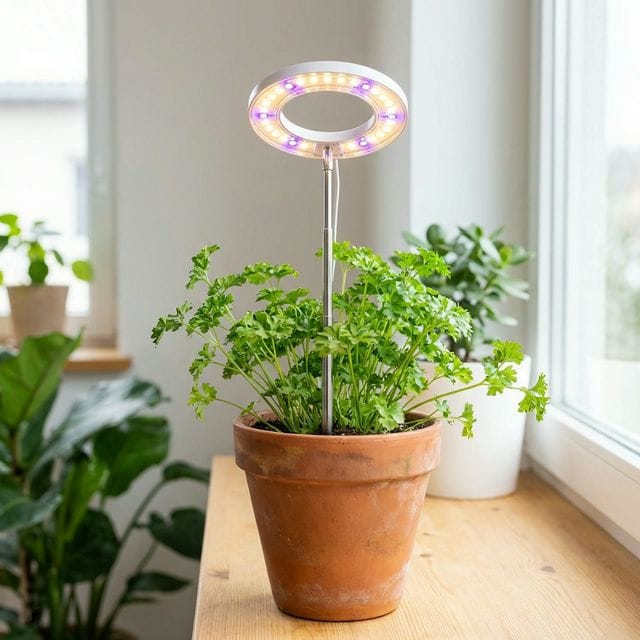
If you only have one or two small pots of basil next to the coffee maker, you do not need a massive lighting array. Sub-compact “halo” lights are small rings of LEDs mounted on a thin, extendable metal stake that pushes directly into the soil of the pot. They provide intense, local light exactly where the plant needs it, without illuminating the entire kitchen.
Under-Cabinet Light Bars
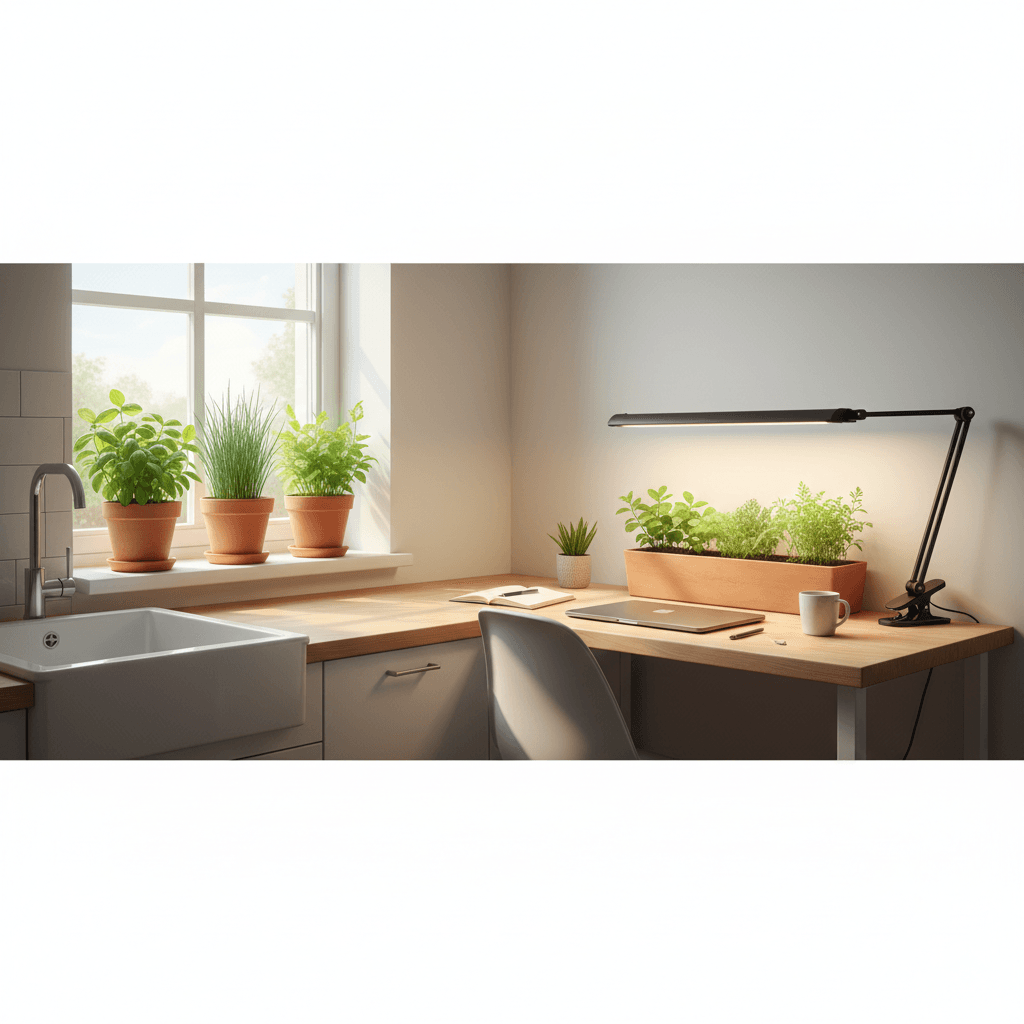
The absolute best LED grow lights for comprehensive kitchen gardens are ultra-thin light bars. These long, rigid strips (usually 1 or 2 feet long) can be attached directly to the underside of your upper kitchen cabinets using simple 3M adhesive strips or tiny screws.
They cast a uniform, intense light straight down onto the counter. Because they are hidden under the cabinet lip, they do not shine directly into your eyes when you are aggressively chopping onions.
The Distance Rule and Heat Management
Modern full-spectrum LEDs run incredibly cool compared to older technology, but they still produce heat. The diodes are usually mounted to an aluminum backplate that acts as a heat sink.
Because they run cool, you can position the best LED grow lights very close to the plants to maximize PPFD. For young seedlings and delicate herbs, position the light 12 to 18 inches above the canopy. As the plants mature and demand more energy, lower the lights to 6 to 8 inches above the highest leaves.
If the leaves begin to bleach white or curl inward tightly, the light is too intense; raise it by a few inches immediately.
Conclusion
You do not have to accept the limitations of a dark kitchen. By outfitting your under-utilized counter space with sleek, full-spectrum lighting, you instantly transform a sterile environment into a highly productive growing zone.
Do your research, ignore the inflated “1000W” marketing claims, and focus entirely on finding low-profile lights with a strong, verifiable PPFD output.
If you are ready to combine perfect lighting with high-yield techniques, read our deep dive on building hydroponic mason jar herb gardens right on your newly illuminated counter, or see how lighting strategies fit into the ultimate growing food in a windowless apartment guide.
Are LED grow lights dangerous to my eyes?
Staring directly into powerful LED diodes can cause optical damage, similar to staring at a bright flashlight. Always position under-cabinet lights so the diodes face straight down, and utilize the cabinet’s front lip to block direct eye contact.
Can I just use a regular LED desk lamp for plants?
While a standard desk lamp emits some light plants can use, it lacks the specific spectrum and the high intensity (PPFD) required for robust growth. Plants under desk lamps almost always become weak, leggy, and pale.
Do I need to turn grow lights off at night?
Yes, absolutely. Plants require a dark period to complete their metabolic cycle of respiration (processing the food they created during the day). Always run your lights on a standard 12-to-16-hour timer.