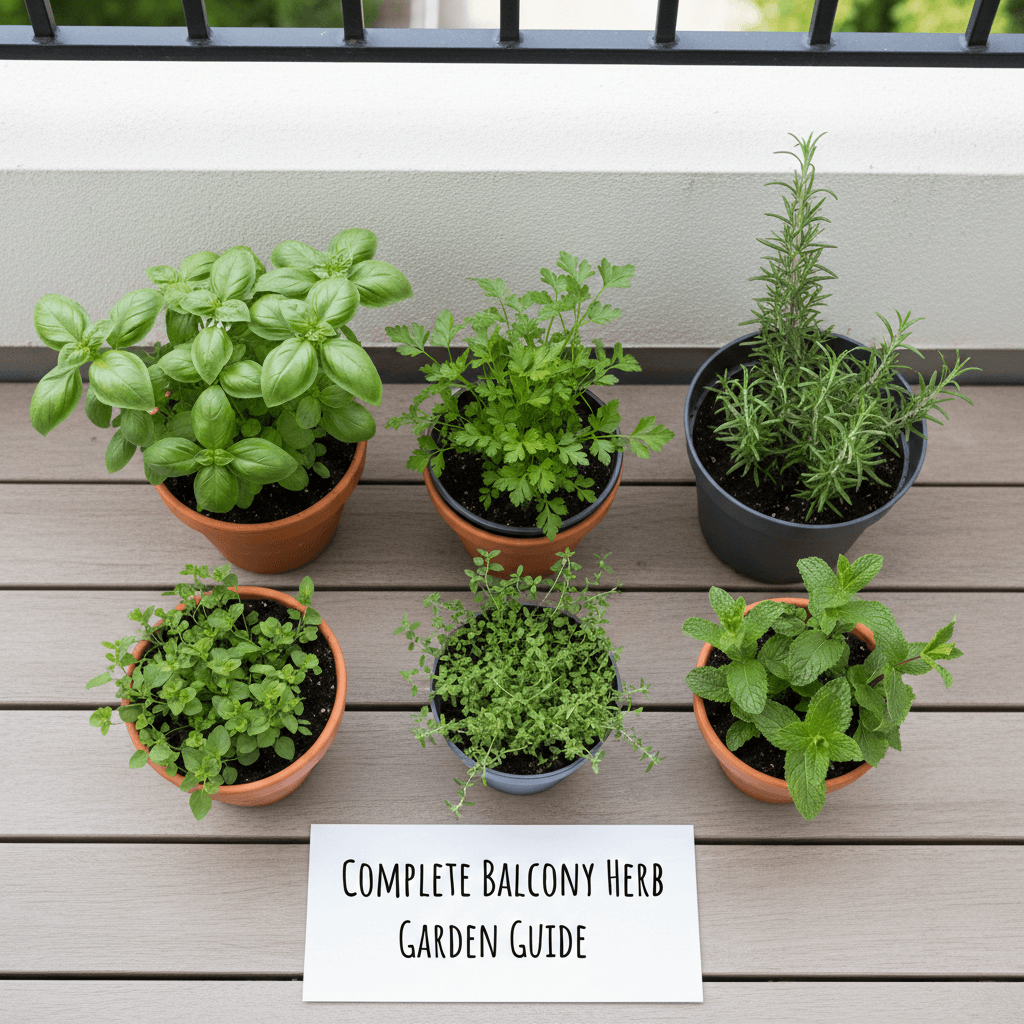
Balcony lighting for herbs and vegetables can transform your harvest. Growing herbs and vegetables on your balcony isn’t just about soil and water—lighting makes or breaks your success. Most balcony plants need 4-8 hours of quality light daily, and you’ll see healthier growth within 2-3 weeks of proper lighting. Setting up basic LED grow lights costs $30-$100, but the payoff is year-round fresh produce. This guide walks you through natural sunlight optimization, choosing grow lights, and avoiding expensive mistakes.
Why Balcony Lighting Matters (Don’t Skip This)
Light is literally food for your plants through photosynthesis, and most balcony failures come from poor lighting choices. Here’s what proper lighting gets you:
- More harvests per year – Basil produces 3-4 times more leaves with 6-8 hours of quality light versus 3-4 hours
- Specific sunlight requirements – Sun-loving herbs like rosemary need 6-8 hours daily, while mint tolerates 3-4 hours
- Real cost savings – Growing your own basil saves $8-12 monthly versus buying those overpriced grocery store packages
- Shade balcony success – LED grow lights let you grow tomatoes and peppers on north-facing balconies that get zero direct sun
With the right lighting setup, even a shaded apartment balcony becomes productive growing space.
How Much Light Do Herbs and Vegetables Need?
Different plants have wildly different light appetites, and matching them to your balcony conditions saves frustration.
| Plant | Minimum Hours/Day | Ideal Light Level | What Happens Without Enough |
|---|---|---|---|
| Basil | 6-8 hours | High (10,000+ lux) | Leggy stems, small leaves, weak flavor |
| Parsley | 4-6 hours | Medium (5,000-7,500 lux) | Slow growth, pale leaves |
| Mint | 3-4 hours | Low-Medium (3,000-5,000 lux) | Still grows, just slower |
| Rosemary | 6-8 hours | High (10,000+ lux) | Won’t develop oils, weak aroma |
| Cherry Tomatoes | 6-8 hours | High (10,000-15,000 lux) | Few flowers, no fruit set |
| Lettuce | 4-6 hours | Medium (5,000-8,000 lux) | Bitter taste, bolts quickly |
| Spinach | 3-5 hours | Low-Medium (4,000-6,000 lux) | Smaller leaves but still edible |
| Chives | 4-6 hours | Medium (5,000-7,500 lux) | Thin shoots, slow regrowth |
Sun-loving plants like basil, tomatoes, and rosemary evolved in Mediterranean climates with intense light, so they need bright conditions to produce the oils that give them flavor. Shade-tolerant plants like mint, spinach, and lettuce originally grew as forest understory plants, so they’re adapted to filtered light and will actually scorch in too much direct sun.
Types of Balcony Lighting for Herbs and Vegetables
You’ve got options ranging from free sunlight to specialized equipment, and knowing the trade-offs helps you spend wisely.
Natural Sunlight (Free But Limited)
Maximizing your existing sunlight is always step one before buying anything. Track where sun hits your balcony throughout the day using your phone’s compass app to identify south-facing areas (northern hemisphere) that get the most hours. Reflective surfaces like white walls, aluminum foil panels, or even white ceramic tiles placed behind pots can bounce 30-40% more light onto your plants without costing a cent.
LED Grow Lights (Best Budget Option)
LEDs produce the specific wavelengths plants actually use—red (630-660nm) for flowering, blue (430-460nm) for leafy growth—while barely heating up your balcony. Modern full-spectrum LEDs last 30,000-50,000 hours, which is 5-8 years of daily use before noticing any dimming. Look for lights labeled 5000K-6500K for vegetative growth, or “full spectrum” that includes both blue and red.
Budget options ($15-40) work fine for 2-4 herb pots, usually pulling 15-30 watts and covering 1-2 square feet. Mid-range lights ($40-100) cover 3-5 square feet with 40-75 watts and often include adjustable heights. Premium setups ($100+) add timers, dimming, and waterproof ratings for outdoor balconies.
Fluorescent Lights (Cheap Alternative)
Old-school T5 or T8 fluorescent tubes still work and cost $10-25, but they run hotter than LEDs and burn out around 8,000 hours. They’re fine if you already own the fixtures, but LEDs make more sense for new purchases since electricity savings pay back the difference within a year.
HPS/MH Lights (Overkill for Balcony)
High-pressure sodium and metal halide lights are what commercial greenhouses use, but they generate serious heat, draw 250-1000 watts, and cost $150-400. Skip these unless you’re setting up a climate-controlled indoor room, not a balcony.
Step-by-Step: Setting Up Balcony Lighting
Here’s how to go from empty balcony to growing herbs under lights.
- Map your balcony’s existing light. Spend one full sunny day checking which spots get direct sun and for how long. Use painter’s tape to mark the sunny zone boundaries at 9 AM, noon, and 3 PM. Anything getting less than 4 hours needs supplemental lighting.
- Choose your lighting type based on sun exposure. If you get 2-4 hours of natural sun, add a budget LED to extend the day to 6-8 hours total. If you get zero direct sun (north-facing balcony), plan on full LED coverage for 12-16 hours daily.
- Calculate coverage area and wattage needed. A general rule is 30-40 watts of LED per square foot for herbs, 40-60 watts per square foot for fruiting vegetables like tomatoes. Measure your growing area and multiply to find total wattage.
- Mount lights 6-12 inches above plant tops. Too close causes bleaching and heat stress, too far reduces intensity below useful levels. Most clip-on LED panels or adjustable goose-neck lights let you dial this in, and you’ll raise them as plants grow.
- Install a basic timer. A $10 mechanical outlet timer prevents you from forgetting to turn lights on or off. Set it for 12-14 hours daily for herbs, 14-16 hours for vegetables during growing season.
- Check electrical safety for outdoor use. If your balcony is exposed to rain, use outdoor-rated lights with IP65 weatherproofing or higher. Run extension cords through GFCI-protected outlets and keep connections off the ground.
- Start with easy herbs to test your setup. Plant basil, parsley, or chives first since they show light deficiency symptoms quickly—leggy growth means not enough light, burned leaf edges means too close.
- Monitor daily for the first two weeks. Check leaf color, stem thickness, and growth direction. Plants leaning hard toward the light need the fixture moved closer or a second light added to balance exposure.
- Adjust height and duration based on plant response. If you see rapid growth and deep green color, you’re dialed in. Pale leaves mean increase hours or move lights closer. Purple/red stems on basil mean too much light intensity.
- First harvest timing depends on light quality. With proper LED supplementation, you’re cutting basil in 3-4 weeks, parsley in 5-6 weeks, and picking cherry tomatoes in 65-80 days from transplant.
Best LED Grow Lights for Balcony Gardening (2026)
Here are realistic options that actually work for small-space growing.
Spider Farmer SF-1000
- Power: 100 watts actual draw
- Coverage: 2×2 feet vegetative, 1.5×1.5 feet flowering
- Price: $110-130
- Best for: Small tomato or pepper plants alongside herbs
- Pros: Samsung diodes, dimmable, low heat. Cons: No built-in timer, slightly heavy for clip mounts.
Mars Hydro TS600
- Power: 100 watts
- Coverage: 2×2 feet
- Price: $70-85
- Best for: 4-6 herb pots or leafy greens
- Pros: Budget-friendly, full spectrum, decent PAR readings. Cons: Non-dimmable, basic design.
Aceple Dual Head LED
- Power: 40 watts (20w per head)
- Coverage: 1-1.5 square feet per head
- Price: $35-45
- Best for: Individual pots on a windowsill or small balcony corner
- Pros: Adjustable goose-neck, clip-on, 4-level dimming. Cons: Lower intensity, flimsy clip.
Barrina T8 LED Tubes (4-pack)
- Power: 20 watts per tube (80w total)
- Coverage: 4 feet linear (great for shelves)
- Price: $55-65 for 4
- Best for: Multiple pots arranged in rows, vertical growing racks
- Pros: Easy linking, lightweight, plug-and-play. Cons: Fixed spectrum, can’t adjust height easily.
GooingTop Tri-Head LED
- Power: 75 watts (25w per head)
- Coverage: 2 square feet total
- Price: $45-60
- Best for: Beginner herb setups, mixing different plant heights
- Pros: Three adjustable arms, auto timer, affordable. Cons: Build quality so-so, lower PAR than premium.
Check current reviews on Amazon or specialty grow shops before buying, since models and availability shift constantly.
Common Lighting Mistakes (Learn From Them)
I’ve made most of these errors, and they cost me plants or money.
Mistake #1: Assuming any LED bulb works for plants
Regular household LED bulbs emit mostly yellow-green wavelengths that look bright to human eyes but don’t drive photosynthesis efficiently. Plants need red (630-660nm) and blue (430-460nm) spectrums that standard bulbs barely produce.
Buy actual “grow lights” or full-spectrum LEDs rated for plants. They’ll specify PAR values (photosynthetically active radiation) or show red/blue wavelength output in the specs.
Mistake #2: Keeping lights on 24/7 thinking more is better
Plants need darkness for certain metabolic processes, and constant light actually stresses them. Tomatoes, for example, set fruit better with a dark period to trigger flowering hormones.
Stick to 12-16 hours of light maximum, with at least 8 hours of darkness. Use a timer to maintain consistency since irregular schedules confuse plant circadian rhythms.
Mistake #3: Placing lights too far above plants
Light intensity drops fast with distance (inverse square law). A light that’s perfect at 8 inches becomes useless at 24 inches because intensity drops by 75%. I watched my basil get leggy and weak until I realized the fixture was mounted way too high.
Measure with your hand: if you can’t feel warmth after 30 seconds at plant height, the light is probably too far. Adjust to 6-12 inches and watch plants respond within days.
Mistake #4: Mixing incompatible plants under one light
Putting low-light mint next to high-light tomatoes under a single fixture means one plant gets scorched while the other stays stunted. They have completely different needs and you can’t satisfy both at the same distance and duration.
Group plants with similar light requirements together. Run separate lights or timers for your shade-lovers (3-4 hours) versus sun-lovers (8+ hours).
Mistake #5: Ignoring electricity costs when running multiple lights
Running three 100-watt LEDs for 14 hours daily costs about $12-15 monthly at average US electricity rates. That adds up if you’re not actually eating $15 worth of herbs and vegetables each month.
Calculate your break-even point before buying expensive setups. A single 40-watt LED running 12 hours costs roughly $3 monthly, which pays for itself if you use even one bunch of basil weekly.
Lighting Schedule for Different Seasons
Your light needs shift dramatically throughout the year, and adjusting prevents waste.
| Season | Natural Sunlight | Supplemental LED | Best Plants | Notes |
|---|---|---|---|---|
| Spring (Mar-May) | 12-14 hours, increasing | 2-4 hours if shaded | All herbs, lettuce, spinach, early tomatoes | Most productive natural sun; use LEDs minimally |
| Summer (Jun-Aug) | 14-16 hours, most intense | Usually unnecessary | Basil, tomatoes (avoid cool-season greens) | Watch for heat stress and leaf bleaching |
| Fall (Sep-Nov) | 10-12 hours, decreasing | 4-6 hours to extend day | Lettuce, spinach, parsley, established herbs | Critical period to add LEDs as days shorten |
| Winter (Dec-Feb) | 8-10 hours, weakest | 8-12 hours daily | Hardy herbs (rosemary, thyme), leafy greens, microgreens | LED lighting becomes essential |
Cost Breakdown: Natural vs. LED Lighting
Here’s the real money comparison over one year of growing.
| Method | Initial Cost | Monthly Electricity | Year 1 Total |
|---|---|---|---|
| Natural sun only | $0 | $0 | $0 |
| Budget LED (30w, $30) | $30 | $2-4 | $54-78 |
| Quality LED (75w, $80) | $80 | $5-8 | $140-176 |
| Premium setup (150w, $200) | $200 | $10-15 | $320-380 |
Natural sunlight wins on cost if your balcony gets 6+ hours daily, but LED pays for itself in extended growing seasons and shade compensation. A $30 LED that lets you grow year-round produces roughly $150-200 worth of fresh herbs annually at grocery store prices, making the ROI positive even in year one.
FAQ: Balcony Lighting for Herbs and Vegetables
How many hours of light do balcony herbs need?
Most culinary herbs need 4-6 hours minimum, with sun-lovers like basil and rosemary preferring 6-8 hours for best flavor and growth. Shade-tolerant herbs like mint and parsley will survive on 3-4 hours but grow slower. You can combine natural sunlight and LED grow lights to hit these targets even on shaded balconies.
Can I use regular LED bulbs for growing herbs?
Regular LED bulbs work poorly because they emit mostly yellow-green light that humans see well but plants barely use. Plants need specific red (630-660nm) and blue (430-460nm) wavelengths for photosynthesis. Actual grow lights or full-spectrum LEDs labeled for plants provide these wavelengths and will outperform standard bulbs by 3-4x for the same wattage.
How far should grow lights be from plants?
Most LED grow lights work best 6-12 inches above plant tops, depending on wattage. Higher wattage lights (75-100w) should be 10-12 inches to prevent bleaching, while lower wattage (20-40w) can go 6-8 inches. Use the hand test: if you feel warmth within 30 seconds at plant height, the light is close enough.
Do balcony herbs need natural sunlight or just artificial light?
Herbs grow fine under quality LED grow lights alone, with no natural sun required. Many indoor growers produce basil, parsley, and chives year-round using only artificial lighting. That said, combining natural sun with supplemental LEDs gives better results than either alone, and plants seem healthier with some natural light exposure.
What’s the best time of day to use grow lights?
Run grow lights during your natural daylight hours to extend the light period, not replace it. If your balcony gets morning sun 8 AM-noon, run LEDs from 1 PM-7 PM to give plants a total 12-hour day. For fully shaded balconies, it doesn’t matter—just maintain a consistent 12-16 hour schedule daily using a timer.
How much does it cost to run LED grow lights?
A typical 40-watt LED running 12 hours daily costs about $3 monthly at average US electricity rates ($0.13/kWh). A larger 100-watt setup running 14 hours daily costs around $6-7 monthly. Calculate your specific cost with: (wattage ÷ 1000) × hours per day × 30 days × your electricity rate.
Can I grow vegetables indoors on a balcony?
Technically a balcony is already outdoors, but yes, you can grow vegetables in enclosed balcony spaces or sunrooms using LED grow lights. Cherry tomatoes, peppers, lettuce, and spinach all produce well with 40-60 watts per square foot of LED coverage. Fruiting vegetables need more light intensity and longer durations (14-16 hours) than herbs.
Do plants grow faster under LED lights or natural sun?
Natural sunlight at peak intensity (100,000+ lux at noon) is stronger than most affordable LED setups (5,000-15,000 lux), so plants generally grow faster outdoors in full sun. However, LEDs let you extend the day length, so total daily light integral (DLI) can actually be higher with LED supplementation than relying on short winter days alone.
Next Steps: From Lighting Setup to First Harvest
You’ve got the knowledge—here’s how to actually start growing.
- Start with herbs instead of vegetables. Basil, parsley, and chives are more forgiving of lighting mistakes and produce harvestable leaves within 3-4 weeks. Once you dial in your setup, add tomatoes or peppers.
- Keep a light journal for two months. Note daily light hours (natural + LED), plant growth rates, leaf color changes, and any problems. This data helps you optimize your specific balcony conditions faster than guessing.
- Test one full growing season before upgrading. Run your budget LED setup for 3-4 months and track harvest quantity. If you’re actually using everything you grow, then invest in better lights or expand coverage. Don’t buy expensive equipment until you know you’ll use it.
- Join balcony gardening communities online. Reddit’s r/balconygardening and Facebook groups for urban growers share real photos of setups, lighting recommendations, and troubleshooting advice from people with similar constraints.
- Add liquid fertilizer once your lighting is dialed in. Lights drive growth, but plants need nutrients to fuel that growth. Feed weekly with half-strength liquid fertilizer once you see consistent healthy growth under your new lighting setup.
What type of LED grow light is best for balcony herbs?
Full-spectrum LED grow lights are the most efficient. They mimic natural sunlight without overheating the small space or consuming excessive electricity.
How many hours of artificial light do herbs need?
If your balcony is completely shaded, indoor herbs need about 12 to 14 hours of continuous LED grow light per day to thrive.
Are grow lights safe to use outdoors?
Standard indoor grow lights are not waterproof and pose a severe fire hazard. You must buy IP-rated outdoor lights if exposed to rain or heavy mist.