A proper balcony garden setup takes about one weekend and costs between $60 and $120 if you’re starting from nothing. I know because I’ve done it four times — across three different apartments, two different countries, and one balcony that was so small (3.5 ft × 6 ft) that I had to stand sideways to water the plants. The setup process is always the same. The variables are your weight limit, your sun exposure, and how much your landlord pays attention.
The first time I tried to set up a balcony garden, I bought everything wrong. Heavy ceramic pots. A bag of standard potting mix. A metal shelf that weighed 8 kg empty. I put it all on a 4th floor balcony with a posted weight limit of 150 kg/m² and felt completely fine about it. Then I actually did the math. The shelf, soil, pots, and plants came to 94 kg on roughly 0.8 m². That’s 117 kg/m². I was at 78% of the structural limit before I’d even sat down out there.
This guide does the thinking for you. Weight first, everything else second.
Table of Contents
- Materials & Tools Needed
- Step 1: Calculate Your Weight Budget
- Step 2: Map Your Sun and Wind
- Step 3: Choose Your Container System
- Step 4: Build Your Support Structure
- Step 5: Get the Soil Right
- Step 6: Set Up Watering Without a Hose
- Step 7: Plant in the Right Order
- How to Start a Renter-Friendly Balcony Garden Setup
- My Experience Setting Up a Balcony Garden in a Rental
- Common Mistakes
- FAQ
Materials & Tools Needed
| Item | Approx Cost ($) | Notes |
|---|---|---|
| Lightweight plastic or fabric grow bags | $8–18 | Fabric bags weigh ~0.3 kg vs ceramic at 3–5 kg |
| Lightweight potting mix (perlite blend) | $14–22 | Avoid standard garden soil — too heavy |
| Railing planters with adjustable brackets | $12–25 | No drilling needed |
| Tension rod or freestanding plant stand | $15–35 | Vertical space without floor load |
| Self-watering reservoir inserts | $10–20 | Critical for no-hose setups |
| Drip irrigation kit (gravity-fed) | $18–30 | Optional but transforms maintenance |
| Watering can or pump sprayer | $8–15 | For manual top-up |
| Cable ties or velcro plant ties | $4 | For training climbers on railing |
| Moisture meter | $8–12 | Prevents overwatering in confined pots |
Step 1: Calculate Your Weight Budget
This is not optional. Skip it and you risk structural damage, liability, and — in severe cases — partial collapse of the balcony slab. Most European balconies are rated at 150–200 kg/m² under Eurocode EN 1991-1-1. US balconies typically run 40–60 lbs/ft² (195–293 kg/m²).
How to calculate your garden’s load: 1. Measure your usable balcony area in m² or ft² 2. Find your rated load (check lease, building documents, or the full guide at how to calculate balcony weight limits) 3. Subtract the weight of any furniture already out there 4. Use 50–60% of the remaining allowance for your garden — never go above 80% of rated capacity
Quick weight reference: – Standard terracotta pot (12-inch): 4–6 kg empty – Plastic grow bag (5-gallon): 0.3 kg empty – Standard potting mix (20L bag): 8–10 kg dry, 14–16 kg wet – Lightweight perlite-blend mix (20L): 5–6 kg dry, 9–10 kg wet – Metal shelf unit (4-tier): 7–12 kg empty
Switching from terracotta to plastic/fabric containers alone can save you 25–40 kg on a medium-sized setup. That’s the weight of a small adult. It matters.
Micro-Fail Warning: Wet soil weighs significantly more than dry. Always calculate your load with saturated soil. Most people calculate dry and then wonder why the balcony feels “heavy” after the first rain.
Step 2: Map Your Sun and Wind
Before buying a single plant, observe your balcony at three times of day: 8am, 1pm, and 5pm. Note where sun falls and for how long.
Sun exposure categories: – Full sun: 6+ hours direct sun — tomatoes, peppers, herbs, most flowers – Partial sun: 3–6 hours — lettuce, spinach, strawberries, most herbs – Shade: Under 3 hours — ferns, hostas, impatiens, mint (which actually prefers shade)
High-rise balconies above the 6th floor face a specific problem: wind. At 10th floor and above, gusts regularly exceed 30 mph during storms, which can snap stems, knock over containers, and dry out soil 3× faster than at ground level. Before finalizing your container placement, check the wind-resistant balcony garden guide — it covers anchoring methods and species selection for exposed floors.
Pro-Tip Checklist: – Note which direction your balcony faces (south = most sun, north = least) – Check for shadow cast by the building above — overhangs can cut 2–3 hours of sun – Test wind speed by leaving a piece of paper on the railing: if it flies off in under 10 seconds, you need windbreaking
Step 3: Choose Your Container System
There are four renter-viable container approaches. Pick based on your weight budget and how much floor space you have.
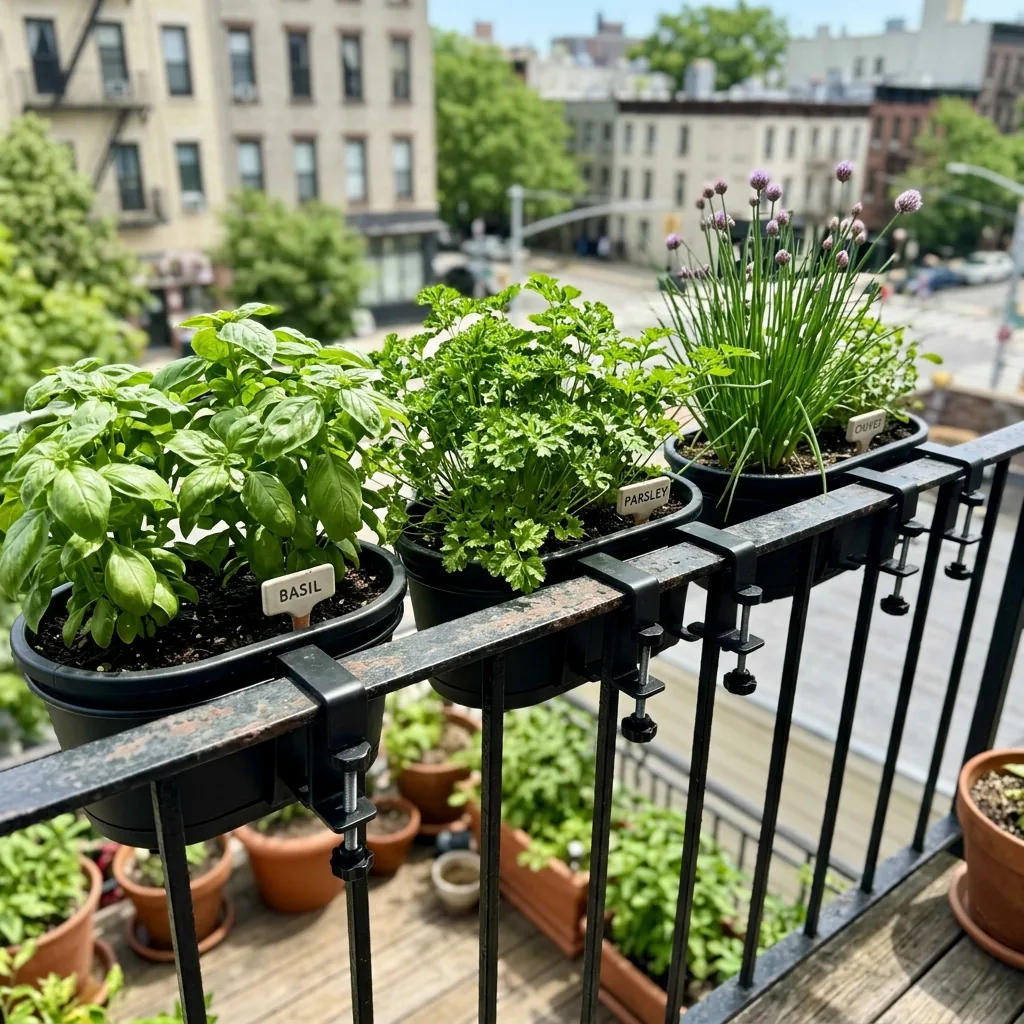
Option A: Railing planters — Hang over the railing via adjustable brackets. No floor weight at all. Maximum capacity: 3–5 kg per planter (check railing structural rating first). Good for herbs, trailing plants, strawberries.
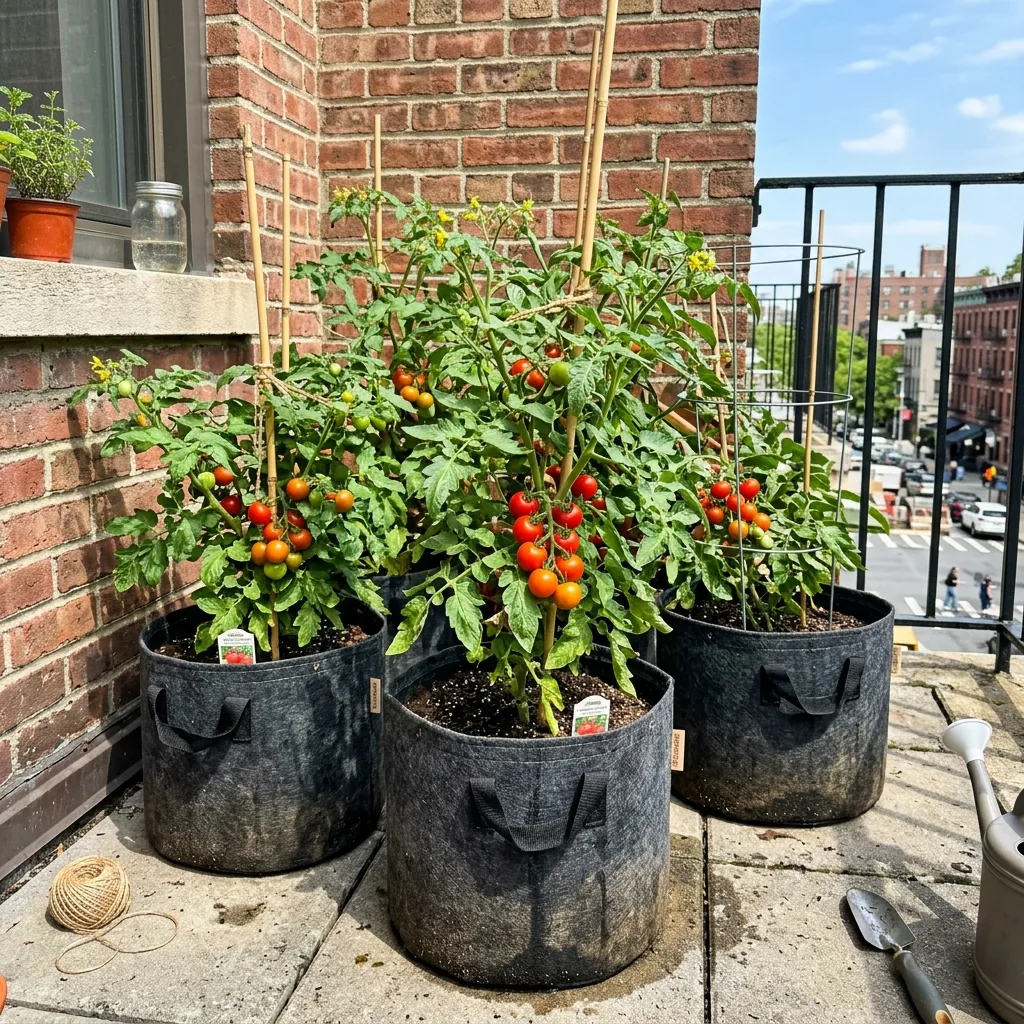
Option B: Fabric grow bags on the floor — Lightweight, flexible, excellent drainage. A 5-gallon fabric bag filled with lightweight mix weighs 8–10 kg wet — about half of an equivalent ceramic pot setup. Stack multiple bags in the corners where structural support is strongest (always at the building wall, not the railing edge).
Option C: Vertical wall planter on tension rod — A tension rod running floor-to-ceiling carries a hanging planter system with zero floor load and zero wall damage. Good for 4–8 small herb pots, trailing plants, or strawberry towers. Full method in the no-drill hanging planters guide.
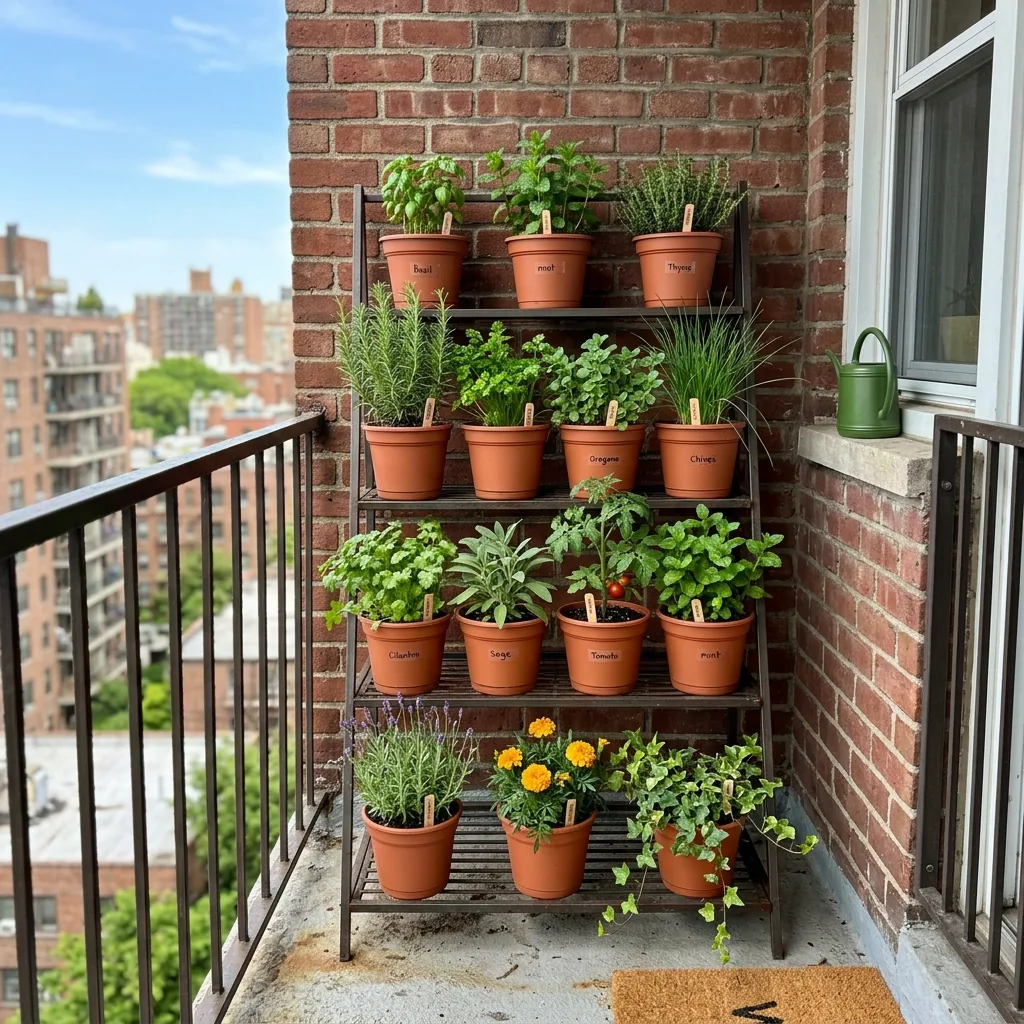
Option D: Freestanding tiered stand — Best weight-to-growing-space ratio. A 4-tier plastic plant stand at 2.5 kg empty holds 8–12 pots. Place directly against the building wall (strongest structural zone).
Most functional setups combine two options: railing planters for herbs and flowers, floor-level grow bags for larger vegetables or fruit.
Step 4: Build Your Support Structure
Set up your non-plant elements before any soil or containers arrive. This is the step most people skip, then regret.
Railing planter installation: Adjustable bracket railing planters require no drilling. The bracket clamps to the railing top rail. Tighten by hand. Check that the planter cannot be lifted off by wind — most have a secondary safety cable or hook. If yours doesn’t, add a cable tie through the bracket and railing bar.
Freestanding shelf or plant stand: Position against the building wall, not the railing. The building wall distributes load into the main structure. The railing edge sits over the cantilevered section of the balcony slab — it’s the weakest zone. Never cluster heavy containers near the railing edge.
Tension rod vertical system: Measure floor-to-ceiling height. Most tension rods extend to 108 inches (274 cm). For heights above this, use two rods side by side with a horizontal crossbar cable-tied between them. Once installed, test by pulling with 15 kg of force — it should not slip.
Micro-Fail Warning: Don’t place anything heavy on the drainage grate sections of the balcony floor. These are covers over drainage channels, not structural floor. On older apartment buildings especially, they can crack under point loads.
Step 5: Get the Soil Right
Standard garden soil and cheap potting mixes are the enemy of balcony gardening. They compact in containers, drain poorly, and weigh twice as much as a proper lightweight mix.
What to use: A blend of 60% peat-free potting compost + 30% perlite + 10% vermiculite gives excellent drainage, aeration, and weight reduction. Per 10L volume, this mix weighs approximately 4–5 kg dry vs 9–10 kg for standard garden soil.
For containers over 15L, add a layer of lightweight drainage material at the bottom: 3–4 cm of leca (clay pebbles) or broken polystyrene chunks. This reduces waterlogging without adding significant weight.
Water retention in small containers: Small pots on exposed balconies dry out fast — sometimes within 24–36 hours in summer heat. Adding 10–15% coconut coir to your mix dramatically improves moisture retention without adding weight. For the most exposed setups, self-watering reservoir inserts (available for $10–15 for a set of 5) sit in the bottom of the pot and create a sub-irrigation zone that keeps roots moist through dry days.
Step 6: Set Up Watering Without a Hose
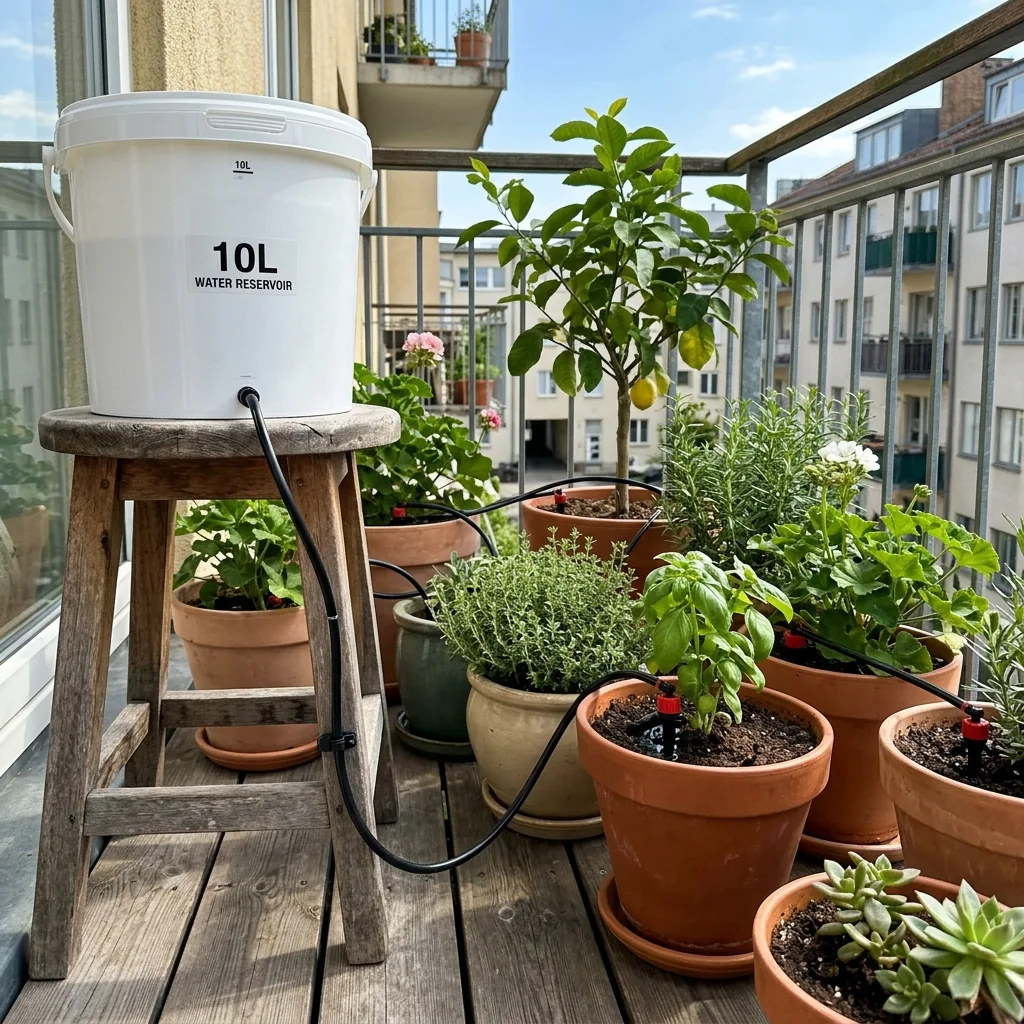
Most apartment balconies have no outdoor tap. Carrying watering cans from the kitchen works for 3–4 plants but becomes a daily chore once you have 10+ containers.
The gravity-fed drip kit: A 10–15L reservoir bucket elevated 30–40 cm above your planters connects to 4mm drip tubing run to each container. No pump, no electricity — gravity does the work. Fill the bucket every 2–3 days. Kits cost $18–25 and cover up to 20 containers. This is the single best upgrade for a setup with more than 6 pots.
Self-watering planters: Built-in reservoirs in the pot base provide 3–7 days of autonomous watering depending on weather. Worth the extra cost ($15–30 per planter) for heat-sensitive plants or if you travel. Full review at smart self-watering balcony planters.
The watering-can optimization: If you’re sticking with manual watering, get a 5L can with a long narrow spout — the long spout reaches inner pots in a tiered stand without disturbing neighboring plants. Water at 6–8am or after 6pm to minimize evaporation. Never water in midday heat.
Pro-Tip Checklist: – Drill a drainage hole in any container that doesn’t have one — standing water kills roots within days – Place saucers under railing planters to catch drips (neighbors below will thank you) – Check soil moisture with your finger 2cm deep, not just the surface — the top always dries first
Step 7: Plant in the Right Order
Install your tallest, heaviest elements first — these anchor the visual structure and determine spacing for everything else.
Installation order: 1. Background layer: Tall climbers or large plants (tomatoes, beans on a trellis, tall grasses) against the building wall 2. Mid layer: Medium containers on the tiered stand — peppers, aubergine, compact herbs like rosemary and thyme 3. Railing layer: Railing planters with trailing plants and herbs — basil, parsley, nasturtiums, strawberries 4. Vertical layer: Hanging pots on tension rod — trailing pothos, string of hearts, mini ferns for shade spots
Leave 15–20 cm of working space between your container layers. You need to be able to water, harvest, and check for pests without disturbing everything.
For the most complete plant selection guide by season and exposure, the year-round balcony garden plan covers what to plant each month, what to pull, and how to rotate crops in small containers.
How to Start a Renter-Friendly Balcony Garden Setup
Starting a renter-friendly balcony garden setup requires four decisions made in order: first establish your weight budget using the building’s load rating, then assess sun exposure over a full day, then select lightweight containers (fabric grow bags and railing planters weigh 60–70% less than ceramic equivalents), and finally configure a gravity-fed or self-watering irrigation system. A functional setup for 6–10 plants requires approximately $60–90 in equipment and one weekend of installation time. The critical constraint for renters is not cost or plant selection — it is structural load management and the use of no-drill attachment methods for all vertical elements.
My Experience Setting Up a Balcony Garden in a Rental
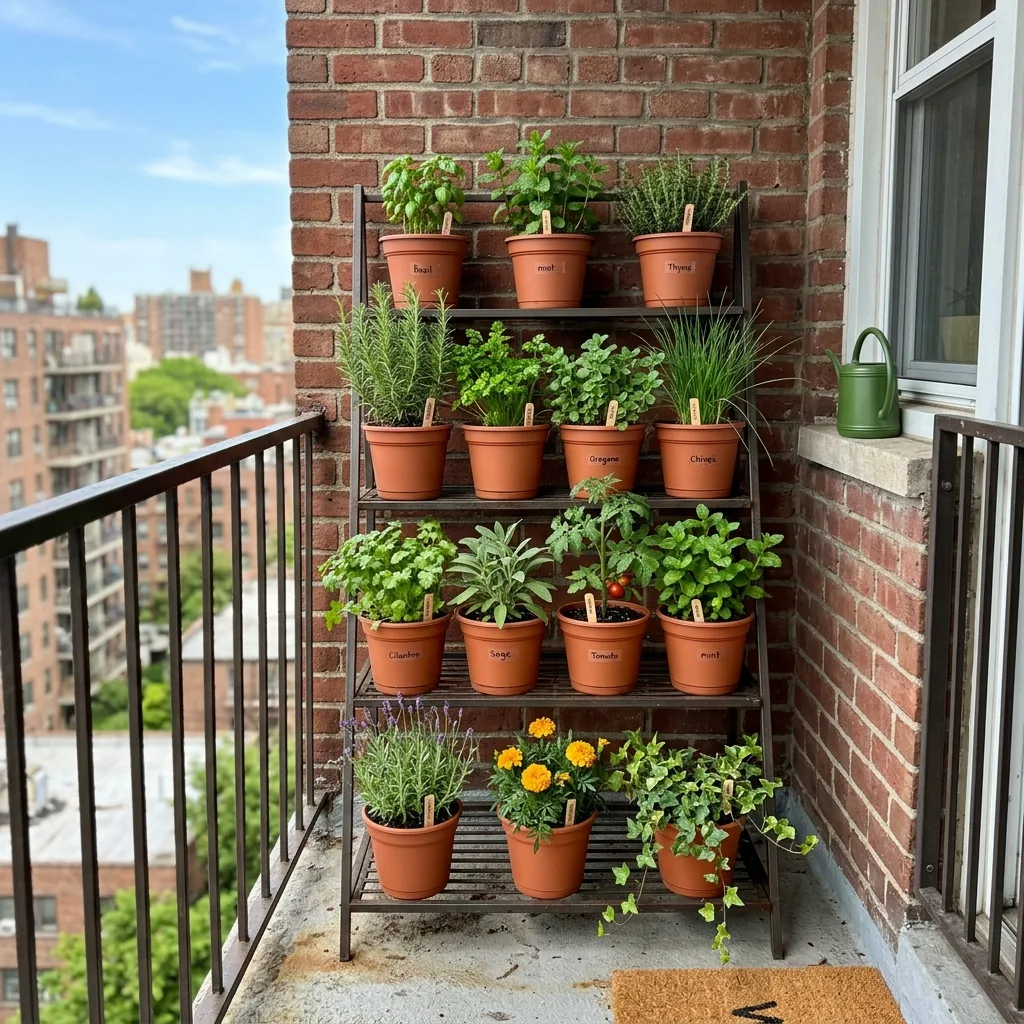
My current setup is on a 3.2 m² balcony (north-northeast facing, 6th floor) in a 1980s brick apartment building. The building’s balcony spec shows 175 kg/m² rated load — giving me a total garden budget of roughly 280 kg before I subtract the cast-iron bistro table already there (22 kg). Working budget for the garden: approximately 170 kg.
My actual setup weighs 68 kg fully watered. I have 14 containers: 6 railing planters, 5 fabric grow bags on a tiered stand, 2 hanging pots on a tension rod, and 1 large 25L fabric bag for the tomato plant against the wall. The entire thing cost $94 to build from scratch — including the tension rod and the drip irrigation kit.
The north-northeast exposure means I get 4–5 hours of direct sun in summer, peaking between 10am and 3pm. I can’t grow peppers or full-sun tomatoes reliably. What works well: cherry tomatoes (Tumbling Tom variety, which tolerates partial shade), all herbs except basil (which sulks), runner beans climbing the tension rod, lettuce, and strawberries in the railing planters. Basil I keep on the kitchen windowsill where it gets the afternoon sun reflected off the building opposite.
The biggest operational problem is wind. At the 6th floor, gusts regularly rattle the railing planters in autumn and spring. I added secondary cable ties through every bracket after losing a $18 oregano planter off the railing in October. Now everything has a backup attachment. The ten seconds it takes per planter is worth it.
Common Mistakes
Buying decorative pots before calculating weight. Terracotta is beautiful. It’s also 3–5× heavier than plastic or fabric alternatives of the same size. Always do the weight math first, then choose aesthetics within the weight budget.
Planting sun-lovers on a north-facing balcony. If you face north, skip tomatoes, most peppers, and aubergine. They’ll grow slowly, produce minimally, and frustrate you. Work with your exposure rather than against it.
Overwatering in containers. Containers have finite drainage. The most common cause of plant death in balcony gardens is root rot from overwatering, not under-watering. Check soil moisture at 2cm depth before every watering session.
Ignoring wind above the 5th floor. Wind at height strips moisture from leaves faster than roots can replace it, even in well-watered plants. If you’re above the 5th floor, windbreaking is not optional — it’s part of the infrastructure.
Crowding the railing edge. Heavier containers belong at the back near the building wall, not at the front near the railing. Weight distribution at the railing edge creates leverage on the cantilever slab.
Safety Disclaimer
Always verify your balcony’s structural load rating before adding any garden weight. Calculate total load including containers, wet soil, plants, and support structures — and stay below **80% of the rated capacity**. Place heavier containers near the building wall, never clustered at the railing edge. Secure all railing planters with secondary cable ties to prevent wind displacement. For balconies above the 5th floor, test all vertical tension structures for wind resistance before loading with plants.
—