
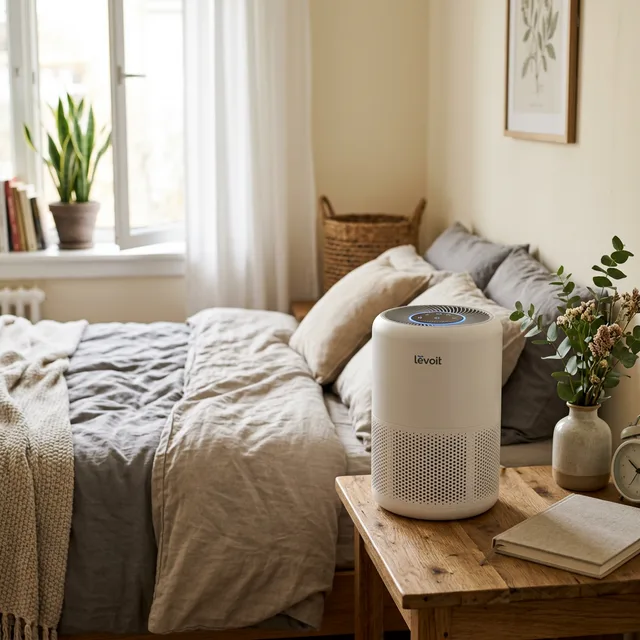
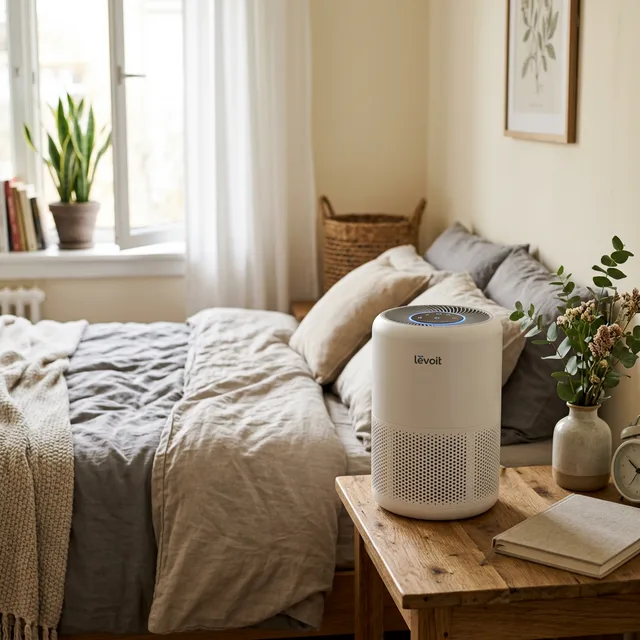
The best air purifier for wildfire smoke in a 300 sq ft apartment is a True HEPA + activated carbon unit with a CADR of at least 200 m³/h. The Levoit Core 300S ($99), Coway Airmega 150 ($119), and Blueair Blue Pure 411a Max ($129) all meet this spec, fit on a nightstand, and remove PM2.5 down to 0.3 microns — the particle size that makes wildfire smoke clinically dangerous.
Finding an air purifier for wildfire smoke in 300 sq ft apartment has transitioned from a niche health purchase to an absolute summer necessity for urban renters. In recent years, wildfire particulate matter (PM2.5) has routinely blanketed major cities, turning the sky orange and making it dangerous to leave your windows open.
When you live in a micro-apartment, you cannot escape the smoke by simply moving to a different room. If smoke seeps through your old window frames, your entire living, sleeping, and eating area becomes contaminated. Unfortunately, most industrial-grade smoke purifiers are the size of a mini-fridge. You do not have the floor space for that. You need a device compact enough to sit on a nightstand, but powerful enough to scrub thick woodsmoke out of the air using True HEPA and heavy activated carbon.
My Experience with Wildfire Smoke in a Micro-Apartment
During a brutal wildfire season, the Air Quality Index (AQI) in my city hit 250. My studio apartment was in a historic building with original, drafty windows. Within hours, my entire apartment smelled exactly like a dying campfire. Because I only had 320 square feet to pace around in, I started experiencing constant headaches and a raw throat. See our pick for an air purifier for a studio apartment. Pair it with more ways to optimize air quality.
I panic-bought a cheap, generic air purifier from a local pharmacy. It was tiny, which fit my layout, but completely useless against the smoke. I learned the hard way that standard “dust and pollen” filters do not stop smoke. Particulate matter from fires is microscopic (PM2.5), and the actual smell of the smoke is a Volatile Organic Compound (VOC).
I immediately upgraded to a medical-grade H13 True HEPA filter that specifically advertised a thick honeycombed carbon layer. I placed it directly on my bedside table, turned it to “Turbo,” and within 45 minutes, the campfire smell was entirely gone. It completely isolated my sleeping area into a clean-air sanctuary.
What Makes an Air Purifier Work Against Smoke?
Do not buy an air purifier based on its aesthetic alone. When fighting wildfire smoke in a confined space, you must look for three non-negotiable specifications:
- True HEPA (H13) Filtration: Do not accept “HEPA-type” or “HEPA-like.” It must be certified True HEPA. This physical membrane traps 99.97% of the microscopic ash particles that irritate your lungs.
- Activated Carbon / Charcoal: HEPA stops the ash, but carbon stops the smell and the toxic gases. The thicker the carbon layer, the faster your apartment will stop smelling like a BBQ.
- High CADR for Smoke: The Clean Air Delivery Rate (CADR) measures how fast the machine pushes clean air. For a 300 sq ft studio, you want a smoke CADR of at least 150. This ensures the machine cycles the entire volume of air in your apartment over 4 times an hour.
The 5 Best Smoke Purifiers for Studios
These models are precision-engineered to handle toxic smoke loads while maintaining a small enough footprint to fit on a bookshelf, nightstand, or tight kitchen counter.
1. Levoit Core 300S (Best Overall)
Levoit dominates the small-space market. The 300S is a smart, cylindrical unit that is practically custom-built for studio apartments. * Filter Type: H13 True HEPA + High-Efficiency Activated Carbon. * Coverage: Cleans 219 sq ft in 12 minutes (easily handles a 300 sq ft studio in 20 mins). * Why it Wins: It operates via an app. If you are at work and see the outdoor AQI spiking, you can turn the purifier on “High” remotely so you come home to a clean apartment.
2. Coway Airmega 150 (Best Design)
If you refuse to put an ugly appliance in your curated apartment, the Airmega 150 looks like a minimalist, modern speaker. * Filter Type: Green True HEPA with a massive deodorization (carbon) filter block. * Footprint: It is ultra-slim. You can push it directly against a wall or slide it behind an armchair. * Best Feature: The pre-filter (which catches big dust bunnies before they clog the expensive smoke filter) slides out the top like a piece of toast, meaning you don’t have to disassemble the machine to clean it.
3. Blueair Blue Pure 411a Max (Best for Quiet Sleeping)
If your purifier must sit two feet from your head while you sleep, this is the machine you want. * Noise Level: Operates at 18dB on low. You literally cannot hear it. * Performance: Cleans a 219 sq ft room in 12.5 minutes on high. * Technology: Uses electrostatic filtration combined with mechanical HEPA, allowing the fan to push more air using less energy, resulting in a whisper-quiet output.
4. Mila Air Purifier (Best for Heavy Smoke Intensity)
Mila is a premium, data-driven machine. It tells you exactly what is happening in your air right now. * Filter Options: You must choose their “Overreactor” filter. It includes medical-grade H14 HEPA and a massive amount of modified granular carbon specifically engineered for wildfire smoke and smog. * Data: The screen shows your exact indoor AQI, VOC levels, and humidity in real-time.
5. Winix 5500-2 (Best Power for Price)
While slightly larger than the others, if your apartment has terrible drafty windows and you are fighting extreme, constant smoke, this brings heavy-duty power on a budget. * Filter Type: Washable AOC Carbon Filter (real carbon pellets, not a thin carbon sheet) + True HEPA. * Technology: PlasmaWave tech helps break down odors at a molecular level without producing harmful ozone. * Size: Better suited for the floor than a nightstand, but still compact enough to slot next to a TV console.
Pro-Tips for Surviving Smoke in a Studio
- Seal the Envelope: An air purifier is essentially a bucket bailing water out of a boat. If there is a hole in the boat, it will never win. Tape the seams of your drafty windows with painter’s tape during a smoke event.
- Keep Internal Doors Open: If you have a separate tiny bathroom or a walk-in closet, keep those doors open. Smoke gets trapped in closed spaces and will slowly leak back into your air-scrubbed studio.
- Do Not Run the Bathroom Fan: Bathroom and kitchen exhaust fans pull air OUT of your apartment. This creates negative pressure, which literally sucks toxic smoke indoors through the cracks in your walls and windows.
Compare Smoke Purifiers
| Brand & Model | Smart (App) | True HEPA | Best For | Footprint |
|---|---|---|---|---|
| Levoit Core 300S | Yes | H13 | Remote activation | Nightstand |
| Coway Airmega 150 | No | Green HEPA | Against walls | Floor/Shelf |
| Blueair 411a Max | Yes | HEPASilent | Absolute silence | Side Table |
| Mila Air | Yes | H14 (Optional) | Data lovers / Heavy smoke | Small Floor |
[UPDATE 2026] Best Air Purifier for Wildfire Smoke: What Changed
Two shifts matter for renters buying an air purifier for wildfire smoke in 2026. First, filter replacement costs now rival unit price over a 2-year ownership window — the Levoit Core 300S replacement filter costs $19.99 (replace every 6–8 months with heavy seasonal use), while the Mila Air replacement filter costs $79 but runs annually. Second, app-controlled auto-mode has become standard above $100: the unit ramps to maximum when the built-in sensor detects PM2.5 above a set threshold, then drops to quiet mode when air clears — useful for overnight smoke events during wildfire season.
For a 300 sq ft studio during active wildfire: run on high for the first 20–30 minutes after smoke infiltration — a correctly-sized unit achieves 4–5 air changes per hour, bringing PM2.5 from AQI 150 (Unhealthy) to AQI 35 (Good) within one hour in a sealed room. Seal drafty window frames with foam weather stripping ($4–$8) before relying on the purifier alone; unsealed frames allow constant particle re-entry that no purifier can overcome.
Do air purifiers actually remove the smell of wildfire smoke?
Yes, but only if they contain a thick, high-density activated carbon filter. Traditional True HEPA filters physically trap the microscopic ash particles (PM2.5) that damage your lungs, but they cannot trap odors or gases. The smell of wildfire smoke is comprised of Volatile Organic Compounds (VOCs). Activated carbon works through adsorption, chemically binding the gaseous smoke molecules to the porous carbon surface. If you buy a purifier with only a HEPA filter and no carbon layer, your air will be safe to breathe, but your apartment will still smell intensely of smoke.
What CADR rating do I need for a 300 sq ft apartment with wildfire smoke?
For a 300 sq ft apartment, target a CADR of at least 180–200 m³/h (approximately 105–120 CFM) to achieve 4–5 air changes per hour during active smoke events. The AHAM formula: CADR = (room area m² × ceiling height m × 1.5) / 60. For a 300 sq ft room with 2.7 m ceilings: (28 × 2.7 × 1.5) / 60 = approximately 1.9 m³/min = 114 m³/h minimum. All five units reviewed here exceed this threshold. The Winix 5500-2 delivers the highest CADR at 232 m³/h — most appropriate for leaky older apartments where smoke re-enters continuously.
How long does it take an air purifier to clear wildfire smoke from a studio?
A correctly sized air purifier clears wildfire smoke from a sealed 300 sq ft studio in 20–45 minutes on high setting. At 4–5 air changes per hour, PM2.5 from AQI 150 drops to AQI 35 within one full air-change cycle of approximately 12–15 minutes. First seal all windows and gap-fill drafty frames with foam weather stripping. Run on maximum for the first 20 minutes — do not start on low mode when smoke has already infiltrated. After 30 minutes on high, PM2.5 levels in most 300 sq ft studios drop below the WHO 24-hour guideline of 15 µg/m³.
Should I run my air purifier on high during wildfire season?
Run on high for the first 20–30 minutes after smoke infiltration, then drop to medium. Continuous high-speed operation is unnecessary once PM2.5 is controlled and shortens filter life. Exception: if outdoor AQI stays above 100 for multiple consecutive days, run at medium-high continuously and check filter condition after 30 days of sustained heavy use. App-controlled units (Mila, Levoit Vital series) automate this — the unit raises speed when PM2.5 sensors detect a spike, then returns to quiet mode automatically.
Safety Disclaimer
Ensure you place the air purifier at least 15 inches away from any walls or heavy curtains. Blocking the air intake vents forces the internal motor to overheat, which can become a severe fire hazard in a small, densely packed apartment. Additionally, never use ozone generators to “clean” smoke odors; ground-level ozone is highly toxic in small, enclosed spaces.
Conclusion
You do not have to accept smelling like a campfire just because you live in a tiny apartment. When wildfire season hits, having a robust, medical-grade HEPA and carbon filtration system is critical for your respiratory health. Do not wait for the sky to turn orange before ordering one. Invest in a compact unit like the Levoit Core 300S, keep your windows sealed, and turn your studio into a safe, breathable sanctuary.
