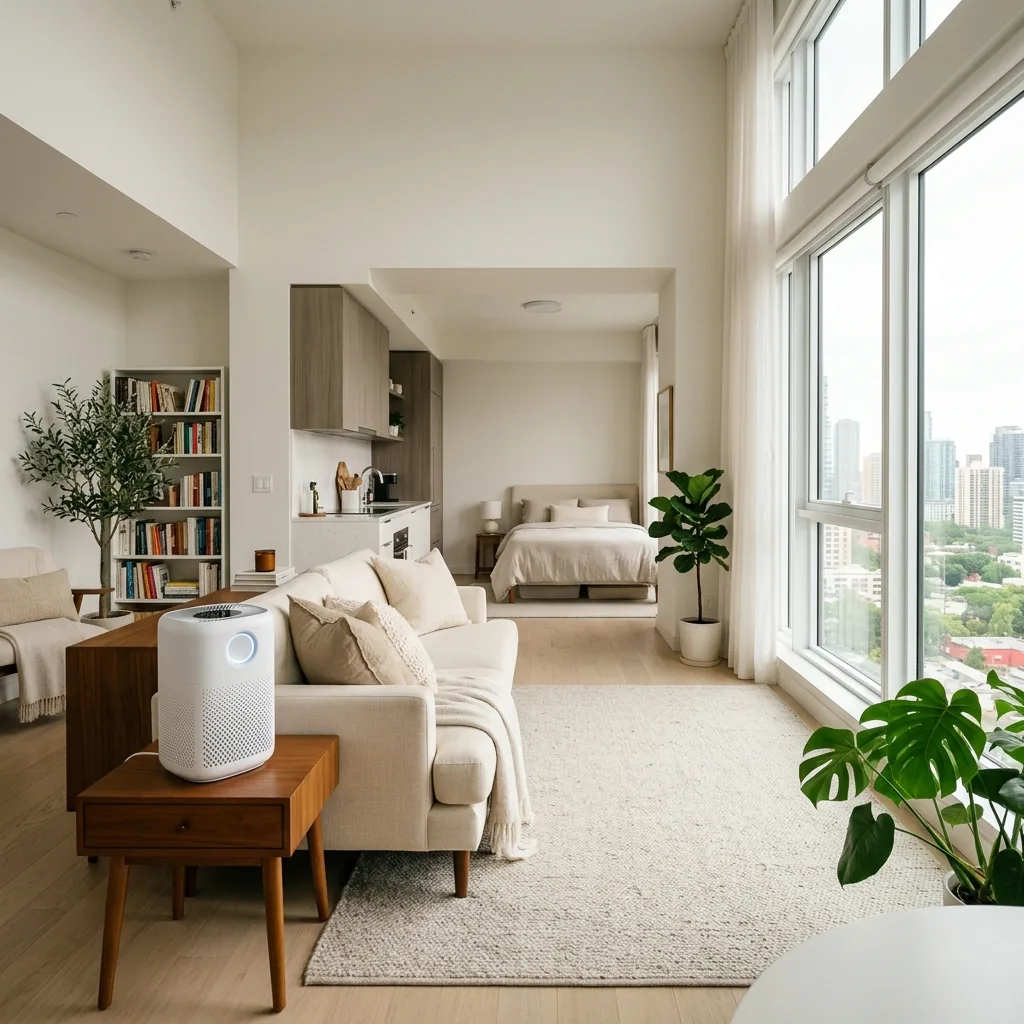
The best air purifier for a studio apartment is not the most powerful purifier available. It’s the one that cleans your specific square footage, runs quietly enough that you actually leave it on overnight, and handles what your studio actually produces — which is usually cooking odors, dust, and whatever comes through the windows, not industrial-level particulates.
Studios have a built-in advantage: the air purifier only needs to clean one room instead of an entire apartment. A unit sized for 300–450 sq ft at a realistic mid-fan-speed handles a 25–40 sqm studio better than a large unit running on low in a space it’s oversized for.
Table of Contents
- What a Studio Air Purifier Actually Needs to Do
- 5 Best Air Purifiers for Studio Apartments
- Placement: Where to Put It in a Studio
- My Experience: Studio Air Purifier Setup Over 2 Years
- FAQ
What a Studio Air Purifier Actually Needs to Do {#what-it-needs}
Coverage. A studio of 25–40 sqm (270–430 sq ft) needs an air purifier with a CADR rating of at least 120–180 CFM to cycle the air 2–4 times per hour. Most mid-range units marketed for “medium rooms” cover this range. Units marketed for “large rooms” or “whole-home” are often overkill at the price points that make sense.
Noise. A purifier that runs at 24–28 dB on low is quiet enough for sleep. Above 35 dB on low, you’ll wake up and turn it off — which means it’s off all night, which means it’s not working. Check the dB spec at the lowest speed setting, not the average.
Odor control. A studio kitchen is 8 feet from your bed. Cooking smells, garbage odors, and general apartment smell (which gets concentrated in a single room) require an activated carbon layer — not just HEPA. HEPA captures particulates (dust, dander, pollen). Only carbon absorbs volatile organic compounds (VOCs) and odors.
Filter cost. The ongoing cost of an air purifier is the filter replacement, not the unit. A $70 purifier requiring $40 replacement filters every 6 months costs more to run annually than a $130 purifier with $20 filters every 12 months. Check filter cost before buying.
5 Best Air Purifiers for Studio Apartments {#the-5-best}
1. Levoit Core 300S — Best Under $100 for Most Studios
$70–$90 | CADR: 141 CFM | Room: up to 219 sq ft | Noise: 24 dB (low)
At 8.7 inches in diameter, the Core 300S has the footprint of a large coffee mug. It runs at 24 dB on low — quieter than a conversation whisper — which means you can run it on a nightstand without disrupting sleep. The app sets a schedule: maximum power when you’re out, low overnight.
For a studio under 25 sqm (270 sq ft), the Core 300S sized correctly for the room. Above that, it works but will need to run on a higher speed to maintain clean air, which increases noise.
Filter replacement: $15–$20 every 6–8 months in a city apartment. Low annual running cost. The standard filter handles dust and most odors. For a studio with a litter box or strong cooking smells, upgrade to the Pet Allergy or Toxin Absorber filter ($20) with denser carbon.
2. Coway AP-1512HH Mighty — Best All-Around Studio Purifier
$80–$100 | CADR: 246 CFM | Room: up to 360 sq ft | Noise: 24 dB (low)
The Coway Mighty has been the most recommended budget air purifier for small spaces for several years, and the reputation holds. At 246 CFM CADR, it handles a studio up to 40 sqm in a single unit, running on low most of the time with capacity to ramp up when it detects particles (cooking, vacuuming, a guest with a coat full of pollen).
Four-stage filtration: pre-filter (catches visible dust and pet hair), activated carbon layer, True HEPA, and a controlled ionizer. The pre-filter is washable — clean it monthly and the HEPA filter lasts 12+ months.
The air quality indicator light changes color based on detected particle levels. In practice: it lights red when you’re frying something, green the rest of the time. Useful for confirming the unit is working rather than just running.
3. Winix 5500-2 — Best for Odor-Heavy Studios
$150–$180 | CADR: 360 CFM | Room: up to 360 sq ft | Noise: 27.8 dB (low)
If your studio has a strong odor problem — a litter box in the same room, frequent cooking of aromatic food, cigarette smoke from a neighboring unit coming through gaps — the Winix 5500-2 has the most substantial carbon filter in the under-$200 range. A full dedicated carbon sheet rather than a thin coating.
PlasmaWave technology (a controlled ionizer) adds VOC neutralization on top of what the carbon handles. This can be disabled if you prefer to run without ionization.
At 360 CFM, this unit is oversized for a 25 sqm studio — but oversized means it runs on low (quieter) and cleans the air more than once per hour, which is the right tradeoff for an odor situation.
4. Blueair Blue Pure 411i Max — Best for Allergies
$100–$130 | CADR: 190 CFM | Room: up to 219 sq ft | Noise: 17 dB (low)
At 17 dB on low — below the threshold of perception in a quiet room — the Blueair 411i Max is the quietest air purifier on this list. HEPASilent technology combines mechanical filtration with electrostatic capture: same particle range as True HEPA at lower fan speeds, which is why the noise is so low.
For allergy sufferers in a studio — particularly cat dander and dust mite allergens — the quietness means it stays on continuously, including during sleep, rather than being turned off because it’s keeping you awake. Consistent run time matters more than peak filtration rate for allergen control.
The fabric pre-filter wraps the exterior and catches larger particles (and is machine-washable). Filter replacement is low-maintenance compared to units with multiple internal filter layers.
5. Levoit Core 400S — Best for Studios Up to 45 sqm
$130–$160 | CADR: 260 CFM | Room: up to 403 sq ft | Noise: 24 dB (low)
The Core 400S is the step up from the Core 300S — significantly larger room coverage (403 sq ft vs 219 sq ft) at the same noise level (24 dB on low). For a larger studio or a one-bedroom where you want a single unit to handle the whole space, the 400S covers it without running on high constantly.
The app integration is the same as the Core 300S — schedule, auto mode, air quality monitoring. The filter cost is higher ($25–$30 per replacement) but the 12-month replacement interval keeps annual cost reasonable.
For a 35–45 sqm studio, the Core 400S is the most efficient choice: right-sized for the room, quiet enough for continuous operation, priced appropriately.
Placement: Where to Put It in a Studio {#placement}
Primary placement: center of the main living zone, elevated off the floor if possible (a shelf, nightstand, or dedicated stand). Intake at floor level recirculates the same floor-adjacent air instead of drawing from the room’s full volume.
For cooking odors: within 6–8 feet of the kitchen, on the counter or island if possible. The closer to the odor source, the more VOCs it captures before they diffuse through the studio.
For sleep quality: on a nightstand or shelf 3–5 feet from the bed at nightstand height (24–30 inches). Running a quiet unit at this distance on low overnight creates a consistent filtered air supply to the sleeping zone.
What to avoid: corners collect clean air and recirculate it. Against a wall with the intake blocked. In a closet or cabinet (blocks airflow entirely).
For studios with pets, placement near the litter box changes the priority — see the air purifier for pets in an apartment guide for that specific setup.
My Experience: Studio Air Purifier Setup Over 2 Years {#my-experience}
My studio is 32 sqm with north-facing windows — no direct sun, which means it gets stale faster than a south-facing unit with solar passive ventilation. I live on the 4th floor in a building where several neighbors smoke on the shared balcony level below. Some of that comes through.
Year 1: Coway Mighty, positioned on the floor next to the kitchen. Results were good for dust but the cooking odor coverage was inconsistent. The issue turned out to be placement — floor-level intake in a studio with 2.6m ceilings pulls from the bottom third of the room. Odors from the kitchen (which are gas-phase VOCs, not heavy particulates) rise and don’t circulate down to floor level efficiently.
Year 2: moved the Coway to a shelf at 90cm height, positioned in the kitchen zone corner. Odor control improved significantly. Added the Core 300S on the nightstand for the bedroom zone (my studio has a defined sleeping alcove separated by a bookshelf). Current combined setup covers the full space in two overlapping zones with different filtration priorities.
The thing that made the biggest difference to how I feel in the apartment: running the nightstand unit continuously at low speed overnight, starting from the day I moved it there. The reduction in morning congestion was noticeable within a week. The apartment air quality indicator on the Coway went from occasional red (especially after cooking) to consistently green.